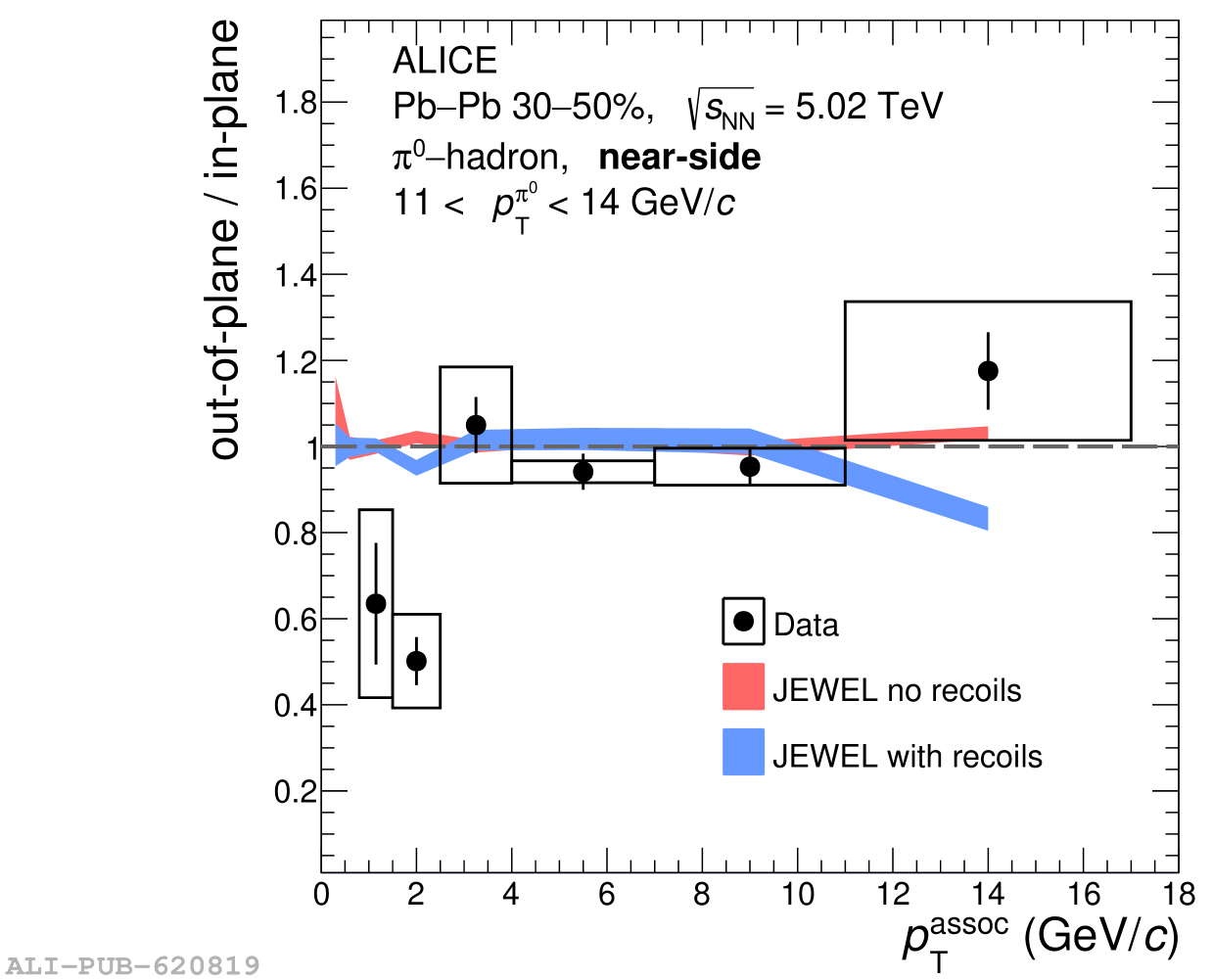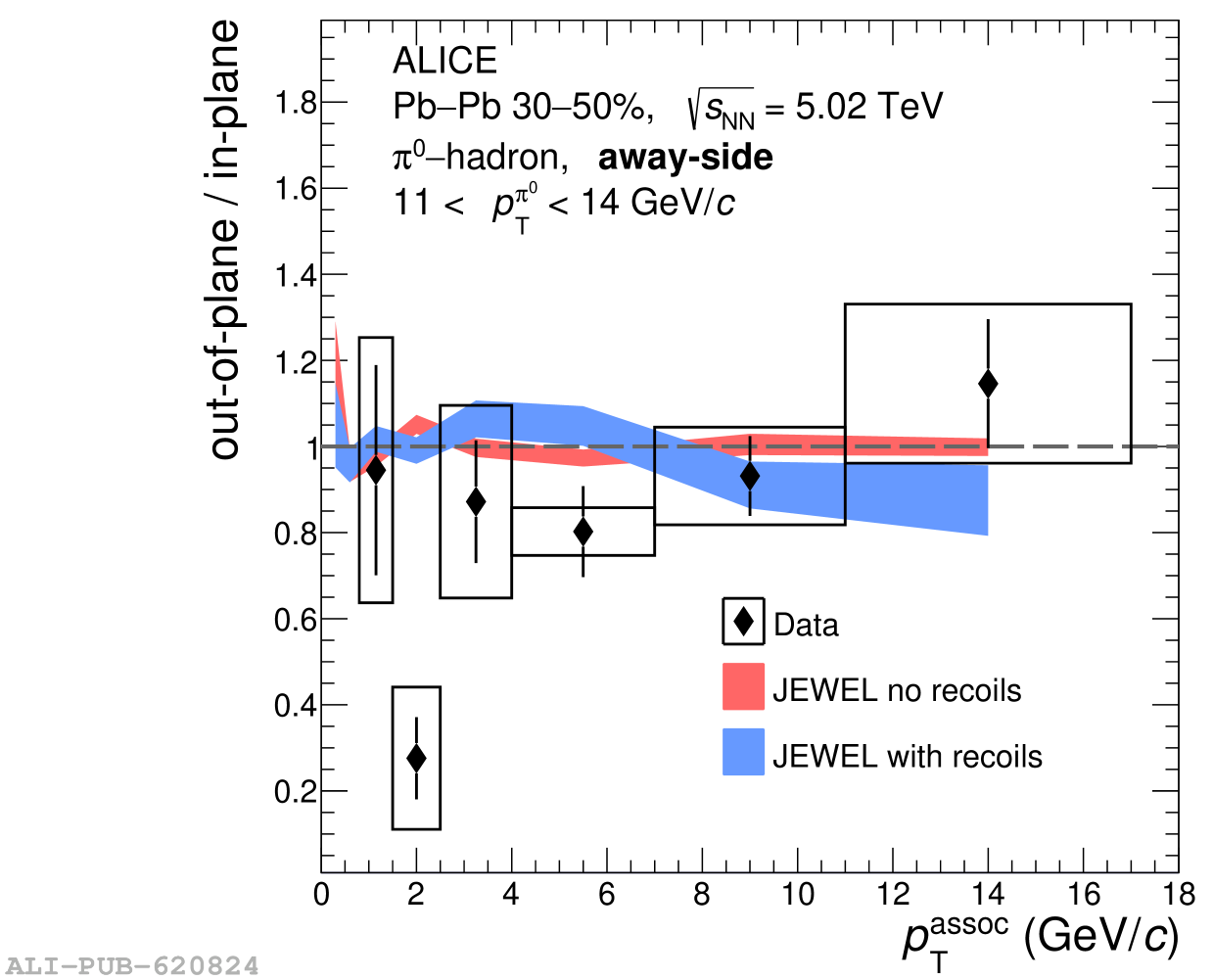
Per-trigger yields of $π^0$-hadron correlations were measured in semicentral Pb-Pb collisions at $\sqrt{s_{\rm NN}} = 5.02$ TeV in ALICE at the LHC. The reconstructed $π^0 \rightarrow γγ$, with a transverse momentum of $11 <~ p_{\rm T}(π^0) <~ 14$ GeV/$c$, is used as the trigger particle to calculate yields of associated charged particles on the near- and away-side. The photons are reconstructed using the ALICE Electromagnetic Calorimeter, and the charged particles are measured in the ALICE central barrel within a pseudorapidity range of $|η|<~0.8$. The yields are reported relative to the orientation of the $π^0$ with the $2^{\rm nd}$-order event plane, and are background subtracted using the reaction plane fit method. The data give an indication of a suppression of the associated charged-particle yields near $p_{\rm T} \approx 2$ GeV/$c$ when comparing out-of-plane to in-plane trigger particles. At associated charged-particle $p_{\rm T} > 3$ GeV/$c$, no significant event-plane dependence is observed within uncertainties. The results are compared with predictions from the JEWEL model, which implements jet energy loss in an expanding medium. JEWEL predicts no significant modification of either the near- or away-side associated yields, independent of whether medium recoils are included. The observed behavior may indicate the presence of additional energy-loss mechanisms beyond those governed by path-length dependence.
Phys. Rev. C 114, 024002 (2026)
HEP Data
e-Print: arXiv:2602.22866 | PDF | inSPIRE
CERN-EP-2026-036
Figure group
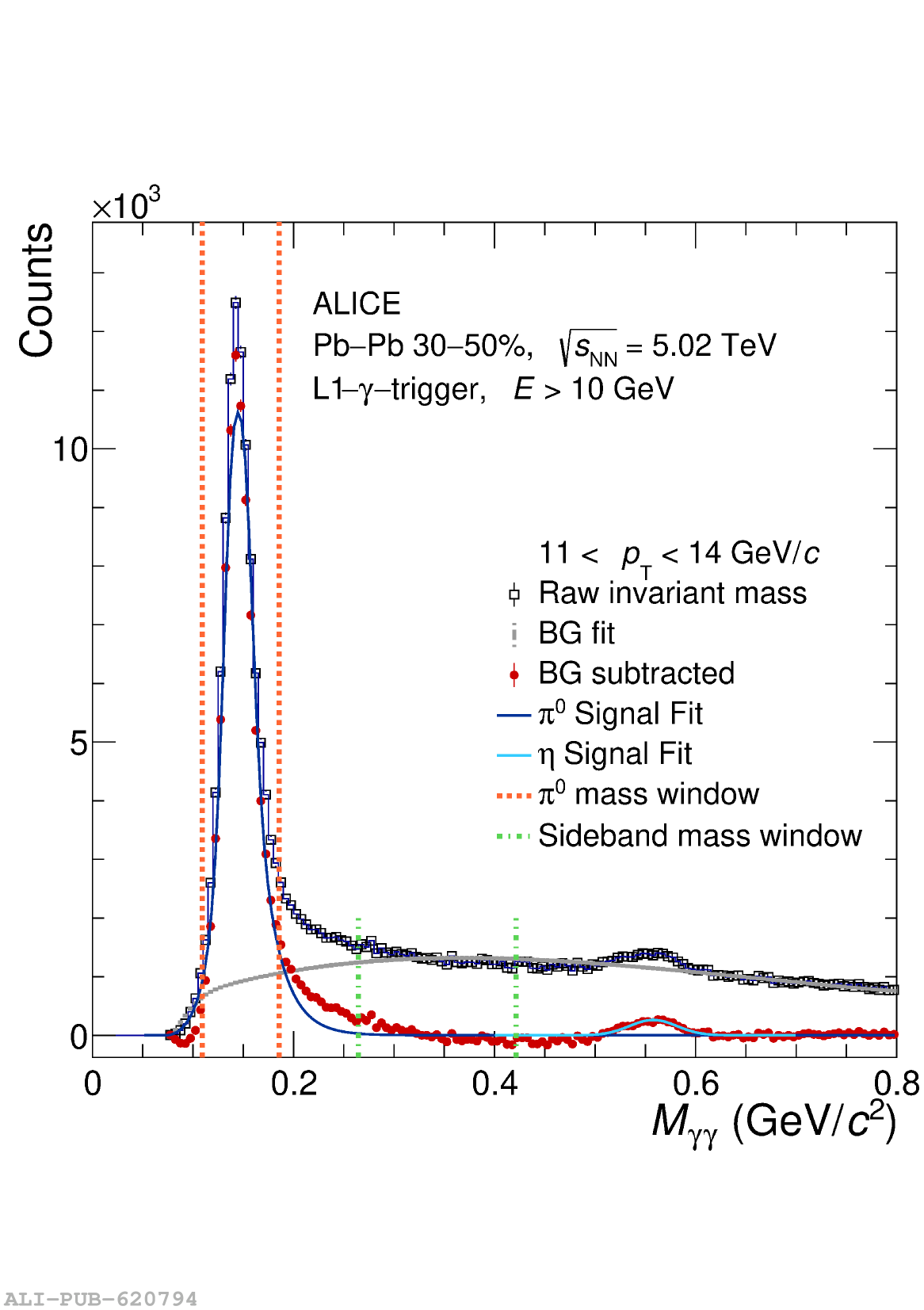
Figure 2
Distributions of $\piz-$hadron correlations as a function of $\Delta \varphi$ in \PbPb collisions at $\snn=5.02 $\TeV, for inclusive, in-, mid-, and out-of-plane orientations of the $\piz-$trigger with respect to the event plane. The near-$\Delta\eta$ ($|\Delta\eta|0.8$) region that includes the near-side jet peak is shown in blue markers, and the far-$\Delta\eta$ ($0.8|\Delta\eta|1.35$) region is shown in red markers. The associated charged hadrons have $1.5\pta2.5 $\GeVc. The flow background is fitted using the RPF method and shown by the colored solid lines, where the thickness of the line is the statistical uncertainty of the fit. | 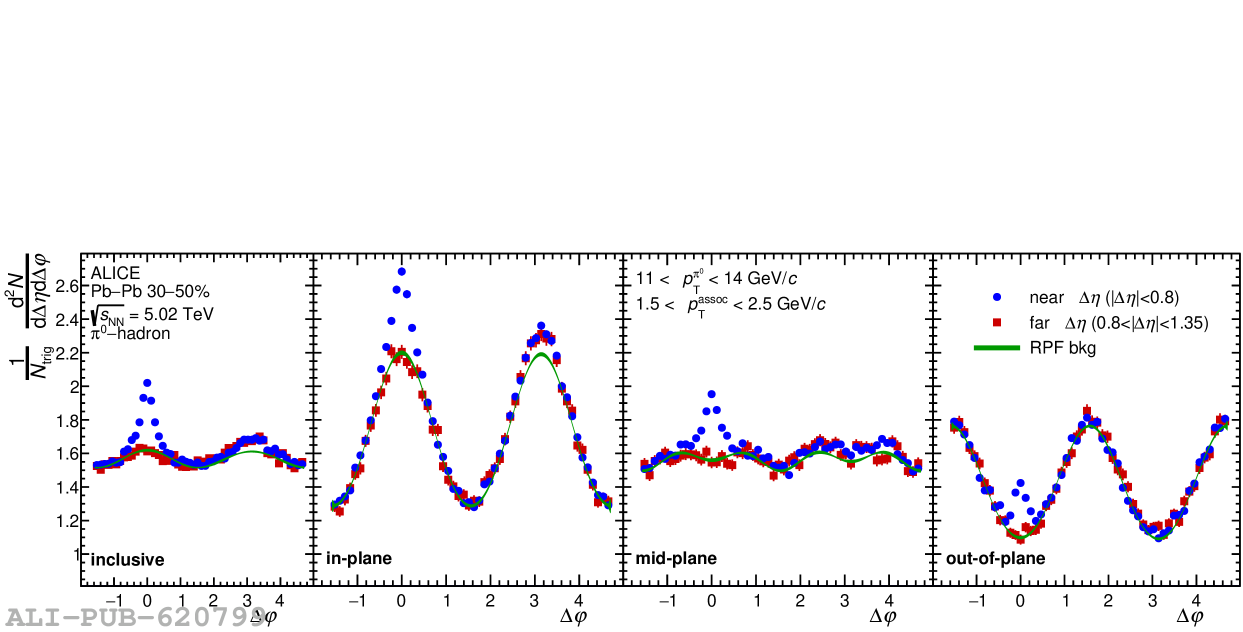 |
Figure 3
Background-subtracted distributions of $\piz-$hadron correlations as a function of $\Delta \varphi$ in \PbPb collisions at $\snn=5.02 $\TeV for inclusive, in-, mid-, and out-of-plane orientations of the $\piz$ trigger with respect to the event plane. The associated charged hadrons have $1.5\pta2.5 $\GeVc. | 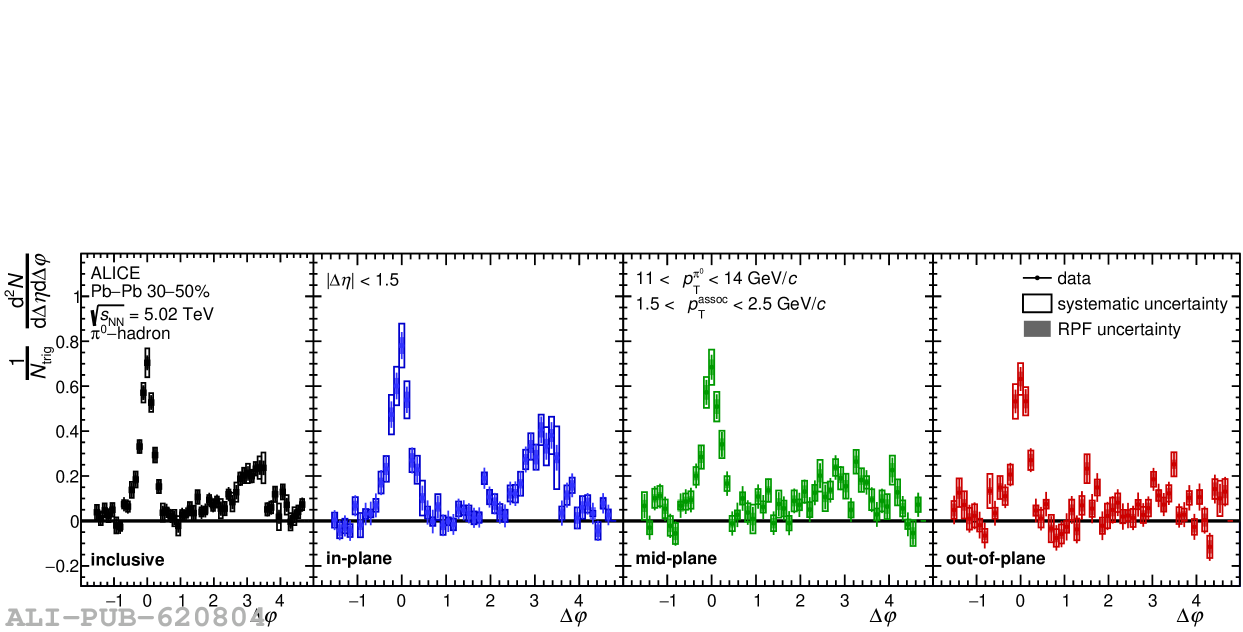 |
Figure 4
Yield of near-side $(|\Delta\eta|0.8)$ and away-side $(|\Delta\eta|1.35)$ $\piz-$hadron correlations as a function of $\pta$ in \PbPb collisions at $\snn=5.02 $\TeV, for the in-, mid-, and out-of-plane orientations of the $\piz$-trigger with respect to the event plane. The data points are slightly displaced for visibility. | 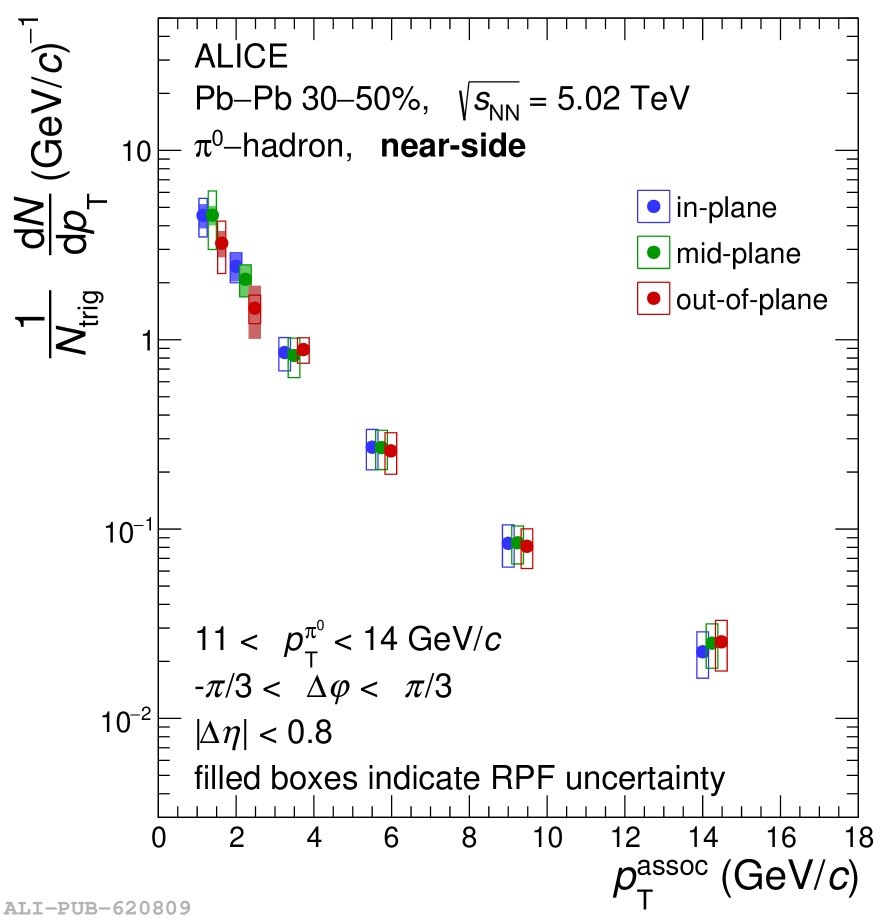 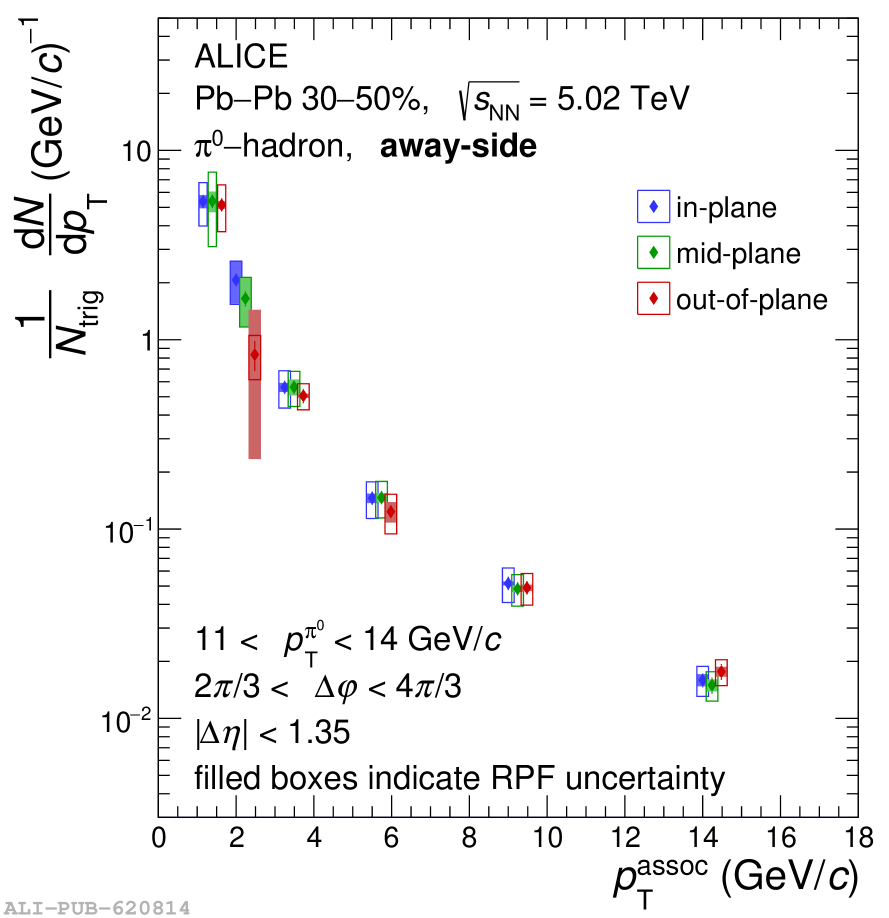 |