
This article presents the first measurement of the (anti)deuteron and antiproton transverse-momentum distributions, the deuteron coalescence parameter, and the ratio between the yields of deuteron and proton in and out of jets in p-Pb collisions at $\sqrt{s_{\rm NN}} = 5.02$ TeV. Three regions are used to study the jet-correlated production: Toward, Away, and Transverse to the jet axis, which direction is approximated by the leading particle in the event with $p_{\rm T}^{\rm lead} > 5$ GeV/$c$. The jet contribution is obtained from the Toward region by subtracting the underlying event, which dominates the Transverse region. In p-Pb collisions, an enhancement of the coalescence parameter $B_{\rm 2}$ is observed in jets compared to the underlying event. The enhancement is larger than the one observed in a similar analysis already in pp collisions. The results are compared with predictions from PYTHIA 8.314 using the Angantyr model with a deuteron production model based on ordinary nuclear reactions. The model is able to qualitatively reproduce the large enhancement of the coalescence parameter in jets with respect to the out-of-jets one. The results are further compared in detail with similar ones from previous studies for pp collisions at $\sqrt{s} = 13$ TeV.
Submitted to: PLB
e-Print: arXiv:2602.22880 | PDF | inSPIRE
CERN-EP-2026-030
Figure group
Figure 1
The average of deuteron and antideuteron (top row) and antiproton (bottom row) \pt -differential yields in the three azimuthal regions (left) and in jets (right) measured in \pPb collisions at \fivenn. Statistical and systematical uncertainties are reported, respectively, with vertical lines and boxes. Individual \LT fits are also shown. The distributions are scaled for visibility reasons. The bottom panel of each figure shows the ratio of the distribution with respect to the Toward one. | 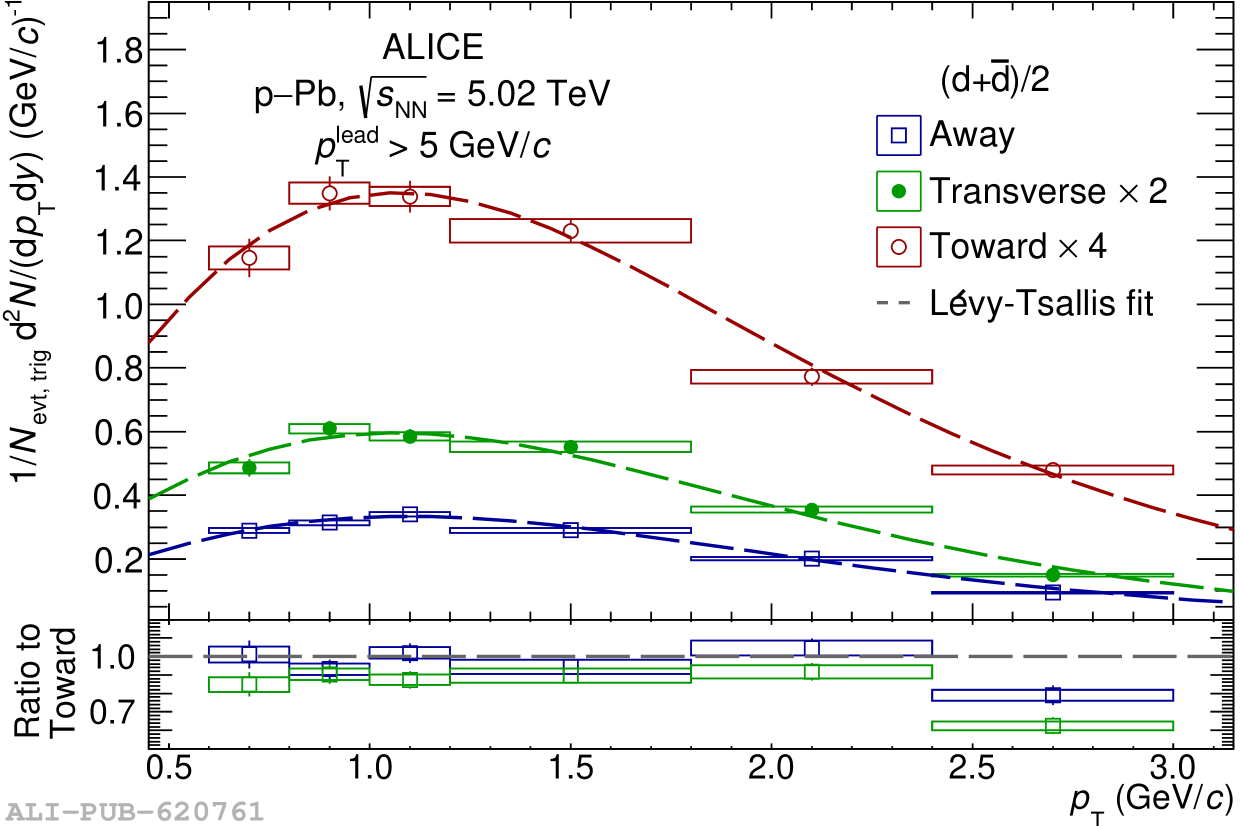 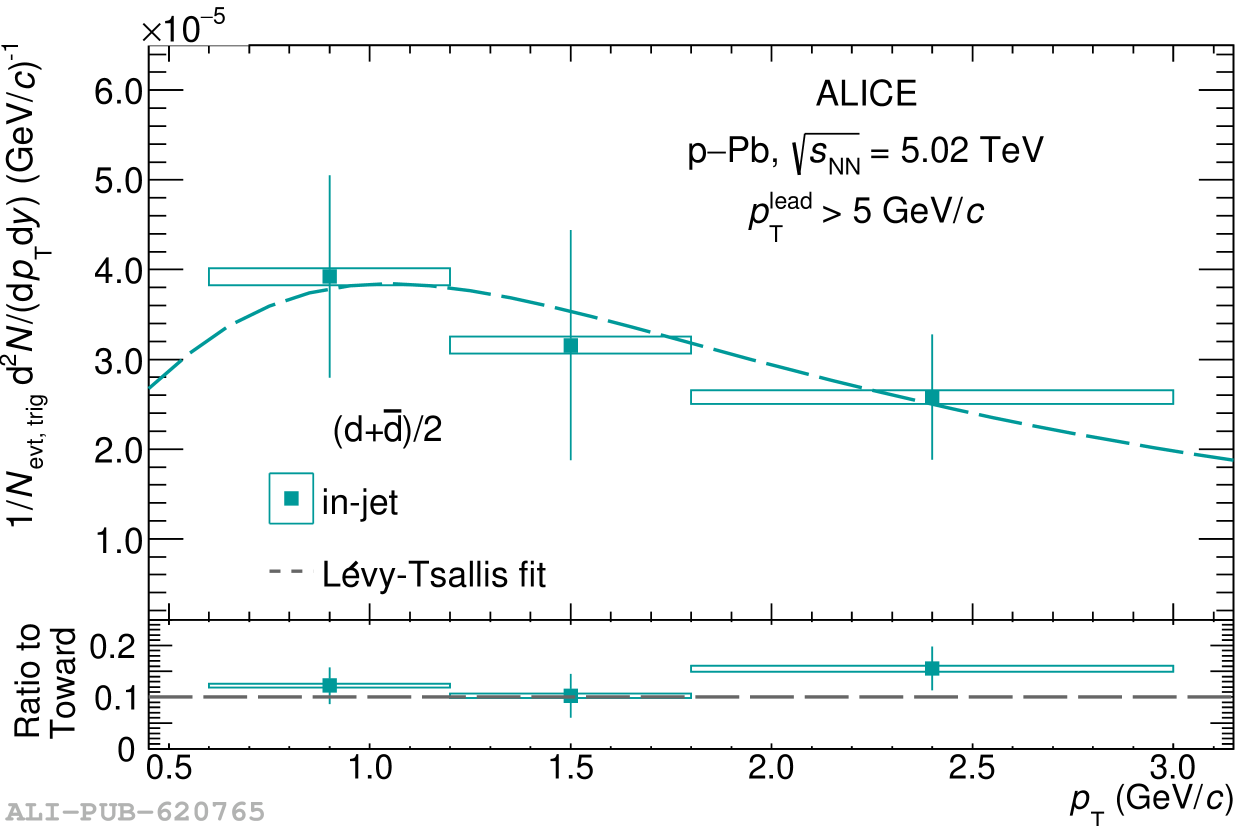 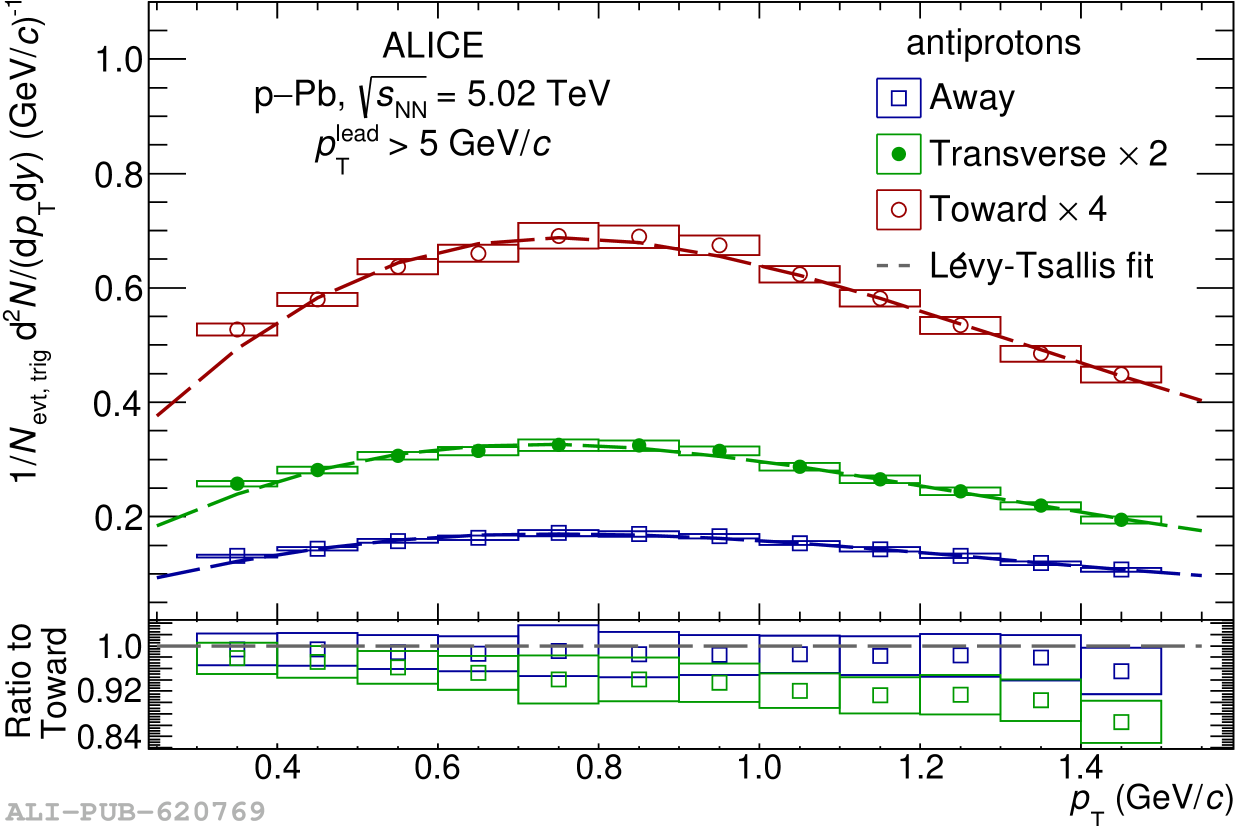 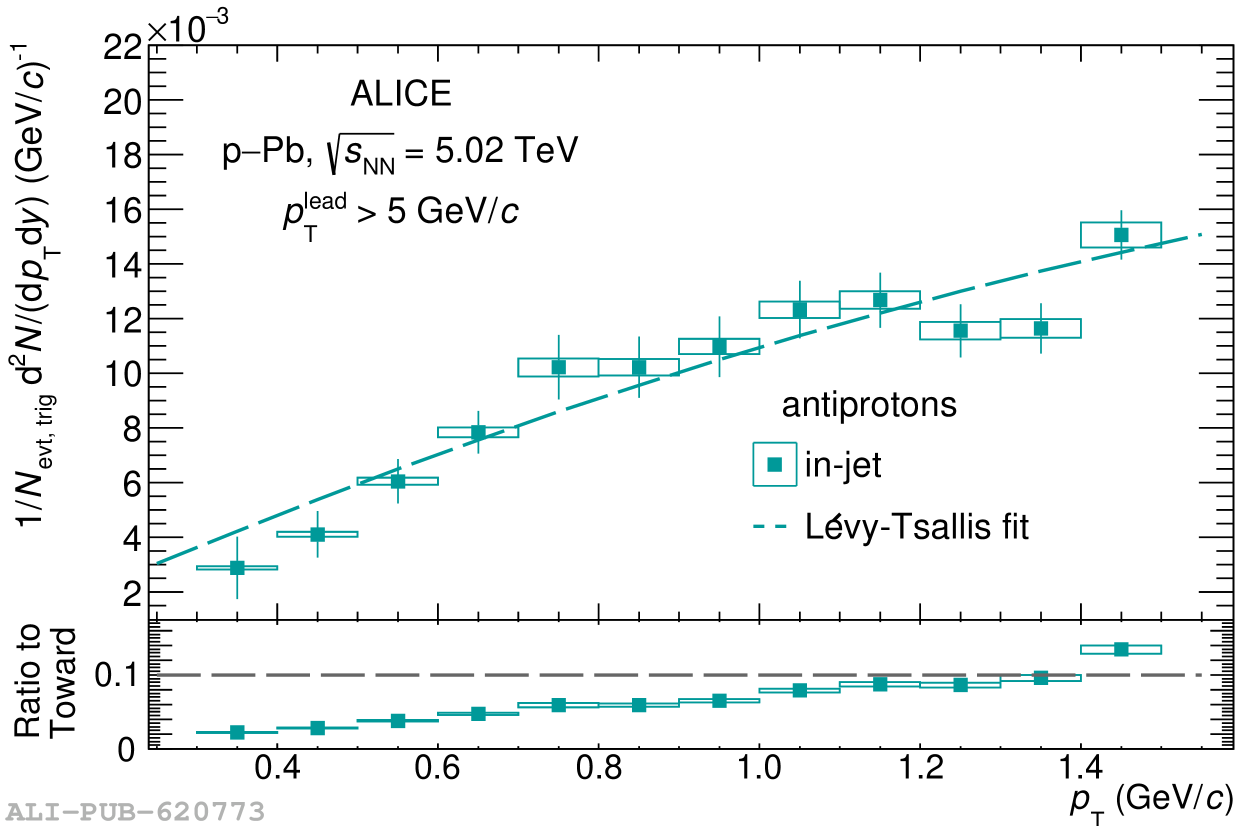 |
Figure 2
The coalescence parameter in jets \coaljet and in the underlying event \coalUE as a function of the per nucleon transverse momentum \pt/$A$ (here, $A = 2$) in \pp collisions at \thirtheen, taken from , and \pPb collisions at \fivenn. Statistical and systematic uncertainties are represented, respectively, by vertical bars and boxes. | 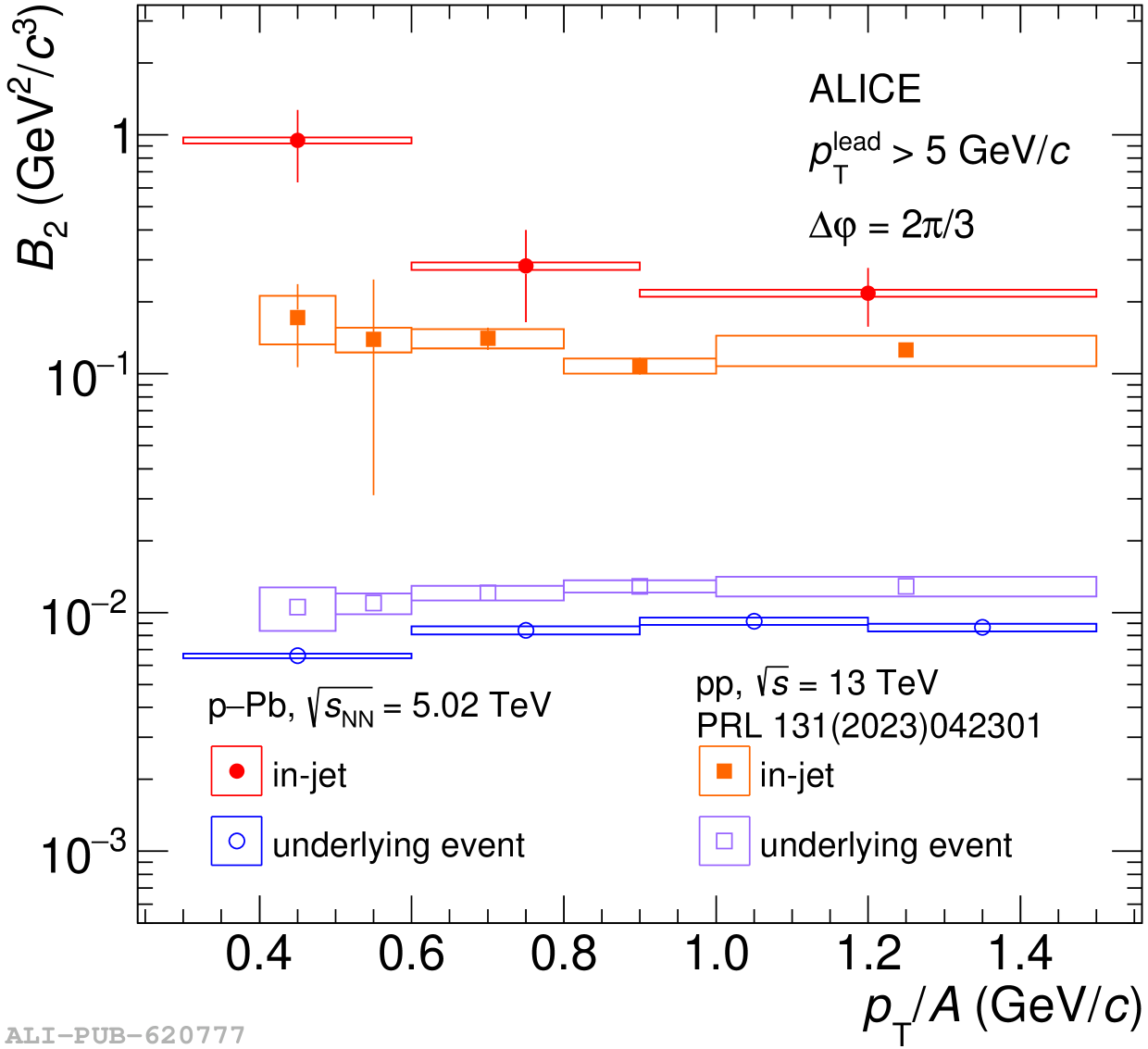 |
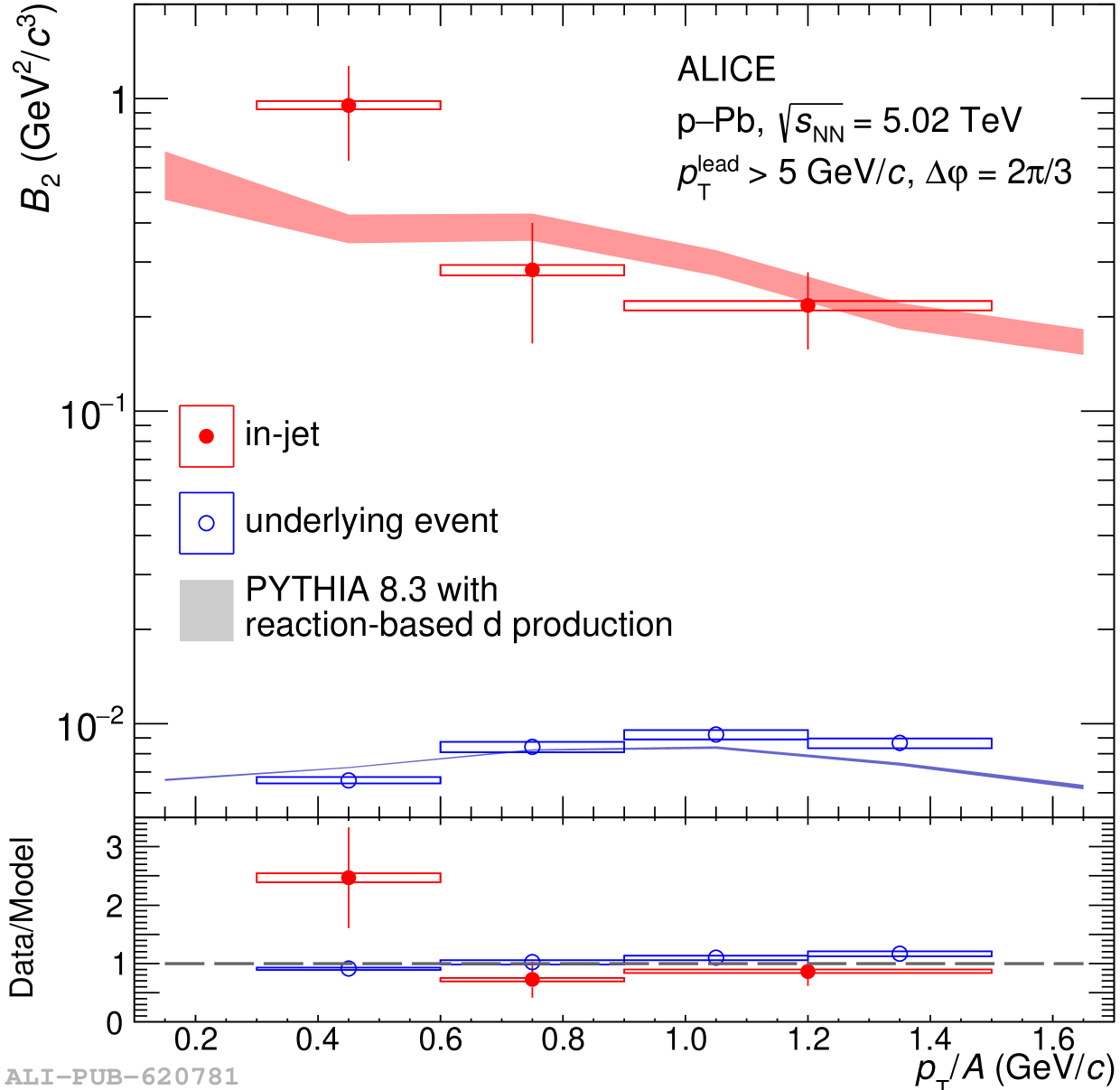
Figure 4
Top: The deuteron-to-proton yield ratio in \pp collisions at \thirtheen (left) and \pPb collisions at \fivenn (right) in jets and in the underlying event. Bottom: The double ratio $(\mathrm{d/p})_{\mathrm{in-jet}}/(\mathrm{d/p})_{\mathrm{UE}}$ in \pp collisions at \thirtheen (left) and \pPb collisions at \fivenn (right). Statistical and systematic uncertainties are represented, respectively, by vertical bars and boxes. | 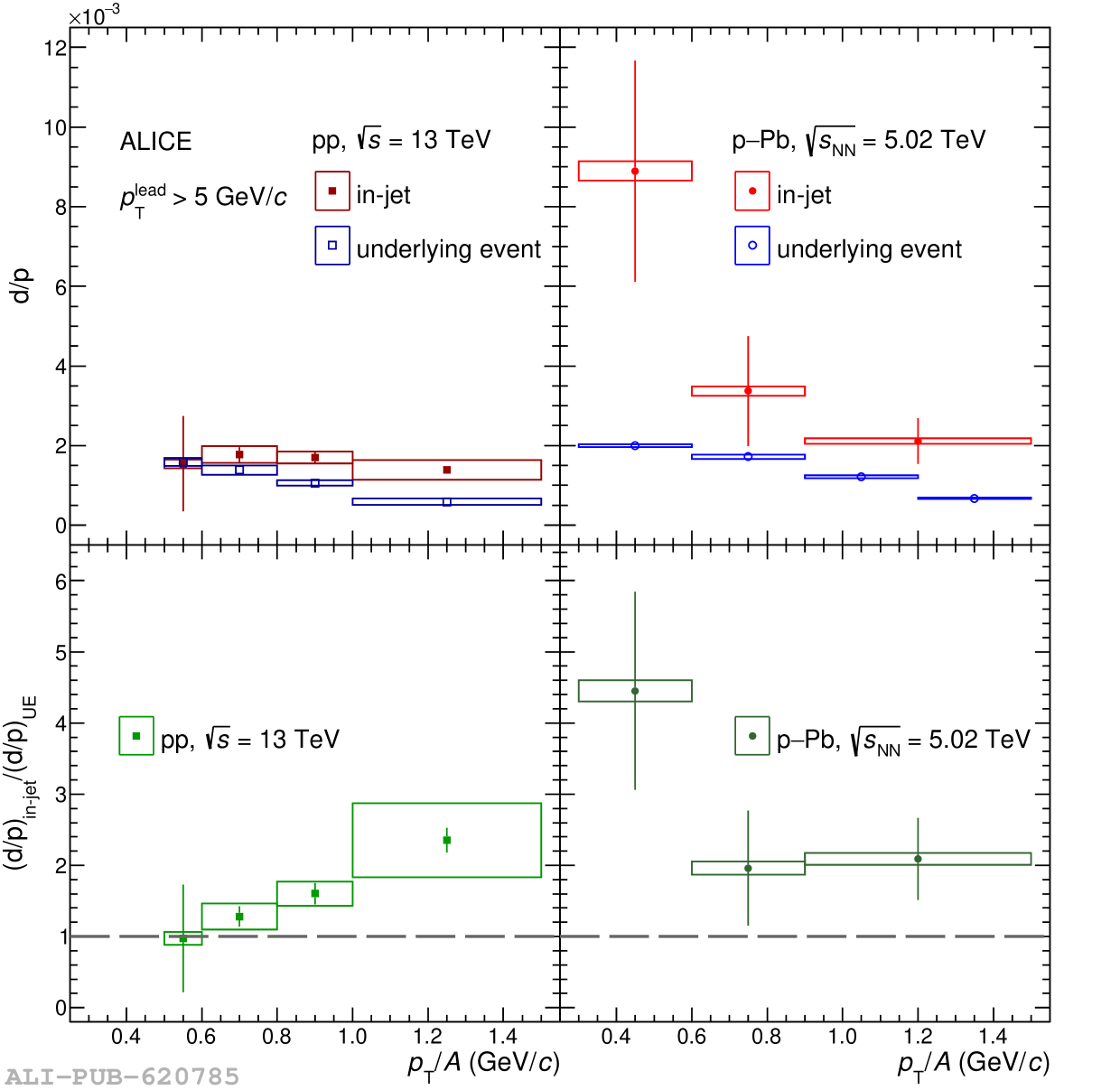 |
Figure 5
Top: The deuteron-to-proton yield ratio in jets (left) and in the underlying event (right) in \pp collisions at \thirtheen and \pPb collisions at \fivenn (right). Statistical and systematic uncertainties are represented, respectively, by vertical bars and boxes. Bottom: The double ratio $(\mathrm{d/p})_{\pPb}/(\mathrm{d/p})_{\mathrm{pp}}$ in jets (left) and in the underlying event (right). The band represents the statistical and systematic uncertainties summed in quadrature. | 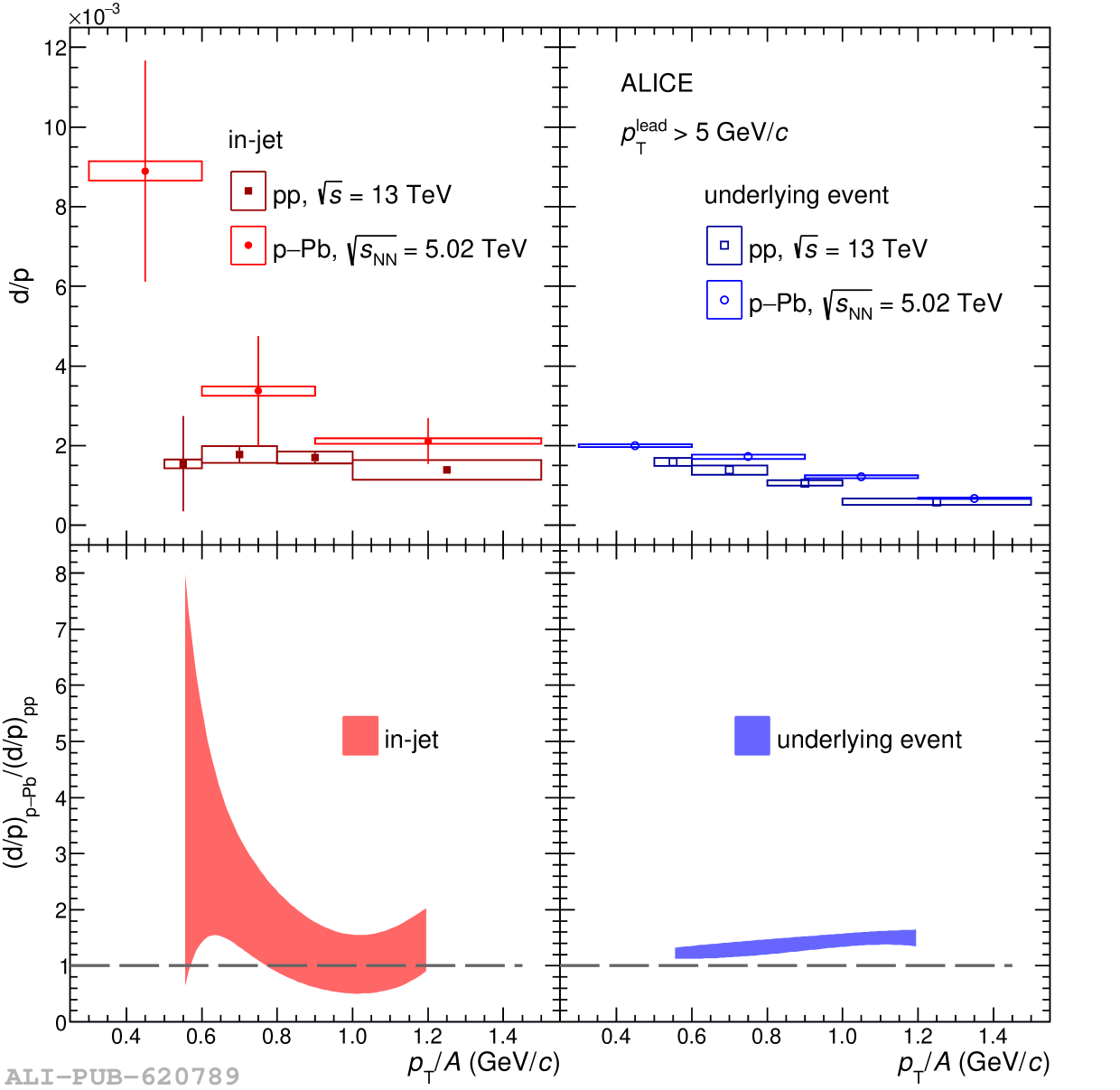 |