
Ultra-relativistic heavy-ion collisions create a hot and dense medium of deconfined quarks and gluons, the quark$-$gluon plasma (QGP), in which parton energy loss ("jet quenching") is a key probe of hot medium properties. While parton energy loss has been firmly established in large systems such as Pb$-$Pb and Au$-$Au collisions, no unambiguous direct evidence exists in smaller systems such as high-multiplicity p$-$Pb and pp collisions. To probe the onset of parton energy loss at intermediate system size, measurements of neutral-pion production are presented in this Letter for oxygen$-$oxygen (OO) and proton$-$oxygen (pO) collisions recorded with the ALICE detector in July 2025, relative to a pp baseline. The nuclear modification factor $R_{\rm OO}$ is suppressed relative to unity with a transverse-momentum dependence similar to that observed in Pb$-$Pb collisions, consistent with a previous CMS measurement in OO collisions with charged particles. As $R_{\rm OO}$ contains contributions from both cold and hot nuclear matter effects, $R_{\rm pO}$ is also presented in order to constrain cold nuclear matter (CNM) contributions. $R_{\rm pO}$ is found to be compatible with unity, indicating that CNM effects alone cannot account for the suppression observed in $R_{\rm OO}$. Final-state effects are isolated using the measured double ratio $R_{\rm OO} \left/ R_{\rm pO}^2 \right.$, which largely cancels CNM contributions and exhibits a significant suppression relative to expectations without energy loss at a $4.9σ$ level. Theoretical models incorporating parton energy loss via different mechanisms predict a significant suppression of the $R_{\rm OO} \left/ R_{\rm pO}^2 \right.$ relative to unity, consistent with the data. These findings establish parton energy loss in OO collisions, extending experimental evidence for jet quenching to the smallest nuclear system studied to date.
Accepted by: PRL
HEP Data
e-Print: arXiv:2606.19967 | PDF | inSPIRE
CERN-EP-2026-171
Figure group
Figure 1
Production cross section of \piz measured in OO collisions at \fivethreesixnn, in pO collisions at \ninesixtwonn and in pp collisions at \fivethirteen, together with the interpolated pp reference at \ninesixtwo used for the \RpO calculation. Vertical bars (boxes) represent the statistical (systematic) uncertainty. Normalization uncertainties (not shown) originating from the luminosity determination are given in the text. | 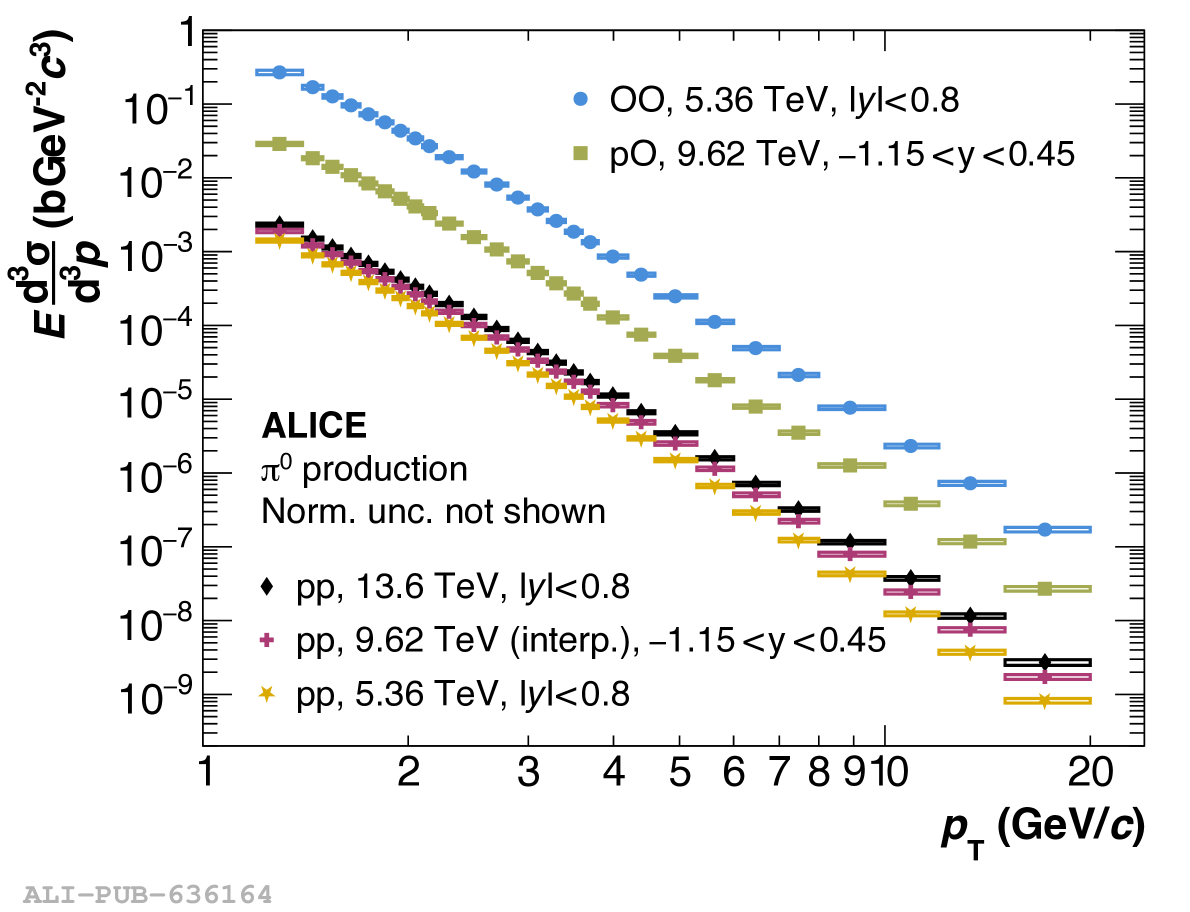 |
Figure 2
Nuclear modification factors \ROO (upper panel) and \RpO (lower panel). Vertical bars (boxes) represent the statistical (systematic) uncertainty, while a box around unity denotes the normalization uncertainty due to the luminosity determination. Shaded bands show predictions of four nPDFs and their 68\% confidence level, including nPDF and scale uncertainty. The lower panel additionally includes two calculations of fully coherent energy loss (FCEL) for the two partonic channels gg$\rightarrow$q$\bar{\text{q}}$ and gg$\rightarrow$gg . | 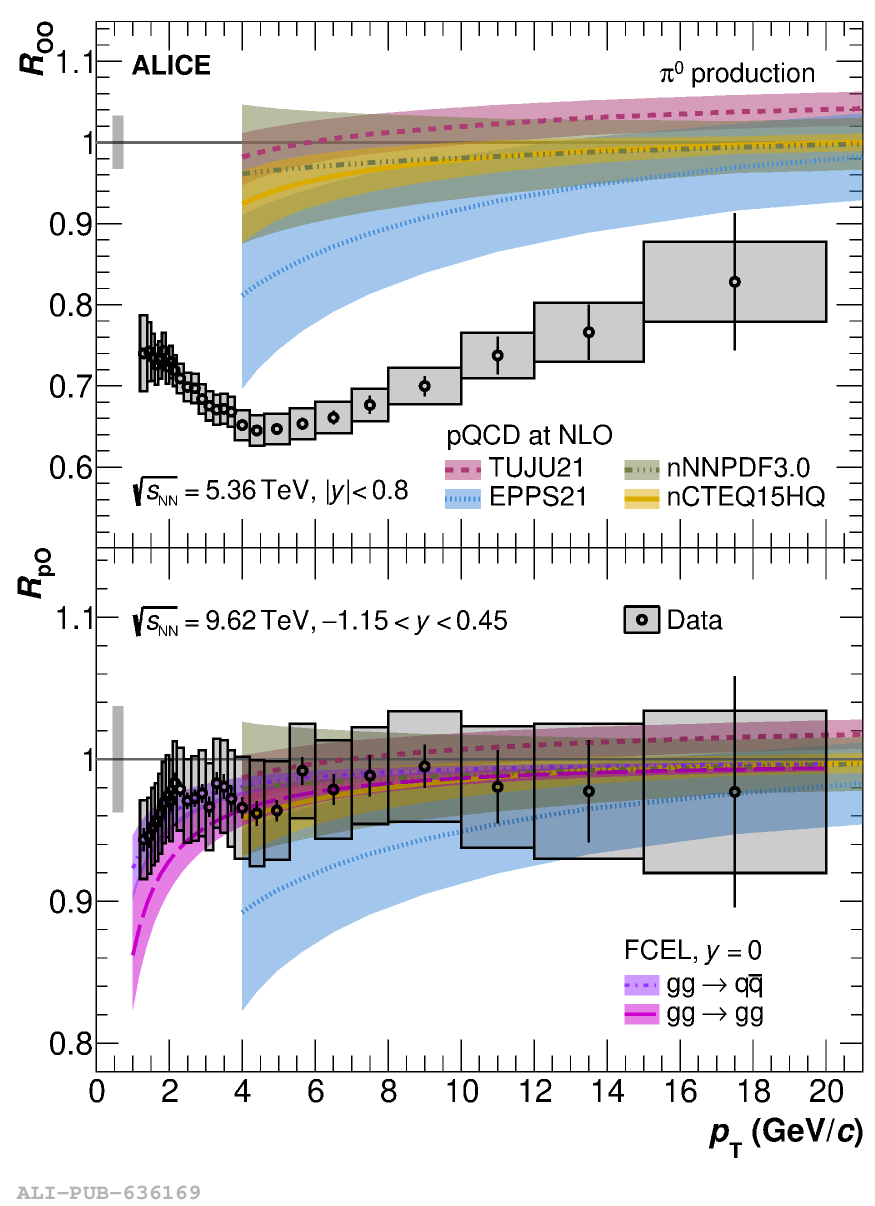 |
Figure 3
Double ratio \ROOpOpO compared to pQCD calculations including only CNM effects , located around unity, and to energy loss models , which exhibit a suppression similar to the one observed in data. Vertical bars (boxes) represent the statistical (systematic) uncertainty, while a box around unity denotes the normalization uncertainty due to the luminosity determination. | 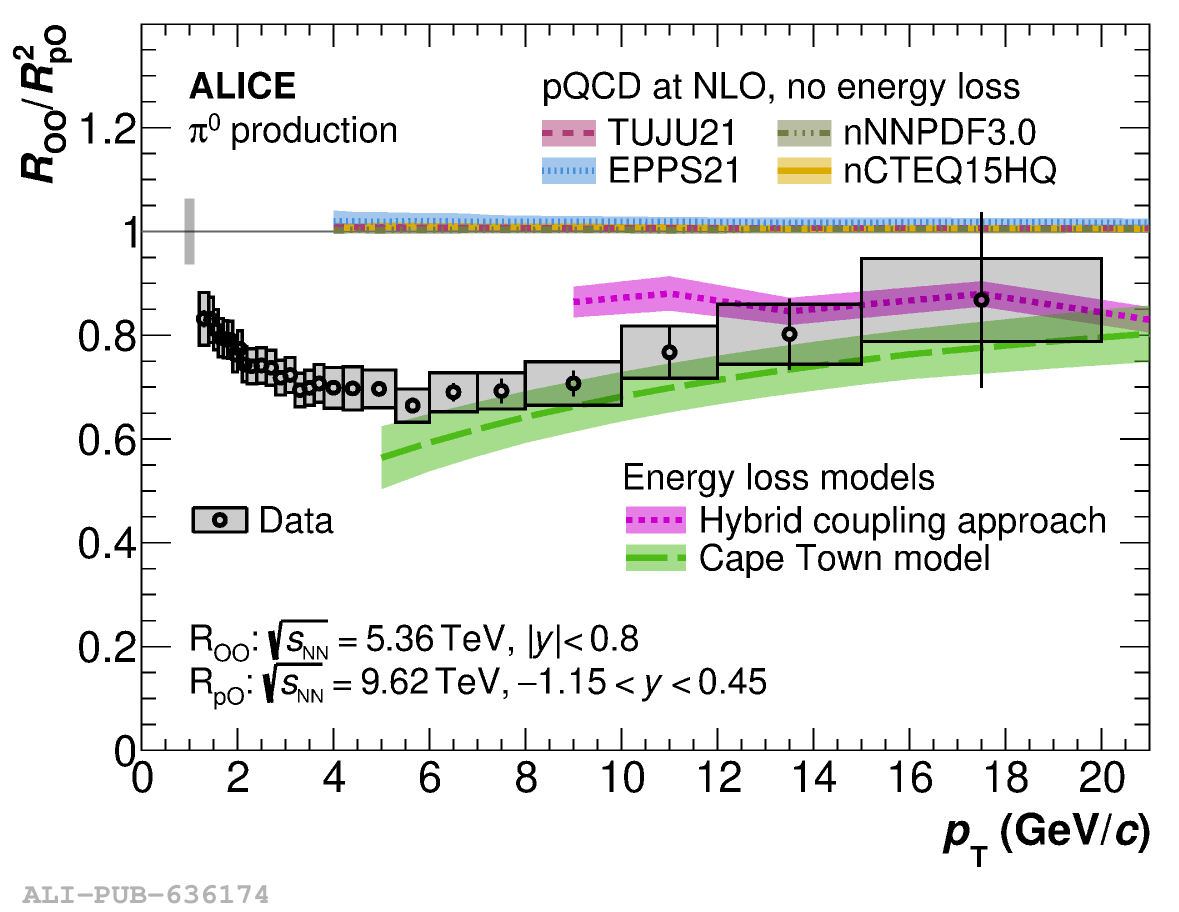 |