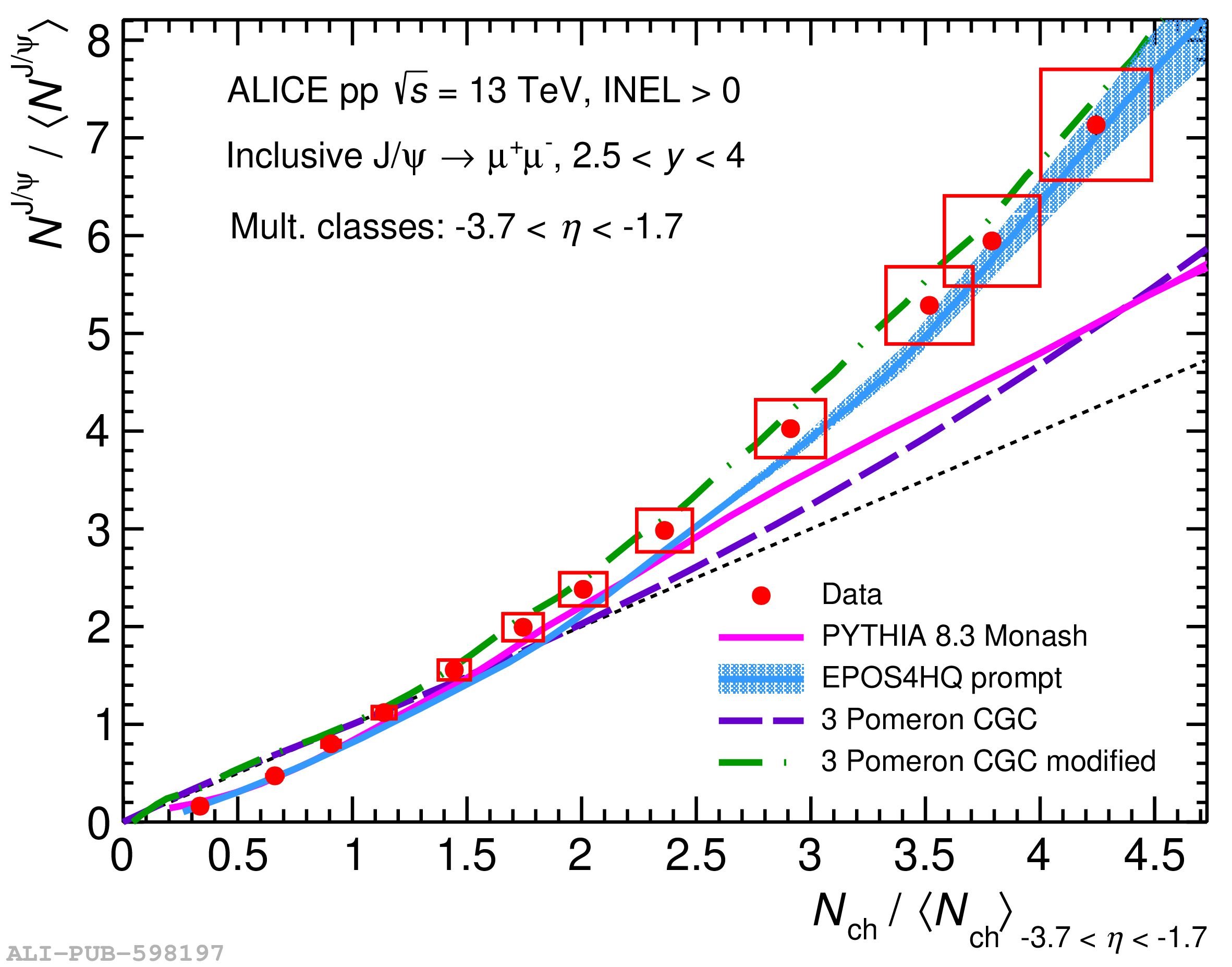
This paper presents a study of the inclusive forward $J/ψ$ yield as a function of forward charged-particle multiplicity in pp collisions at $\sqrt{s} =13$ TeV using data collected by the ALICE experiment at the CERN LHC. The results are presented in terms of relative $J/ψ$ yields and relative charged-particle multiplicities with respect to these quantities obtained in inelastic collisions having at least one charged particle in the pseudorapidity range $|η| <~ 1$. The $J/ψ$ mesons are reconstructed via their decay into $μ^+ μ^-$ pairs in the forward rapidity region ($2.5 <~ y <~ 4$). The relative multiplicity is estimated in the forward pseudorapidity range which overlaps with the $J/ψ$ rapidity region. The results show a steeper-than-linear increase of the $J/ψ$ yields versus the multiplicity. They are compared with previous measurements and theoretical model calculations.
JHEP 07 (2025) 238
HEP Data
e-Print: arXiv:2504.00686 | PDF | inSPIRE
CERN-EP-2025-070
Figure group
Figure 1
The V0C distributions in minimum-bias events in data, PYTHIA 8.2 Monash MC and EPOS3 MC. The chosen multiplicity classes are indicated by alternating gray and white areas. The percentile ranges corresponding to the multiplicity classes (from low to high multiplicities) are 70-100%, 50-70%, 40-50%, 30-40%, 20-30%, 15-20%, 10-15%, 5-10%, 1-5%, 0.5-1%, 0.25-0.5%, 0-0.25%. The bottom panel shows the ratio between data and MC. | 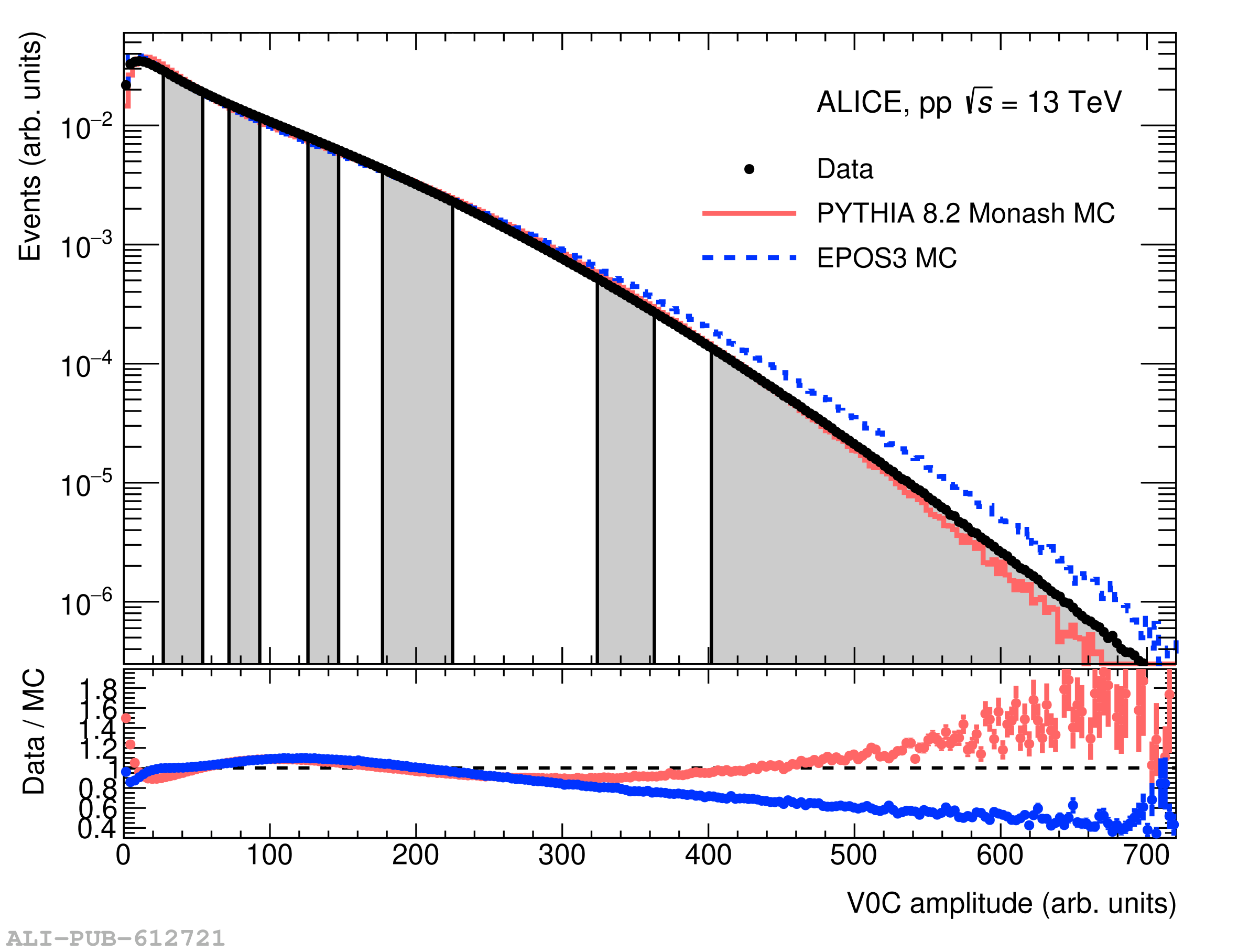 |
Figure 2
The dimuon invariant-mass distribution in the 5-10% multiplicity class. Each dimuon is weighted with the inverse of the detector acceptance and efficiency as a function of the dimuon $p_{\rm T}$ and $y$. The data are fitted to a combination of double-sided Crystal Ball (CB2) functions for the J/$\psi$ and $\psi(2S)$ signals, and a Variable-Width Gaussian function for the background. Only statistical uncertainties are shown. The bottom panel shows the ratio between the data and the fit. | 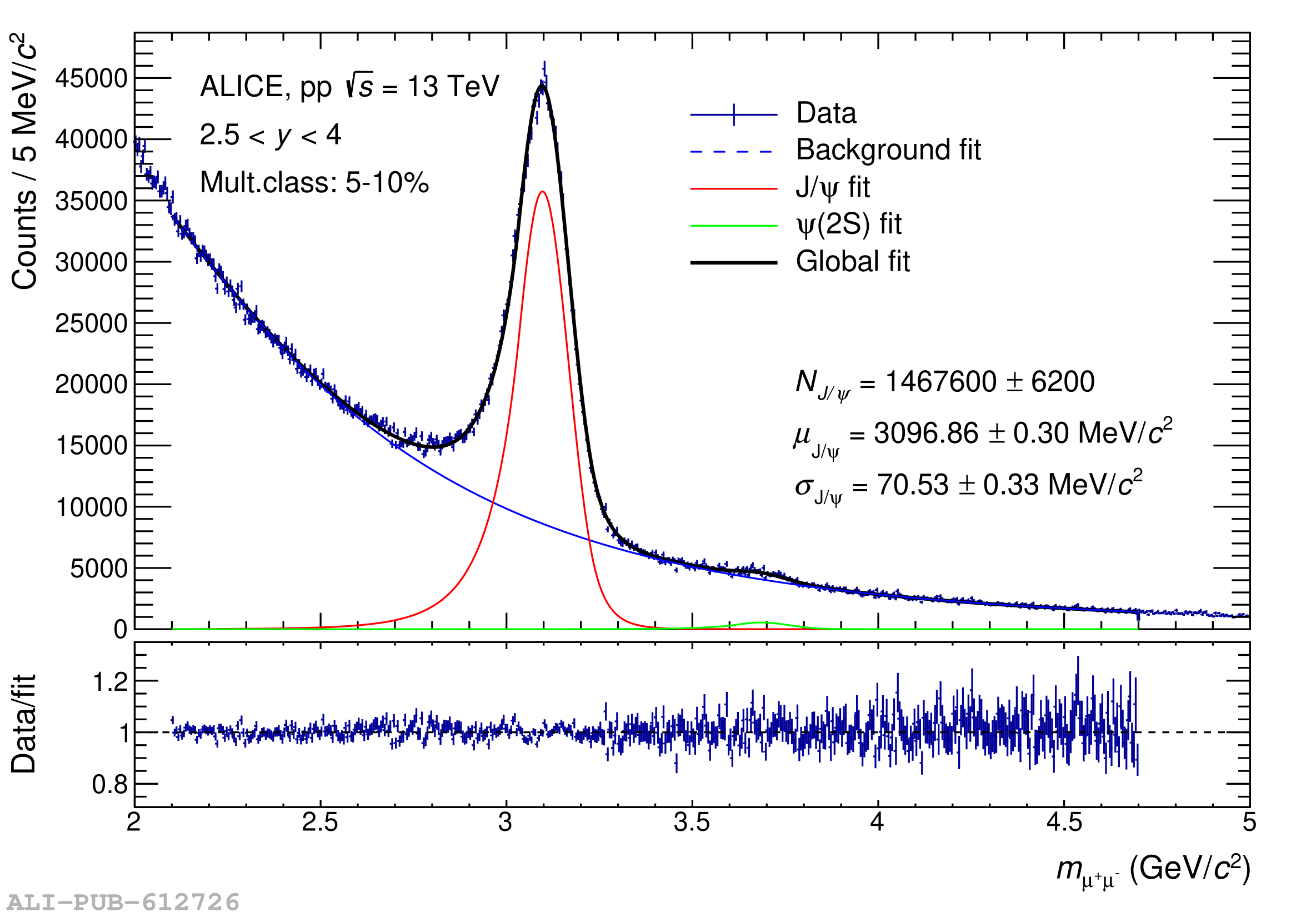 |
Figure 3
Forward and midrapidity J/$\psi$ relative yields versus the relative charged-particle multiplicity. The relative forward J/$\psi$ yields as a function of the relative forward charged-particle multiplicity are shown as red circles. The data of midrapidity J/$\psi$ and forward rapidity J/$\psi$ versus midrapidity multiplicity are taken from Refs.[13] and [14], respectively. The error bars and boxes represent the statistical and systematic uncertainties, respectively. The dotted line represents the diagonal. | 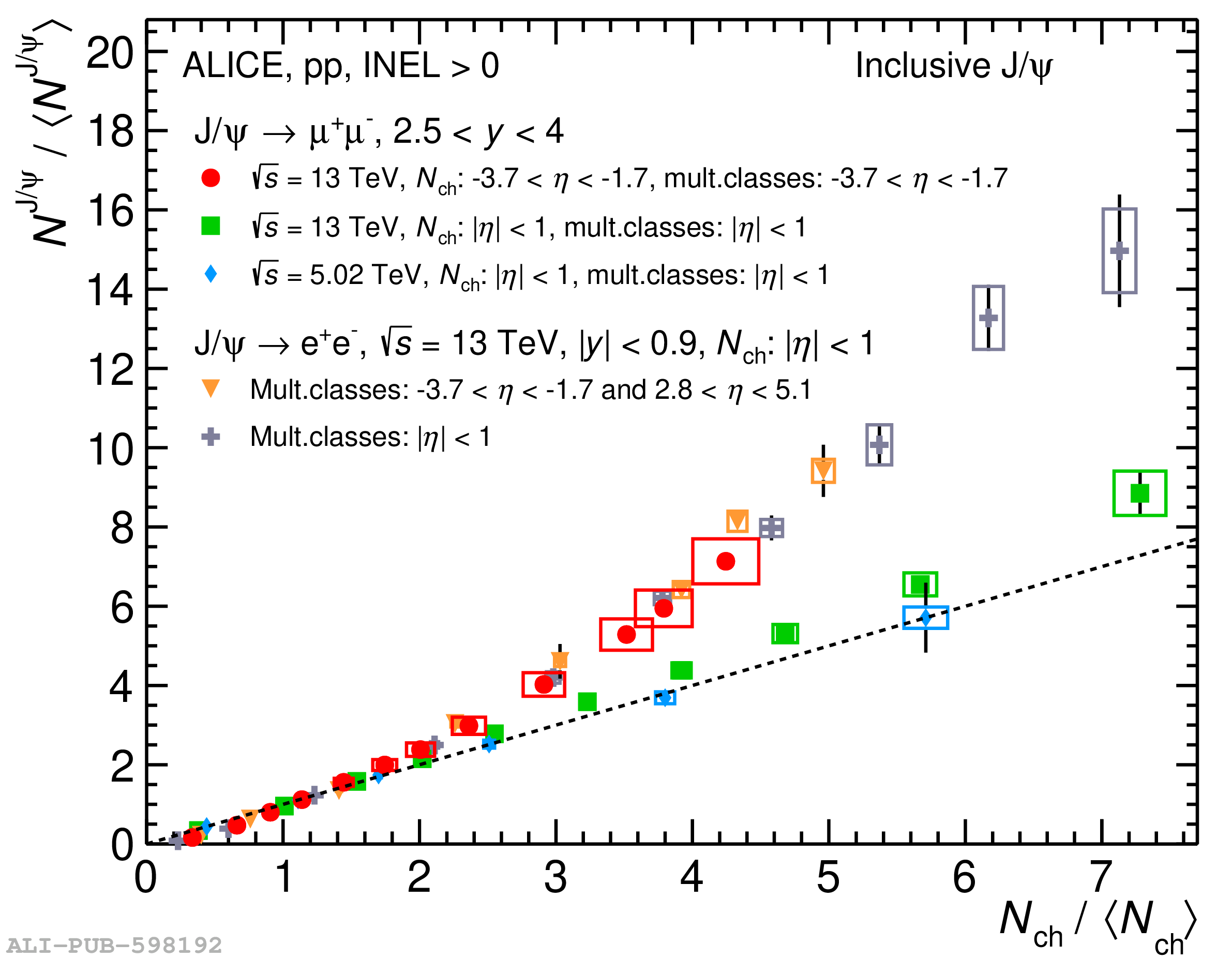 |