The recent measurements of event-by-event correlations between the antideuteron and antiproton numbers in Pb$-$Pb collisions at the LHC deviate from the statistical hadronization model parameterizations that describe the yields and fluctuations of light-flavored hadrons. This discrepancy may stem from nucleosynthesis processes involved in the formation of composite states like antideuterons. In this letter, we present the first measurement of the antideuteron$-$net-$Λ$ number correlation obtained in Pb$-$Pb collisions with the ALICE detector. This quantity is mostly sensitive to the quantum-number correlations induced by the hadronization process, as $Λ$ hyperons are not constituents of antideuterons. Both the antideuteron$-$net-$Λ$ number correlation and the normalized second-order cumulant of the net-$Λ$ number are well described by the statistical hadronization model implemented in Thermal-FIST. This establishes strong evidence that the antideuteron$-$antiproton correlation is driven by the nucleosynthesis processes, while the correlation between antideuterons and non-nucleonic hadrons is primarily sensitive to the hadronization mechanism.
Submitted to: PRL
e-Print: arXiv:2610.36307 | PDF | inSPIRE
CERN-EP-2026-283
Figure group
Figure 1
Upper panels: normalized second-order cumulants \kratioP , \kratioL, and \kratioX . Lower panels: Pearson correlation coefficients \rhodp , \rhodL, and \rhokx . The results of the analysis described in this Letter are shown in panels (b), (d), and (e): (b) and (e) are obtained from the 2018 data, while (d) is obtained with the combined 2015+2018 data. The observables are measured as a function of centrality in Pb--Pb collisions at $\sqrt{s_{\mathrm{NN}}}=5.02\ \mathrm{TeV}$. The error bars and boxes show the statistical and systematic uncertainties, respectively. For \kratioL, \rhodp, and \rhodL, the boxes and shaded areas indicate the centrality uncorrelated and correlated components of the systematic uncertainty, respectively. The correlated components are centered around the value of the uncorrelated particle-production baseline, which is represented as a dashed black line in each panel The results are compared with model calculations, shown as colored bands, obtained with the Thermal-FIST model , both with and without nuclear coalescence effects, and for different $V_c$ values. The yellow bands with purple shades correspond to the cases where the calculations with and without coalescence effects coincide. The width of the band represents the statistical uncertainty in the model calculations. | 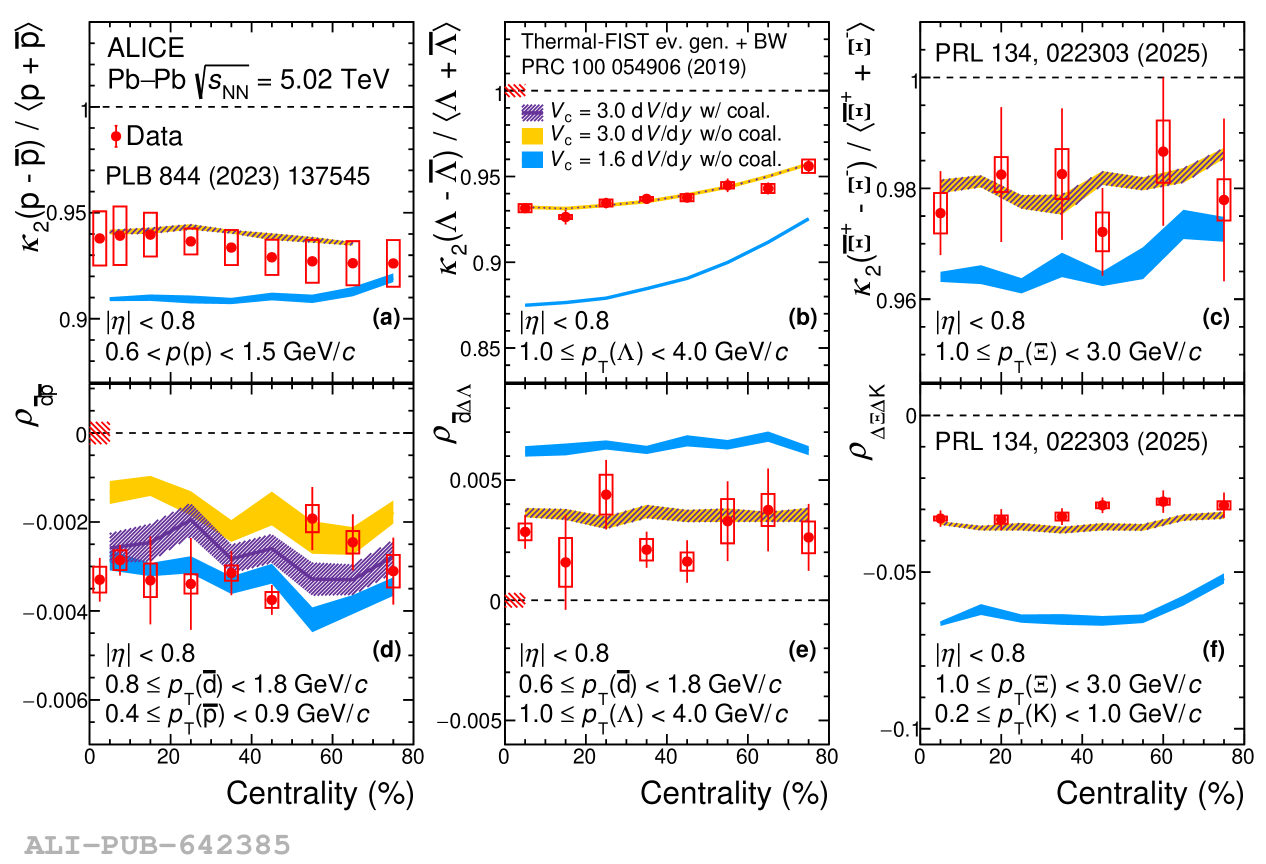 |