
The first measurement of the elliptic-flow coefficient ($v_{2}$) of $φ$, K$^0_{\rm S}$, and $Λ(\overlineΛ)$ hadrons performed in OO collisions at $\sqrt{s_{\mathrm{NN}}}=5.36$ TeV with the ALICE detector is presented as a function of transverse momentum ($p_{\rm T}$) in central and semi-central collisions. For the $φ$ meson, in particular, this is the first measurement of the elliptic flow in a small collision system. At low $p_{\rm T}$, a characteristic mass ordering of $v_{2}$ is observed, consistent with collective expansion of the system, in which heavier hadrons are shifted to higher $p_{\rm T}$ by a common velocity field. At intermediate $p_{\rm T}$, above 3 GeV/$c$, a baryon$-$meson splitting with a $10σ$ significance emerges, with the $Λ(\overlineΛ)$ baryon exhibiting larger $v_{2}$ values than mesons, while, despite its mass being close to the mass of the $Λ$, the $φ$ follows the K$^{0}_{\rm S}$. The $φ$ meson behavior disfavors a purely mass-driven interpretation of the observed patterns and supports the role of hadronization via quark recombination from a collectively flowing partonic medium. These results provide complementary evidence that key signatures of partonic collectivity observed in Pb$-$Pb collisions persist in light nucleus$-$nucleus systems.
Submitted to: PRL
e-Print: arXiv:2610.36237 | PDF | inSPIRE
CERN-EP-2026-281
Figure group
Figure 1
Simultaneous fit of the invariant-mass distribution (top panel) and the elliptic-flow coefficient, $V_{2\Delta}^{\phi\text{-}h}$ (bottom panel), as a function of the invariant mass of oppositely-charged kaon pairs in the transverse-momentum interval 1.6 < $p_{\rm T}$ < 2 GeV/$c$ in OO collisions at $\sqrt{s_{\rm NN}}$ = 5.36 TeV for the 10$-$40% $N_{\rm trk}$ class. The total fit function is shown as a solid blue line, while the combinatorial background contribution to the invariant-mass distribution is indicated by the red dashed line. |  |
Figure 2
The results of $v_2$ as a function of $p_{\rm T}$ for K$^0_{\rm S}$, $\Lambda$, and $\phi$ hadrons measured in OO collisions at $\sqrt{s_{\rm NN}}$ = 5.36 TeV for two centrality classes. Statistical and systematic uncertainties are shown as vertical bars and shaded boxes, respectively. The data points are drawn at the $\langle p_{\rm T}\rangle$ of the corresponding bin. | 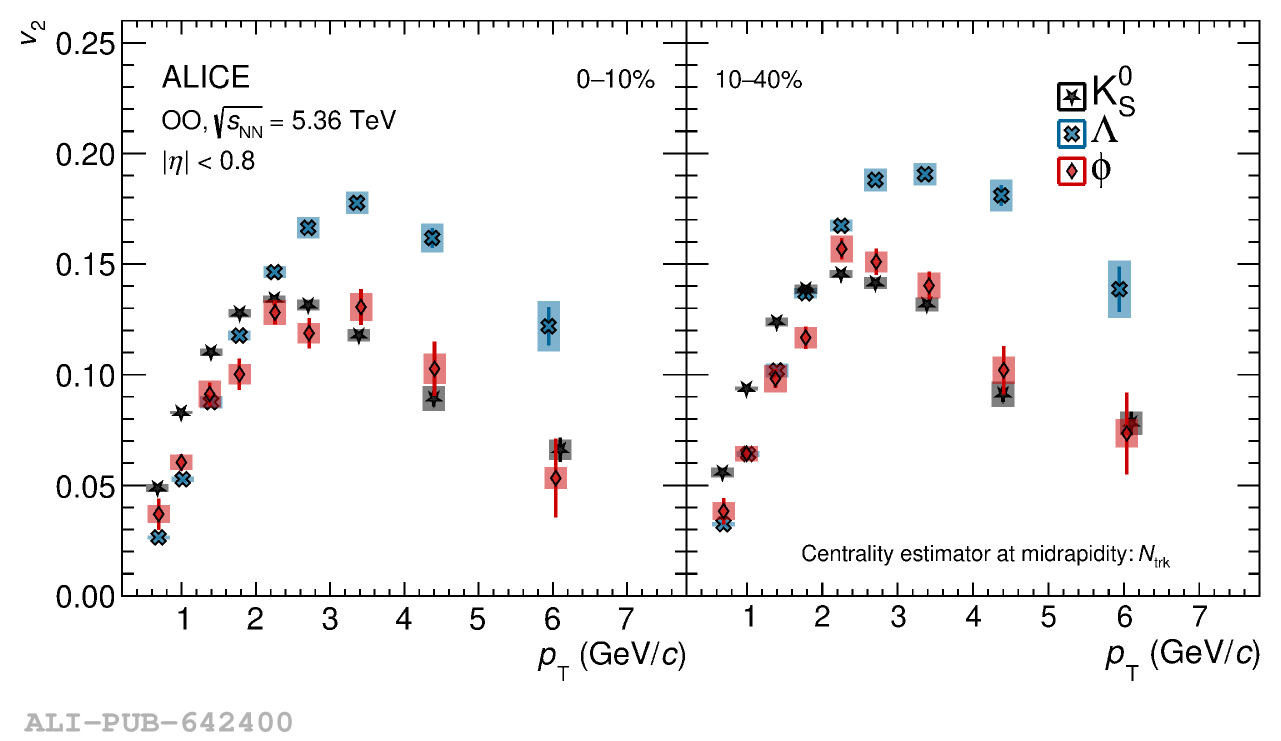 |
Figure A.1
The value of $v_2$ as a function of $p_{\rm T}$ for K$^0_{\rm S}$, $\Lambda$, and $\phi$ hadrons measured in OO collisions at $\sqrt{s_{\mathrm{NN}}}=5.36$ TeV for the 0$-$10% (left panel) and 10$-$40% (right panel) centrality classes, defined using the charged-particle multiplicity measured with the forward FT0C detector. Statistical and systematic uncertainties are shown as vertical bars and shaded boxes, respectively. The data points are drawn at the $\langle p_{\rm T}\rangle$ of the corresponding bin. | 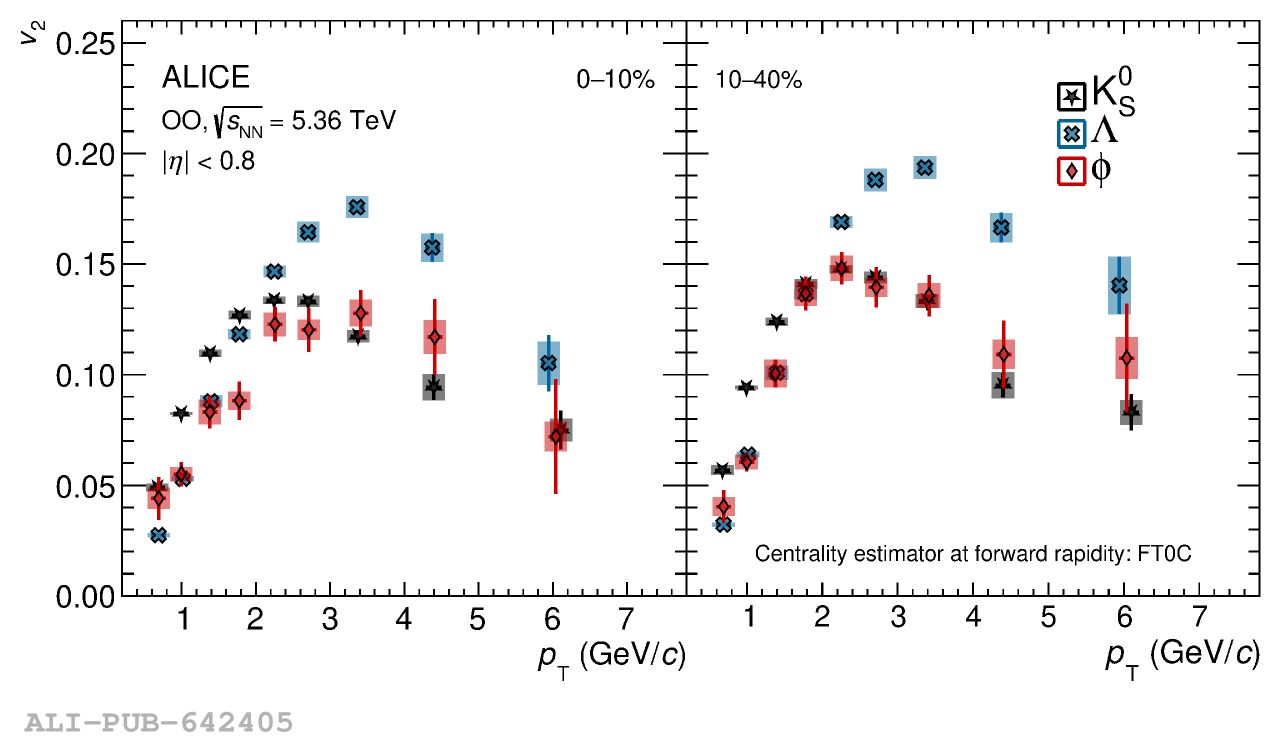 |