
A precise measurement of prompt and non-prompt ${\rm D}^{\rm *+}$-meson spin alignment with respect to the helicity and production axes in proton-proton (pp) collisions at $\sqrt{s} = 13.6$ TeV is presented, using data collected with the ALICE experiment at the LHC. The spin alignment is quantified by measuring the diagonal spin density matrix element $ρ_{\rm 00}$ for ${\rm D}^{\rm *+}$ mesons at midrapidity ($|y|<~0.8$). The measurement is performed in the transverse-momentum ($p_{\rm T}$) range $3<~p_{\rm T}<~100$ GeV/$c$ for prompt ${\rm D}^{\rm *+}$ mesons and $3<~p_{\rm T}<~30$ GeV/$c$ for non-prompt ${\rm D}^{\rm *+}$ mesons, respectively. The measured $ρ_{\rm 00}$ values for prompt ${\rm D}^{\rm *+}$ mesons are consistent with the unpolarised expectation of $1/3$ over the entire $p_{\rm T}$ range, indicating no evidence of spin alignment. In contrast, $ρ_{\rm 00}$ of non-prompt ${\rm D}^{\rm *+}$ mesons exhibit a deviation from $1/3$, consistent with expectations from weak beauty-hadron decays and well described by PYTHIA 8 simulations coupled with the EvtGen decay package. These results confirm and extend previous measurements, providing a precise baseline for future studies of ${\rm D}^{\rm *+}$ spin alignment in heavy-ion collisions.
Submitted to: JHEP
e-Print: arXiv:2609.39713 | PDF | inSPIRE
CERN-EP-2026-267
Figure group
Figure 1
Sketch of the \Dstar-meson decay and the reference frames considered for the spin alignment measurement, namely the helicity and production ones. The momentum vectors of the decay products \Dzero and $\uppi^+$ are considered in the rest frame of the parent \Dstar meson and the $\vartheta^*$ angles are between the momentum of the $\uppi^+$ and the two quantisation axes. | 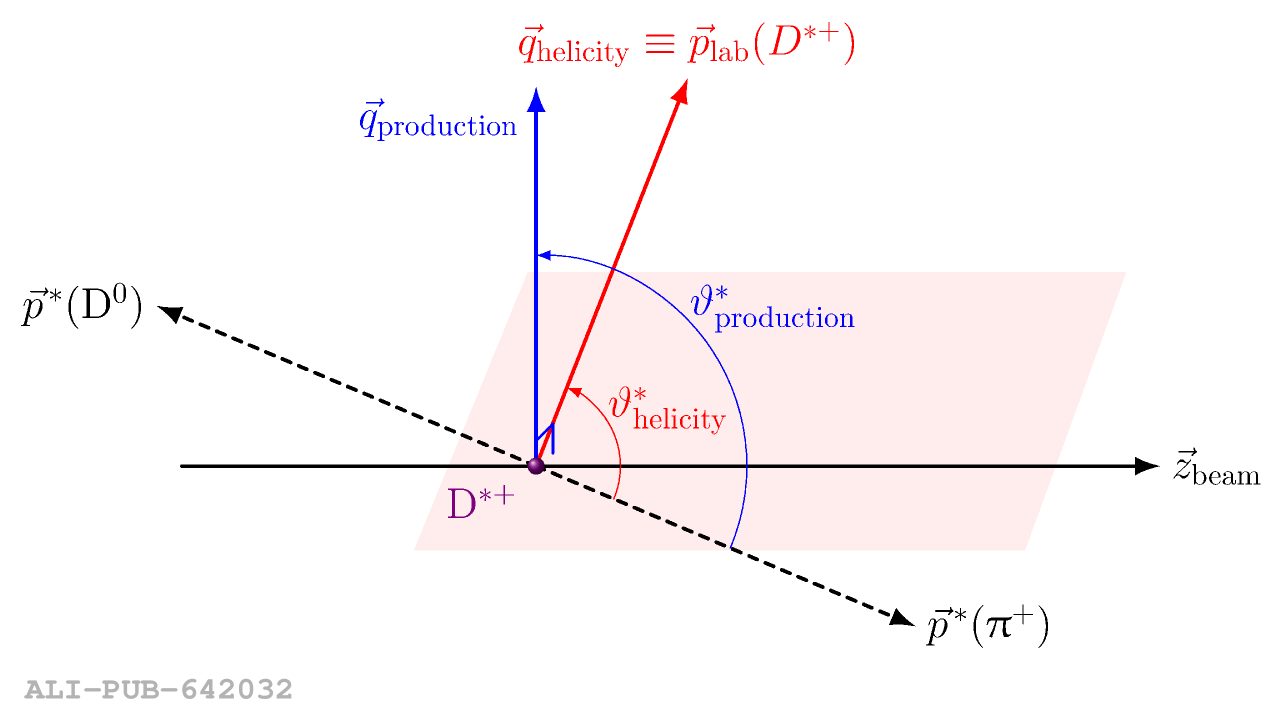 |
Figure 2
Invariant-mass distributions $\Delta M$ of \Dstar-meson candidates obtained from prompt (left) and non-prompt (middle) enhanced sample in $3\pt5 \GeVc$ and for the prompt enhanced sample in $30\pt50 \GeVc$ (right). Distributions are shown for $\cost$ integrated (top), $-0.8\cost-0.6$ (middle) and $0.6\cost0.8$ (bottom) at midrapidity ($|y|0.8$) in pp collisions at $\sqrt{s}=13.6$ Te\kern-.1emV\xspace. | 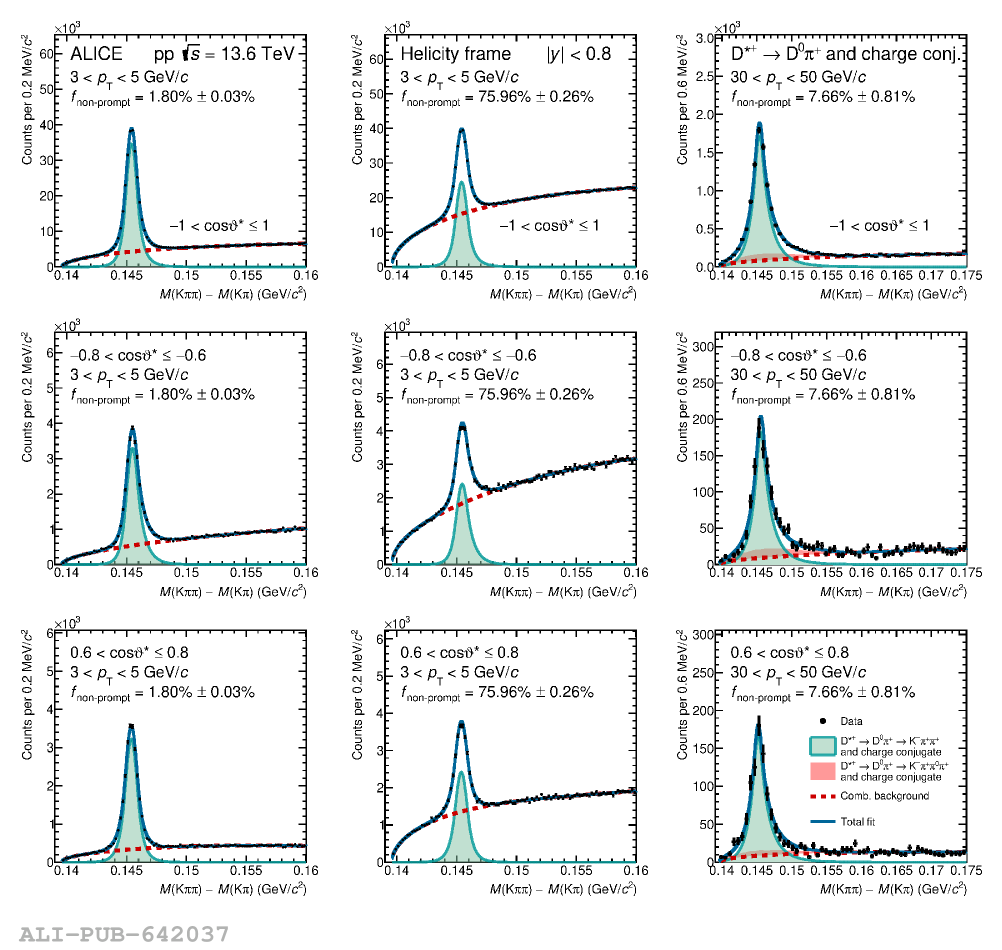 |
Figure 3
Acceptance and efficiency corrected angular distribution of the decay products in the rest frame of the \Dstar mesons with respect to the helicity (upper panels) and production (bottom panels) frame. The left panels show the angular distribution for the charm-enhanced \Dstar sample, and the right panel shows the same but for the beauty-enhanced \Dstar sample. The distributions are obtained in $3\pt5 \GeVc$ and are fitted with Eq. \ref{eq:rzz} to extract the value of spin density matrix element $\rzz^\mathrm{obs}$. | 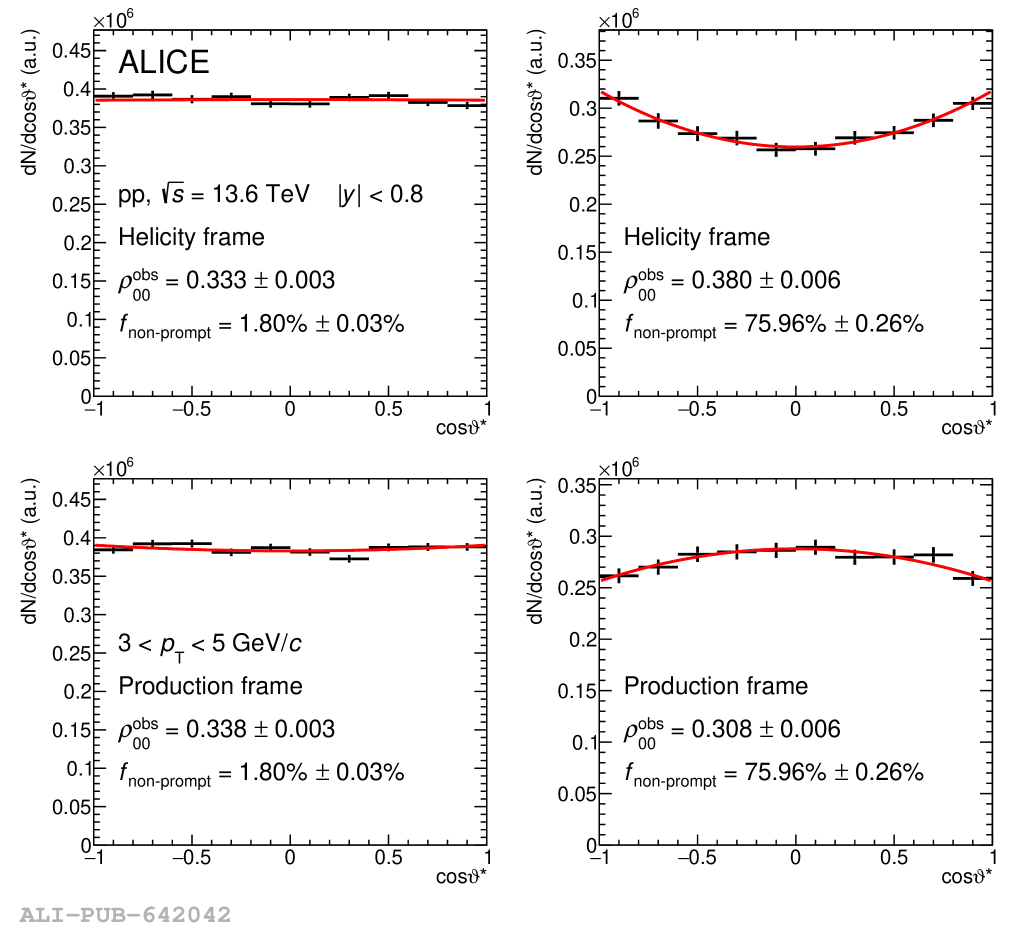 |
Figure 4
Left: raw yield as a function of BDT selections and extracted contributions from prompt and non-prompt \Dstar mesons with $3\pt5 \GeVc$. Right: the spin density matrix element (\rzzo) with respect to the helicity axis as a function of $f_{\rm non\text{-}prompt}$ in $3\pt5 \GeV/c$ for charm- and beauty-enhanced samples. Only statistical uncertainties are shown. The red line represents the linear fit to the data with the blue band indicating its $1\sigma$ confidence interval. | 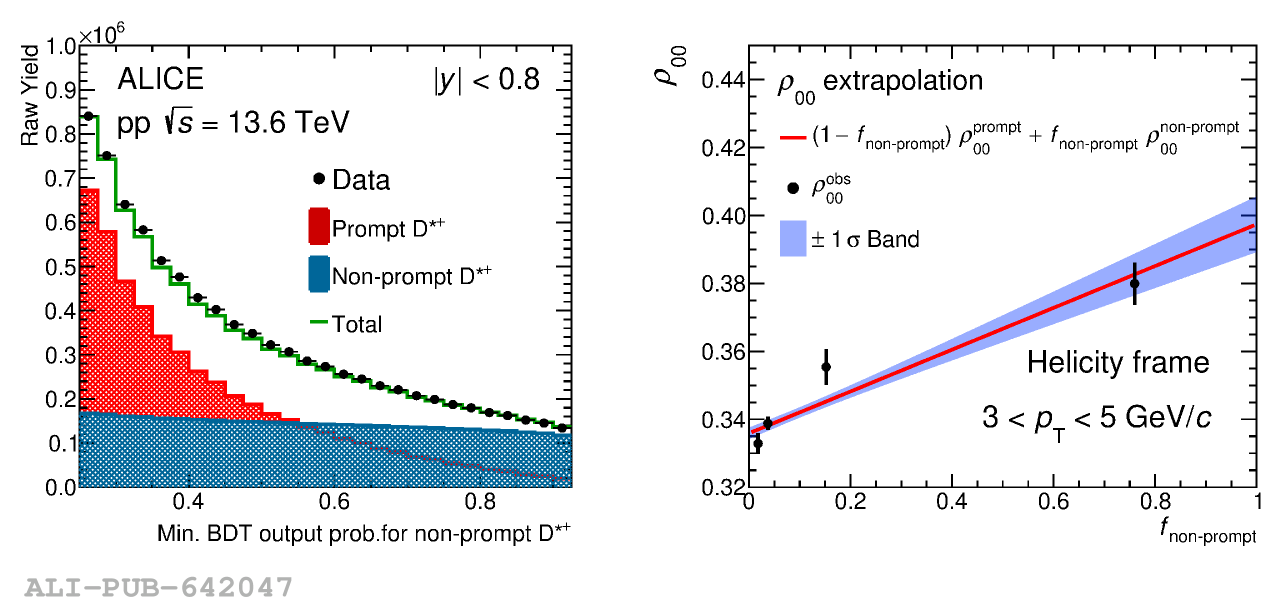 |
Figure 5
The spin density matrix element (\rzz) for prompt and non-prompt \Dstar mesons as a function of \pt in the production (left panel) and helicity (right panel) frames in pp collisions at $\s=13.6 \TeV$. The measurements in the helicity frame are compared with previous results at $\s=13 \TeV$ . All the data points are compared with predictions from the PYTHIA 8 + EvtGen MC generators . |  |
Figure 6
The spin density matrix element \rzz for prompt \Dstar mesons as a function of \pt with respect to the helicity axis in pp collisions at $\s=13.6 \TeV$. The measurements are compared with the theoretical calculations with spin-dependent fragmentation functions \DLL (FFs) tuned to measurements from \ee collisions . No uncertainties are considered in the model predictions. | 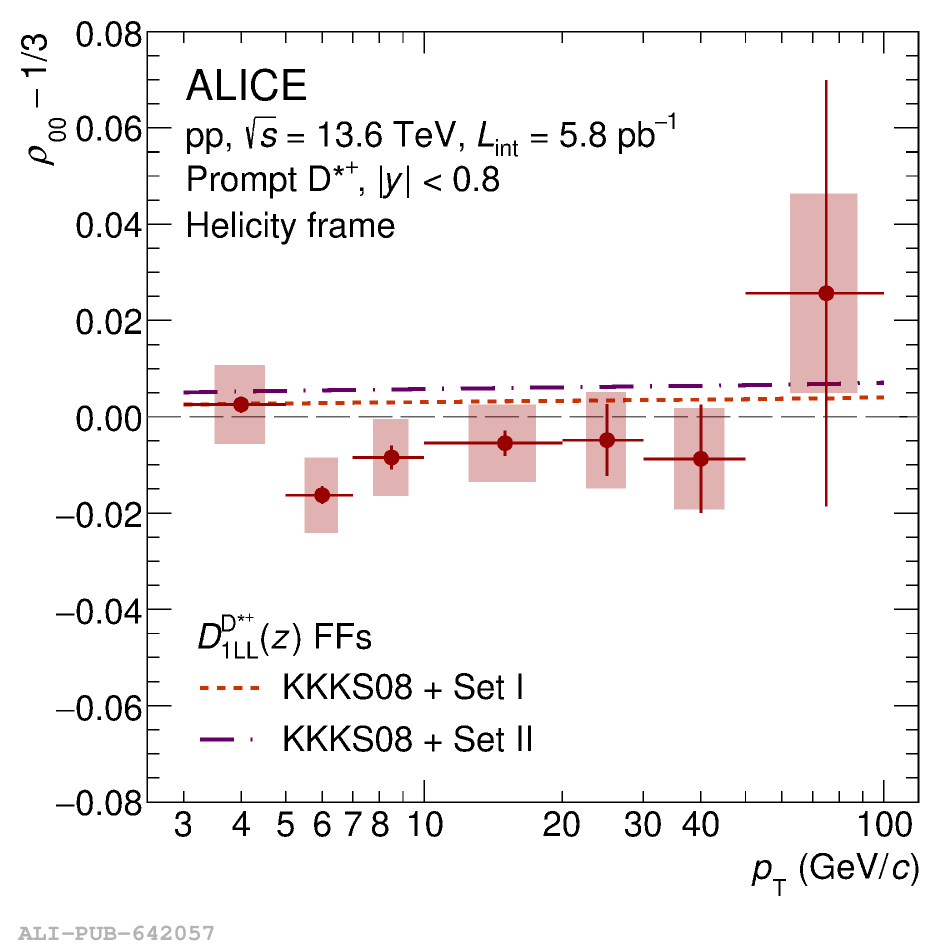 |
Figure 7
The spin density matrix element \rzz of non-prompt \Dstar mesons with respect to the helicity axis as a function of \pt in the rapidity interval $|y| 0.8$ in pp collisions at $\s=13.6 \TeV$, compared to that of non-prompt \Jpsi and \PsiTwoS mesons in the rapidity interval $|y|1.2$ measured by the CMS Collaboration in pp collisions at $\s=13 \TeV$ . All the data points are also compared to predictions from the PYTHIA 8 + EvtGen MC generators . | 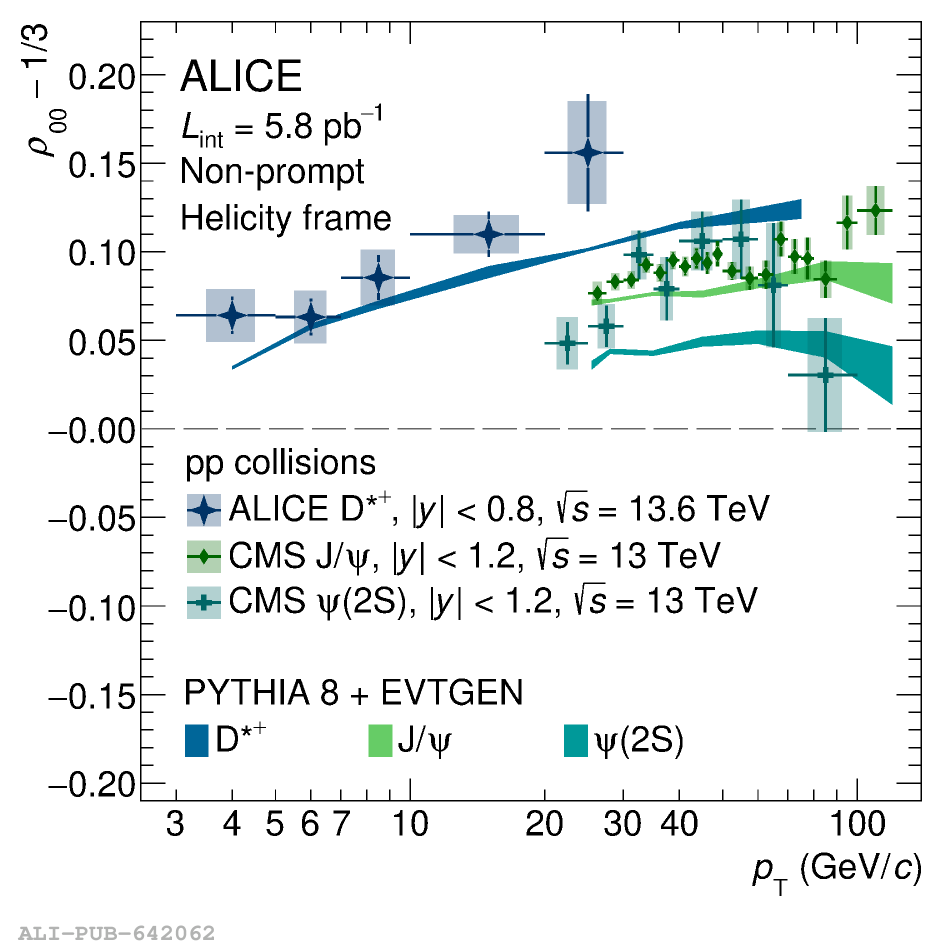 |