
A measurement of the correlation between the splitting angle $θ_{\rm g}$ and the momentum-sharing fraction $z_{\rm g}$ of the first hard splitting in a parton shower in pp collisions and 0$-$10% central Pb$-$Pb collisions at $\sqrt{s_{\rm NN}}$ = 5 TeV with the ALICE detector is reported. Charged-particle jets are reconstructed using the anti-$k_{\rm T}$ algorithm with a jet resolution parameter $R$ = 0.2, in the transverse-momentum range $60 \leq p_{\rm T,ch\;jet} <~ 80$ GeV/$c$. The Soft Drop grooming algorithm is used to identify the first splitting in the parton shower. Jets observed in Pb$-$Pb collisions are narrower than in pp collisions. This effect is more pronounced for balanced than for unbalanced jets. No significant modification of the momentum-sharing fraction is observed for jets with small opening angles. In contrast, there is a hint that jets with a large opening angle may be less balanced in transverse momentum in Pb$-$Pb collisions compared to pp collisions. The correlations between $θ_{\rm g}$ and $z_{\rm g}$ are well described in pp collisions by PYTHIA 8 and POWHEG while HERWIG shows too few jets with large opening angle. In Pb$-$Pb collisions the measurement is compared to a variety of models. The measurement is insensitive to the different implementations of medium response. Inclusion of elastic scatterings, as implemented in the HYBRID model is preferred to describe the unbalanced jets with large $θ_{\rm g}$ in Pb$-$Pb collisions. The balanced jets, however, are less sensitive to elastic scatterings.
Submitted to: JHEP
e-Print: arXiv:2609.39515 | PDF | inSPIRE
CERN-EP-2026-258
Figure group
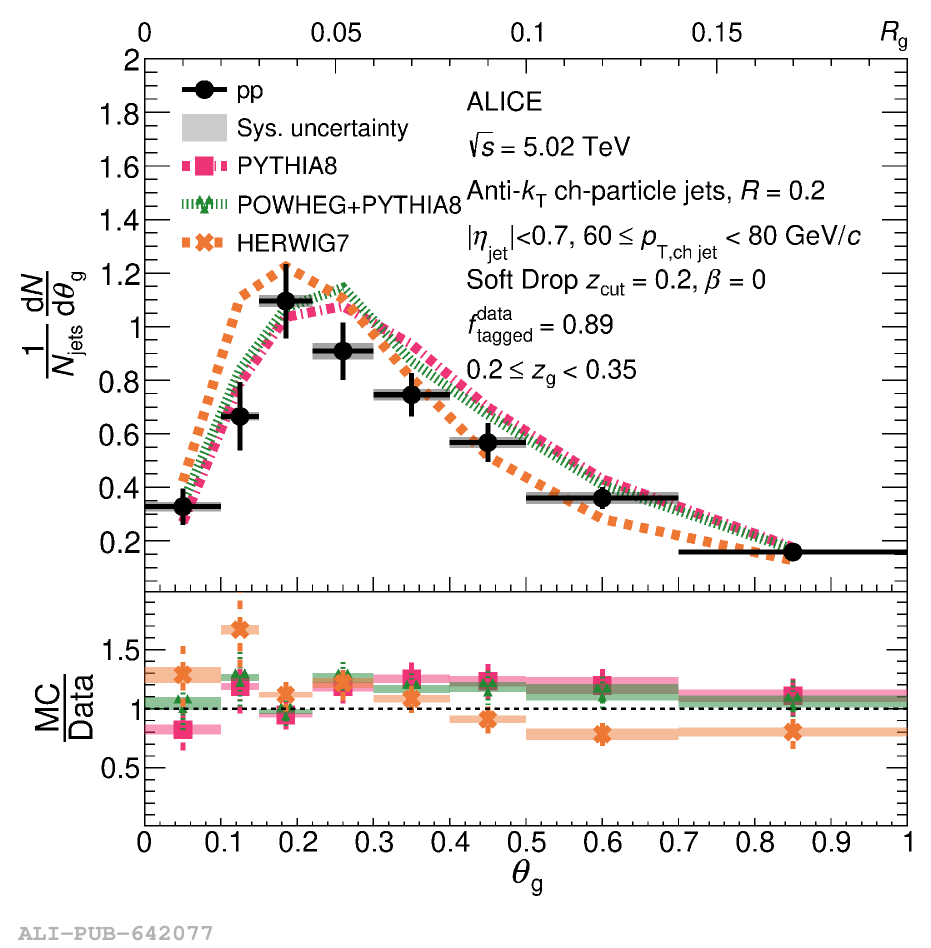
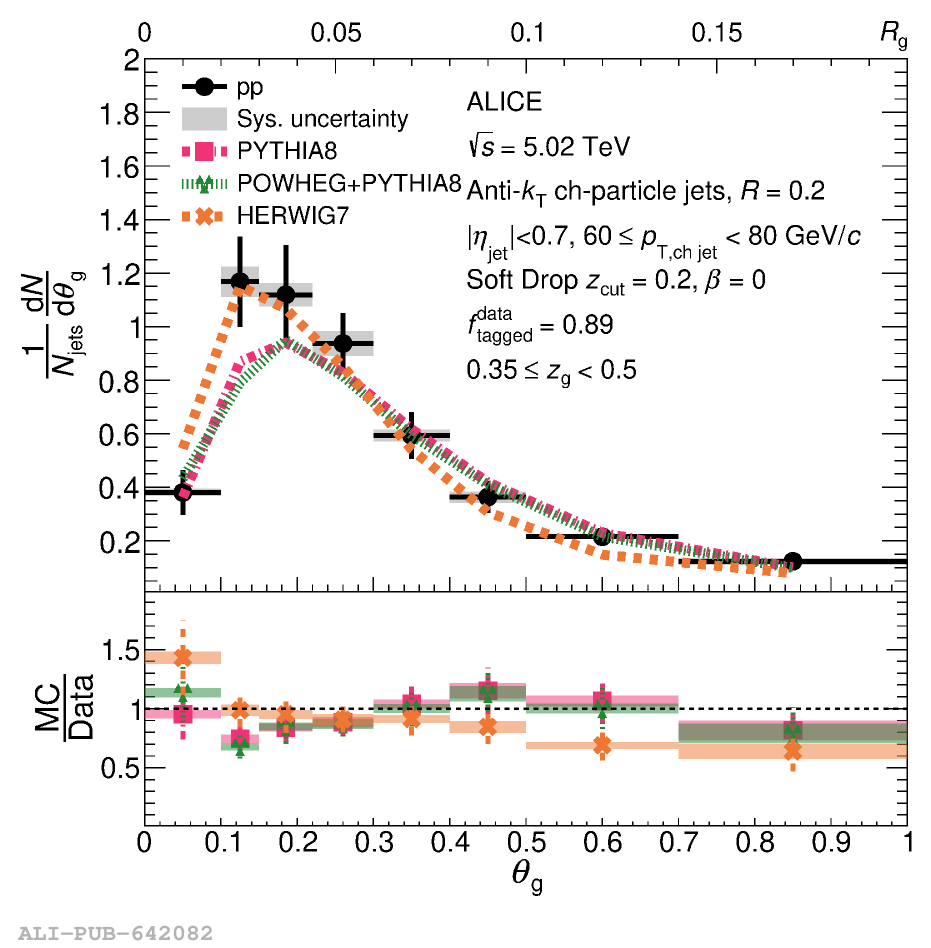
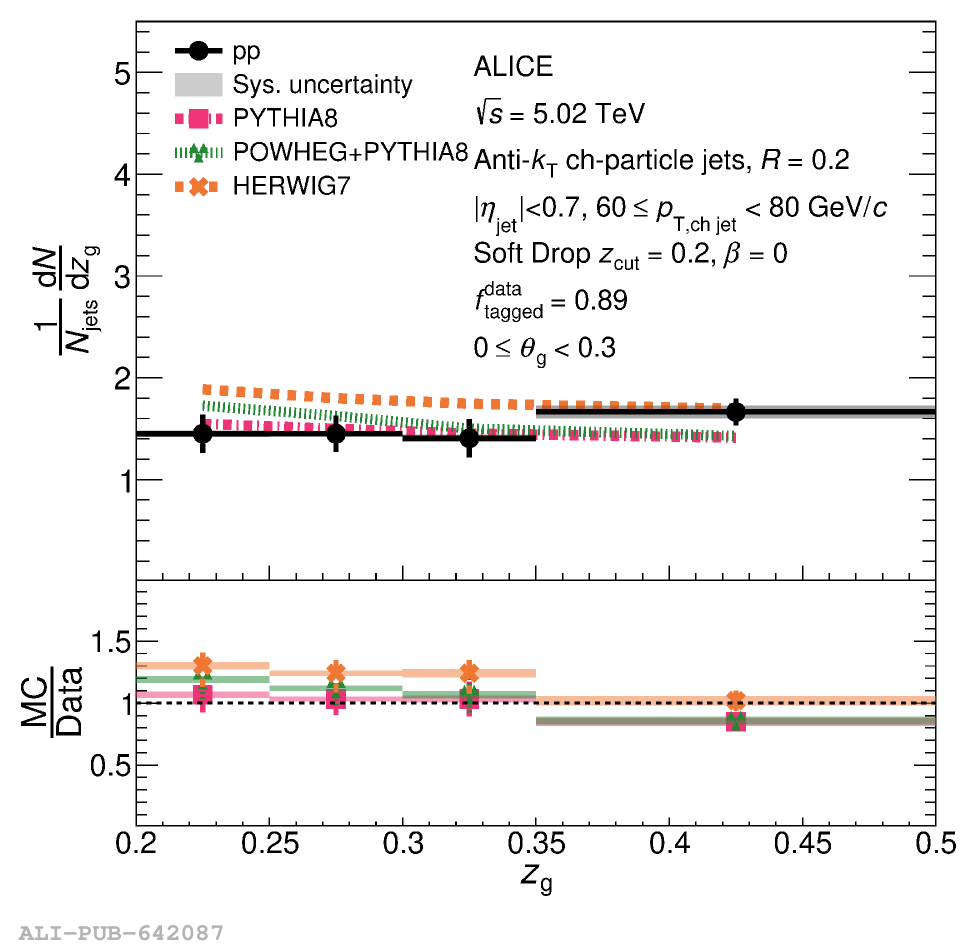
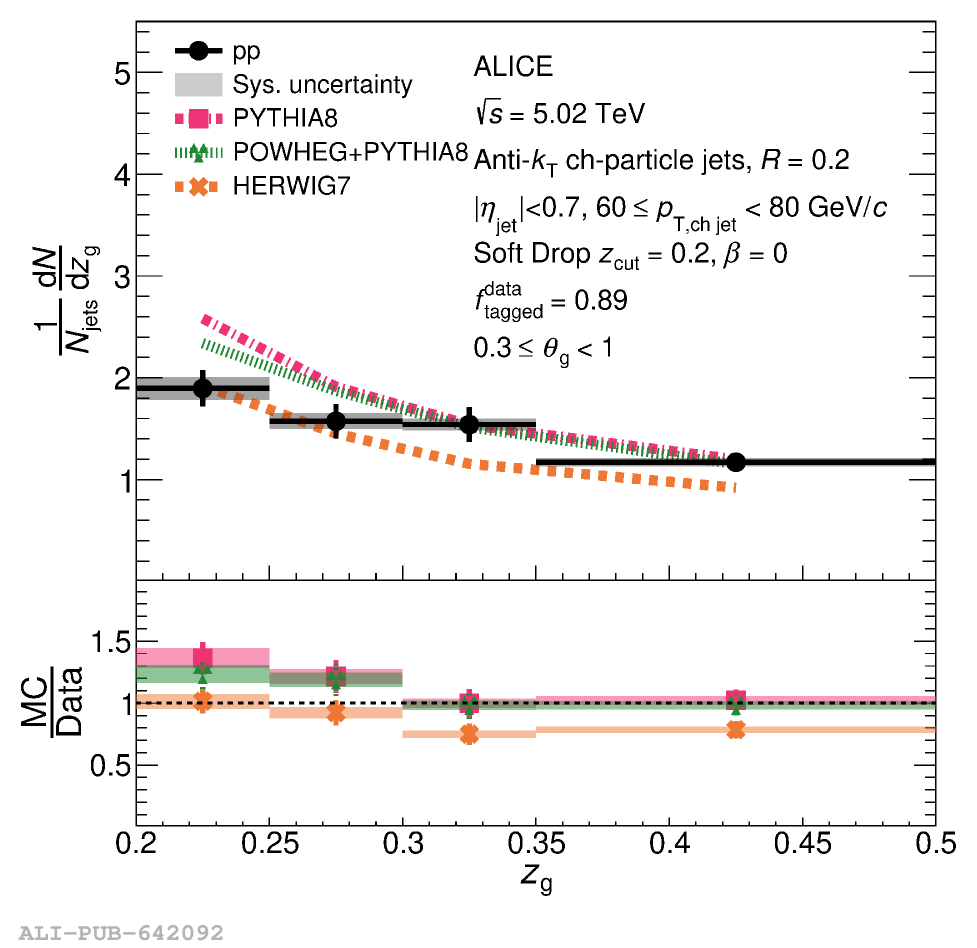
Figure 4
The distributions of \rg in \PbPb collisions at \fivenn for jets with $60 \leq $ \ptjetch $ 80$ \GeVc for selections of small and large \zg. The left panels show the \rg distribution for $0.2 \leq \zg 0.35$, and the right panels show \rg for $0.35 \leq \zg 0.5$. Top panels compare the \JEWEL and \JETSCAPE models and bottom panels present the different \Hybrid tunes. | 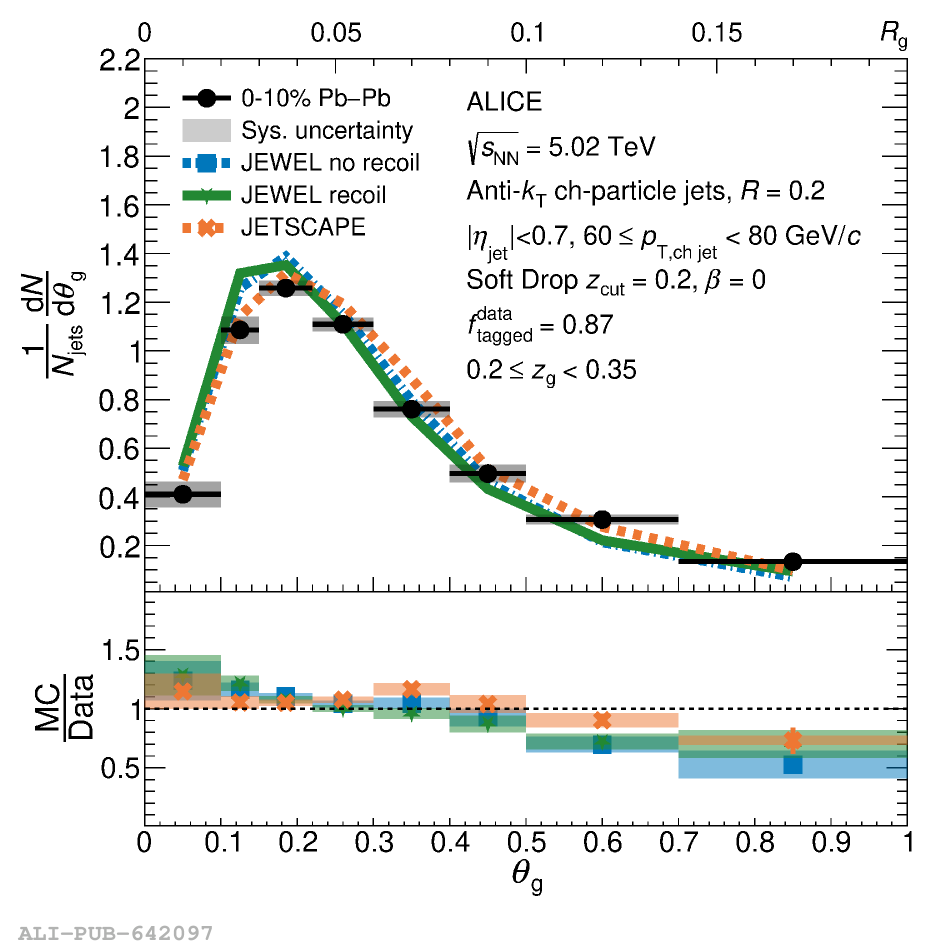 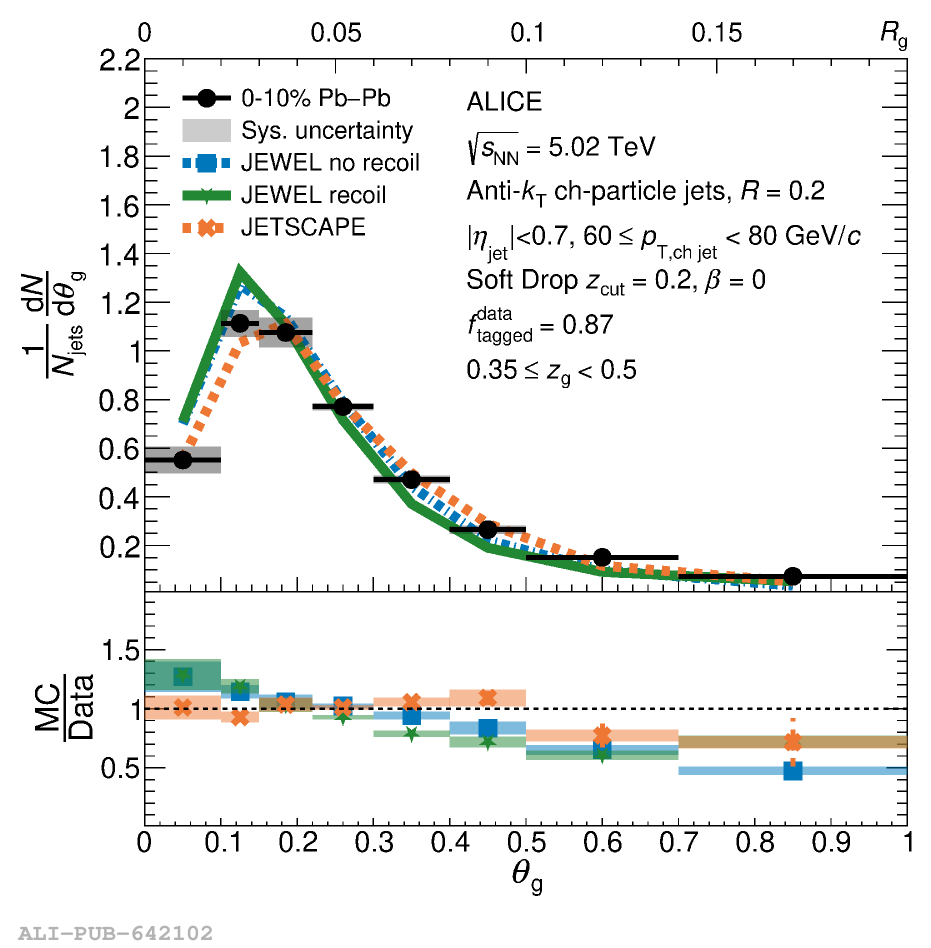 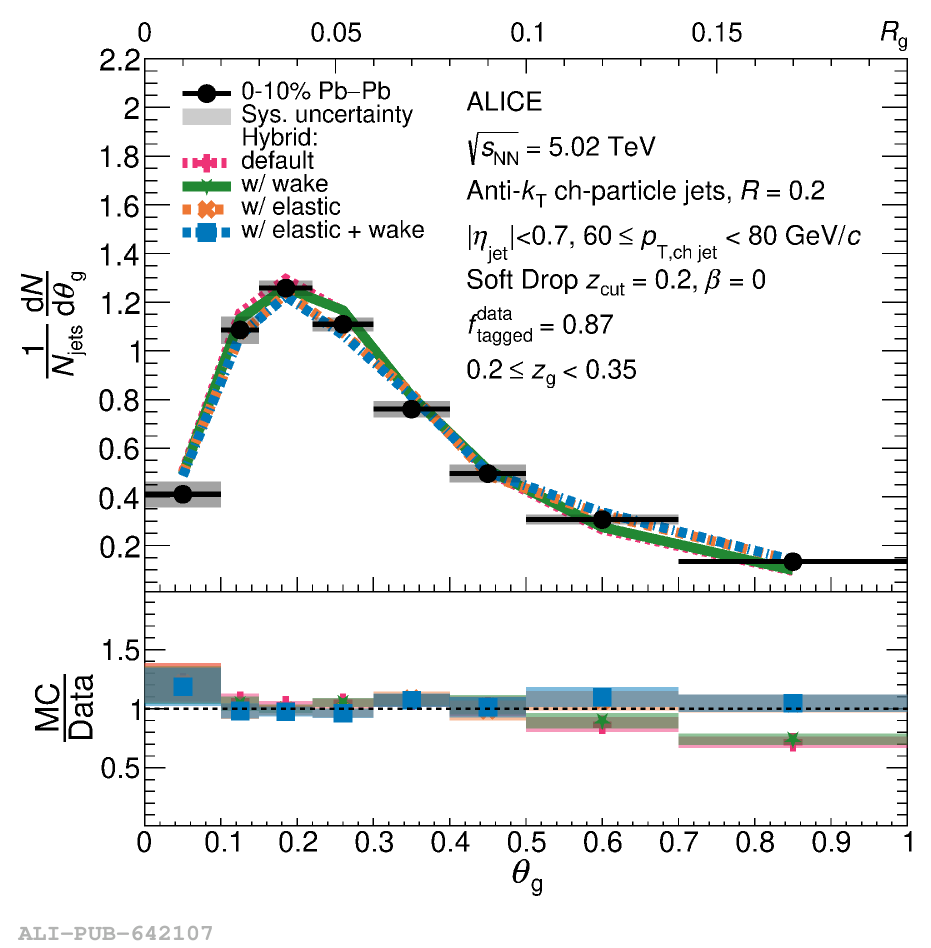 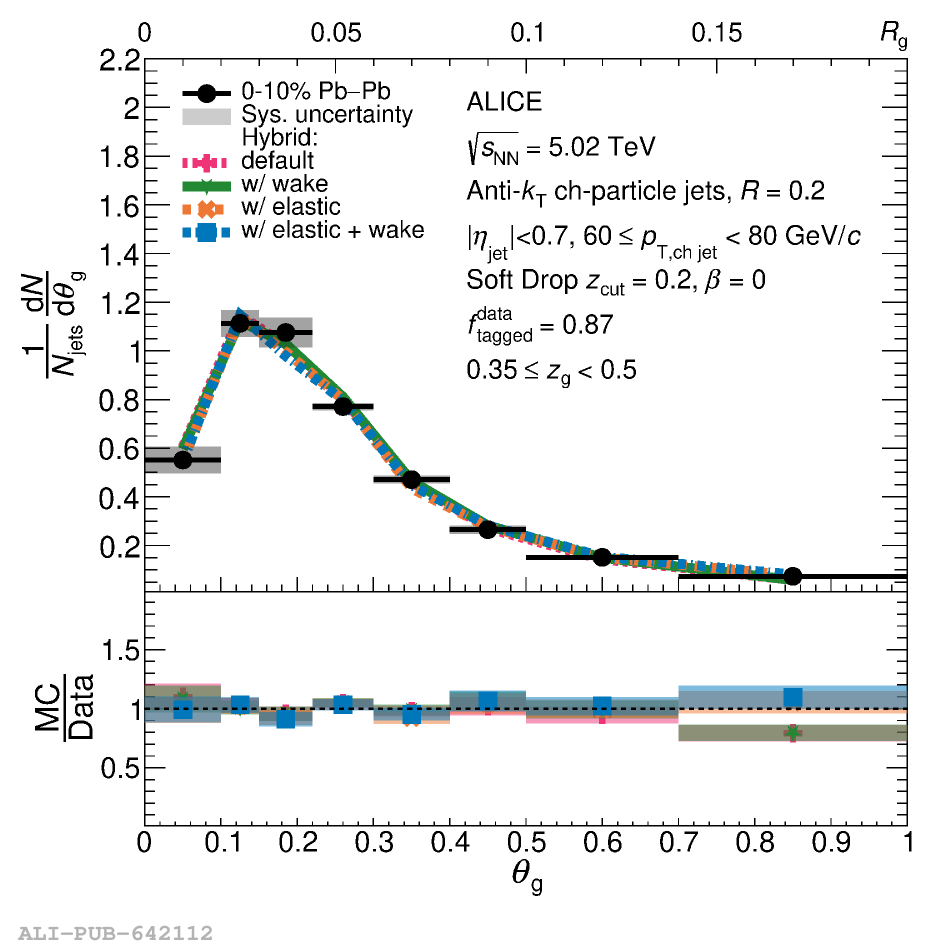 |
Figure 5
The distributions of \zg in \PbPb collisions at \fivenn for jets with $60 \leq $ \ptjetch $ 80$ \GeVc for selections of small and large \rg. The left panels show the \zg distribution for $0.0 \leq \rg 0.3$, and the right panels show \zg for $0.3 \leq \rg 1.0$. Top panels compare the \JEWEL and \JETSCAPE models and bottom panels present the different \Hybrid tunes. | 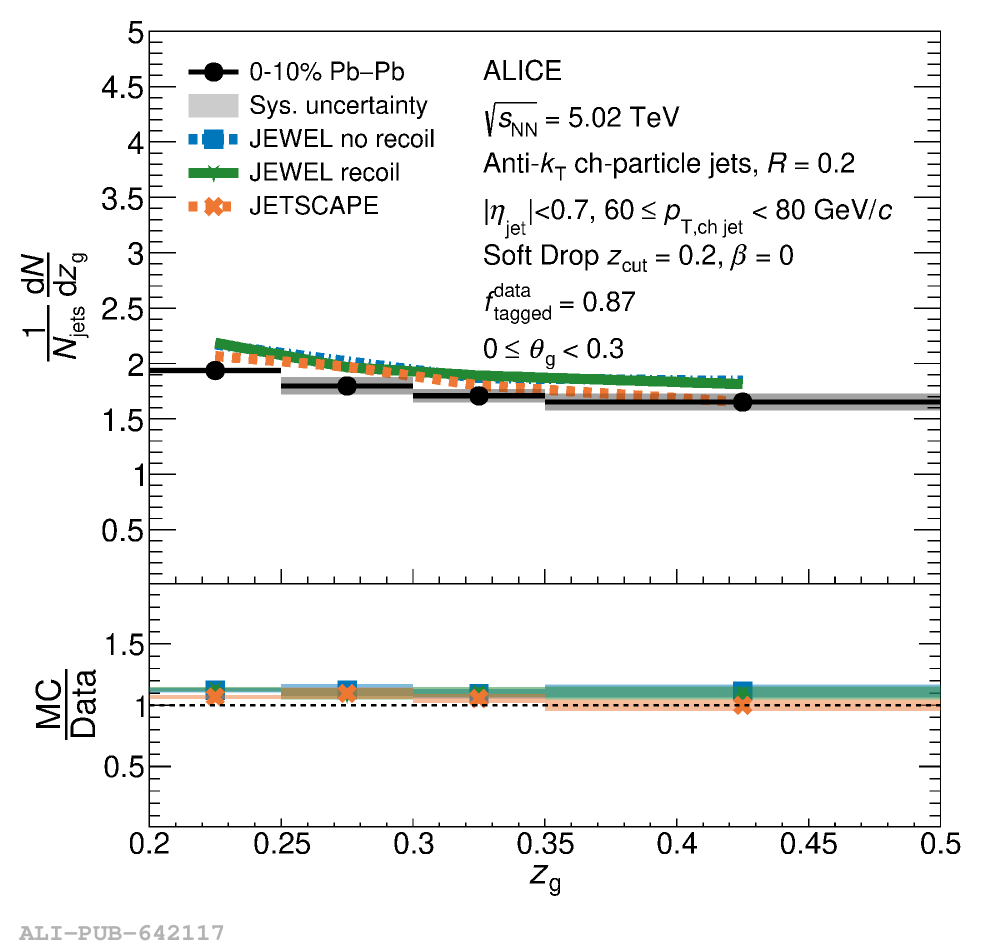  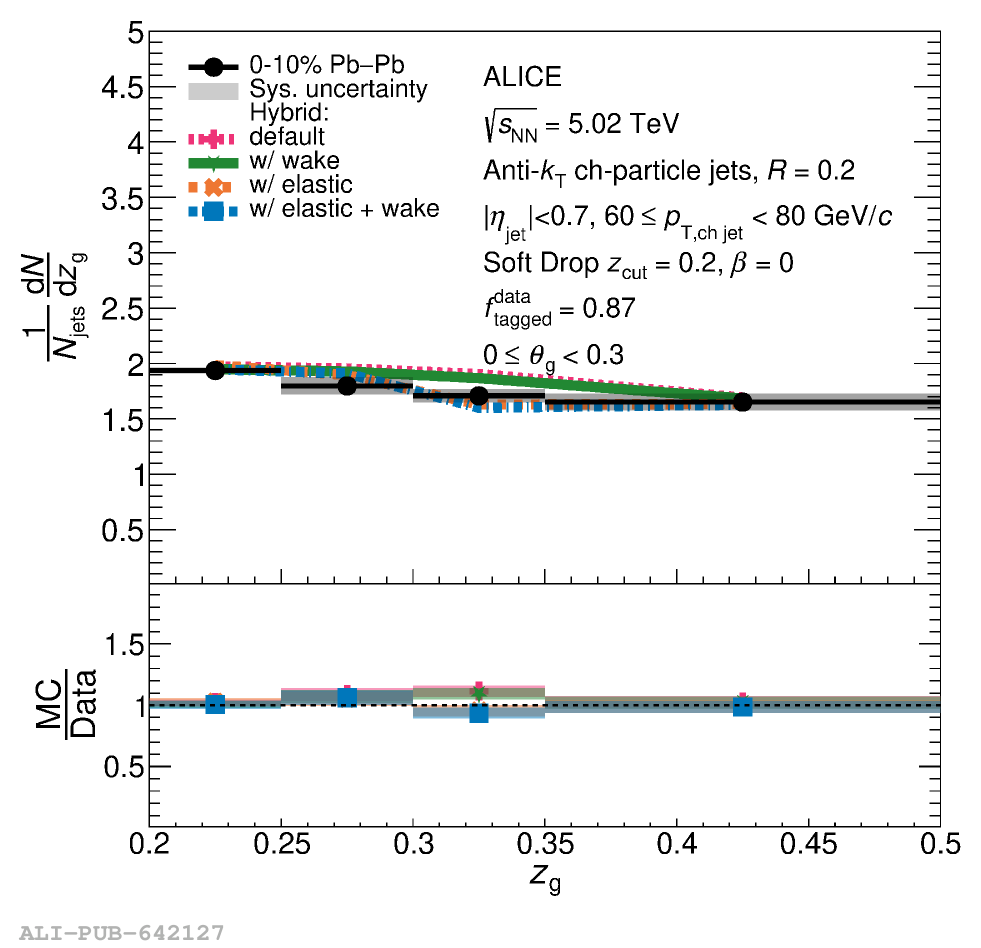 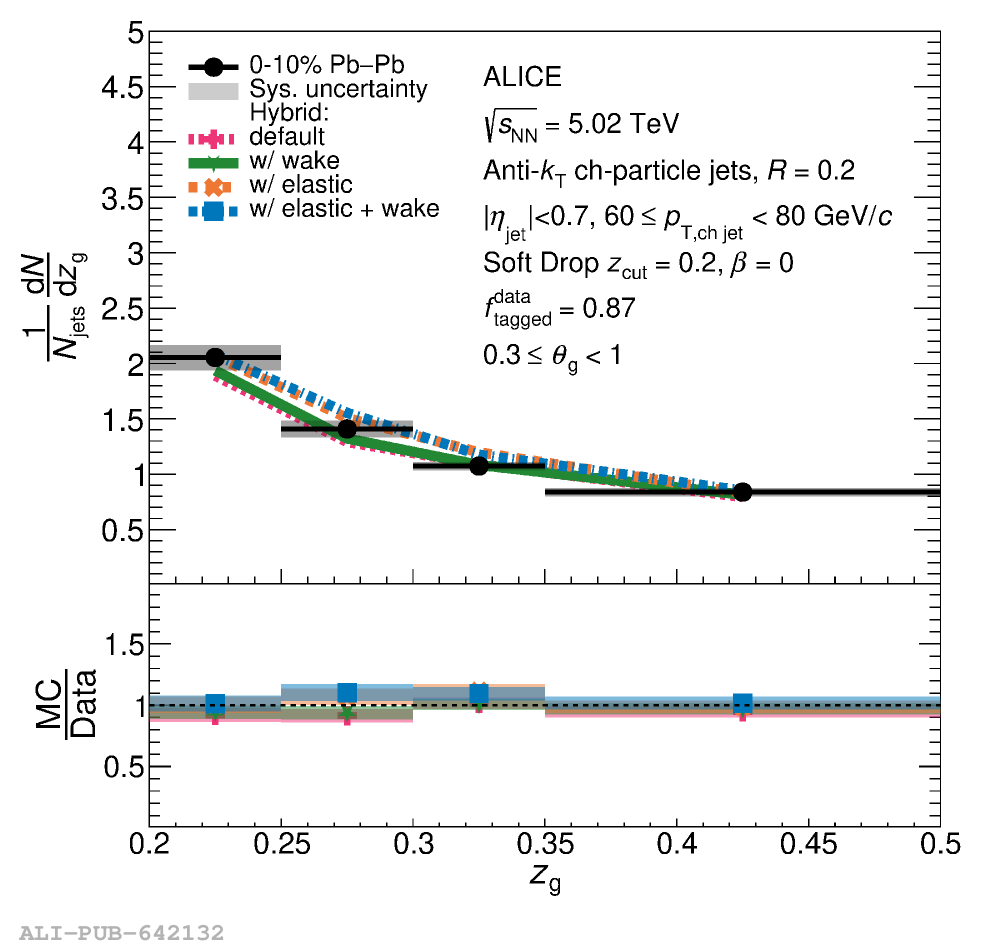 |
Figure 6
The distributions of \rg in \pp and \PbPb collisions at \fivenn for jets with $60 \leq $ \ptjetch $ 80$ \GeVc for selections of small and large \zg. The left panel shows the \rg distribution for $0.2 \leq \zg 0.35$, and the right panel shows \rg for $0.35 \leq \zg 0.5$. The bottom panels show the ratio of the measurement in \PbPb collisions to the measurement in \pp collisions. | 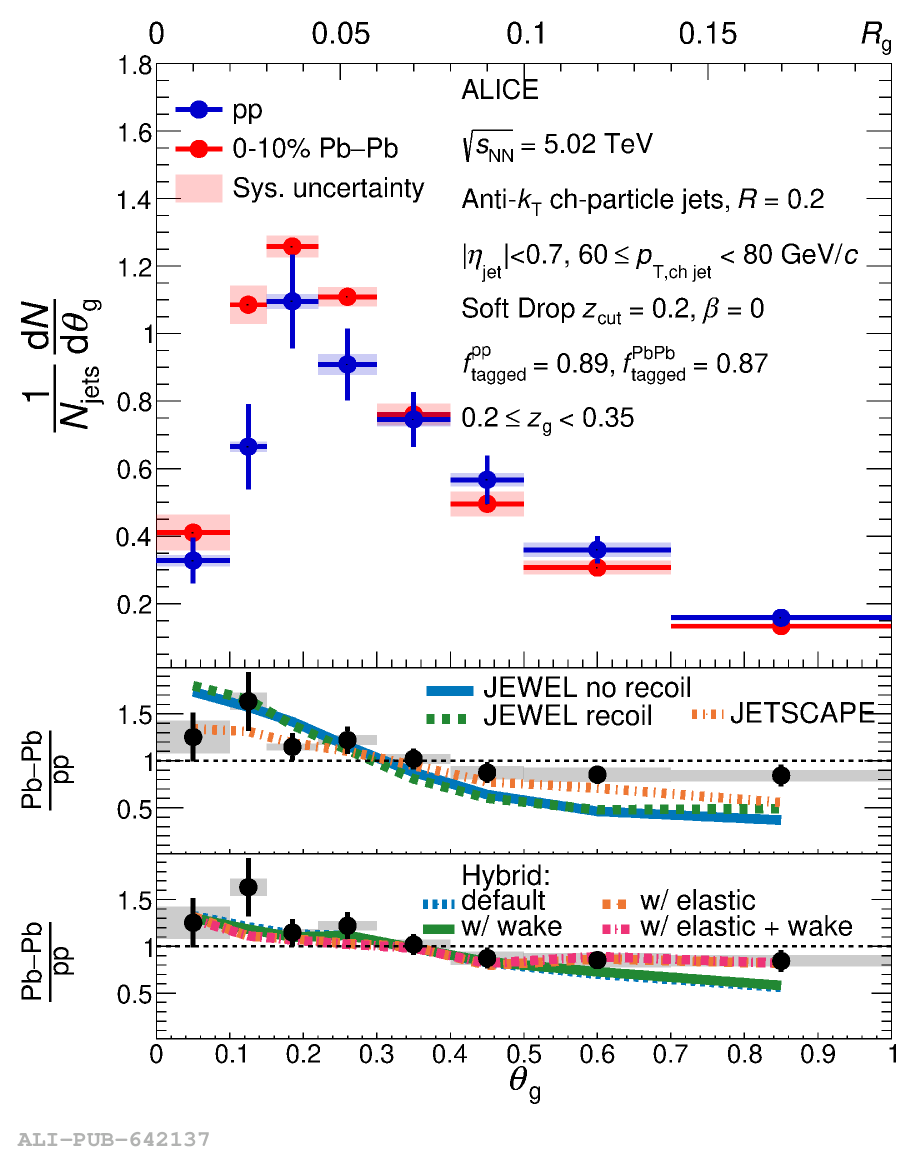 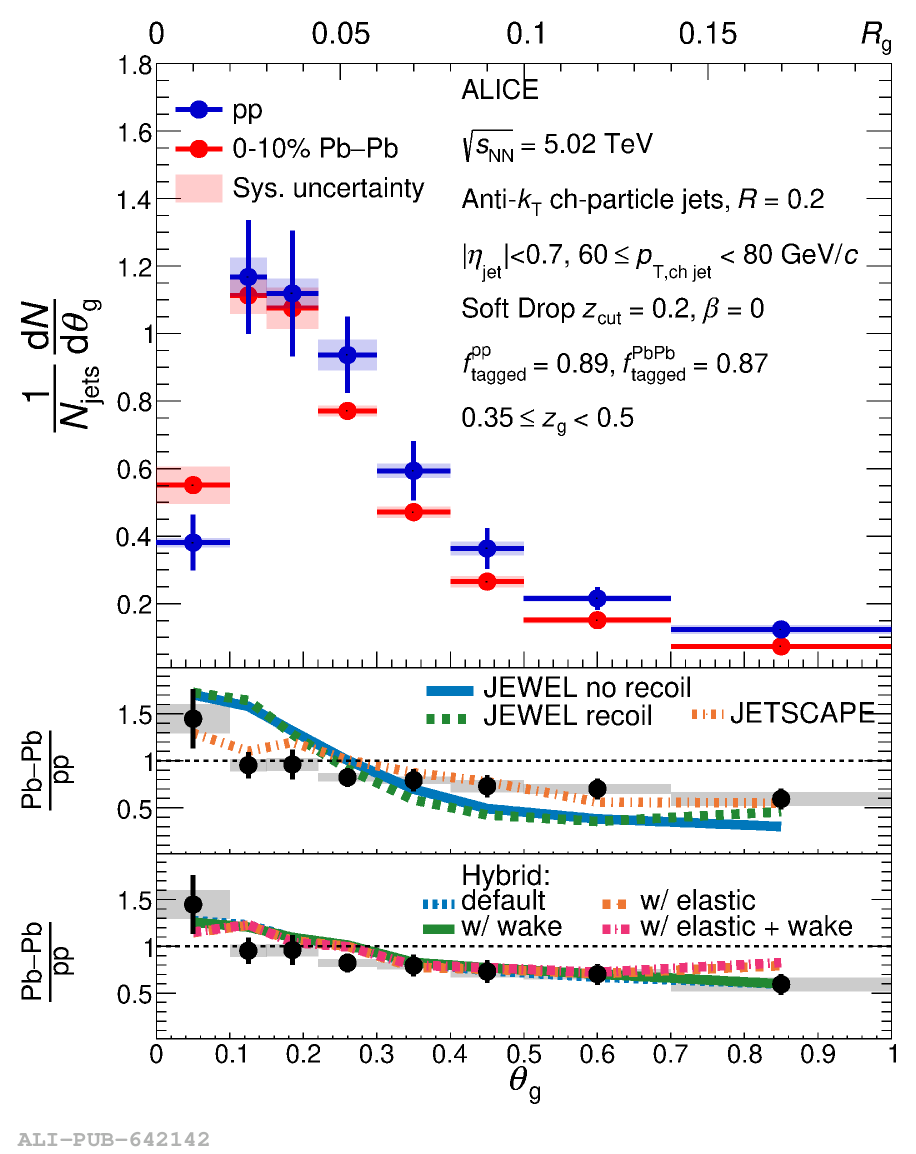 |
Figure 7
The measurement of \zg in \pp and \PbPb collisions at \fivenn for jets with $60 \leq $ \ptjetch $ 80$ \GeVc for selections of small and large \rg. The left panel shows the \zg distribution for $0.0 \leq \rg 0.3$, and the right panel shows \zg for $0.3 \leq \rg 1.0$. The bottom panels show the ratio of the measurement in \PbPb collisions to the measurement in \pp collisions. | 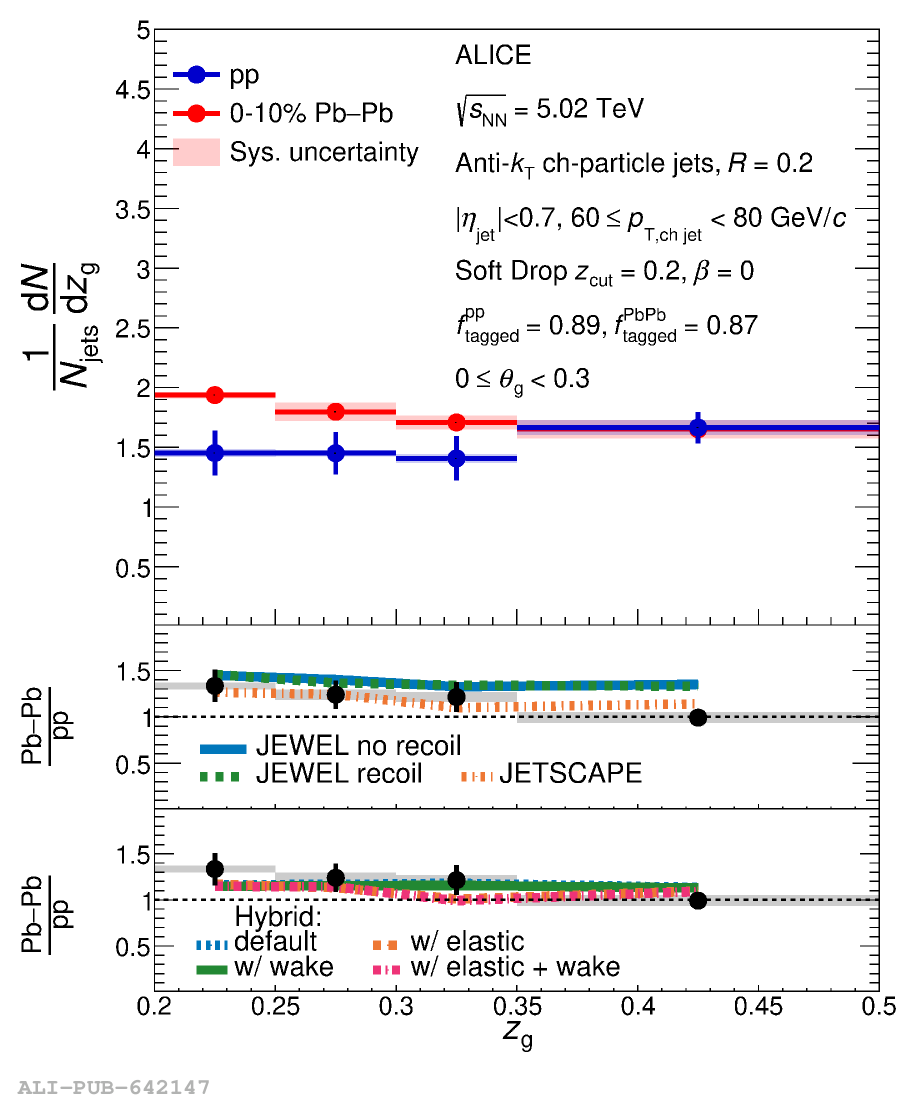 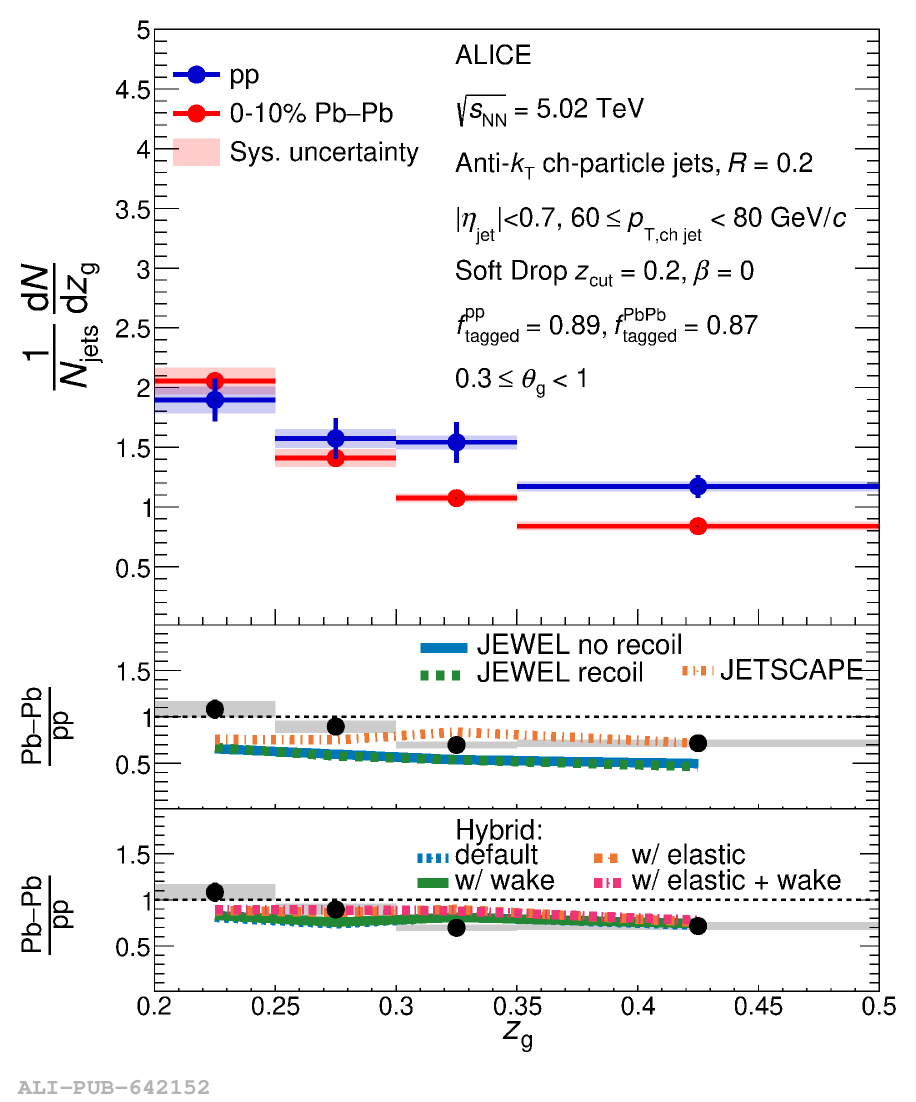 |
Figure A.1
The distributions of \rg in \pp collisions, compared to jet-quenching \pp baselines, at \five for jets with $60 \leq $ \ptjetch $ 80$ \GeVc, for selections of small and large \zg. The left panel shows the \rg distribution for $0.2 \leq \zg 0.35$, and the right panel shows \rg for $0.35 \leq \zg 0.5$. | 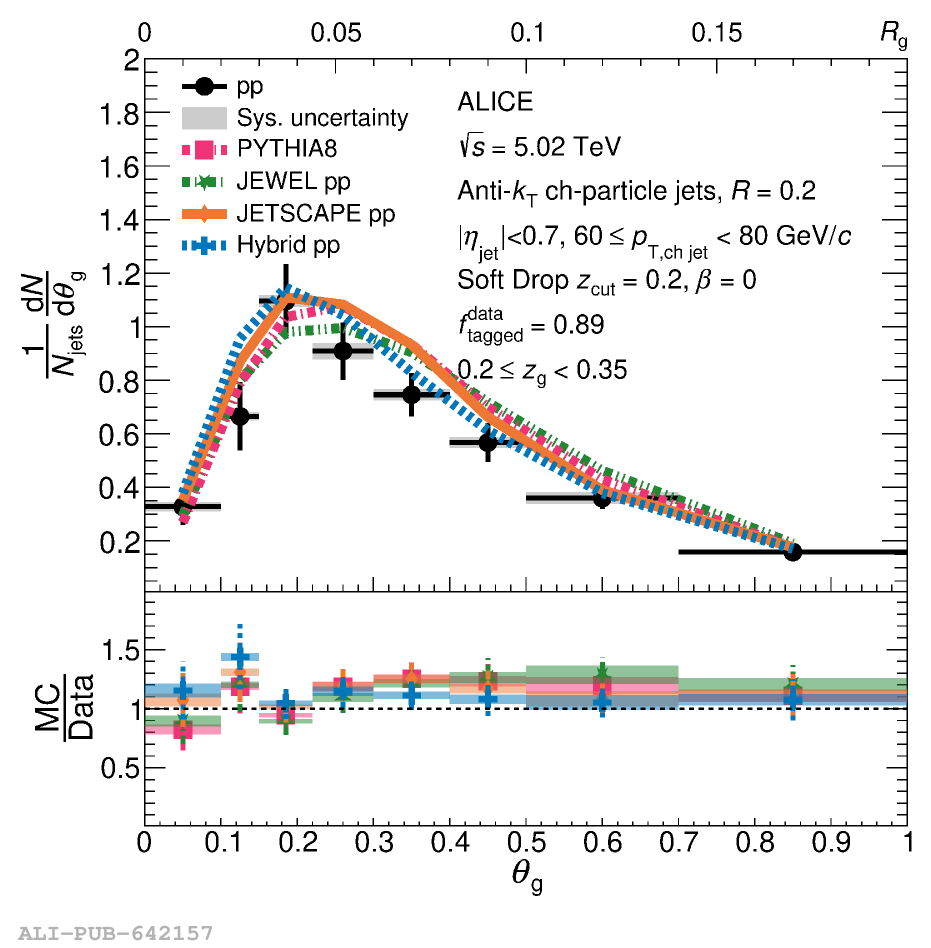 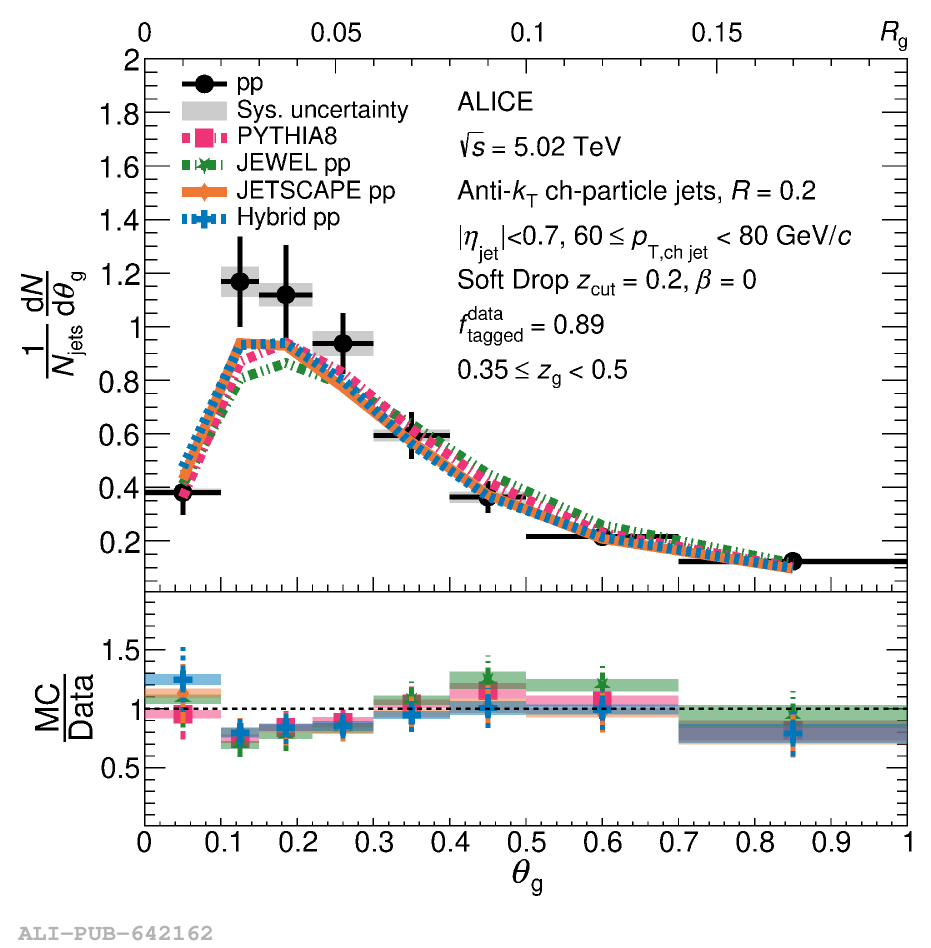 |
Figure A.2
The distributions of \zg in \pp collisions, compared to jet-quenching \pp baselines, at \five for jets with $60 \leq $ \ptjetch $ 80$ \GeVc, for selections of small and large \rg. The left panel shows the \zg distribution for $0.0 \leq \rg 0.3$, and the right panel shows \zg for $0.3 \leq \rg 1.0$. | 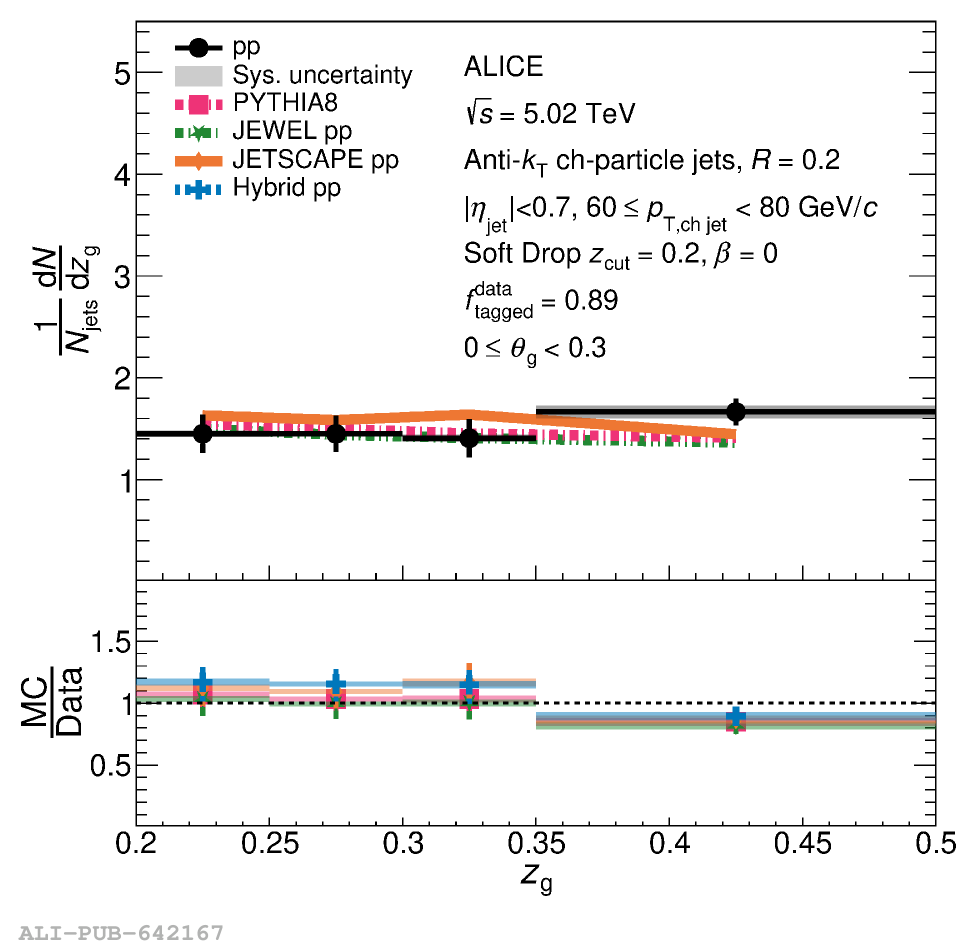 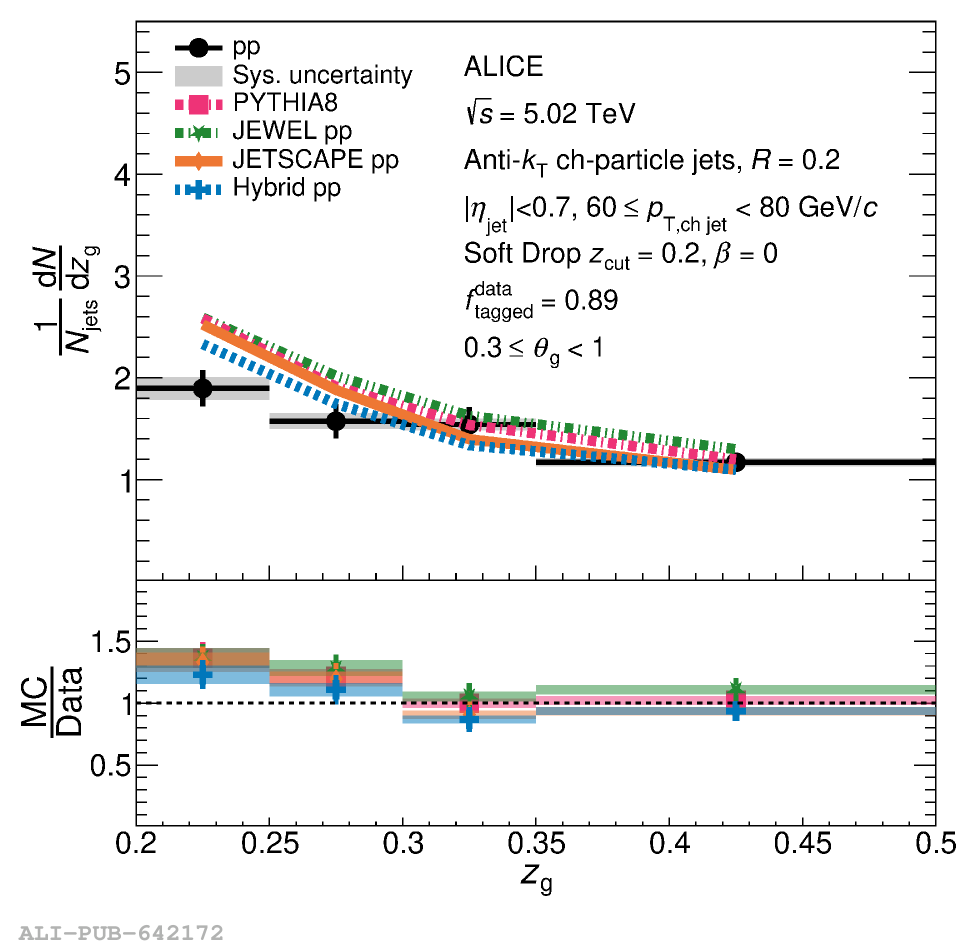 |
Figure A.3
The ratio of the \rg distributions for the low and high \zg selections for \pp and \PbPb collisions at \fivenn for jets with $60 \leq $ \ptjetch $ 80$ \GeVc. The ratios shows that in \PbPb collisions the high \zg selection has significantly narrower jets compared to \pp collisions. The dashed line in the bottom panel represents the ratio of the integral of the \PbPb collision distribution to the integral of the \pp collision distribution. | 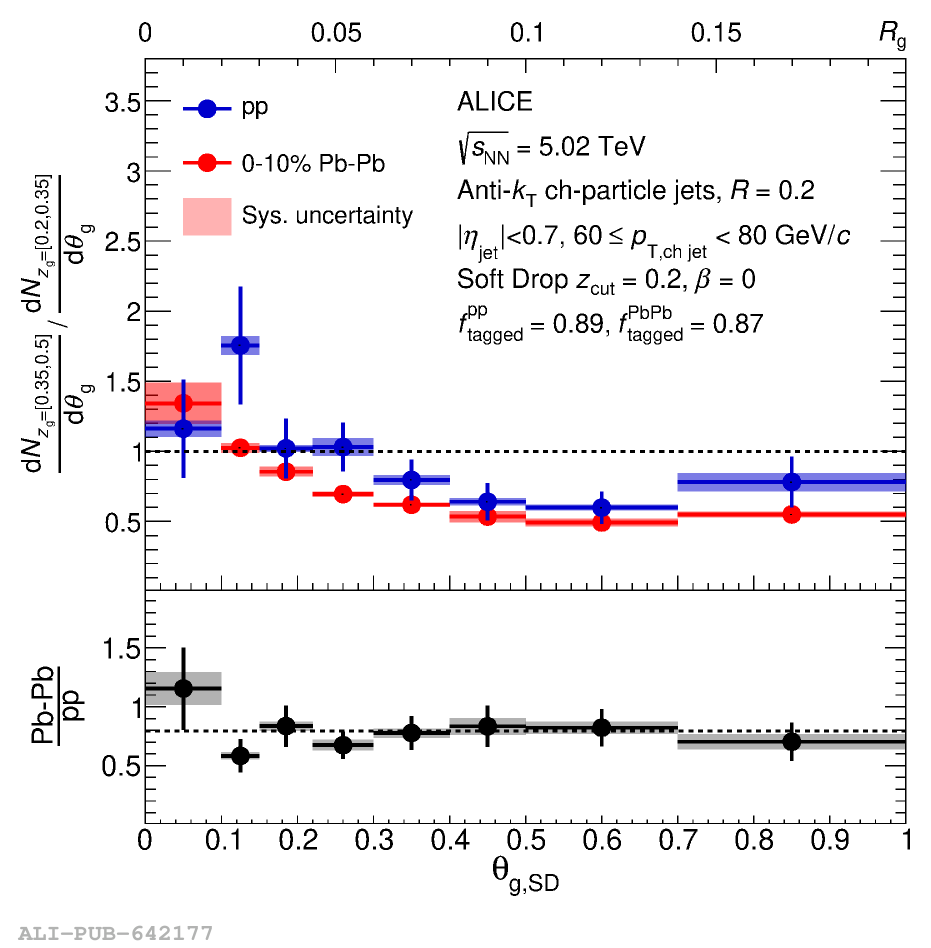 |