
The yields of prompt and non-prompt \jpsi and the fraction of non-prompt J/$ψ$ are measured at midrapidity ($|y|<~0.9$) via the dielectron decay channel as a function of the midrapidity charged-particle multiplicity ($|η|<~0.9$) in pp collisions at $\sqrt{s} = 13$ TeV. The J/$ψ$ yields and the multiplicity are normalized by their average value in inelastic collisions. The multiplicity-dependent yield ratio between prompt J/$ψ$ and D$^0$ is reported. The multiplicity is further divided into three azimuthal regions with respect to the J/$ψ$ momentum: toward the J/$ψ$ emission direction, transverse, or opposite to it. A stronger-than-linear increase of the self-normalized yields is observed for both prompt and non-prompt J/$ψ$ production, with similar trends. This behaviour is also observed in the toward region, while a weaker increase is observed in the transverse and away regions.
JHEP 07 (2026) 051
HEP Data
e-Print: arXiv:2604.07968 | PDF | inSPIRE
CERN-EP-2026-109
Figure group
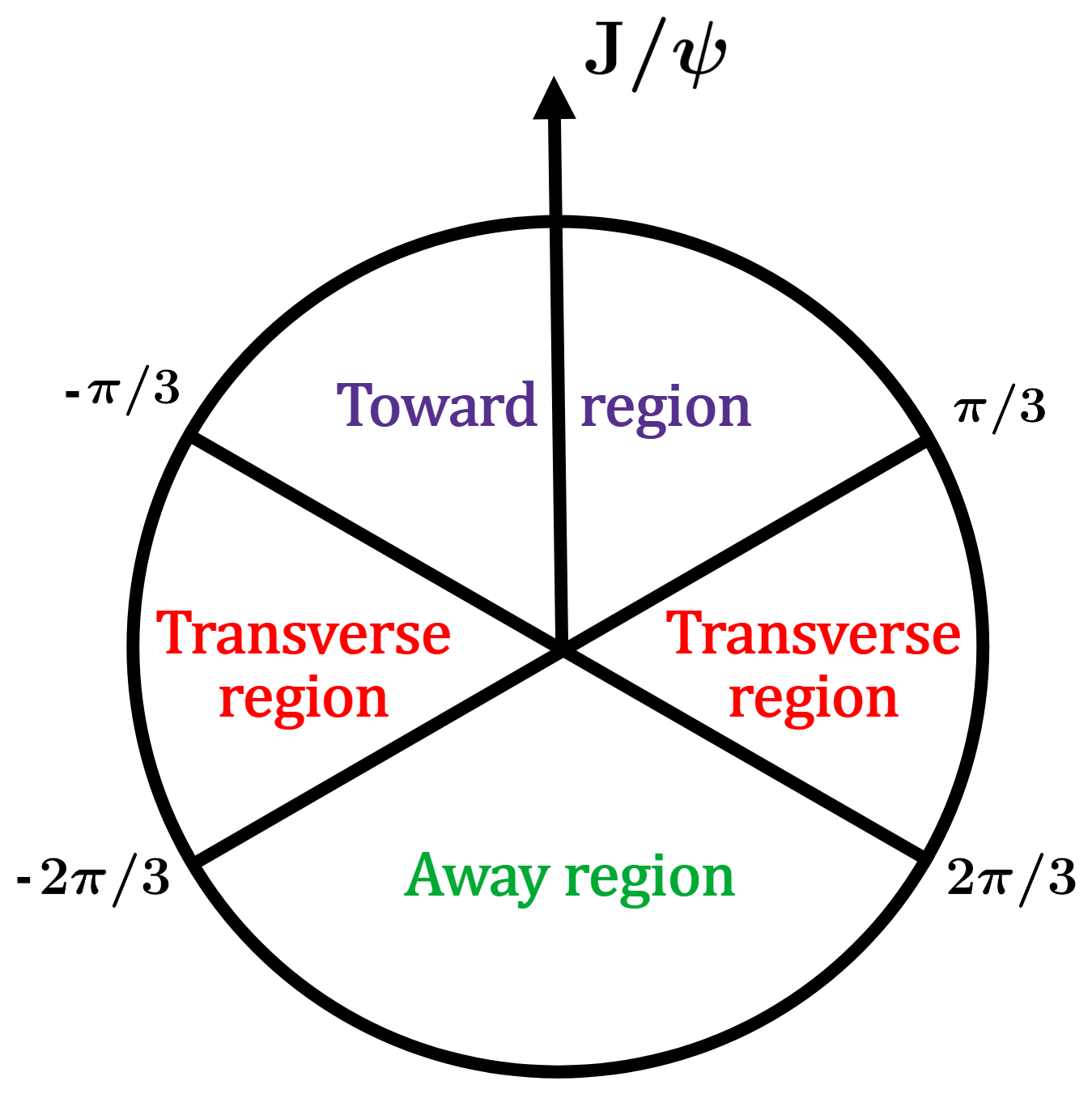
Figure 2
Raw inclusive \jpsi yield as a function of the selection on the BDT non-prompt output probability for $39\leq N_{\rm trks} < 46$, and $\pt >1$ GeV/$c$. The error bars indicate statistical uncertainties. The lines correspond to the prompt (dashed), non-prompt (dot-dashed) and total (continuous) \jpsi scaled efficiencies. See text for more details. | 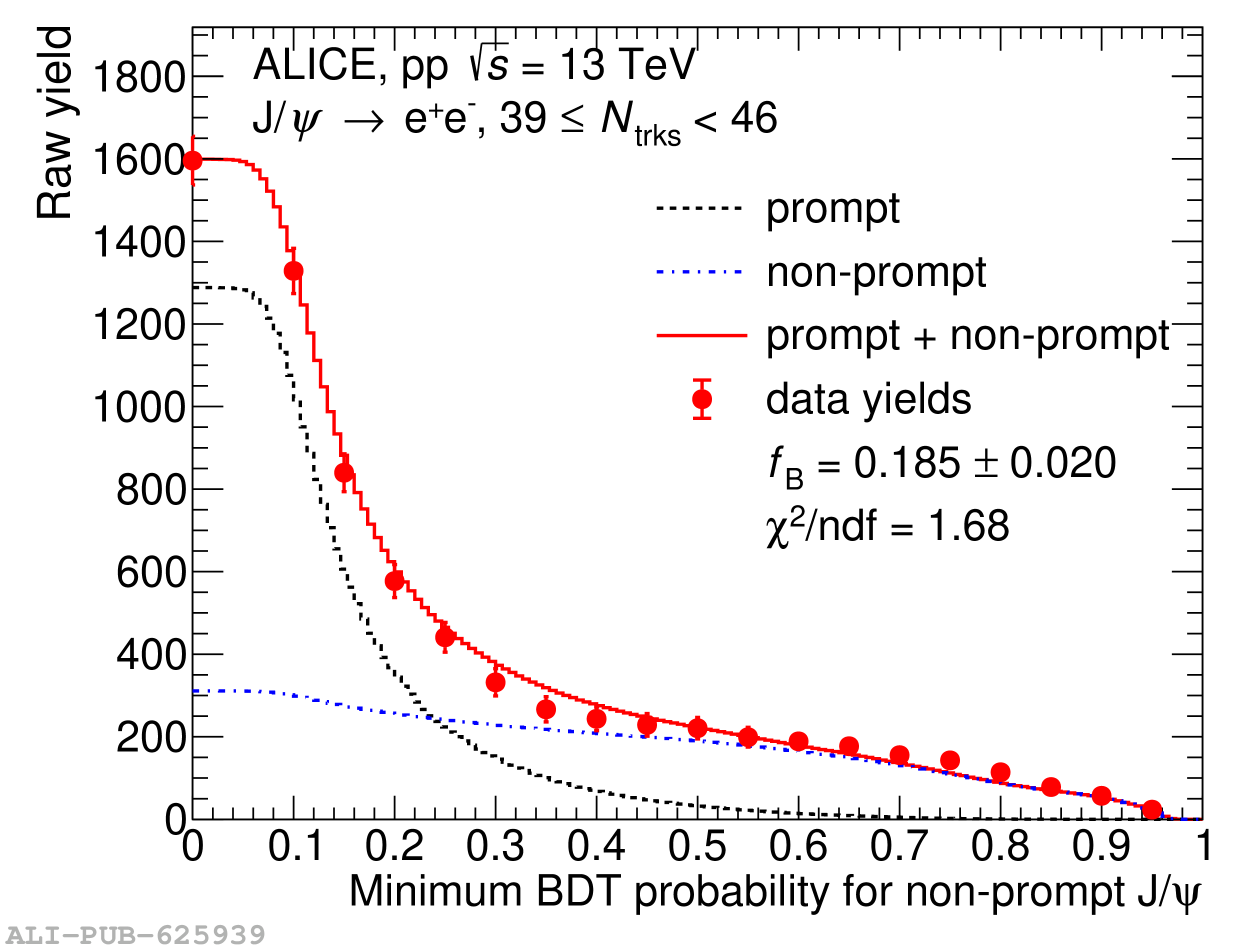 |
Figure 3
Fraction of non-prompt \jpsi mesons, $f_{\rm B}$, for $\pt>1$ \GeVc as a function of the self-normalized charged-particle multiplicity measured within $|\eta| < 0.9$ for the INEL$>$0 (full markers) and V0M 0--0.1\% (open markers) event classes. The vertical bars and boxes indicate the statistical and systematic uncertainties, respectively. The results are compared to PYTHIA 8 simulations using different tunes, as indicated by the legend . The PYTHIA calculations emulating the V0M 0--0.1\% class (0.1\% highest multiplicity events in the V0 acceptance) are shown as hashed lines. | 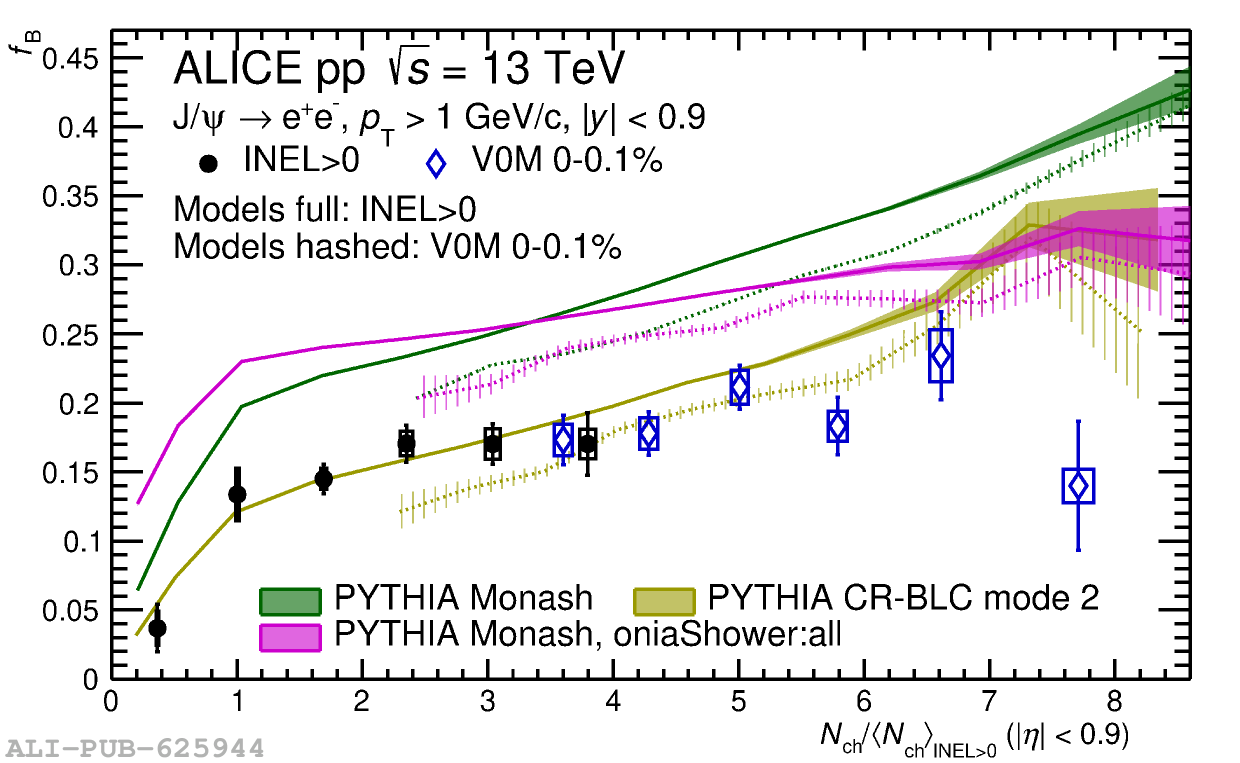 |
Figure 4
Self-normalized prompt (left) and non-prompt (right) \jpsi yields with $\pt>1$ \GeVc as a function of self-normalized charged-particle multiplicity at midrapidity. The data are shown separately for the INEL$>$0 and V0M 0--0.1\% event classes. The yields are compared to PYTHIA 8 using different settings , as well as EPOS4 and the 3-Pomeron CGC model . Lower panels show the ratios to the expectation from a linear increase. The vertical bars and boxes indicate the statistical and systematic uncertainties, respectively. | 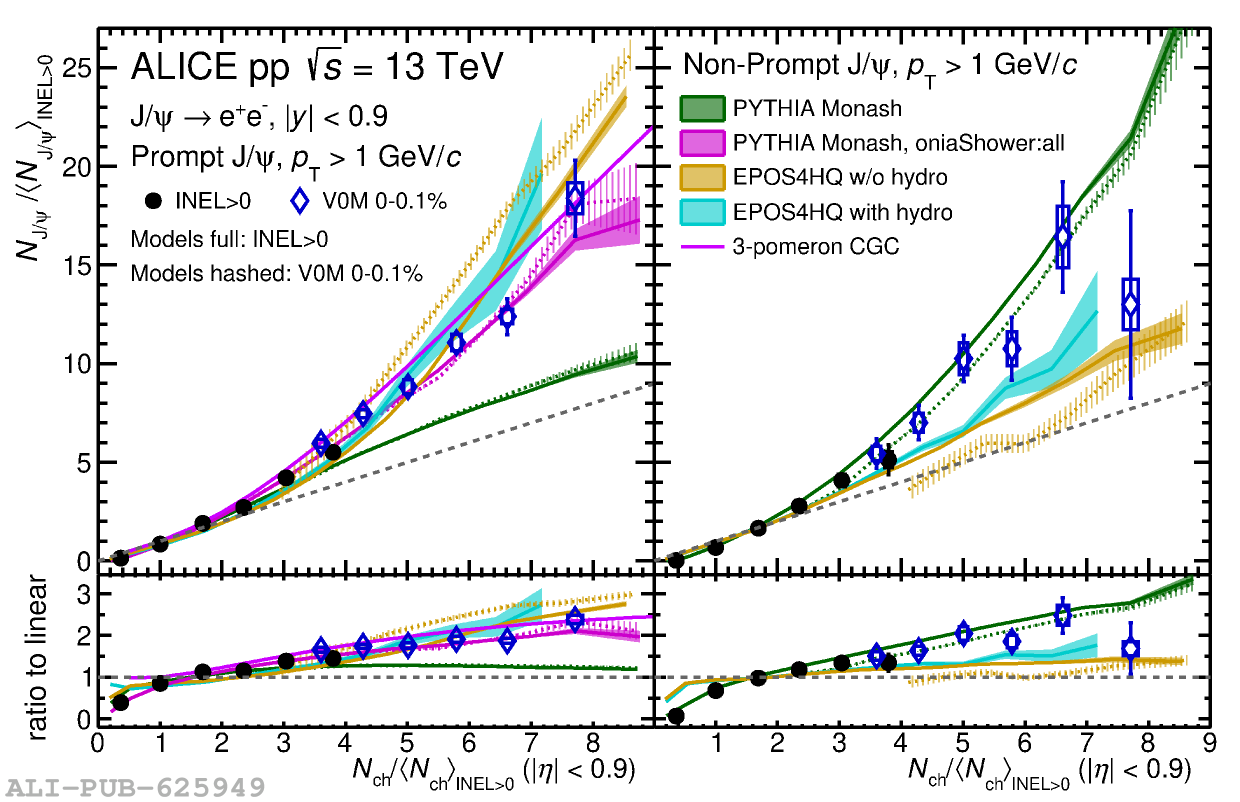 |
Figure 5
Prompt \jpsi yield for $1 < \pt < 4$ \GeVc (left), $4 < \pt < 8$ \GeVc (middle) and $\pt>8$ \GeVc (right) as a function of self-normalized charged-particle multiplicity within $|\eta|< 0.9$ for the INEL$>$0 and V0M 0--0.1\% event classes. The data are compared to PYTHIA 8 using different settings , as well as EPOS4HQ , the 3-Pomeron CGC model and the CGC+ICEM model . Lower panels show the ratios to the expectation from a linear increase. The vertical bars and boxes indicate the statistical and systematic uncertainties, respectively. | 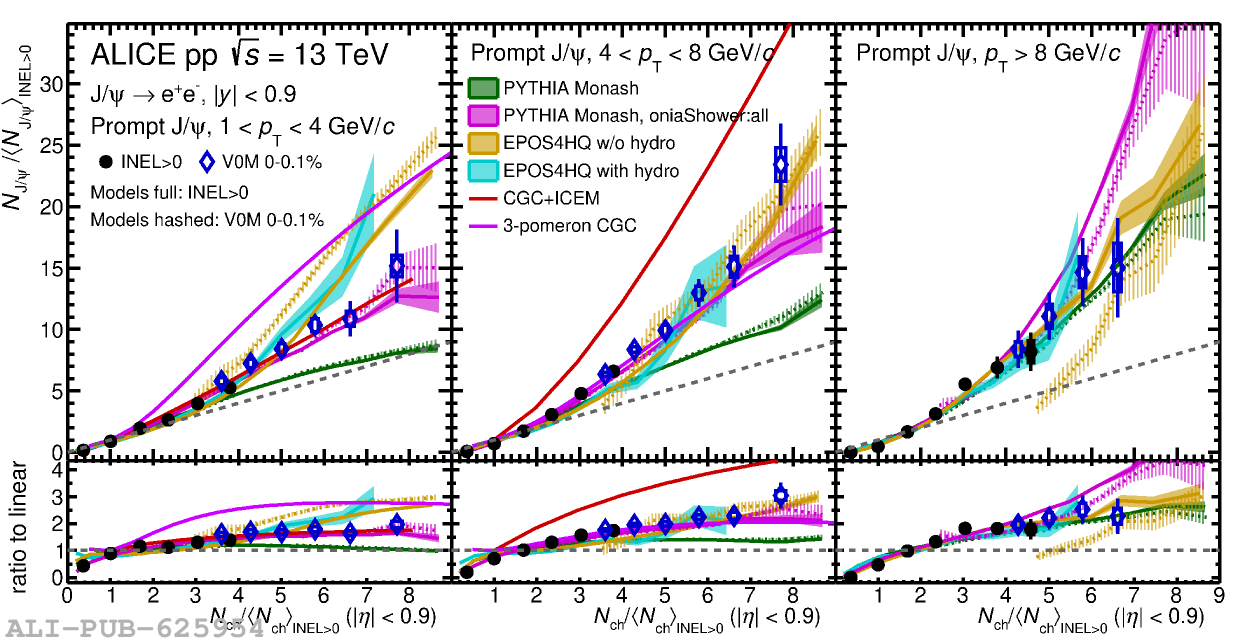 |
Figure 6
Non-prompt \jpsi yield for $1 < \pt < 4$ \GeVc (left), $4 < \pt < 8$ \GeVc (middle) and $\pt>8$ \GeVc (right) as a function of self-normalized charged-particle multiplicity within $|\eta| < 0.9$ for the INEL$>$0 and V0M 0--0.1\% event classes. The data are compared to PYTHIA 8 using different settings , as well as EPOS4HQ with and without hydrodynamics activated . Lower panels show the ratios to the expectation from a linear increase. The vertical bars and boxes indicate the statistical and systematic uncertainties, respectively. | 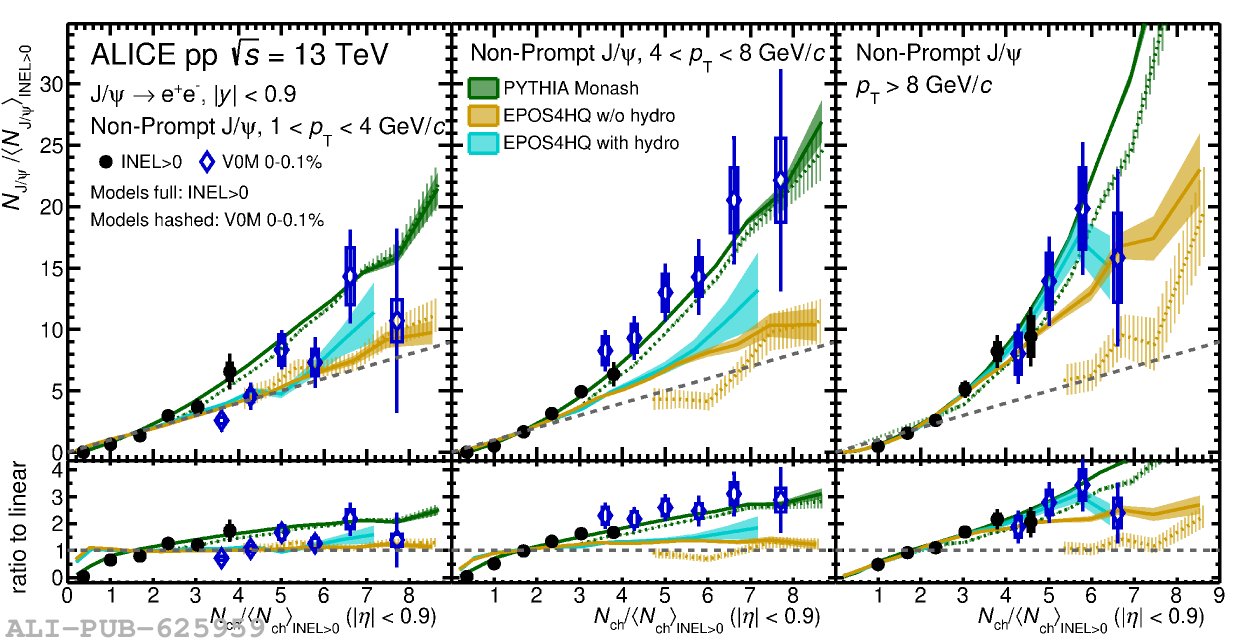 |
Figure 7
The fractions of \jpsi mesons from beauty feed-down with $\pt>1$ \GeVc as a function of the self-normalized charged-particle multiplicity in $|\eta|< 0.9$ in the toward (top-left), transverse (top-right), and away (bottom left) azimuthal regions with respect to the \jpsi momentum direction. The data are shown separately for the INEL$>$0 and V0M 0--0.1\% event classes and are compared to results from PYTHIA 8 simulations using different settings . The vertical bars and boxes indicate the statistical and systematic uncertainties, respectively. | 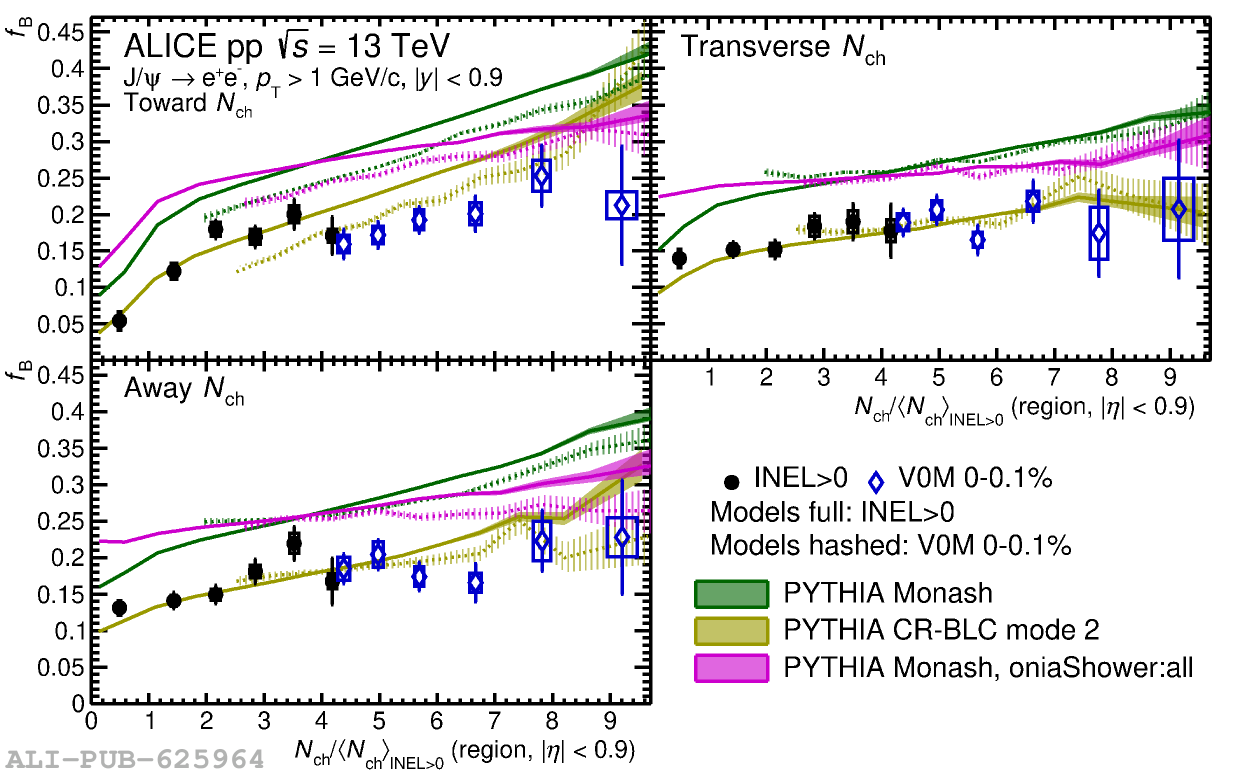 |
Figure 8
Self-normalized prompt \jpsi yields with $\pt>1$ \GeVc as a function of the self-normalized charged-particle multiplicity in $|\eta|< 0.9$ measured in the toward (left), transverse (middle), and away (right) azimuthal regions with respect to the \jpsi momentum direction. The data are shown separately for the INEL$>$0 and V0M 0--0.1\% event classes and are compared to PYTHIA 8 simulations using different settings , as well as EPOS4HQ with and without hydrodynamics activated . The lower panels show the ratios to the expectation from a linear increase. The vertical bars and boxes indicate the statistical and systematic uncertainties, respectively. | 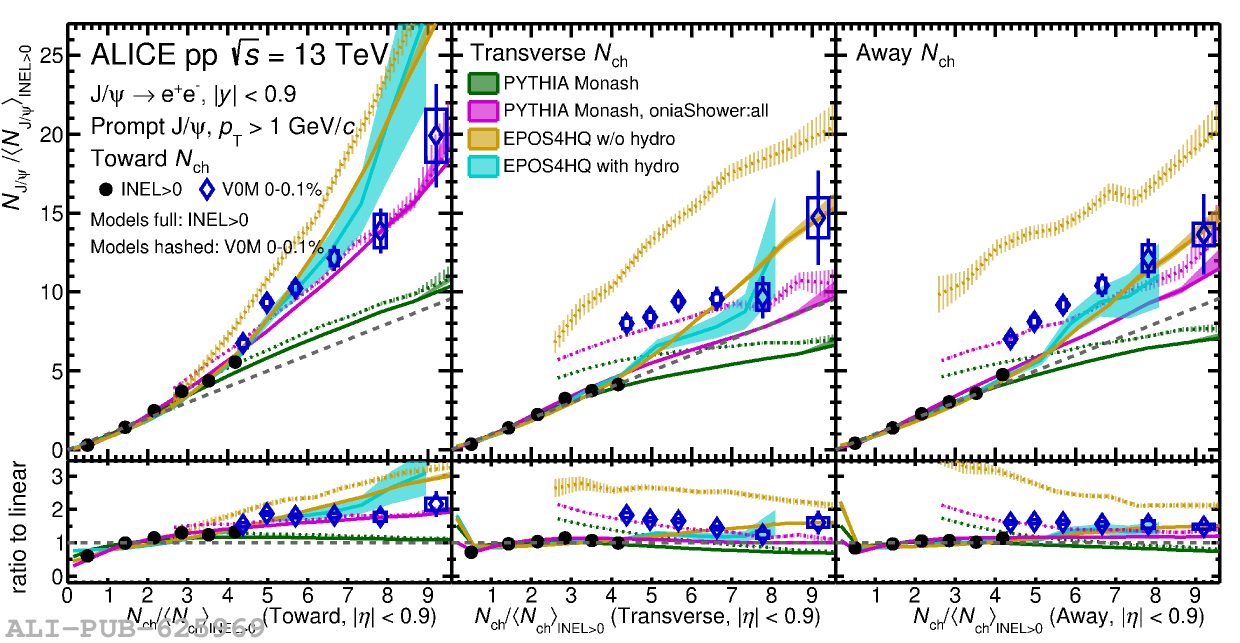 |
Figure 9
Self-normalized non-prompt \jpsi yields with $\pt>1$ \GeVc as a function of the self-normalized charged-particle multiplicity in $|\eta|< 0.9$ measured in the toward (left), transverse (middle), and away (right) azimuthal regions with respect to the \jpsi momentum direction. The data are shown separately for the INEL$>$0 and V0M 0--0.1\% event classes and are compared to PYTHIA 8 simulations using different settings , as well as EPOS4HQ with and without hydrodynamics activated . Lower panels show the ratios to the expectation from a linear increase. The vertical bars and boxes indicate the statistical and systematic uncertainties, respectively. | 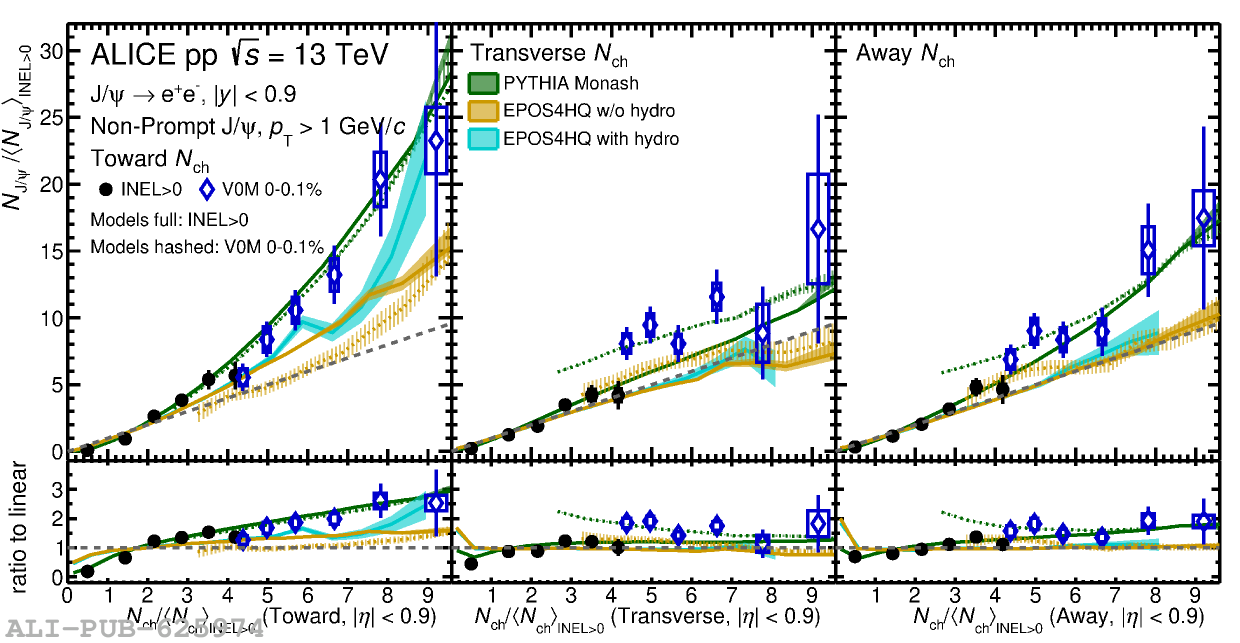 |
Figure 10
Self-normalized prompt \jpsi yields in the \pt intervals $1< \pt < 4$ \GeVc (left column), $4< \pt < 8$ \GeVc (middle column), and $\pt>8$ \GeVc (right column) as a function of the self-normalized charged-particle multiplicity in $|\eta|< 0.9$ measured in toward (top row), transverse (middle row), and away (bottom row) azimuthal regions with respect to the \jpsi momentum direction. The data are shown separately for the INEL$>$0 and V0M 0--0.1\% event classes and are compared to PYTHIA 8 simulations using different settings , as well as EPOS4HQ with and without hydrodynamics activated . The dashed grey lines represent a linear increase with slope 1. The vertical bars and boxes indicate the statistical and systematic uncertainties, respectively. | 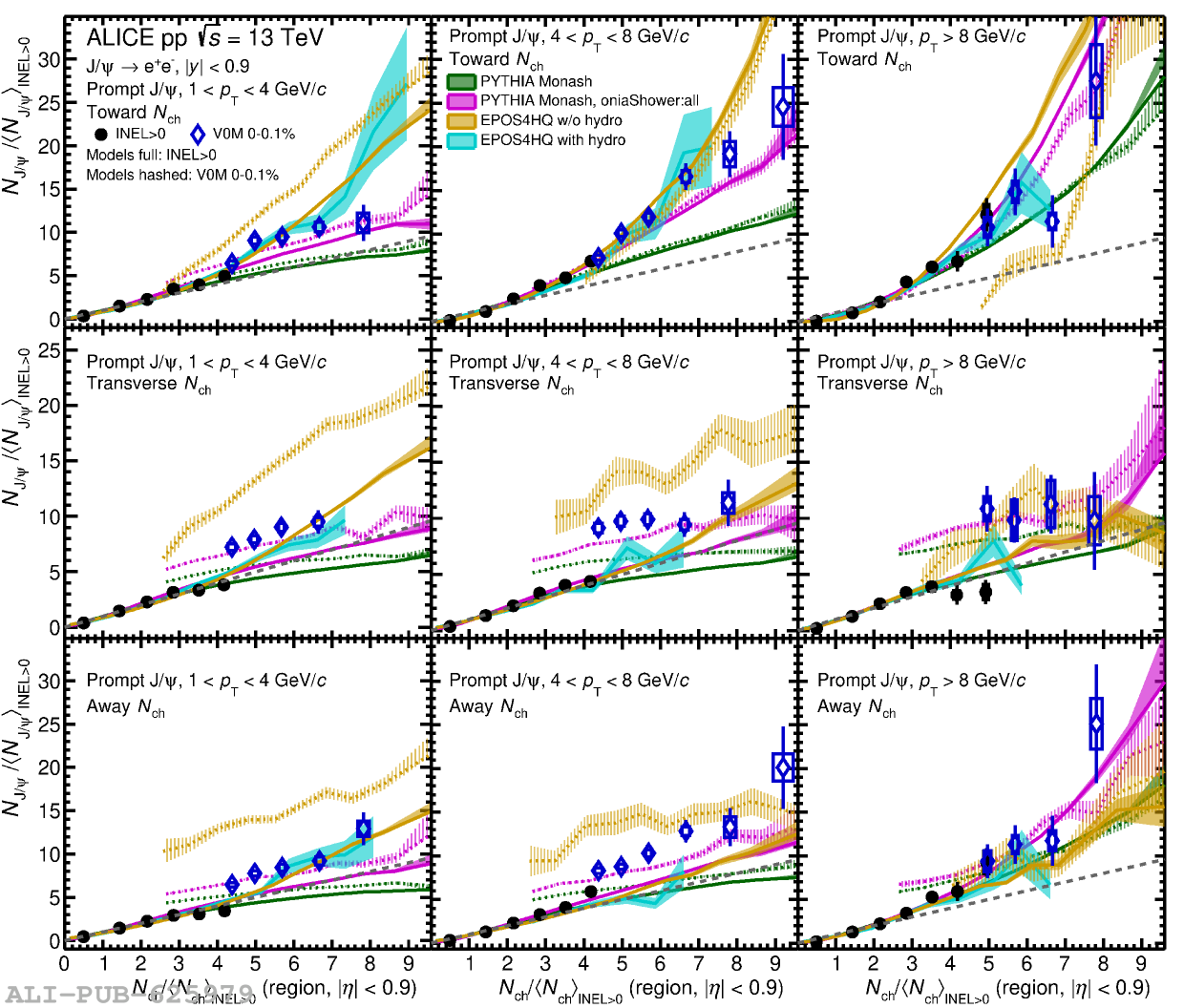 |
Figure 11
Self-normalized non-prompt \jpsi yields in the \pt intervals $1 < \pt < 4$ \GeVc (left column), $4 < \pt < 8$ \GeVc (middle column), and $\pt>8$ \GeVc (right column) as a function of the self-normalized charged-particle multiplicity in $|\eta|< 0.9$ measured in toward (top row), transverse (middle row), and away (bottom row) azimuthal regions with respect to the \jpsi momentum direction. The data are shown separately for the INEL$>$0 and V0M 0--0.1\% event classes and are compared to PYTHIA 8 simulations using different settings , as well as EPOS4HQ with and without hydrodynamics activated . The dashed grey lines represent a linear increase with slope 1. The vertical bars and boxes indicate the statistical and systematic uncertainties, respectively. | 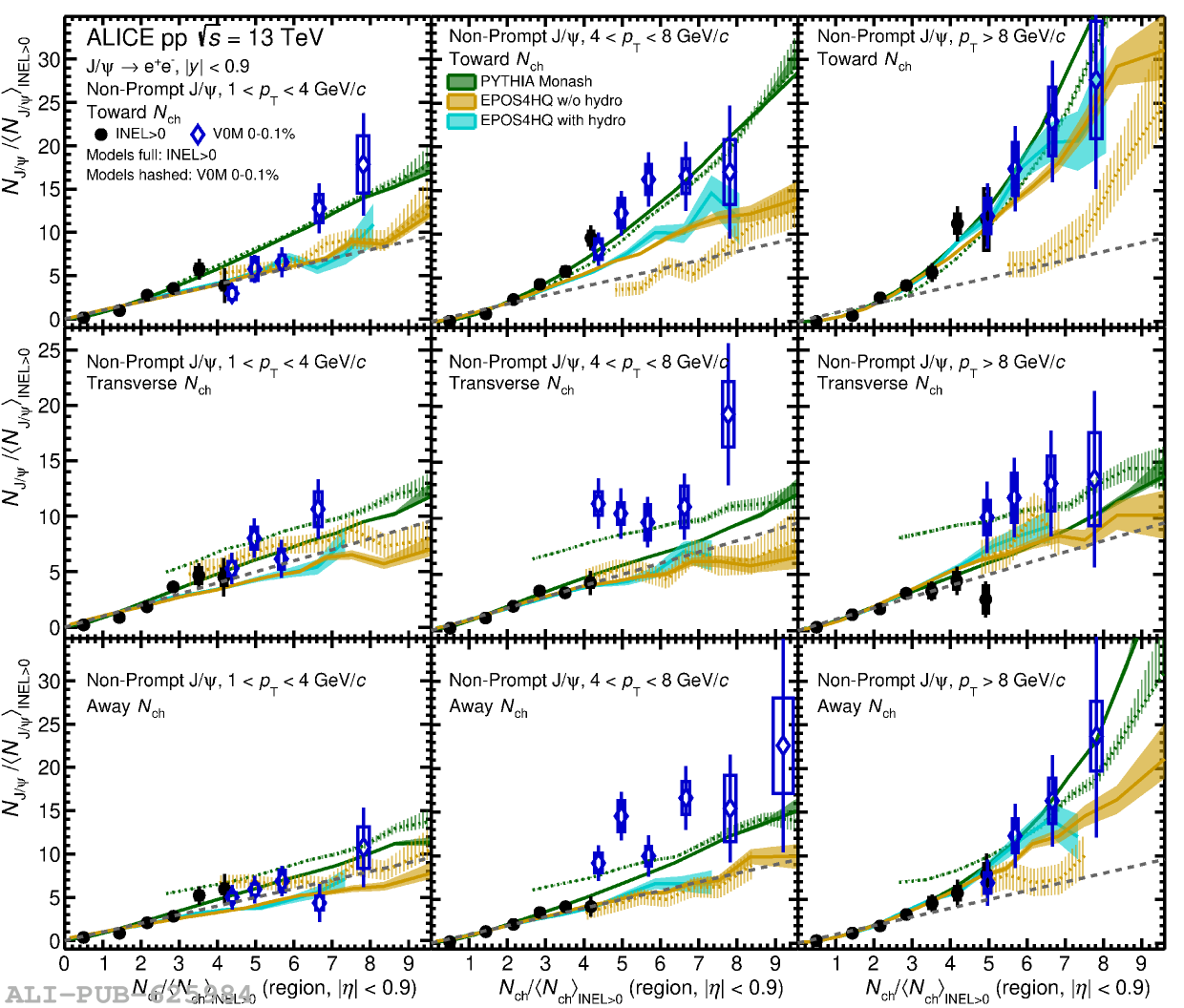 |
Figure 12
Ratio between the \pt-integrated prompt \jpsi and prompt D$^0$ yields as a function of charged-particle multiplicity within $|\eta|< 0.5$ in several collision systems . This is compared to the prediction from the Statistical Hadronization Model (SHMc) . The vertical bars, empty and shaded boxes indicate the statistical, systematic and extrapolation uncertainties, respectively. | 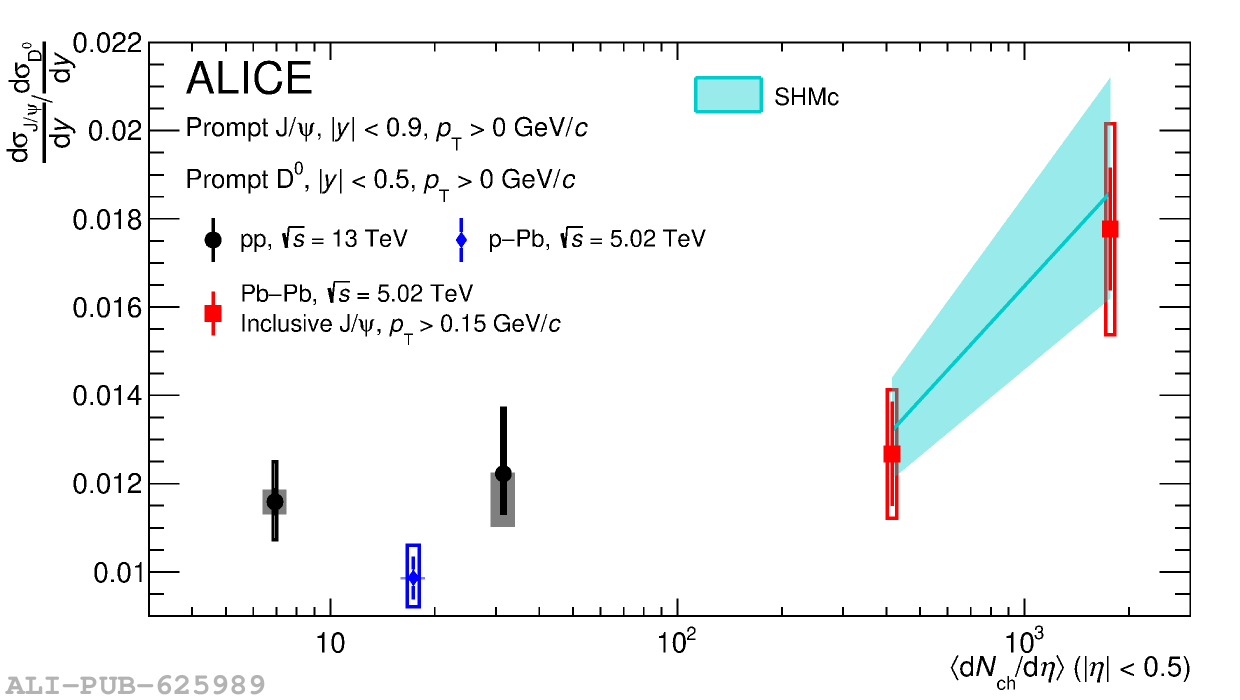 |
Figure A.1
Self-normalized prompt (left) and non-prompt (right) \jpsi yields with $\pt>1$ \GeVc as a function of self-normalized charged-particle multiplicity within $|\eta| < 0.9$, in the INEL$>$0 (full markers) and V0M 0--0.1\% (open markers) event classes. The case when the \jpsi decay daughters are included in the multiplicity calculation is compared with the case when both \jpsi decay daughters are removed from the multiplicity calculation. The yields are compared to PYTHIA 8 using oniaShower:all settings. The dashed grey lines represent a linear increase with slope 1. The vertical bars and boxes indicate the statistical and systematic uncertainties, respectively. The prompt \jpsi yields are also compared to the inclusive \jpsi yields from the PHENIX collaboration . | 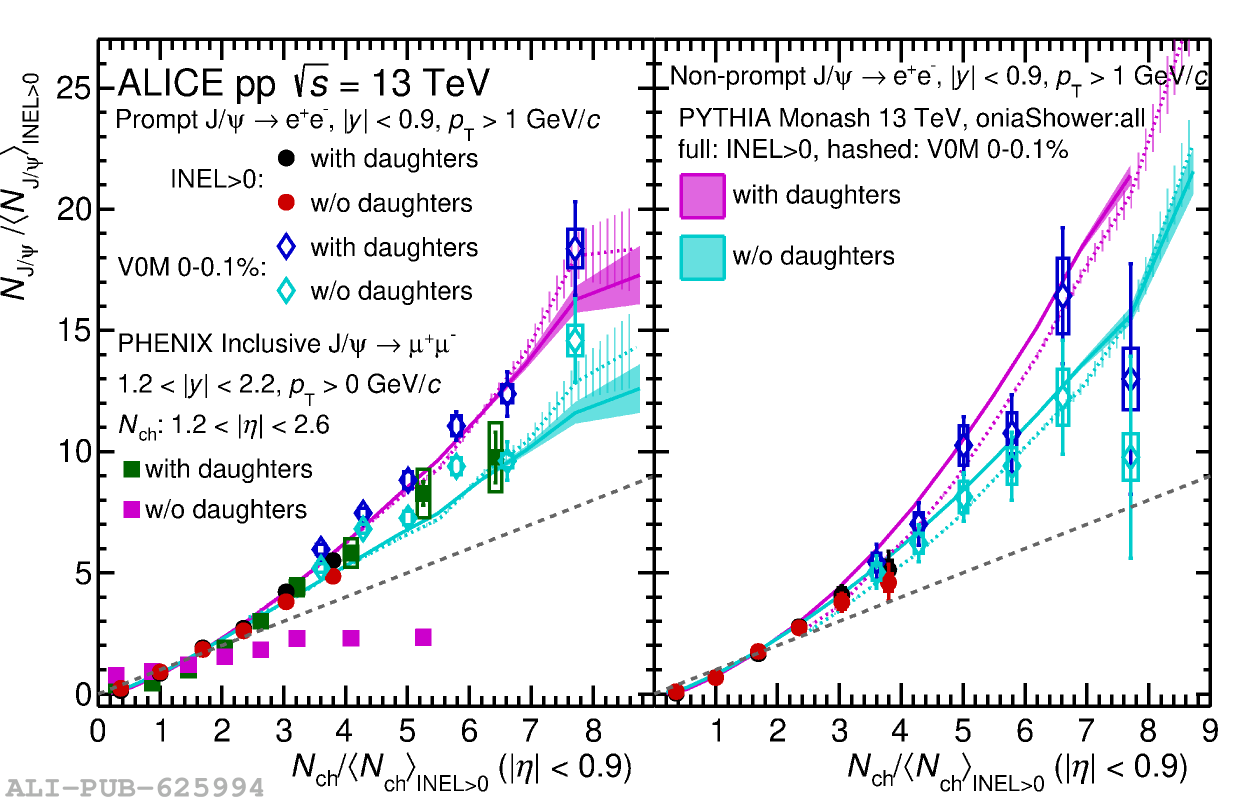 |
Figure A.2
Self-normalized prompt (left) and non-prompt (right) \jpsi yields with $\pt>1$ \GeVc as a function of self-normalized charged-particle multiplicity at midrapidity from PYTHIA 8 simulations with different settings . The yields are shown separately for the INEL$>$0 (full) and V0M 0-0.1\% (hashed) event classes. Lower panels show the ratios to the expectation from a linear increase. | 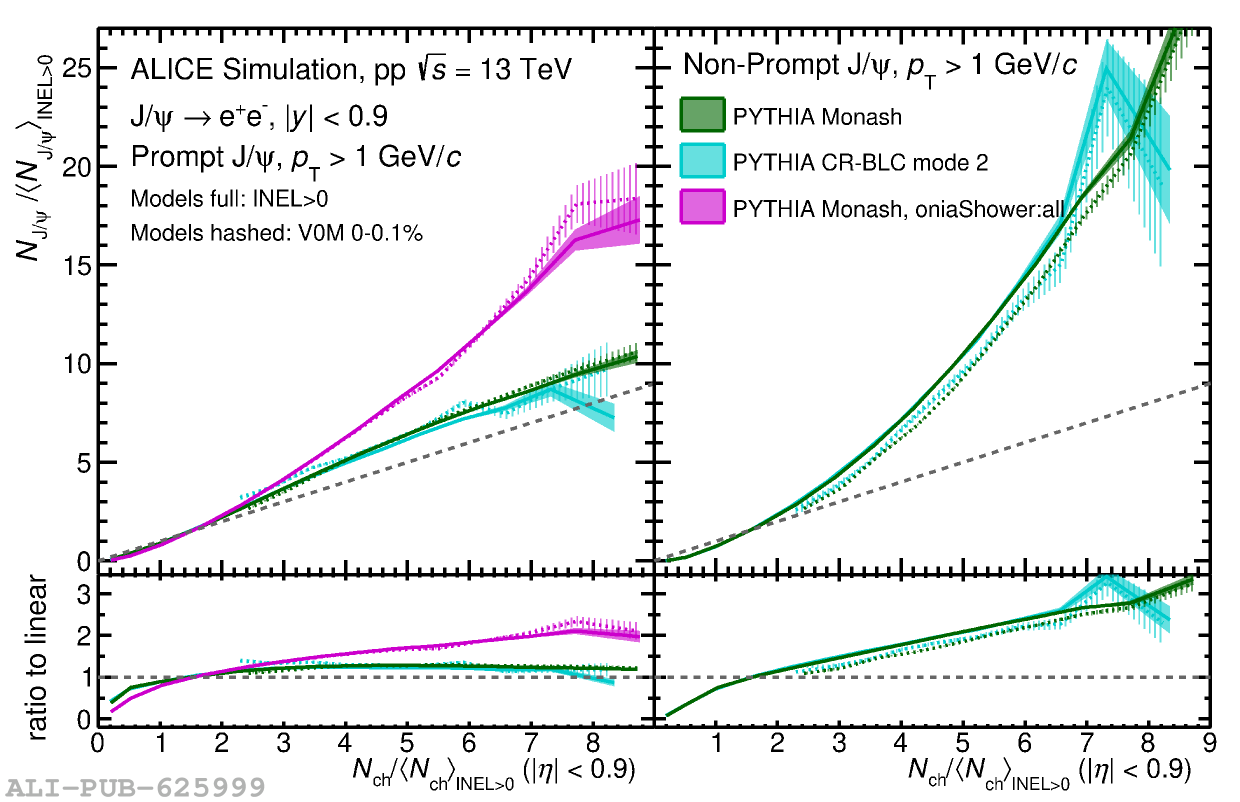 |
Figure A.3
Self-normalized prompt \jpsi yields with $\pt>1$ \GeVc, taken from PYTHIA 8 simulations with different settings , as a function of the self-normalized charged-particle multiplicity in $|\eta|< 0.9$ in the toward (left), transverse (middle), and away (right) azimuthal regions with respect to the \jpsi momentum direction. The yields are shown separately for the INEL$>$0 (full) and V0M 0-0.1\% (hashed) event classes. Lower panels show the ratios to the expectation from a linear increase. | 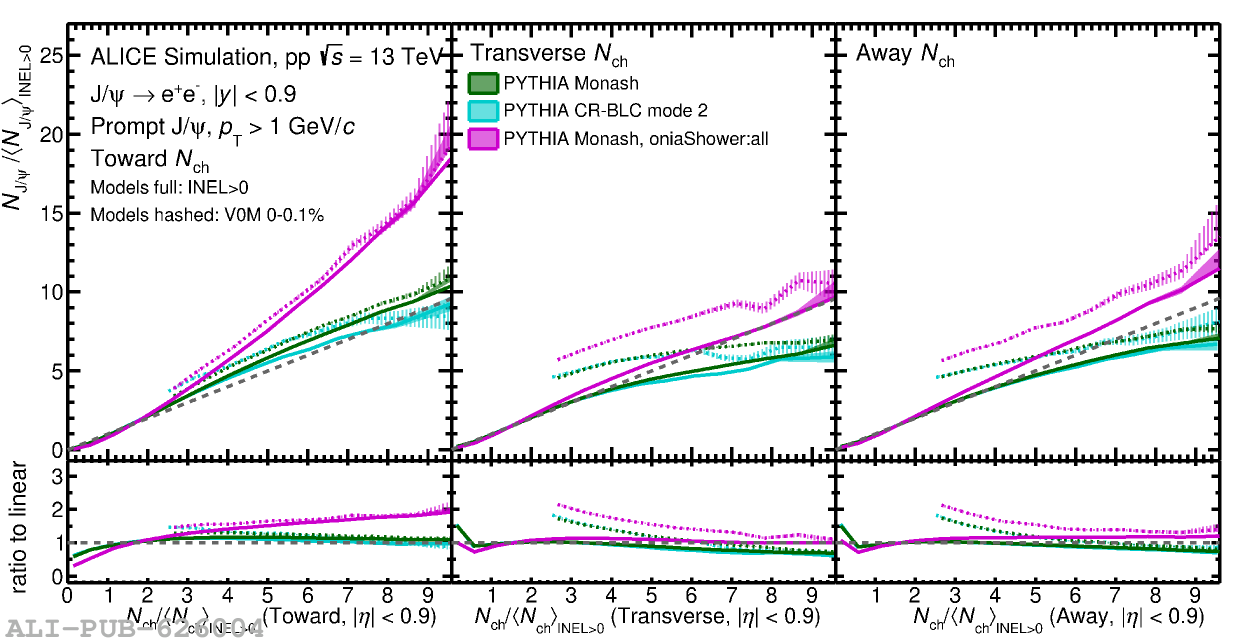 |