
The first measurements of the average transverse-momentum fraction ($\langle z \rangle$) as a function of transverse momentum ($p_{\rm T}$) for strange baryons ($Λ$ and $\barΛ$) and strange mesons ($K_{\rm S}^0$), produced in mini-jets defined through angular correlations in pp collisions at $\sqrt{s} = 13$ TeV, are reported by the ALICE Collaboration at the LHC. The observable is obtained using a novel method, where the angular correlation between the strange hadrons and inclusive charged hadrons is weighted by the $p_{\rm T}$ of correlated particles at small angular distance. As a function of strange particles' $p_{\rm T}$, the results reveal a flat trend for strange mesons and a decreasing trend for strange baryons in the measured $p_{\rm T}$ region, indicating distinct hadronization mechanisms for $K_{\rm S}^0$ and $Λ$($\barΛ$). The measurements are compared to Monte Carlo models, namely PYTHIA~8 (with both Monash and Color Rope tunes) and the AMPT (A Multi-Phase Transport) model with string melting. None of these models provides a satisfactory description of the $\langle z \rangle$ distributions at low and intermediate $p_{\rm T}$.
Phys. Lett. B 880 (2026) 140766
HEP Data
e-Print: arXiv:2603.19387 | PDF | inSPIRE
CERN-EP-2026-074
Figure group
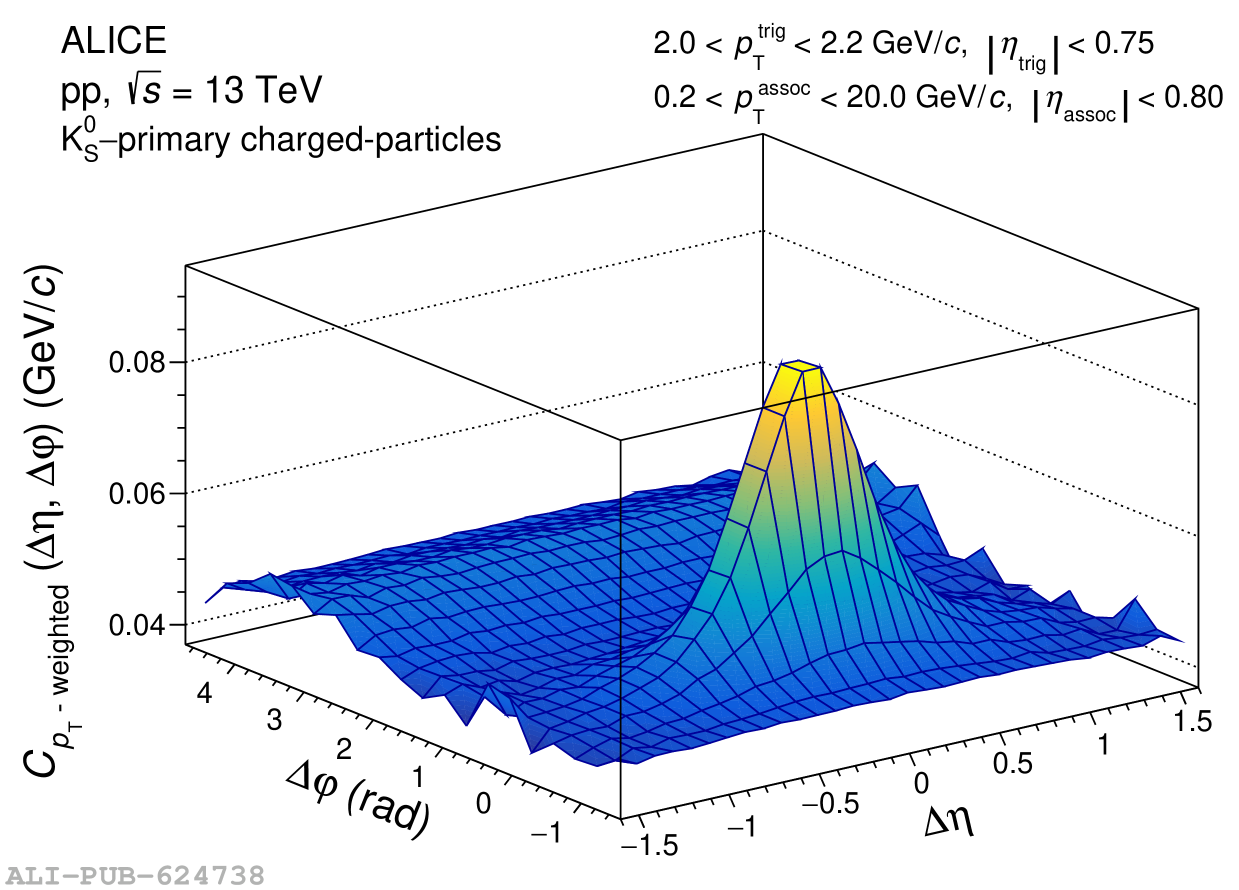
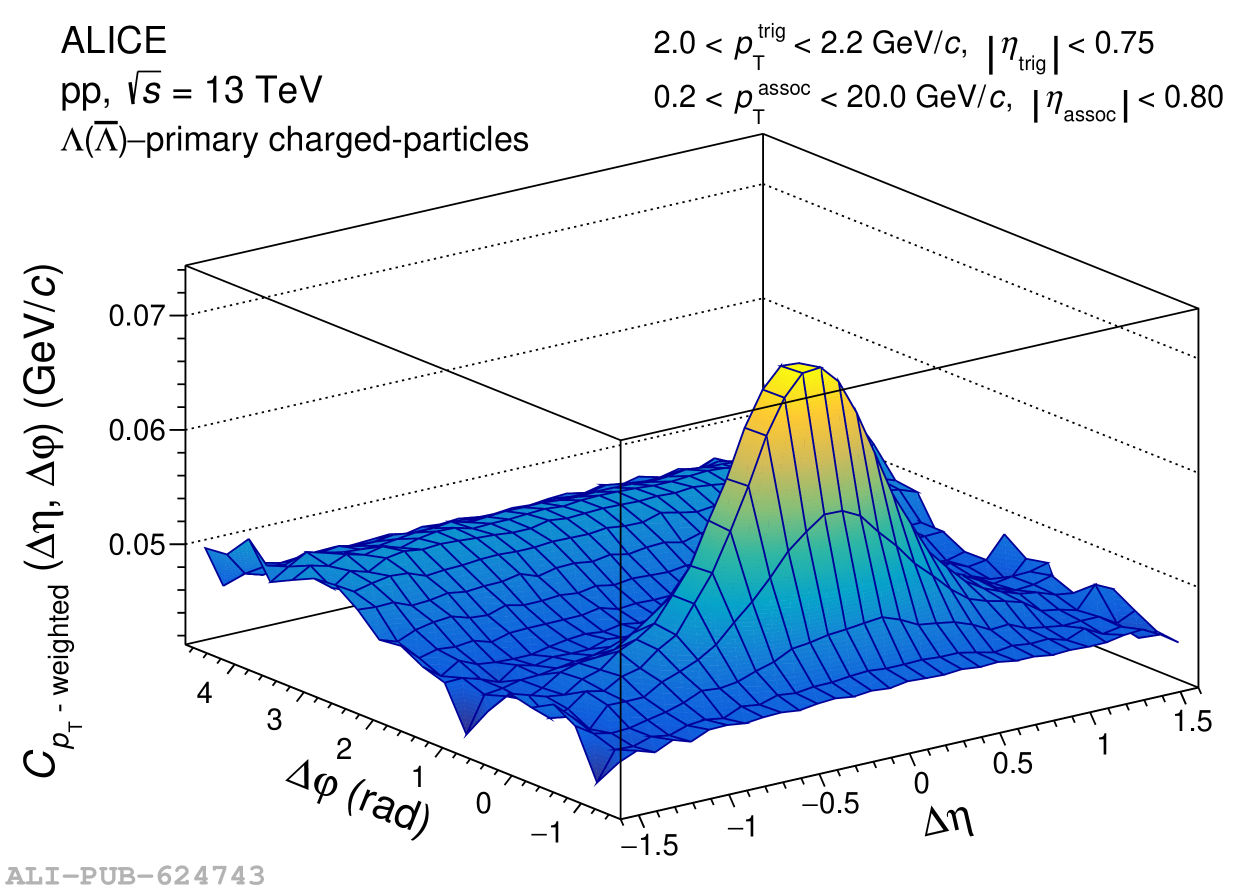
Figure 2
The average transverse-momentum fraction (\meanz) for \lmb (\almb) (blue) and \kzero (red) as a function of \pts in minimum bias \pp collisions at \thirteen. The \pts ranges from 0.6 to 20 \GeVc Statistical and systematic uncertainties of \meanz are represented by vertical error bars and empty boxes, respectively Data points are drawn at the corresponding average \pts values in each interval The horizontal bars represent the \pts interval widths The statistical and systematic uncertainties of the average \pts values are negligible. | 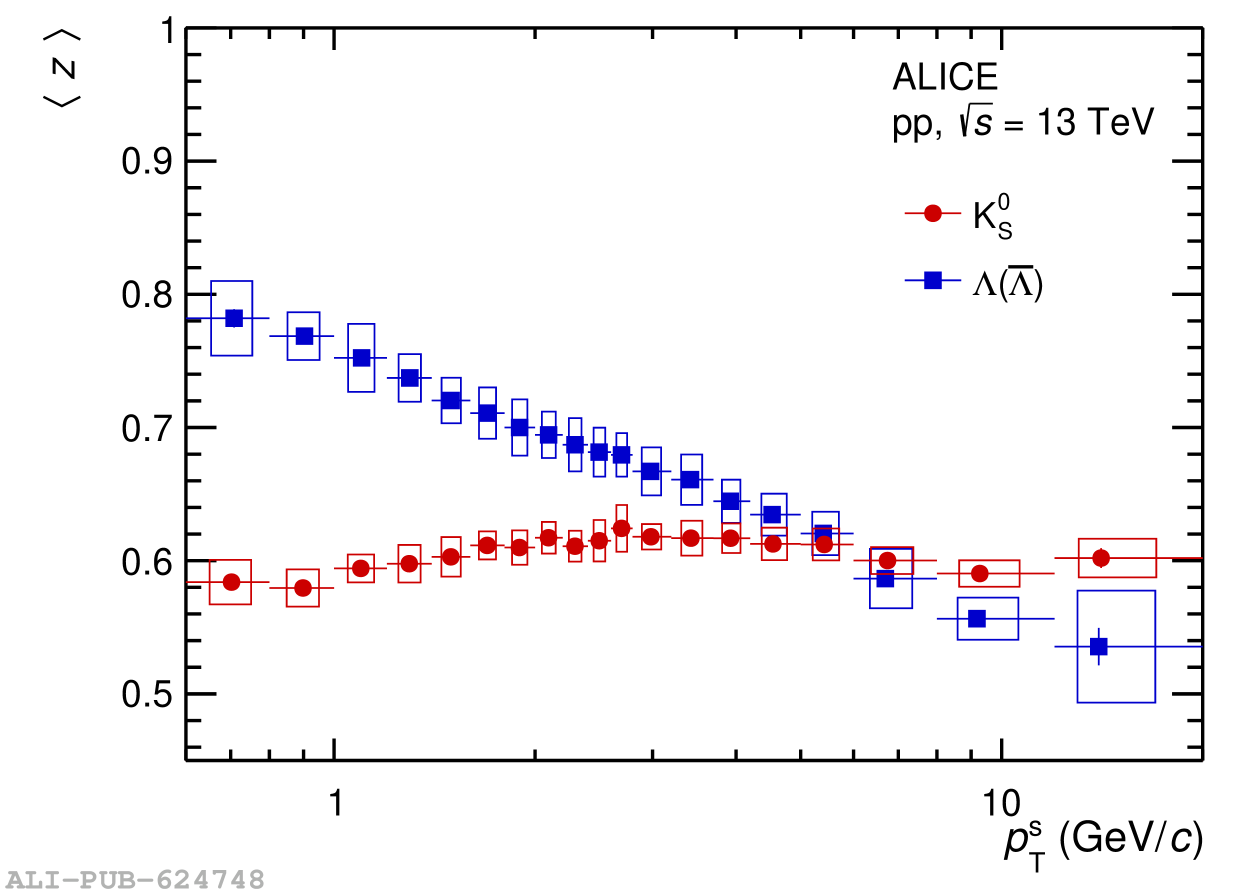 |
Figure 3
The average transverse-momentum fraction (\meanz) for \kzero (top) and \lmb (\almb) (bottom) in data compared with model calculations. The data are compared to \Pyeight with the Monash tune (red band), the Color Rope tune (green band) and the AMPT model with the string melting (blue band). For both \Pyeight tunes, the hatched bands represent the results excluding \kzero triggers coming from decays of the resonances ${\rm K}^{*}(892)^{0}$, ${\rm K}^{*}(892)^{\pm}$, and $\phi(1020)$, and \lmb (\almb) triggers coming from decays of $\Sigma^{\pm}$, $\Xi^{-}$, $\Omega^{-}$ and their corresponding antiparticles. | 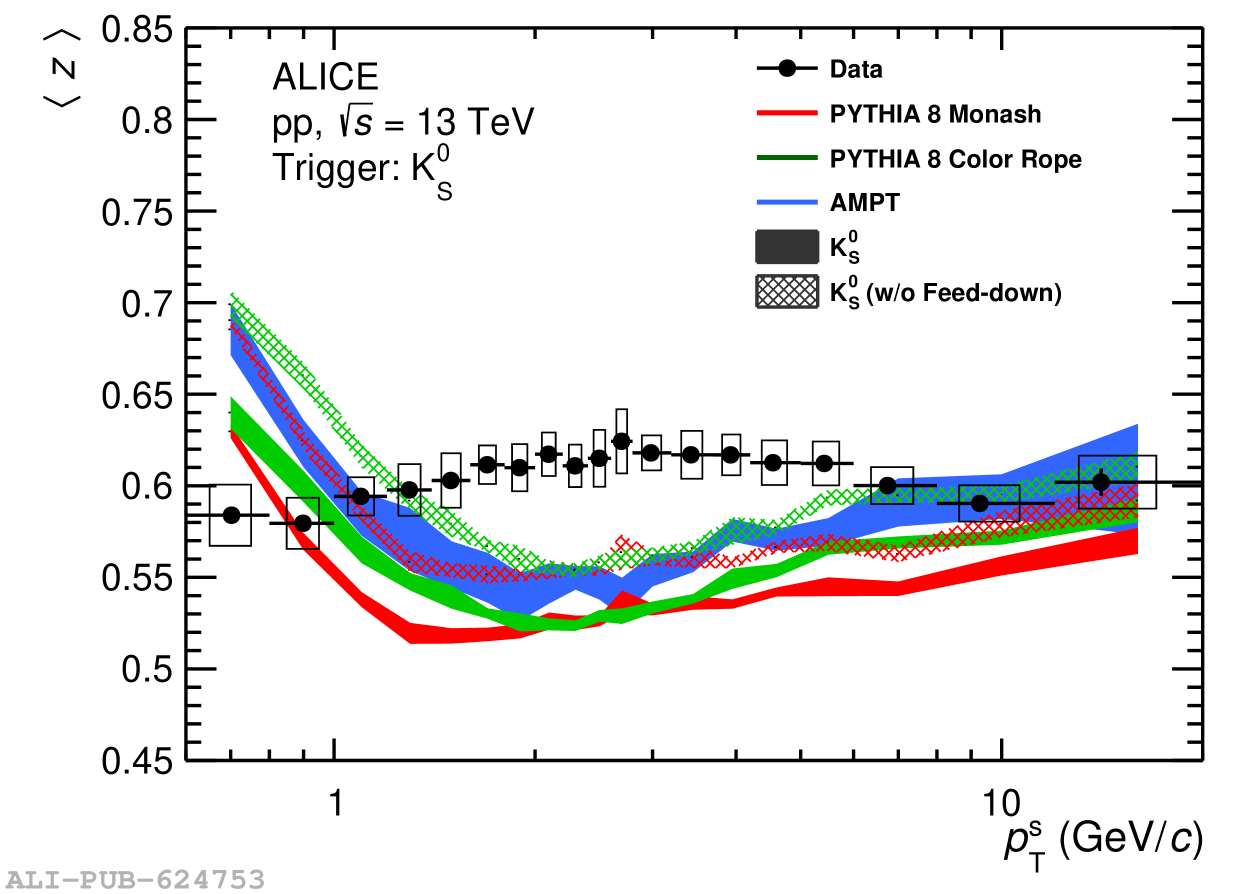 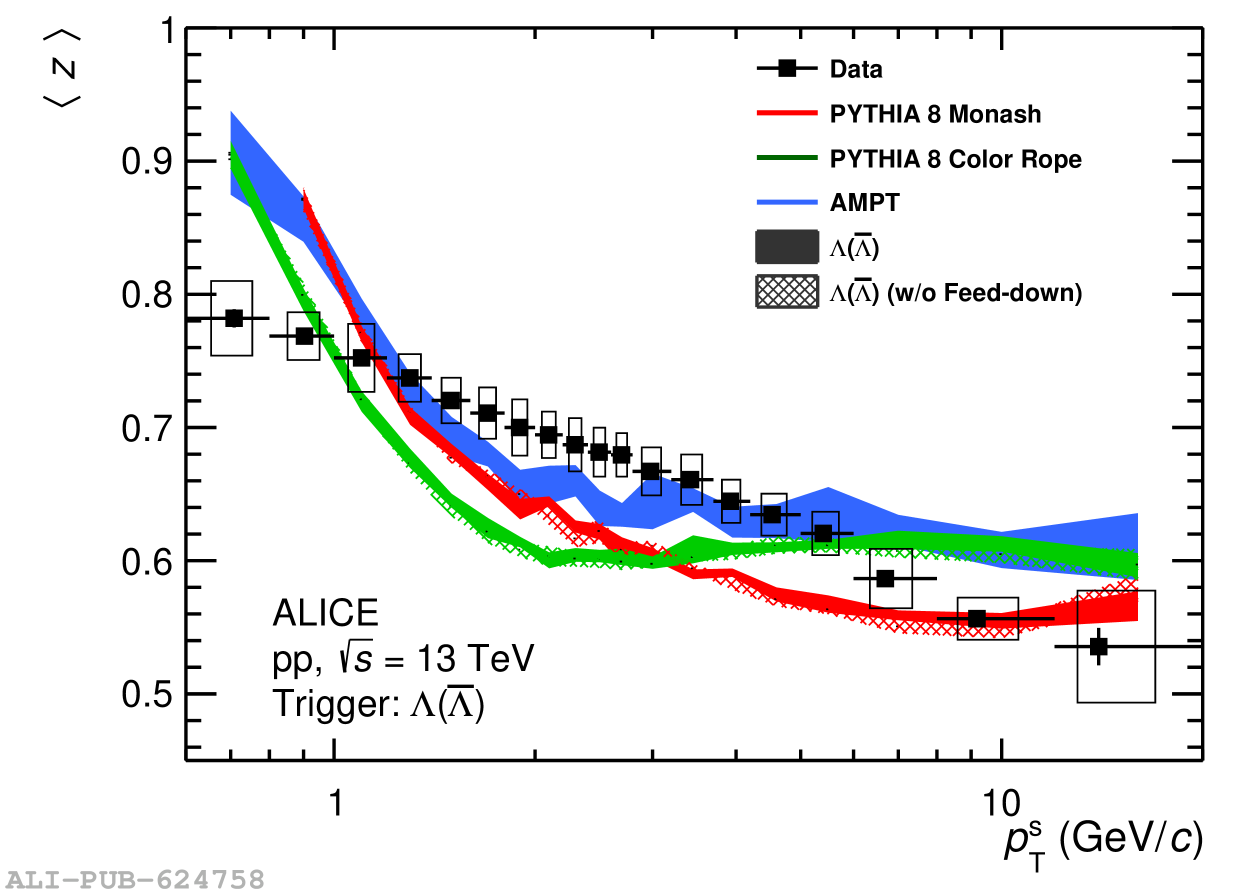 |