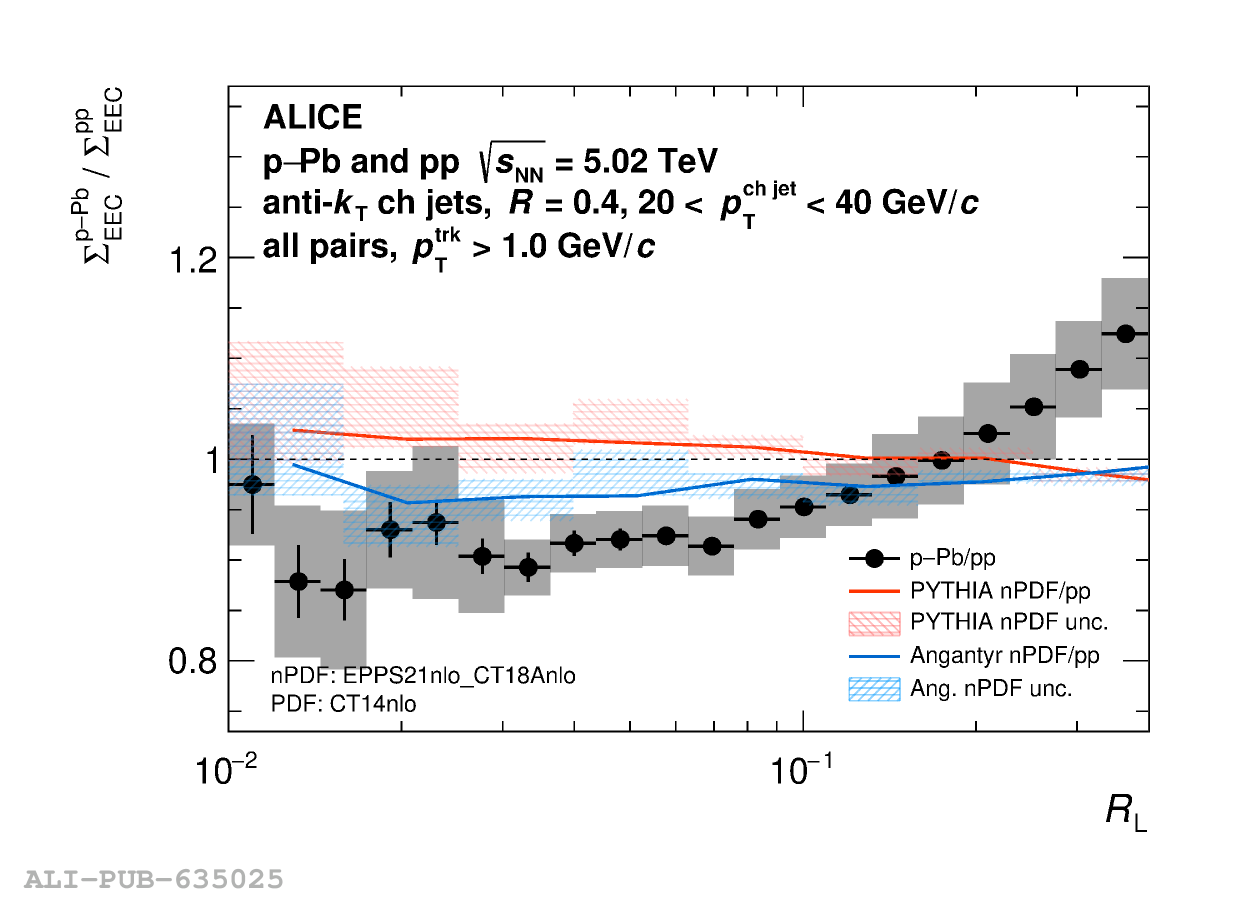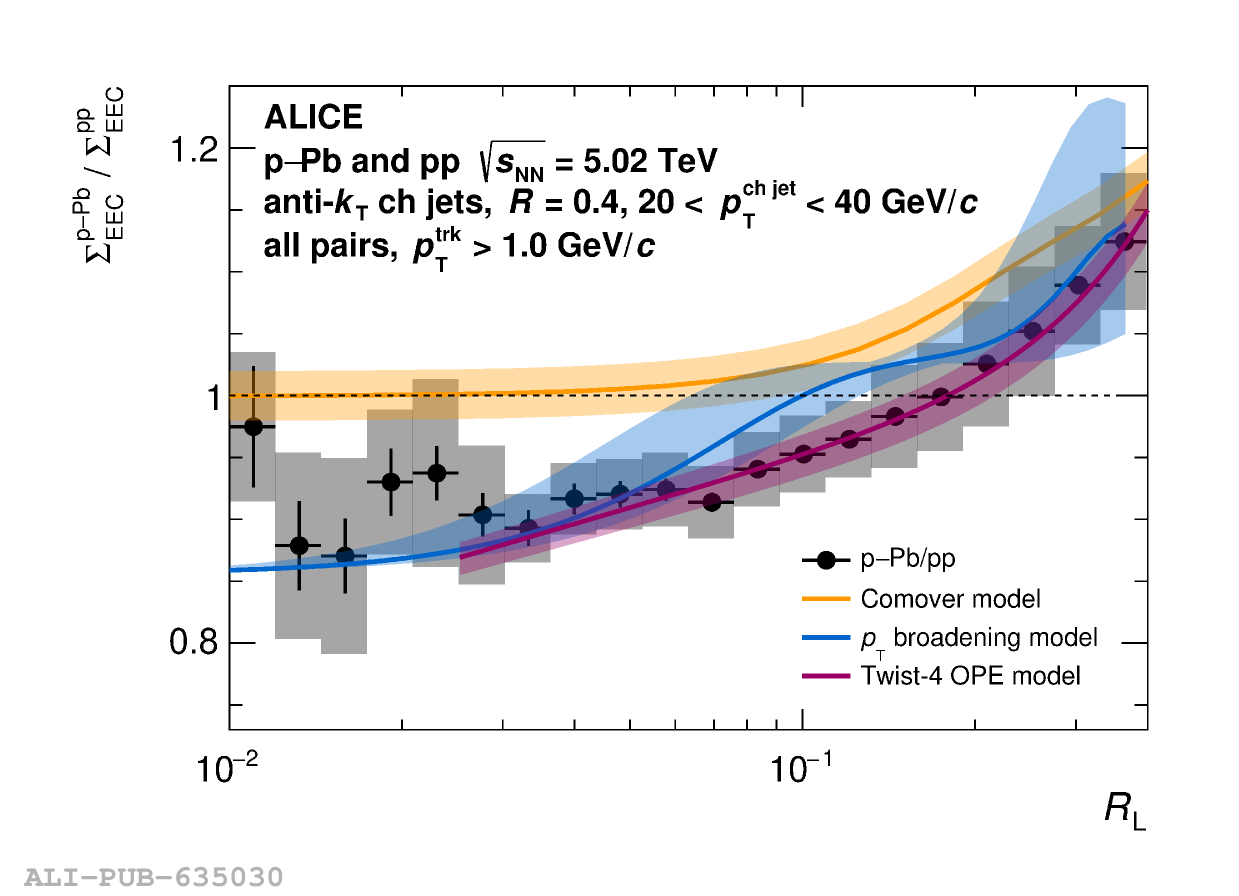
This paper presents the first measurement of the two-point energy-energy correlator (EEC) inside charged-particle jets in p-Pb collisions at $\sqrt{s_{\rm NN}} = 5.02$ TeV with the ALICE experiment. The two-point EEC, an infrared- and collinear-safe measure of angular energy flow within jets, is used to probe both perturbative and non-perturbative stages of the jet evolution. The EEC is reported in 20-80 GeV/$c$ jets in p-Pb collisions and compared to a measurement of the EEC in pp events at $\sqrt{s} = 5.02$ TeV. A modification is observed in the 20-40 GeV/$c$ interval, with an enhancement at large opening angles and a suppression at small angles relative to pp collisions. The dependence of this modification on jet transverse momentum, rapidity, and forward activity is investigated. These results provide new constraints on cold nuclear matter effects relevant for disentangling initial- and final-state contributions to jet-structure modifications. An understanding of these cold nuclear matter effects is also relevant for interpreting EEC measurements in heavy-ion collisions.
Submitted to: PRC
e-Print: arXiv:2606.18143 | PDF | inSPIRE
CERN-EP-2026-176
Figure group
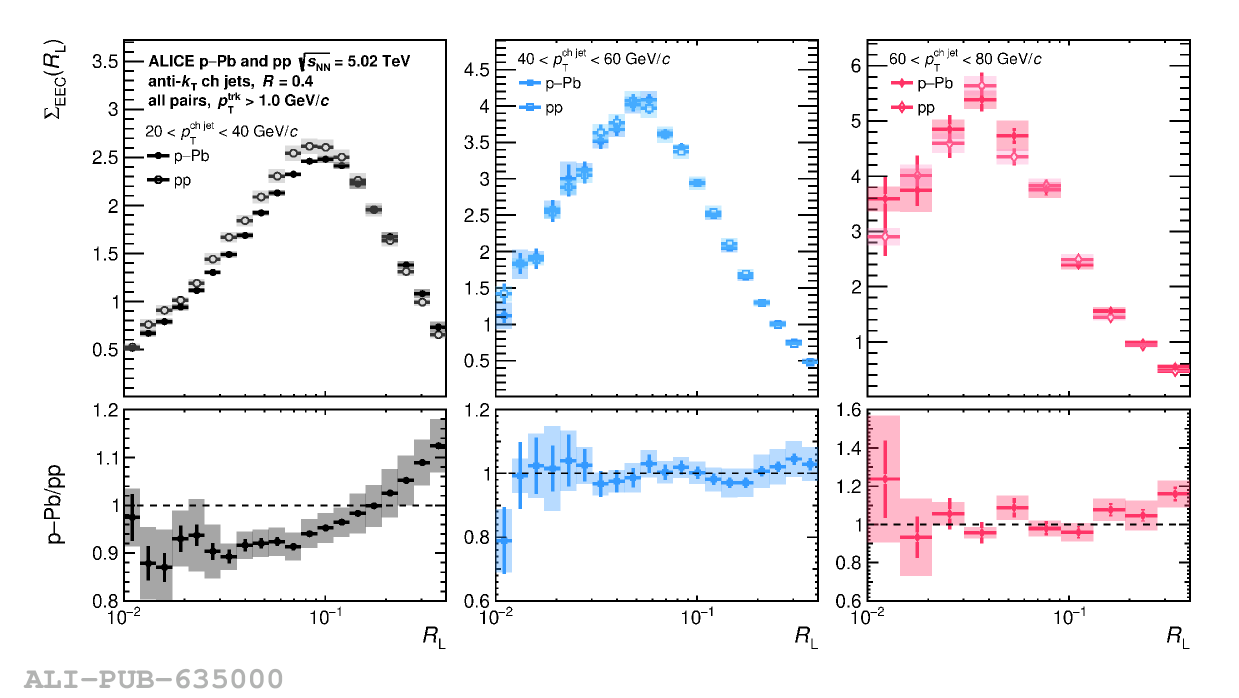
Figure 2
Top: The fully corrected $\Sigma_{\rm EEC}$ in p–Pb collisions as a function of $R_{\rm L}$, with a varying $p_{\rm T, track}$ threshold (150 MeV/$c$, 1 GeV/$c$, and 2 GeV/$c$), in 20–40, 40–60, and 60–80 GeV/$c$ jets. Bottom: The ratio of $\Sigma_{\rm EEC}$ in p–Pb to pp with different $p_{\rm T, track}$ thresholds, where in the pp reference the $p_{\rm T, track}$ threshold is also varied. Systematic uncertainties are shown with shaded boxes around the data points. | 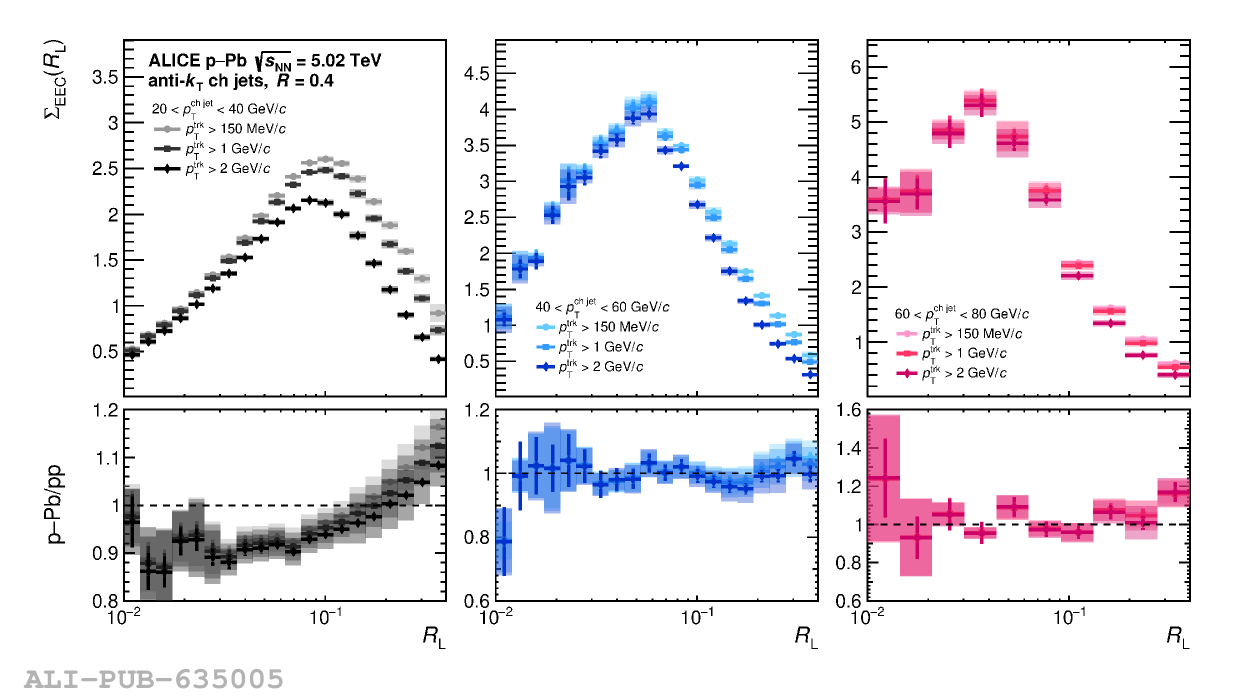 |
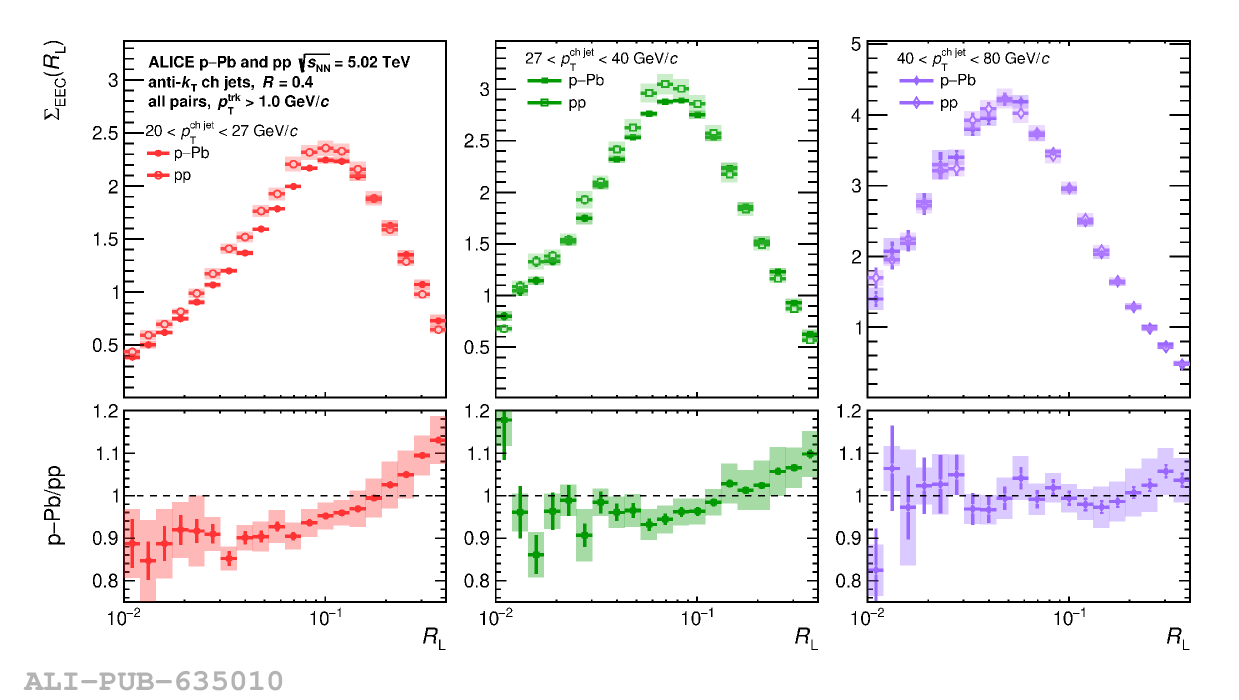
Figure 4
Top: The ratio of p-going ($\eta_{\rm jet}< 0$) to Pb-going ($\eta_{\rm jet}>0$) $\Sigma_{\rm EEC}$ in 20–40 GeV/c p–Pb jets. Bottom: The ratio of $\Sigma_{\rm EEC}$ in high-multiplicity events (0–5% V0A) to $\Sigma_{\rm EEC}$ in low-multiplicity events (5–100% V0A), in 20–40 GeV/$c$ p–Pb jets. | 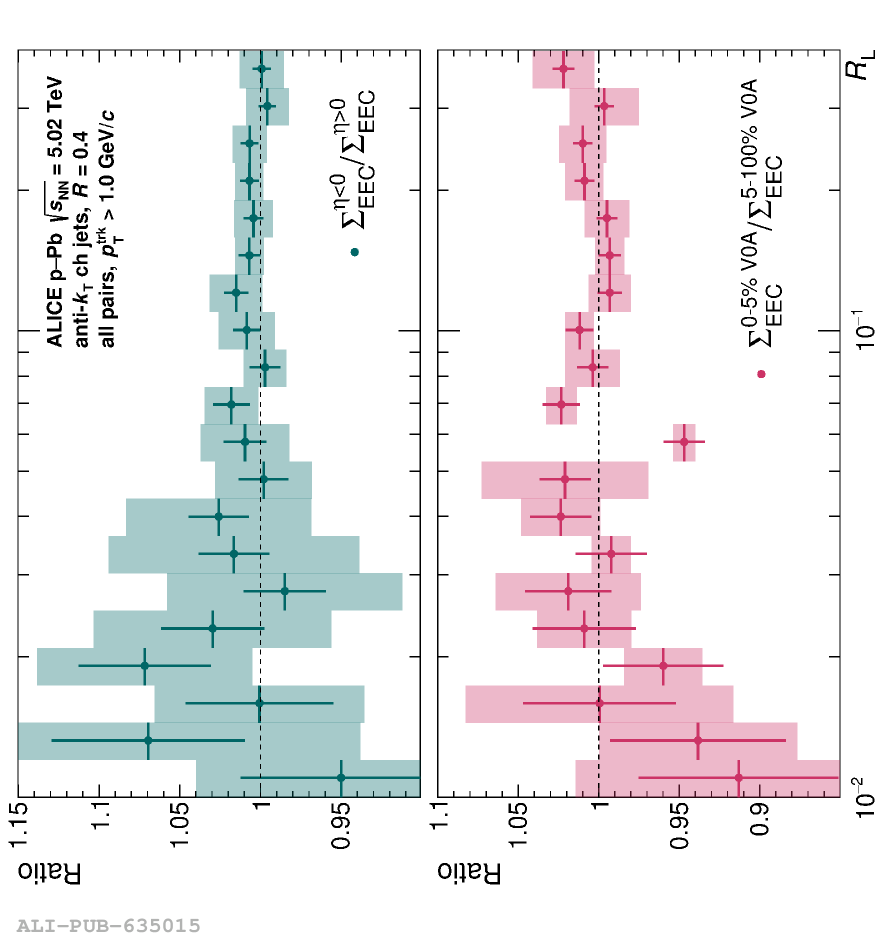 |
Figure 5
The normalized $\Sigma_{\rm EEC}$ as a function of $\langle p_{\rm T}^{\rm ch jet}\rangle$$R_{\rm L}$. The logarithm $\ln\langle p_{\rm T}^{\rm ch\> jet}\rangle$ represents $\ln(\langle p_{\rm T}^{\rm ch\> jet}\rangle/({\rm GeV}/c))$. The dashed grey line corresponds to the maximum location of the distribution and the grey band corresponds to a $\pm0.07$ GeV/$c$ uncertainty along the x-axis. | 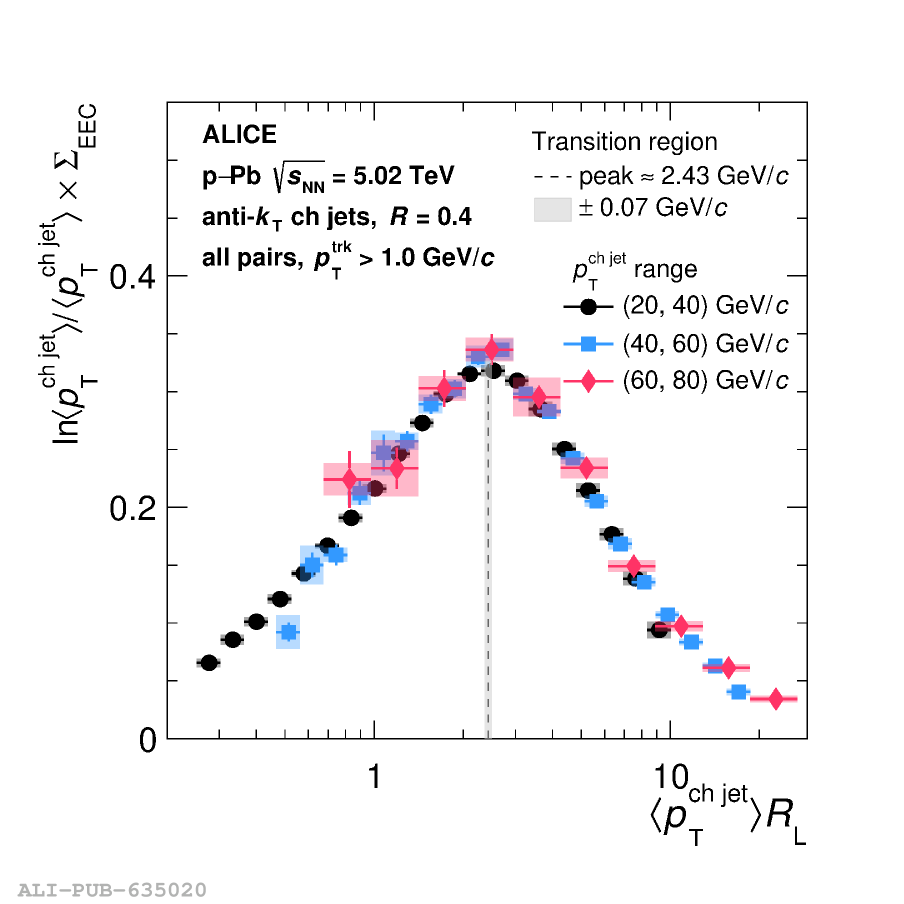 |