
Inclusive production of $ψ(2S)$ mesons is measured for the first time at midrapidity ($|y| <~ 0.9$) in pp collisions at $\sqrt{s} = 13$ TeV using the ALICE detector at the LHC. The measurement is performed in the transverse-momentum ($p_{\rm T}$) range of 4 to 16 GeV/$c$ and is based on events triggered by the Transition Radiation Detector, corresponding to an integrated luminosity of $1.7 \pm 1.8\%$ (syst.) pb$^{-1}$. The $p_{\rm T}$-differential production cross section of the $ψ(2S)$ and its ratio to the J/$ψ$ production cross section are presented. The results extend the accessible $p_{\rm T}$ range down to 4 GeV/$c$, and a mild rise of the $ψ(2S)$-to-J/$ψ$ cross section ratio with increasing $p_{\rm T}$ is observed. The measurements are compared with theoretical predictions based on NRQCD and the ICEM model.
Accepted by: EPJC
HEP Data
e-Print: arXiv:2602.22848 | PDF | inSPIRE
CERN-EP-2026-042
Figure group
Figure 1
Acceptance times \TRD-trigger efficiency ($\epsilon_{\mathrm{TRD}}(p_{\mathrm{T}}^{\mathrm{e}})$) described by Eq. \ref{eq:slEff} for single electrons (left) and positrons (right) obtained from \TRD-triggered data (red solid circle), fitted with an error function (red line), and MC simulation (black open circle). See text for details. | 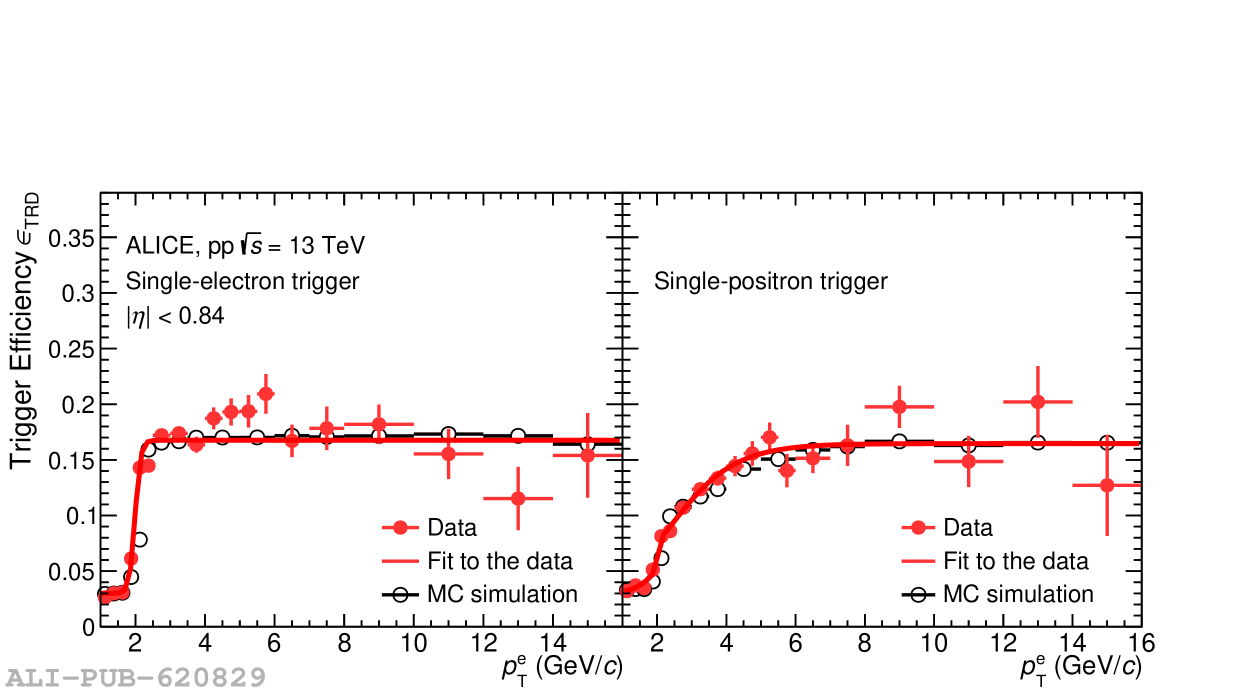 |
Figure 2
Invariant-mass distributions of \ee pairs in the same event for the lowest (left) and the highest (right) \ptee intervals. Superimposed to the data are the fits containing the signals of \jpsi and \psis and the correlated (blue area) and uncorrelated (gray area) background sources (see text). | 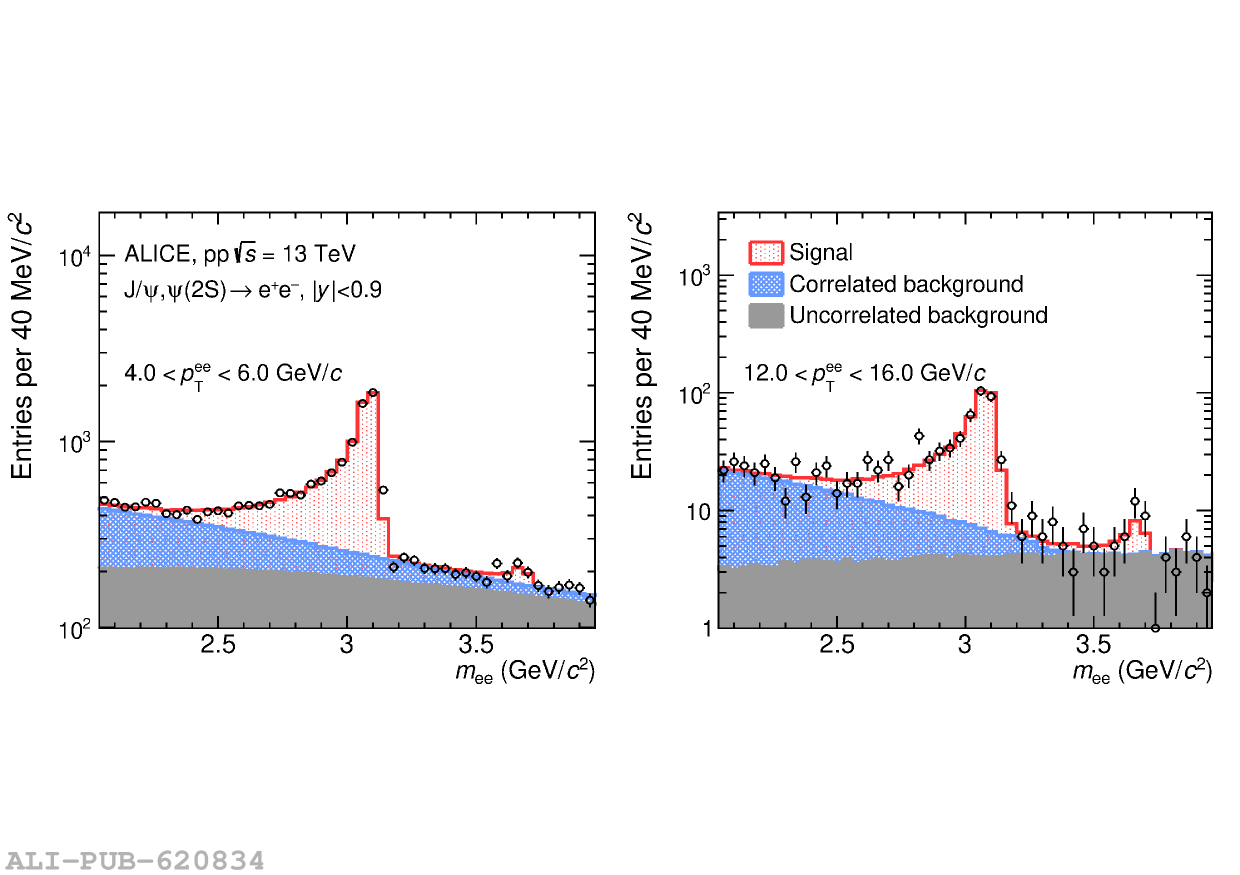 |
Figure 4
\pt-differential inclusive \psis production cross section at midrapidity in \pp collisions at \thirteen. Statistical and systematic uncertainties are shown as error bars and boxes, respectively, and data points are plotted according to the Lafferty–Wyatt prescription . The data points for the inclusive production are obtained by summing the published prompt and non-prompt measurements . The statistical and systematic uncertainties are combined in quadrature. Uncertainties related to integrated luminosity are not shown. | 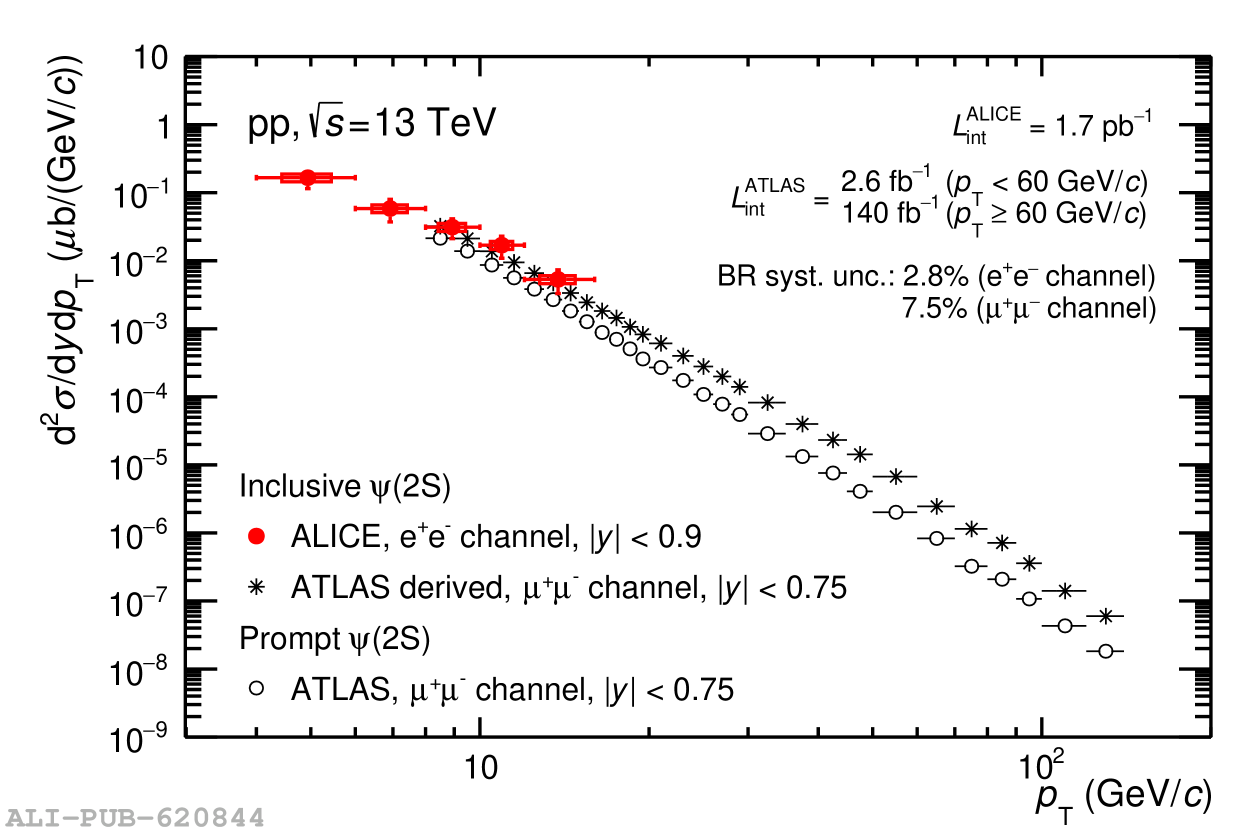 |
Figure 5
\pt-differential inclusive \psis production cross section at midrapidity in \pp collisions at \thirteen is compared with ALICE results at forward rapidity (left) and with the model calculations from ICEM and NRQCD (right). Both calculations include a non-prompt contribution from beauty-hadron decays via FONLL . Data points are plotted according to the Lafferty–Wyatt prescription . The lower panels show the ratios of the data points or model calculations to the power-law fit to the midrapidity data. | 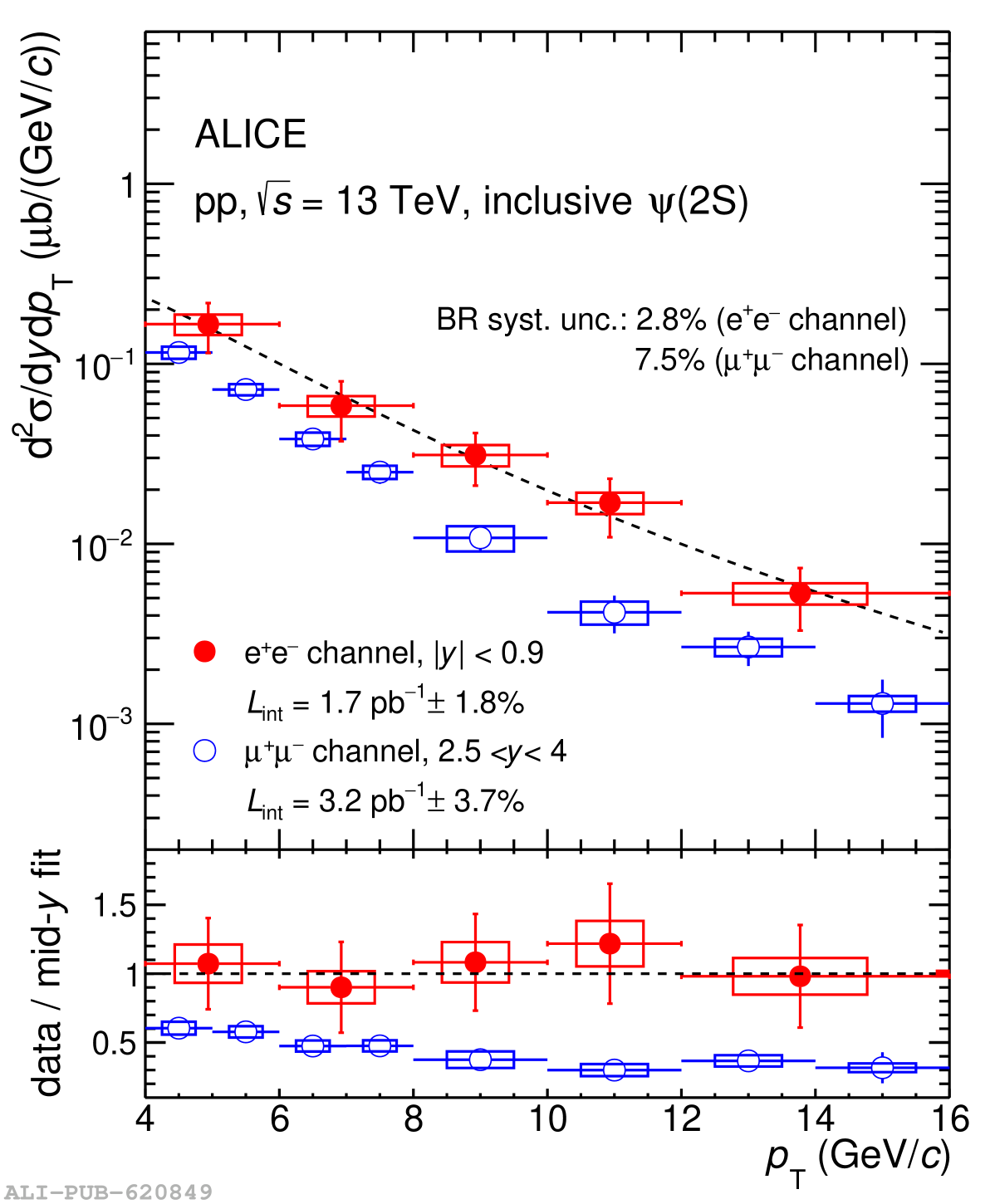 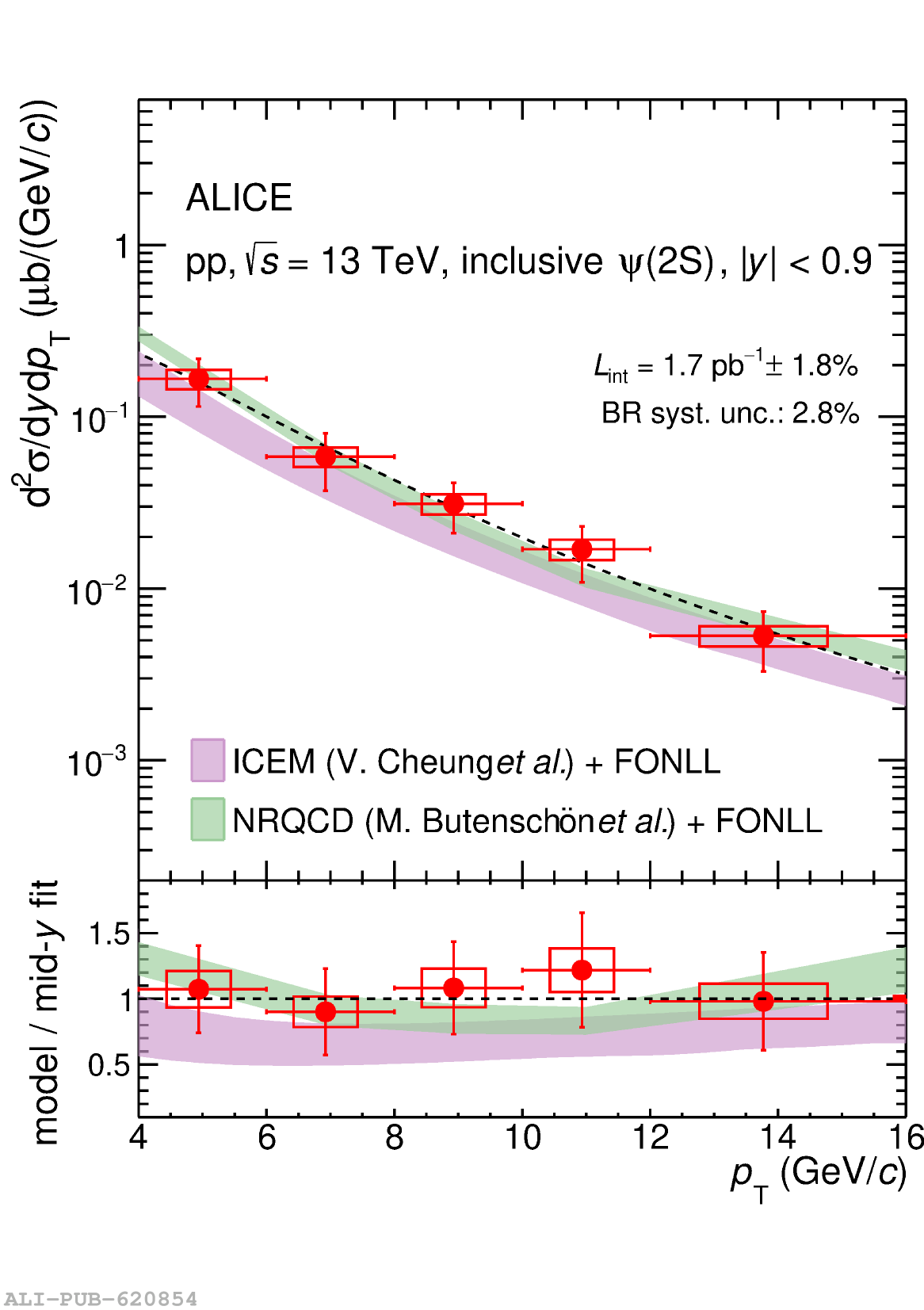 |
Figure 6
\pt-differential \psis-to-\jpsi production cross section ratio measured by the ALICE and the ATLAS Collaborations at midrapidity in \pp collisions at \thirteen . For the ALICE Collaboration, statistical and systematic uncertainties are shown as error bars and boxes, respectively, and data points are plotted according to the Lafferty–Wyatt prescription Inclusive \psis-to-\jpsi points from the ATLAS Collaboration (solid black circles) are obtained by summing the published prompt and non-prompt components of each state , and taking their ratio. Statistical and systematic uncertainties are treated as uncorrelated and combined in quadrature. | 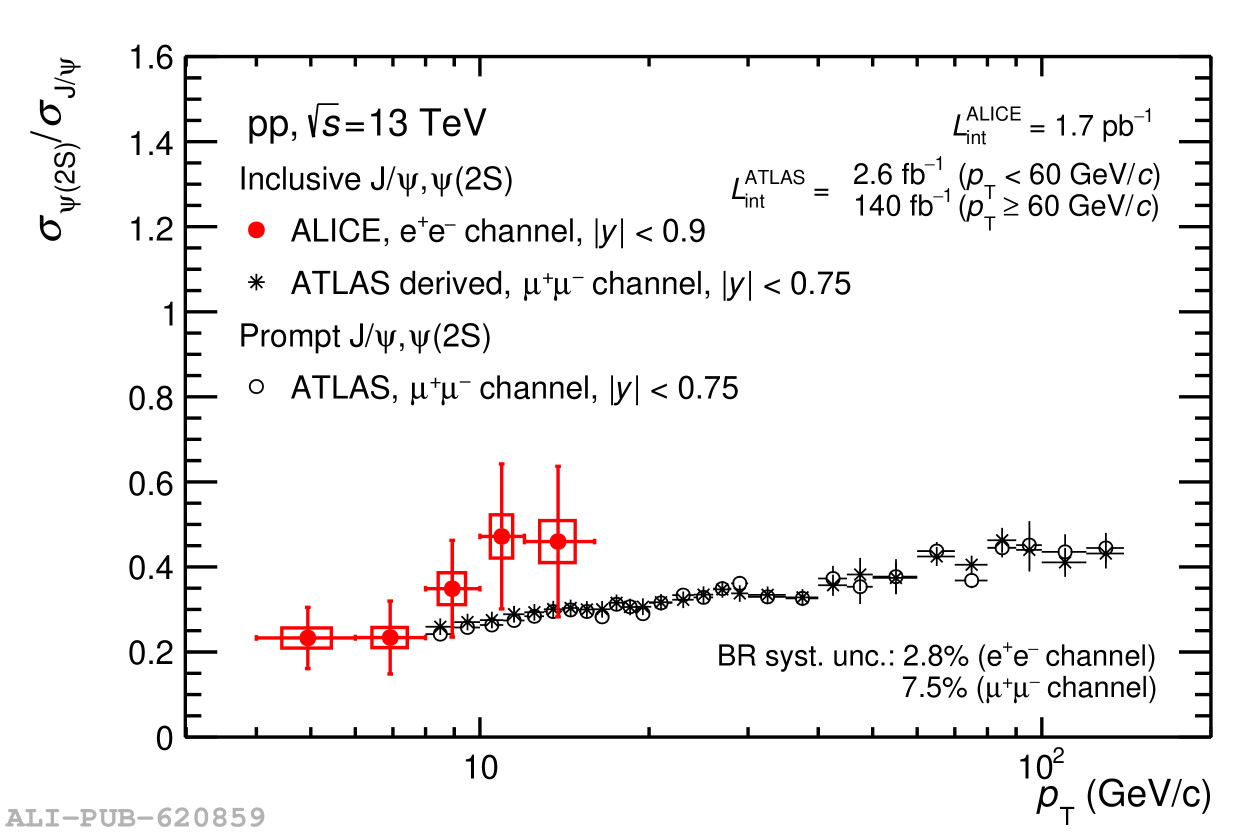 |
Figure 7
\pt-differential \psis-to-\jpsi production cross section ratio at midrapidity in \pp collisions at \thirteen compared with a measurement at forward rapidity in \pp collisions at the same collision energy (left), and compared with the model calculations (right) The error bars indicate the statistical uncertainties, and the boxes indicate the systematic uncertainties. The data points are plotted at the effective \pt values evaluated according to the Lafferty-Wyatt prescription The widths of the bands reflect the theoretical uncertainties. | 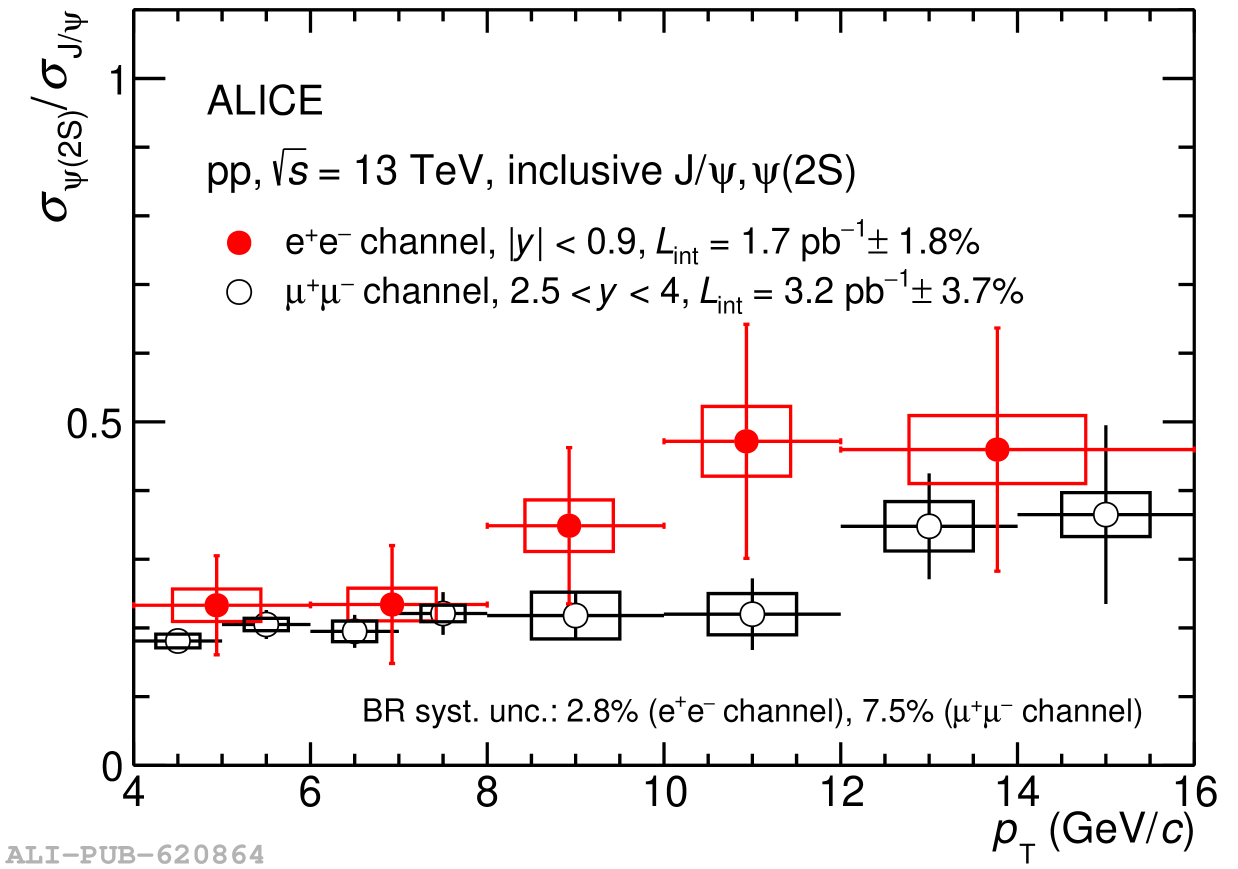 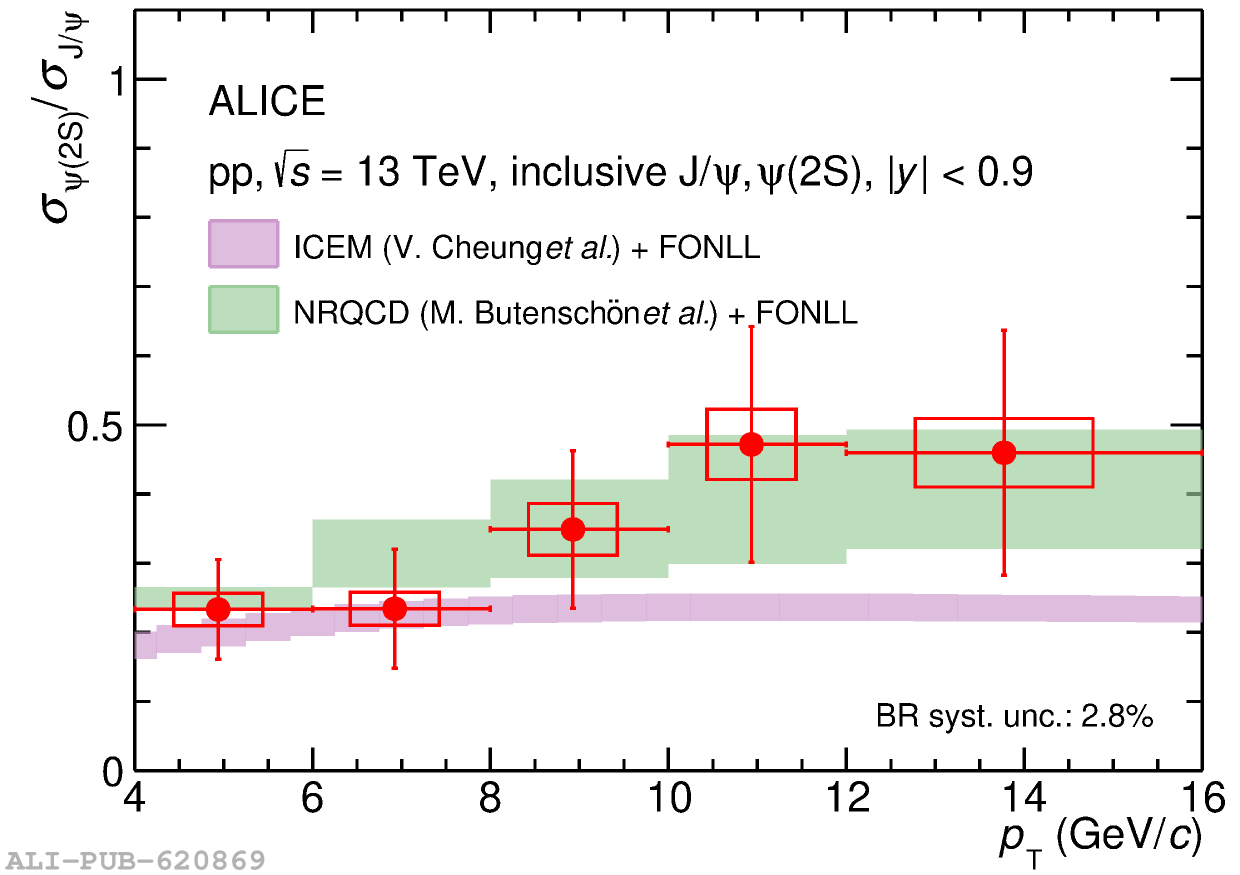 |