
The first measurement at midrapidity ($|y| <~ 0.5$) of the production yield of the strange-charm baryons $Ξ_c^+$ and $Ξ_c^0$ as a function of transverse momentum ($p_{\rm T}$) in different charged-particle multiplicity classes in proton-proton collisions at $\sqrt{s} = 13$ TeV with the ALICE experiment at the LHC is reported. The $Ξ_c^+$ baryon is reconstructed via the $Ξ_c^+ \rightarrow Ξ^-π^+π^+$ decay channel in the range $4 <~ p_{\rm T} <~ 12$ GeV/$c$, while the $Ξ_c^0$ baryon is reconstructed via both the $Ξ_c^0 \rightarrow Ξ^-π^+$ and $Ξ_c^0 \rightarrow Ξ^-e^+ν_e$ decay channels in the range $2 <~ p_{\rm T} <~ 12$ GeV/$c$. The baryon-to-meson ($Ξ_c^{0,+}/{\rm D}^0$) and the baryon-to-baryon ($Ξ_c^{0,+}/Λ_{\rm c}^+$) production yield ratios show no significant dependence on multiplicity. In addition, the observed yield ratios are not described by theoretical predictions that model charm-quark fragmentation based on measurements at $e^+e^-$ and $e^-$p colliders, indicating differences in the charm-baryon production mechanism in pp collisions. A comparison with different event generators and tunings, including different modelling of the hadronisation process, is also discussed. Moreover, the branching-fraction ratio of BR($Ξ_c^0 \rightarrow Ξ^-e^+ν_e$)/BR($Ξ_c^0 \rightarrow Ξ^-π^+$) is measured as 0.825 $\pm$ 0.094 (stat.) $\pm$ 0.081 (syst.). This value supersedes the previous ALICE measurement, improving the statistical precision by a factor of 1.6.
JHEP 12 (2025) 038
HEP Data
e-Print: arXiv:2508.09955 | PDF | inSPIRE
CERN-EP-2025-175
Figure group
Figure 1
Invariant-mass distributions of signal candidates for the hadronic decays of $\Xi_{\rm c}^+$ in $4 < p_{\rm T} < 6$ GeV/$c$ (left), and $\Xi_{\rm c}^0$ in $6 < p_{\rm T} < 8$ GeV/$c$ (right), in the high-multiplicity class. The blue solid curve shows the total fit, and the red dashed curve shows the combinatorial background. |  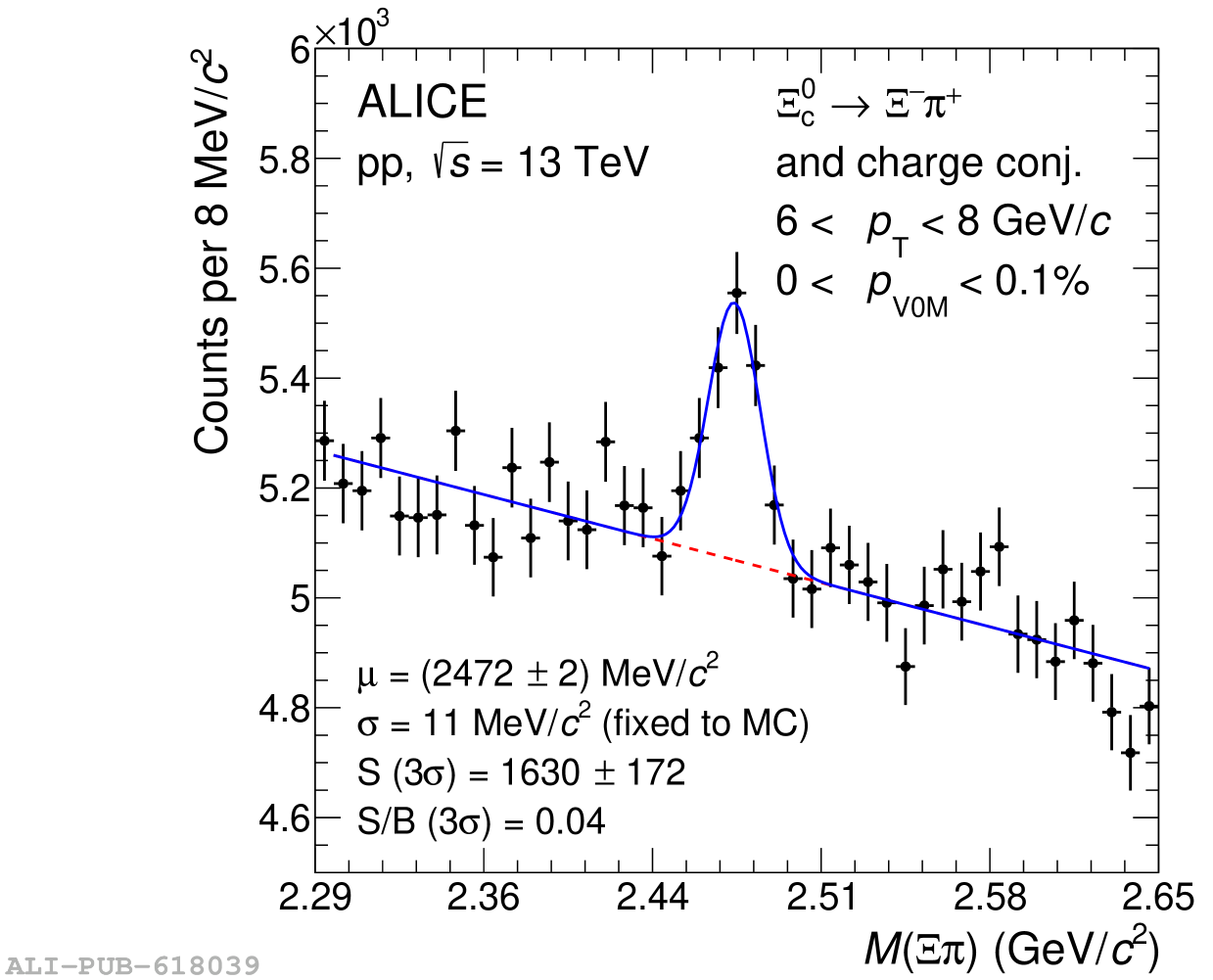 |
Figure 2
Invariant-mass distribution of e$\Xi$ pairs for $\Xi_{\rm c}^0 \rightarrow e \, \Xi \, \nu_{\rm e}$ in $4 < p_{\rm T} < 6$ GeV/$c$, in the high-(left) and low-(right) multiplicity classes. The blue-filled distribution shows the total fit and the coloured lines indicate the different sources contributing to the fit. |   |
Figure 3
$p_{\rm T}$-differential per-event yield of prompt $\Xi_{\rm c}^0$ (left) and $\Xi_{\rm c}^+$ (right) baryons measured in the different multiplicity classes in pp collisions at $\sqrt{s}=13$ TeV at midrapidity ($|y| < 0.5$), along with the corresponding ratios to the multiplicity-integrated (INEL $>$ 0) class in the bottom panel. The values shown in the legend, denoted as $\langle {\rm d}N/{\rm d}\eta \rangle_{|\eta|< 0.5}$, correspond to the average charged-particle multiplicity at midrapidity for the respective multiplicity classes, as introduced in Table.2. The statistical and systematic uncertainties are shown as bars and open boxes, respectively. The shaded boxes indicate the uncertainty of the branching ratio. | 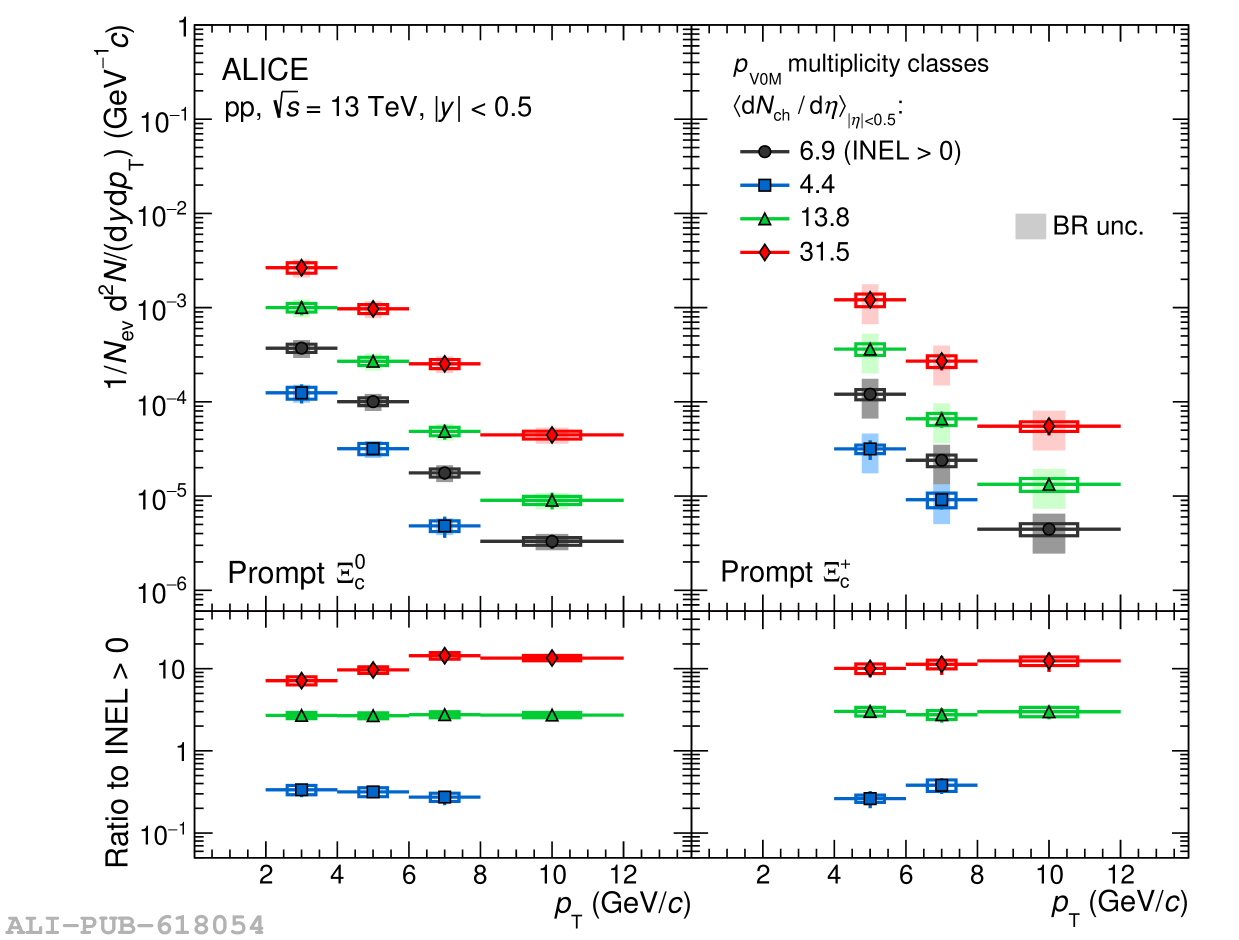 |
Figure 4
The prompt production yield ratios between $\Xi_{\rm c}^{0,+}$ and D$^0$ mesons (top) and $\Xi_{\rm c}^{0,+}$ and $\Lambda_{\rm c}$ baryons (bottom) measured in the same multiplicity classes in pp collisions at $\sqrt{s}=13$ TeV. The statistical and systematic uncertainties are shown as bars and open boxes, and the uncertainty from BR is represented in shaded boxes, respectively. |  |
Figure 5
The baryon-to-meson ratios (top) and baryon-to-baryon ratios (bottom), measured in the low- (left) and high- (right) multiplicity classes. The measurements are compared with the predictions from two event generators: PYTHIA 8 with different tunes (namely Monash, CR-BLC Mode 0, 2, and 3) and EPOS4HQ. |  |
