
The dependence of $\mathrm{f}_{0}$(980) production on the final-state charged-particle multiplicity is reported for proton-proton (pp) collisions at the centre-of-mass energy, $\sqrt{s}=13$ TeV. The production of $\mathrm{f}_{0}$(980) is measured with the ALICE detector via the $\mathrm{f}_0 (980) \rightarrow π^{+}π^{-}$ decay channel in a midrapidity region of $|y|<~0.5$. The evolution of the integrated yields and mean transverse momentum of f$_{0}$(980) as a function of charged-particle multiplicity measured in pp at $\sqrt{s}=13$ TeV follows the trends observed in pp at $\sqrt{s}=5.02$ TeV and in proton-lead (p-Pb) collisions at $\sqrt{s_{\rm{NN}}}=5.02$ TeV. Particle yield ratios of $\mathrm{f}_{0}$(980) to $π^{\pm}$ and $\mathrm{K}^{*}$(892)$^{0}$ are found to decrease with increasing charged-particle multiplicity. These particle ratios are compared with calculations from the canonical statistical thermal model as a function of charged-particle multiplicity. The thermal model calculations provide a better description of the decreasing trend of particle ratios when no strange or antistrange quark composition for f$_{0}$(980) is assumed, which suggests that the data do not support significant hidden strangeness in the f$_{0}$(980).
Eur. Phys. J. C (2026) 86:76
HEP Data
e-Print: arXiv:2507.19347 | PDF | inSPIRE
CERN-EP-2025-146
Figure group
Figure 2
Transverse momentum spectra of \fzero in pp collisions at $\sqrt{s}=$ 13 TeV for different multiplicity classes. Each spectrum is scaled with the number shown in the figure. Statistical and systematic uncertainties are represented as bars and boxes, respectively. The normalisation uncertainty from the $\mathrm{B.R.}$ of $46\pm6$\% is not expressed in the figure. The lower panel shows the ratios of the spectra in multiplicity classes to the INEL $>$ 0 spectrum. | 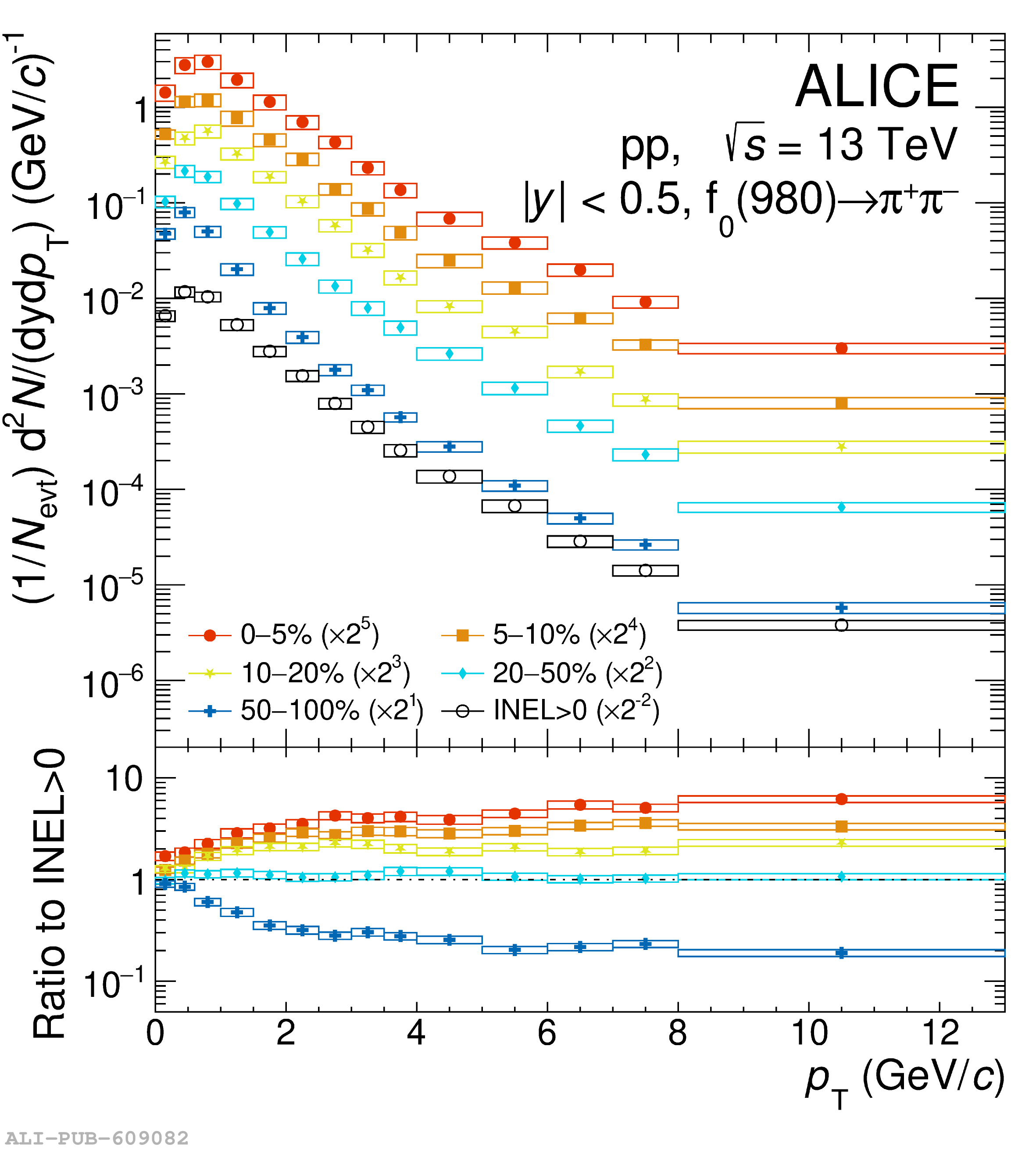 |
Figure 3
$p_{\mathrm{T}}$-integrated yield (left) and mean transverse momentum of \fzero (right) as a function of charged-particle multiplicity. Statistical and systematic uncertainties are represented as bars and boxes, respectively. The uncertainty from the $\mathrm{B.R.}$ is not represented in the left panel. | 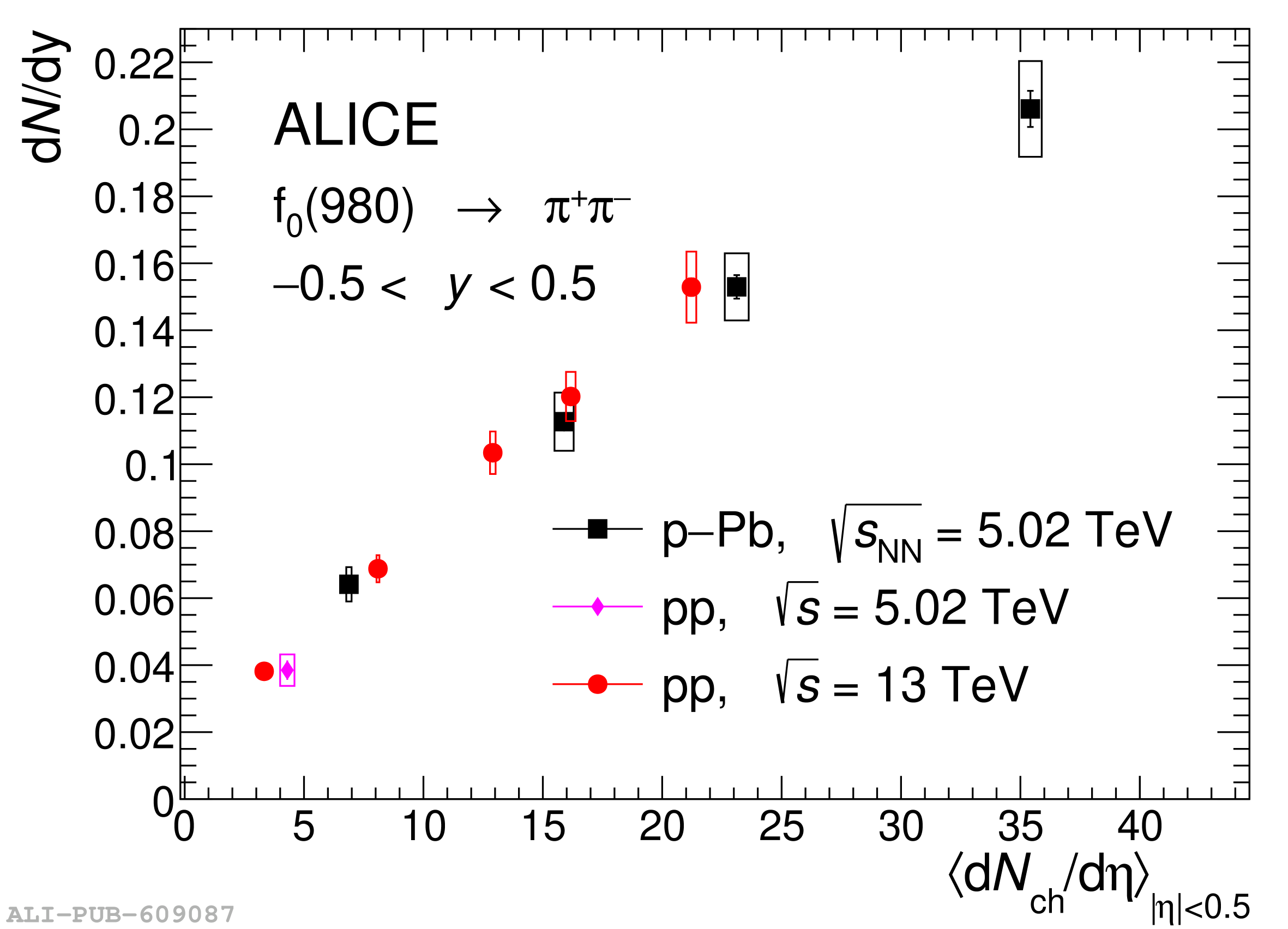 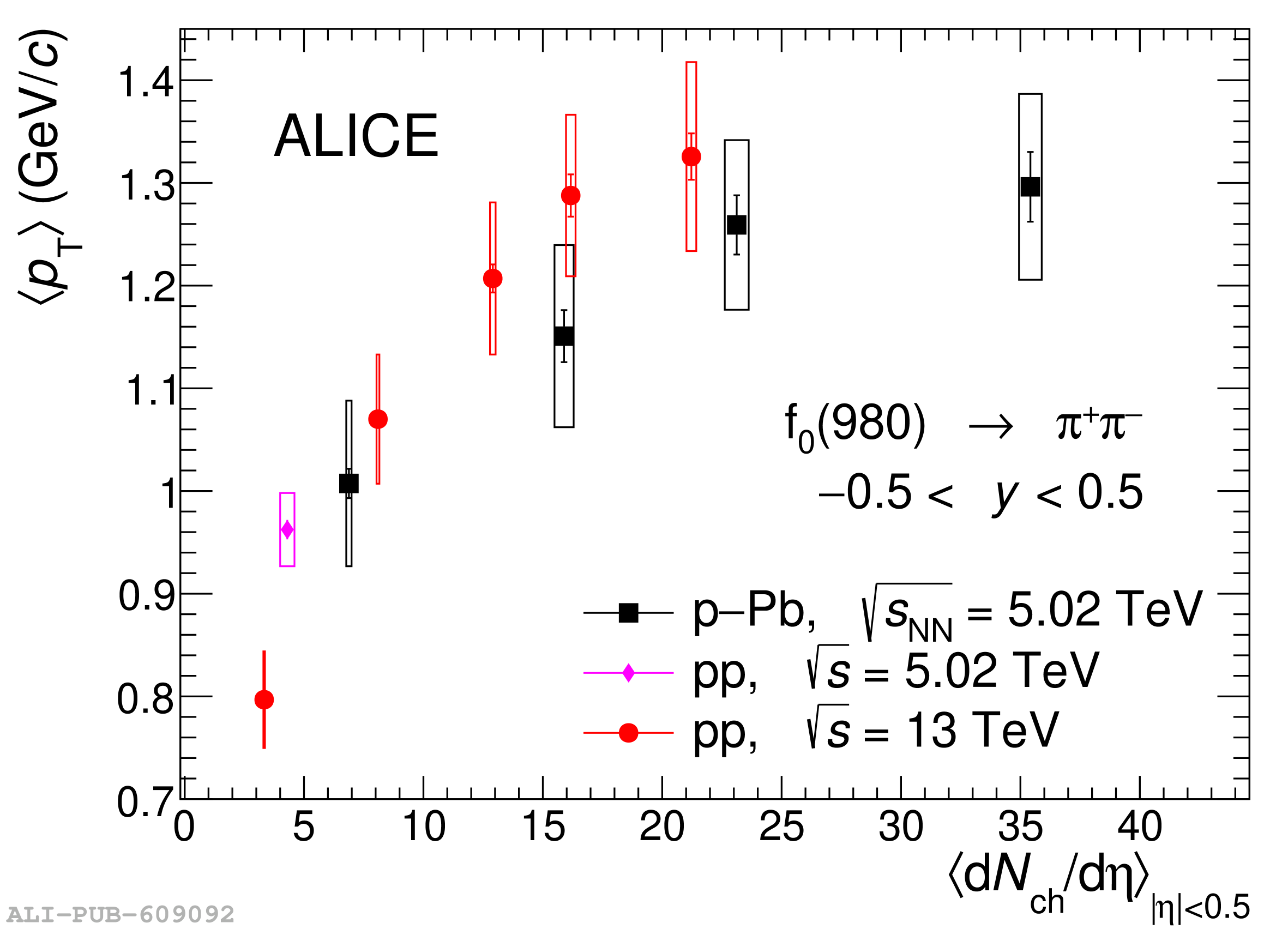 |
Figure 4
Particle yield ratio of \fzero to charged pions as a function of charged-particle multiplicity. Vertical lines and boxes around data points represent statistical and systematic uncertainties, respectively. Two curves show calculations from $\gamma_{s}$CSM with two assumptions for the hidden strangeness of \fzero in the correlation volume of 3$\mathrm{d}V/\mathrm{dy}$. | 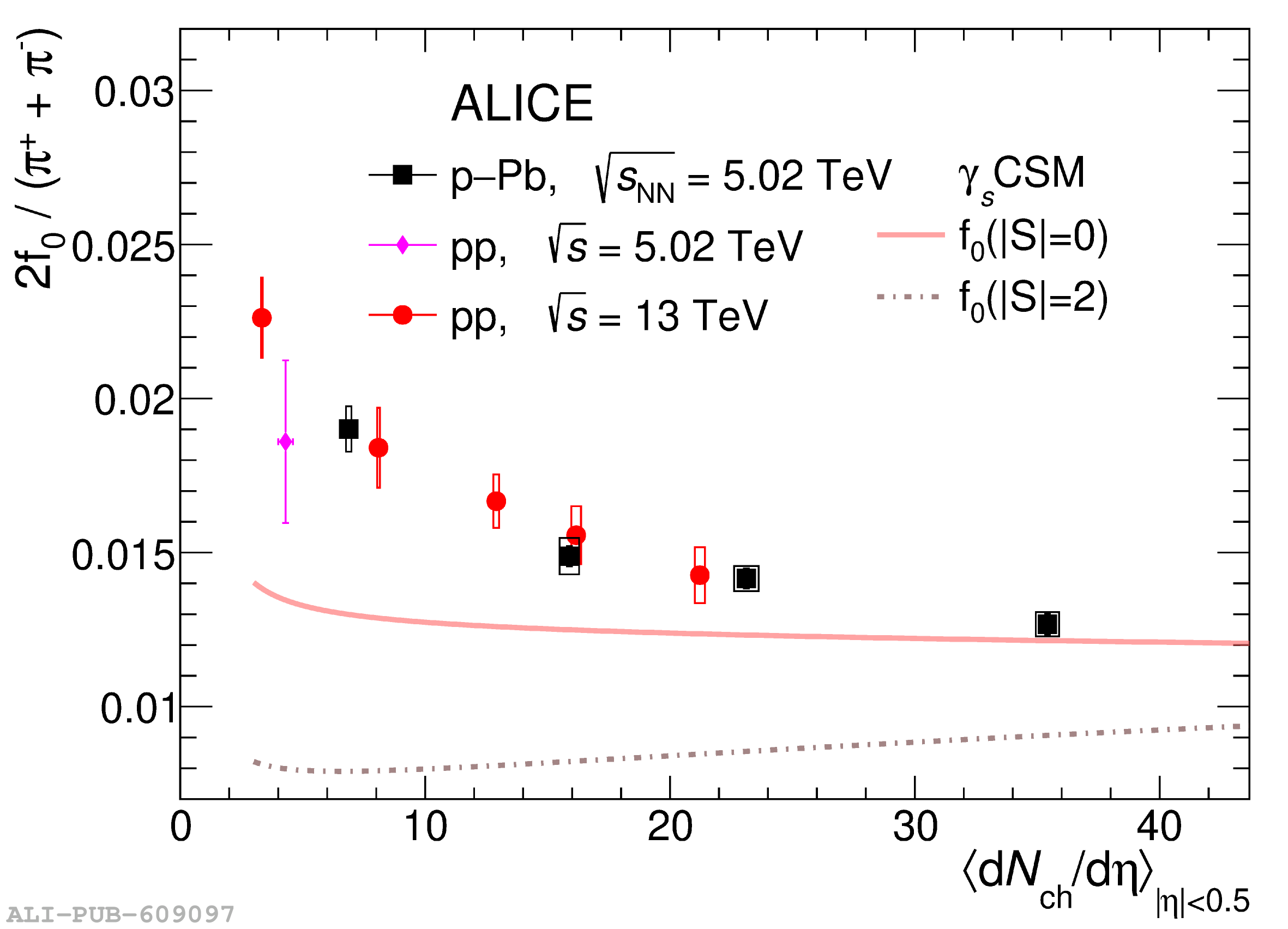 |
Figure 5
Particle yield ratio of \fzero to K$^{*}$(892)$^{0}$ as a function of charged-particle multiplicity. Vertical lines and boxes around data points represent statistical and systematic uncertainties, respectively. Two curves show calculations from $\gamma_{S}$CSM with two assumptions for the hidden strangeness of \fzero in the correlation volume of 3$\mathrm{d}V/\mathrm{dy}$. | 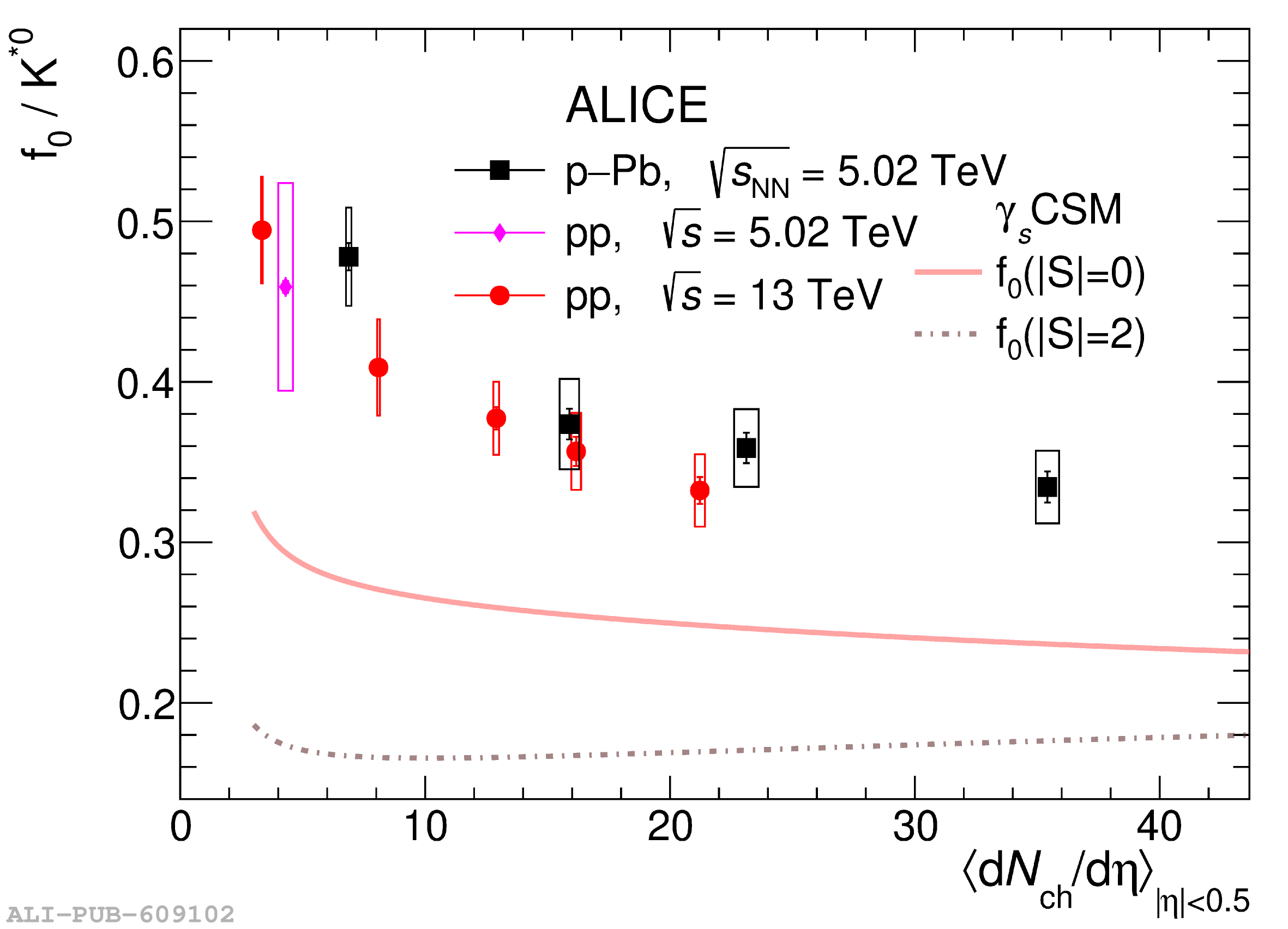 |
Figure 6
Double ratios of \fzero to $\pi$ (left panel) and K$^{*}$(892)$^{0}$ (right panel) as a function of charged-particle multiplicity. The single ratio is divided by the ratio in INEL $>$ 0 events, which cancels correlated systematic uncertainty. Two curves show calculations from $\gamma_{S}$CSM with two assumptions for the hidden strangeness of \fzero in the correlation volume of 3$\mathrm{d}V/\mathrm{dy}$. | 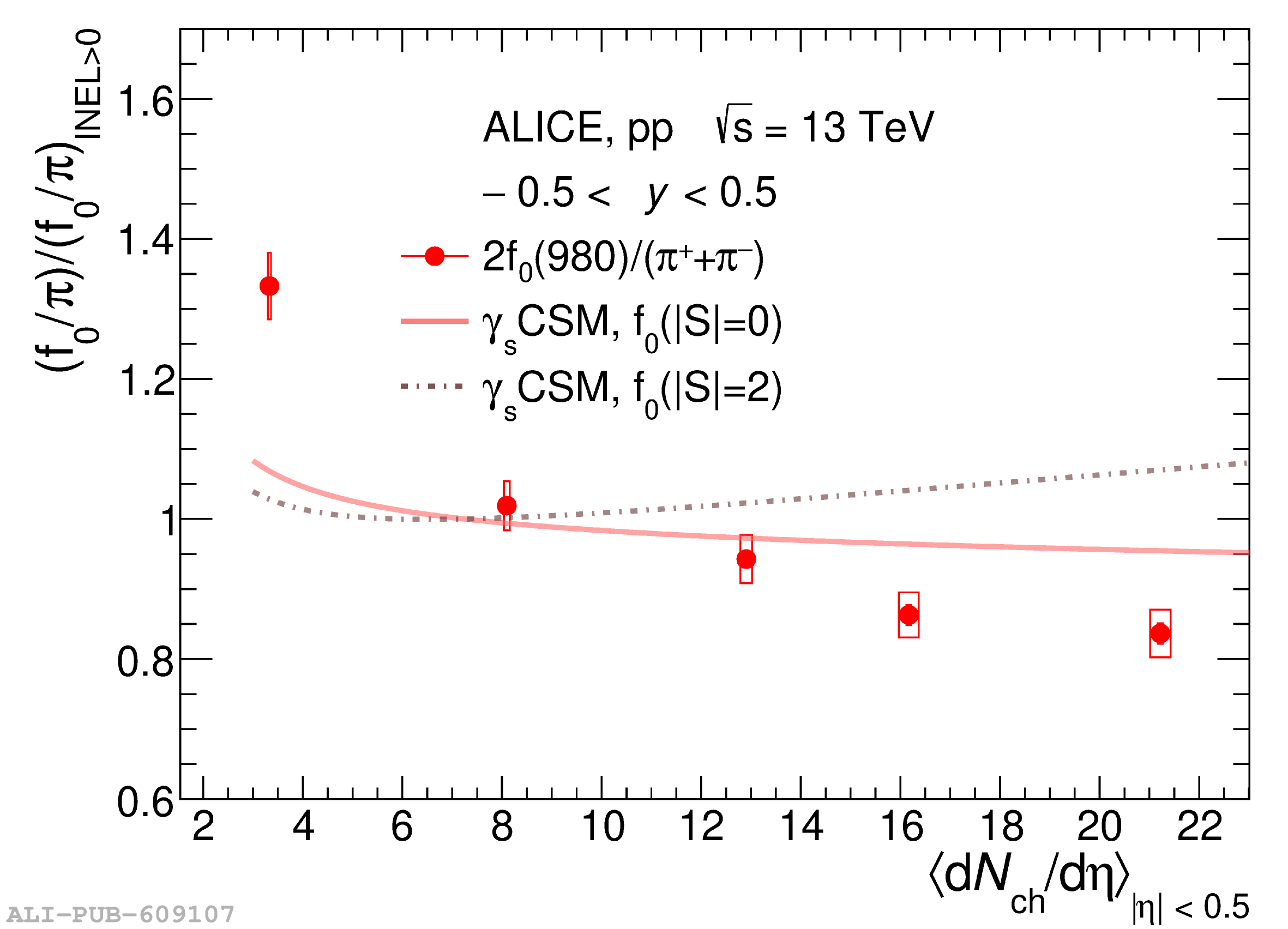 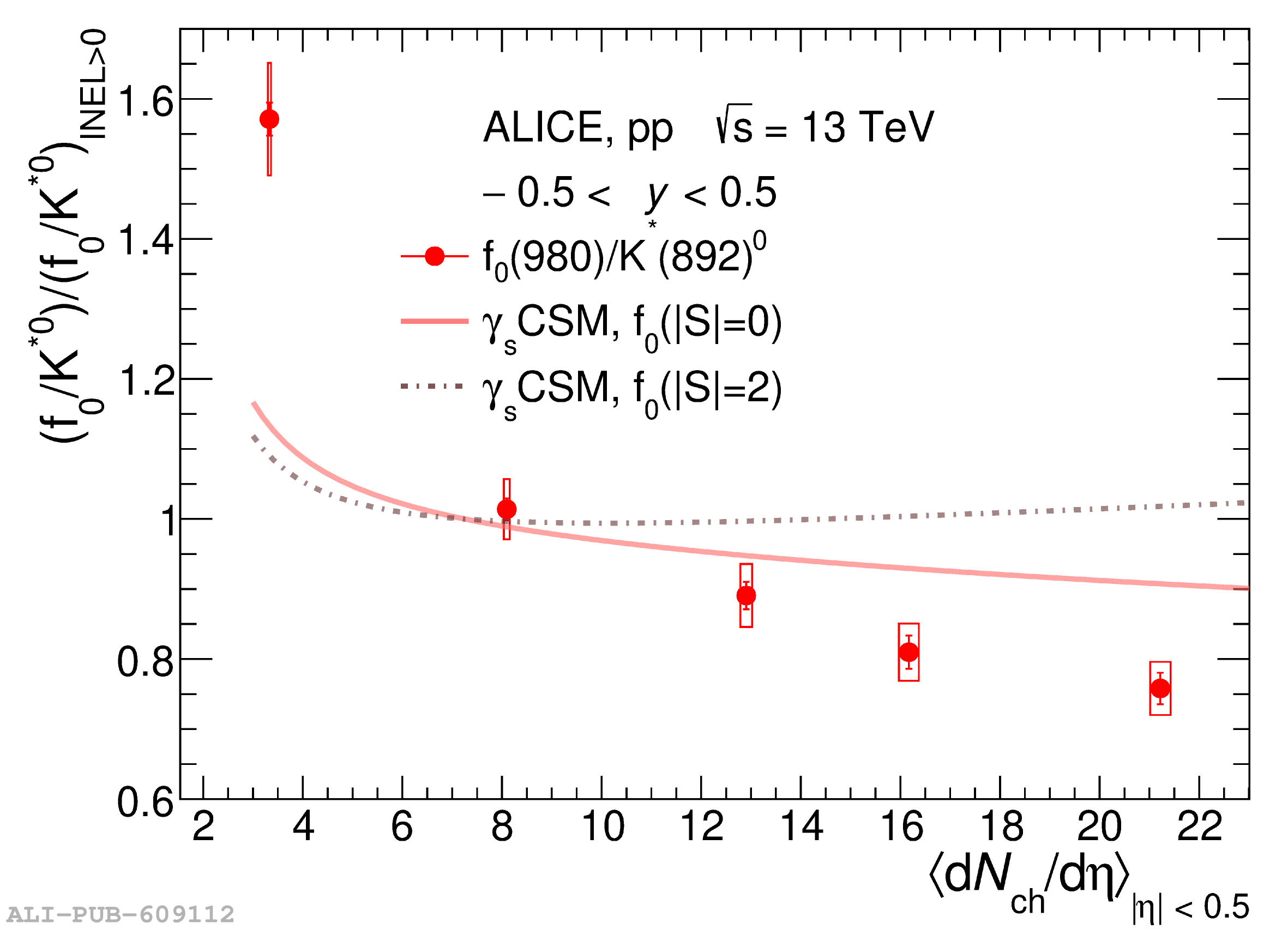 |
Figure 7
Particle yield ratios of \fzero to $\pi$ (left panel) and K$^{*}$(892)$^{0}$ (right panel) as a function of $p_{\mathrm{T}}$ for different multiplicity classes. The lower panel shows double ratios of ratio spectra to INEL $>$ 0 events, where the correlated uncertainties cancel. |   |