
The first results of K$^*$(892)$^{\pm}$ production at midrapidity ($|y| <~ 0.5$) in pp collisions at $\sqrt{s} = 13$ TeV as a function of the event multiplicity are presented. The K$^*$(892)$^{\pm}$ has been reconstructed via its hadronic decay channel K$^*$(892)$^{\pm} \rightarrow~π^{\pm}~+$K$_{\rm S}^0$ using the ALICE detector at the LHC. For each multiplicity class, the differential transverse momentum ($p_{\rm T}$) spectrum, the mean transverse momentum $\langle p_{\rm T} \rangle$, the $p_{\rm T}$-integrated yield (d$N$/d$y$), and the ratio of the K$^*$(892)$^{\pm}$ to K$_{\rm S}^0$ yields are reported. These are consistent with previous K$^*$(892)$^0$ resonance results with a higher level of precision. Comparisons with phenomenological models such as PYTHIA6, PYTHIA8, EPOS-LHC, and DIPSY are also discussed. For the first time, a significant K$^*$(892)$^{\pm}$/K$_{\rm S}^0$ suppression in pp collisions is observed at a 7$σ$ level passing from low to high multiplicity events. The ratios of the $p_{\rm T}$-differential yields of K$^*$(892)$^{\pm}$ and K$_{\rm S}^0$ in high and low multiplicity events are also presented along with their double ratio. For $p_{\rm T} \lesssim 2$ GeV/$c$ this double ratio persists below unity by more than $3σ$ suggesting that the suppression affects mainly low \pt resonances. The measured decreasing trend of the K$^*$(892)$^{\pm}$/K$_{\rm S}^0$ ratio with increasing multiplicity, which in heavy-ion collisions is typically attributed to the rescattering of decay particles of the short-lived resonances, is reproduced by the EPOS-LHC model without the use of hadronic afterburners.
Phys. Lett. B 874 (2026) 140253
HEP Data
e-Print: arXiv:2507.19332 | PDF | inSPIRE
CERN-EP-2025-159
Figure group
Figure 1
The K$^0_{\rm S}\pi^{\pm}$ invariant mass distribution at $|y|< 0.5$ in pp collisions at $\sqrt{s}=13$ TeV for the $1.6 < p_{\rm T} < 2.0$ GeV/$c$ interval in the VI V0M multiplicity class (black full circles), before (upper panel) and after (lower panel) the uncorrelated background subtraction. Statistical uncertainties are shown with error bars. In the upper panel the red open circles describe the background shape evaluated via the event-mixing technique, while the yellow-filled area represents the normalization region (1.1$-$1.2 GeV/$c^2$) between the mixed-event background and the same-event pair invariant mass distribution. In the lower panel the solid green curve is the result of the fit with Eq.1, while the dashed red and blue line describe, respectively, the residual background given by Eq.2 and the non-relativistic Breit--Wigner function. The blue regions represent the tails of the non-relativistic Breit–Wigner fit outside theintegration region. | 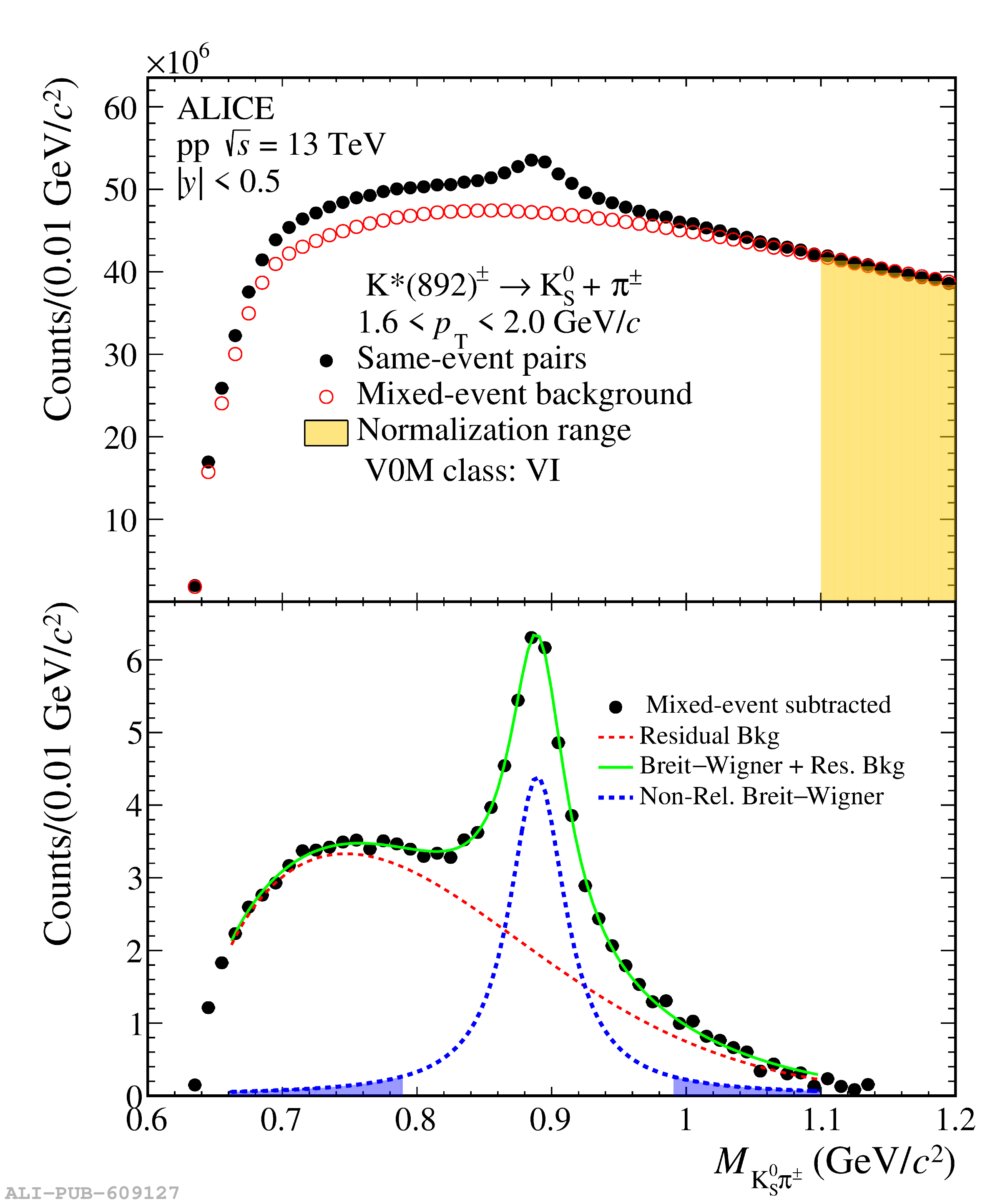 |
Figure 2
The K$^{*\pm}$ and K$^{*0}$ $ p_{\rm T}$ distributions in pp collisions at $\sqrt{s}=13$ TeV for the different multiplicity classes studied, scaled by the indicated factors. Lower panel: ratios of the $ p_{\rm T}$ spectra in each multiplicity class to the multiplicity-integrated INEL$>0$ spectrum. | 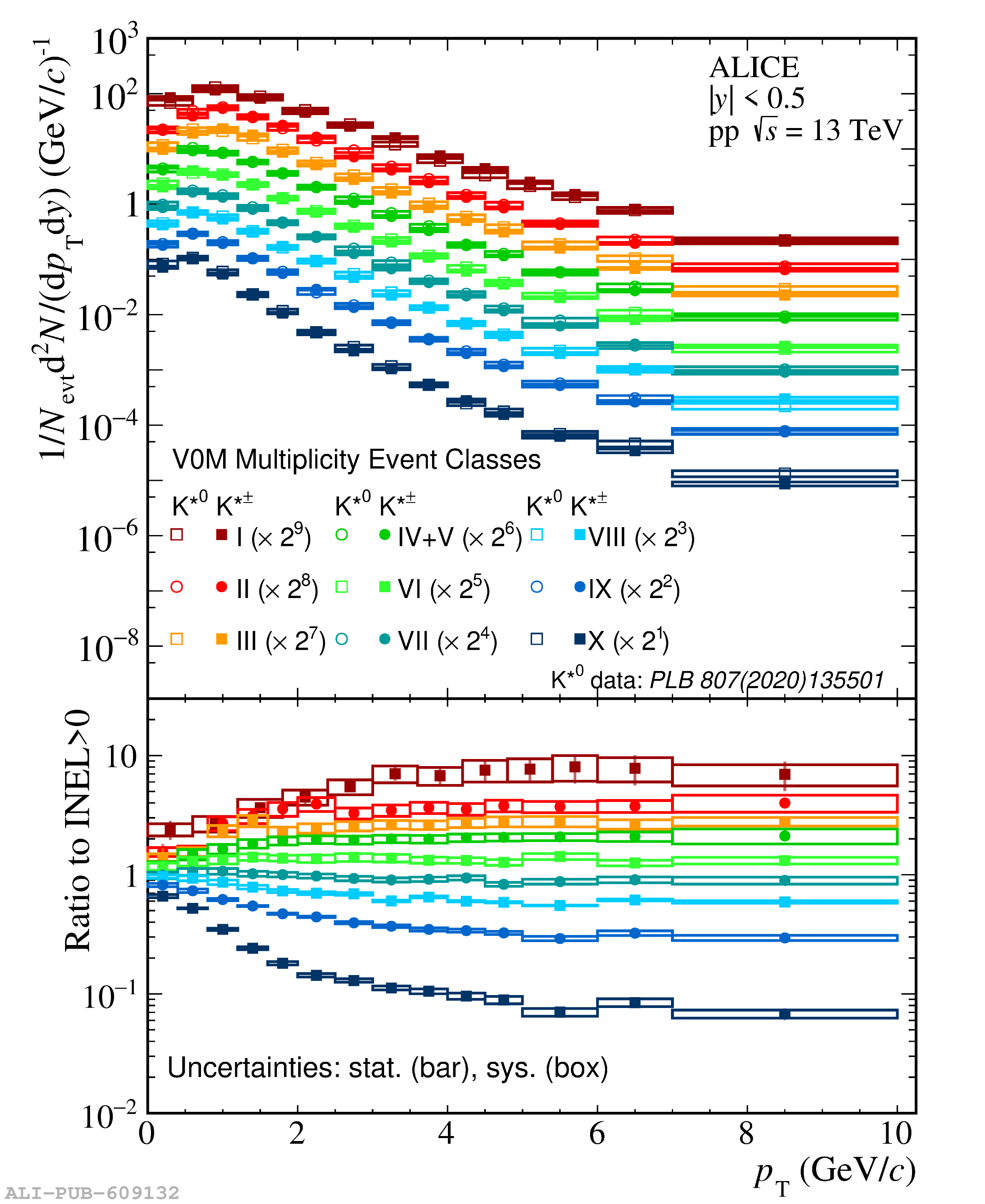 |
Figure 3
The per-event $ p_{\rm T}$-integrated yields d$N$/d$y$ (upper panel) and mean transverse momenta $\langle p_{\rm T} \rangle$ (lower panel) for K$^{*\pm}$ and K$^{*0}$ as a function of the average charged-particle multiplicity density $\langle {\rm d}N/{\rm d}\eta \rangle$. Bars represent statistical uncertainties, open boxes represent total systematic uncertainties, and shaded boxes are the systematic uncertainties uncorrelated with multiplicity. Symbol dimension represents the average charged-particle density uncertainty. The measurements are also compared to predictions from different event generators. | 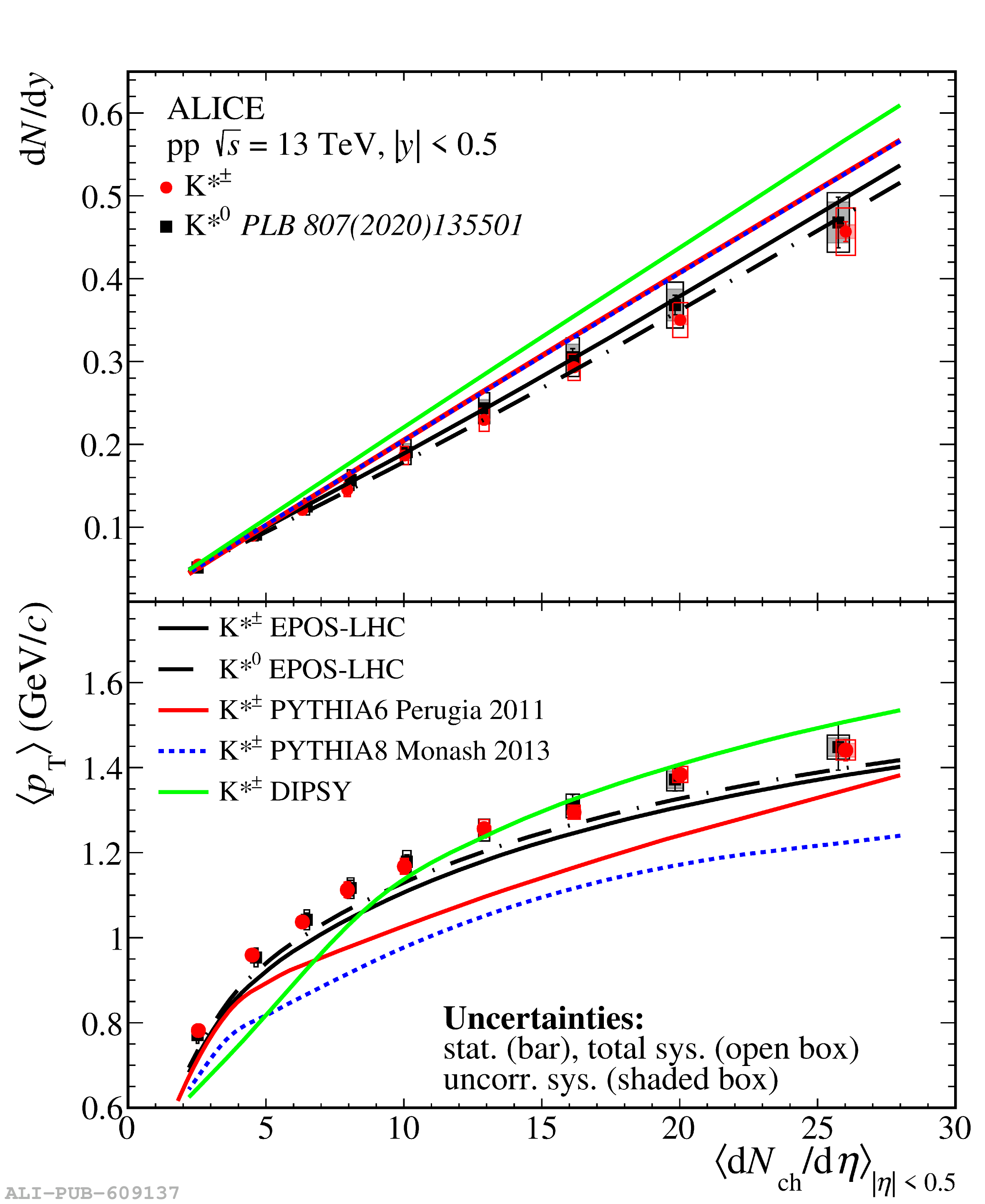 |
Figure 4
Ratios of K$^{*\pm}$/K$^0_{\rm S}$ and K$^{*0}$/K$^0_{\rm S}$ yields in pp collisions at $\sqrt{s}=13$ TeV as a function of the average charged-particle multiplicity density at midrapidity $\langle {\rm d}N/{\rm d}\eta \rangle$. Bars represent statistical uncertainties, open boxes represent total systematic uncertainties, and shaded boxes are the systematic uncertainties uncorrelated with multiplicity. The measurements are also compared to predictions from the PYTHIA6, PYTHIA8, EPOS-LHC, and DIPSY event generators [54, 61–63]. The prediction from EPOS-LHC for K$^{*0}$/K$^0_{\rm S}$ ratio distribution reported in [42] is also shown. | 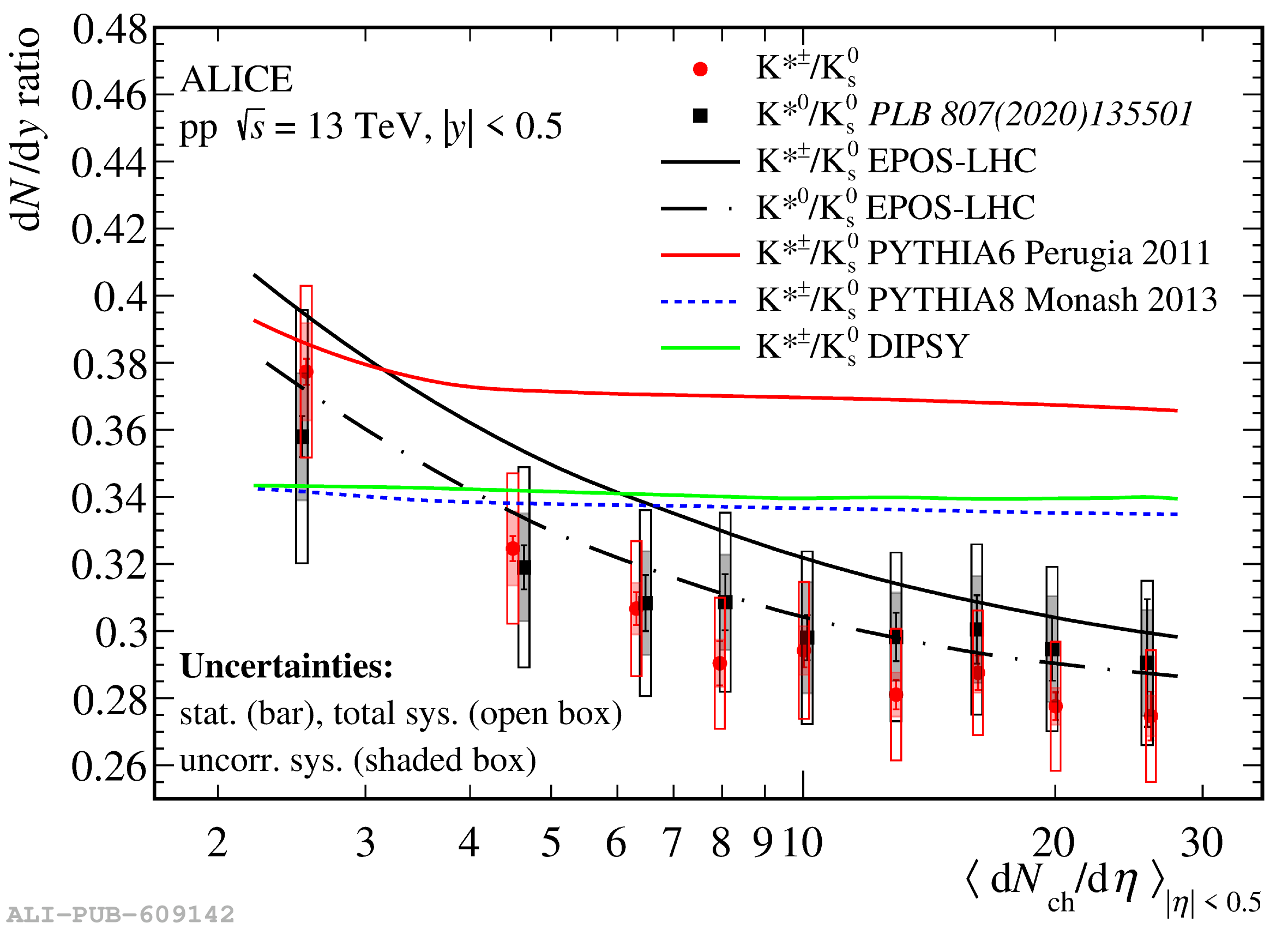 |
Figure 5
Upper panel: ratios of K$^{*\pm}$/K$^0_{\rm S}$ as a function of $p_{\rm T}$ for low (X) and high (I) multiplicity classes. Predictions for PYTHIA8 - Monash2013 (dashed lines) and EPOS-LHC (continuous lines) are also reported Middle panel: the highest multiplicity K$^{*\pm}$/K$^0_{\rm S}$ ratio divided by the lowest multiplicity one (double ratio). Lower panel: significance of the deviation of the double ratio from unity. The dashed black line indicates a deviation at the $3\sigma$ level. Bars represent the statistical uncertainties, while boxes represent the part of the systematic uncertainty that is uncorrelated between the multiplicity classes. | 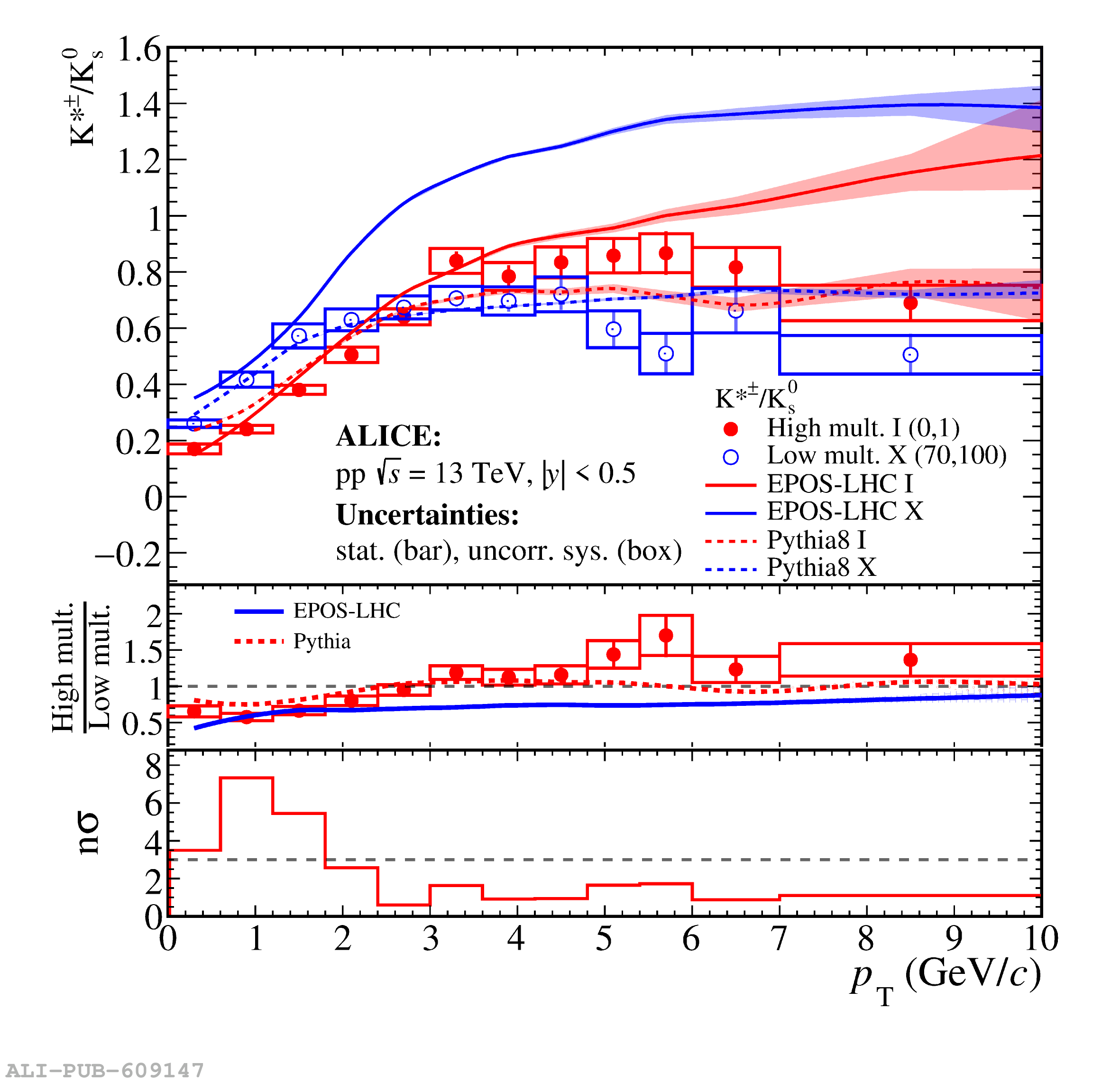 |