
The first measurements of the average transverse-momentum fraction ($\langle z \rangle$) as a function of transverse momentum ($p_{\rm T}$) for strange baryons ($Λ$ and $\barΛ$) and strange mesons (K$_{\rm S}^0$), produced in mini-jets defined through angular correlations in pp collisions at $\sqrt{s}=13$ TeV, are reported by the ALICE Collaboration at the LHC. The observable is obtained using a novel method, where the angular correlation between the strange hadrons and inclusive charged hadrons is weighted by the $p_{\rm T}$ of correlated particles at small angular distance. As a function of strange particles' $p_{\rm T}$, the results reveal a flat trend for strange mesons and a decreasing trend for strange baryons in the measured $p_{\rm T}$ region, indicating distinct hadronization mechanisms for K$_{\rm S}^0$ and $Λ$($\barΛ$). The measurements are compared to Monte Carlo models, namely PYTHIA 8 (with both Monash and Color Rope tunes) and the AMPT (A Multi-Phase Transport) model with string melting. None of these models provides a satisfactory description of the $\langle z \rangle$ distributions at low and intermediate $p_{\rm T}$.
Phys. Lett. B 880 (2026) 140766
HEP Data
e-Print: arXiv:2603.19387 | PDF | inSPIRE
CERN-EP-2026-074
Figure group


Figure 2
Examples of $\Delta\varphi$ projections of the fully corrected $p_{\rm T}$-weighted correlation functions for K$^0_{\rm S}$$-$primary charged-particles correlation (left) and for $\Lambda$ ($\bar{\Lambda}$)$-$primary charged-particles correlation (right). The “short-range” ($\left| \Delta\eta \right| < 1.2$) and the normalized “long-range” ($1.2 < \left| \Delta\eta \right| < 1.4$) projections are shown in green and red points, respectively. | 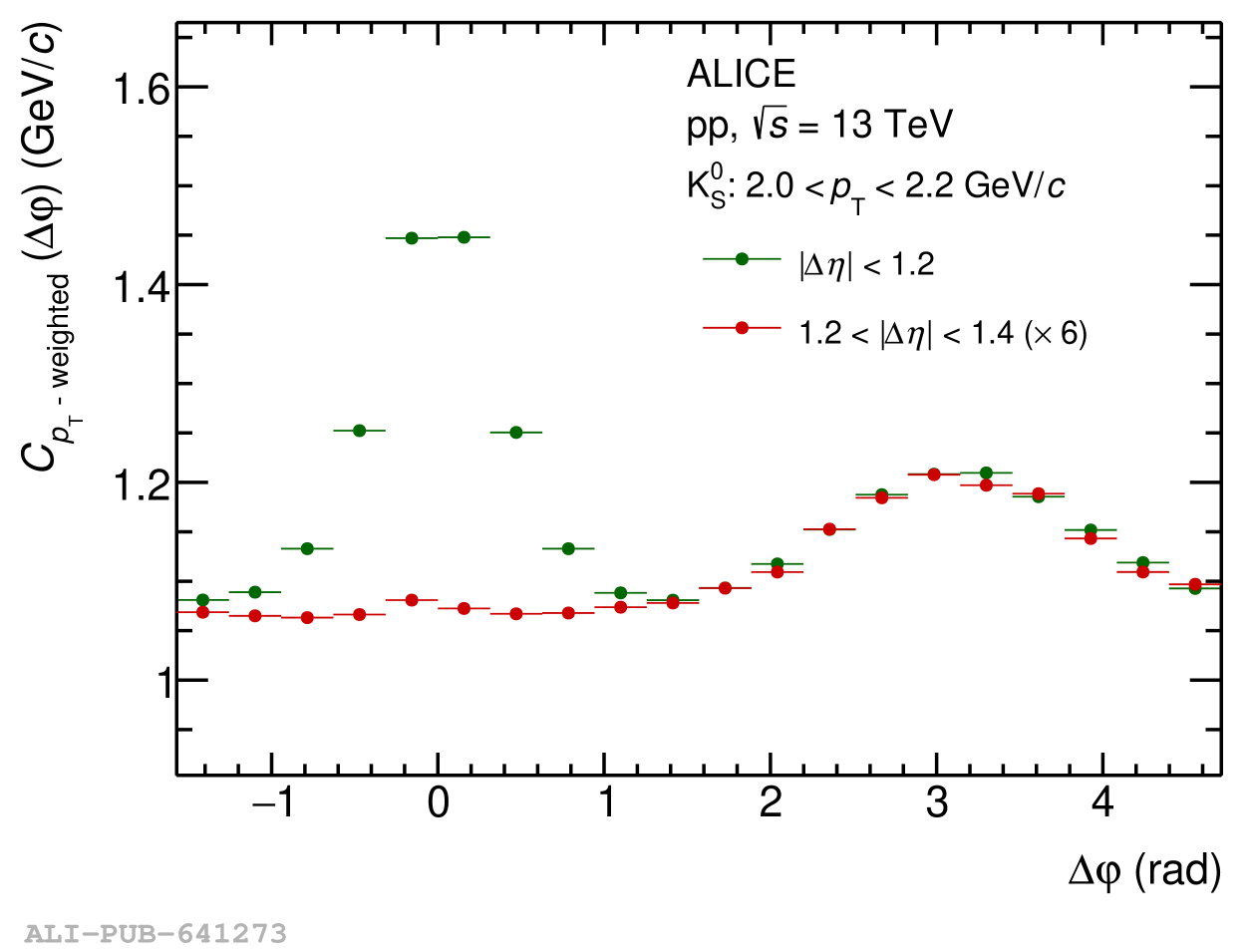 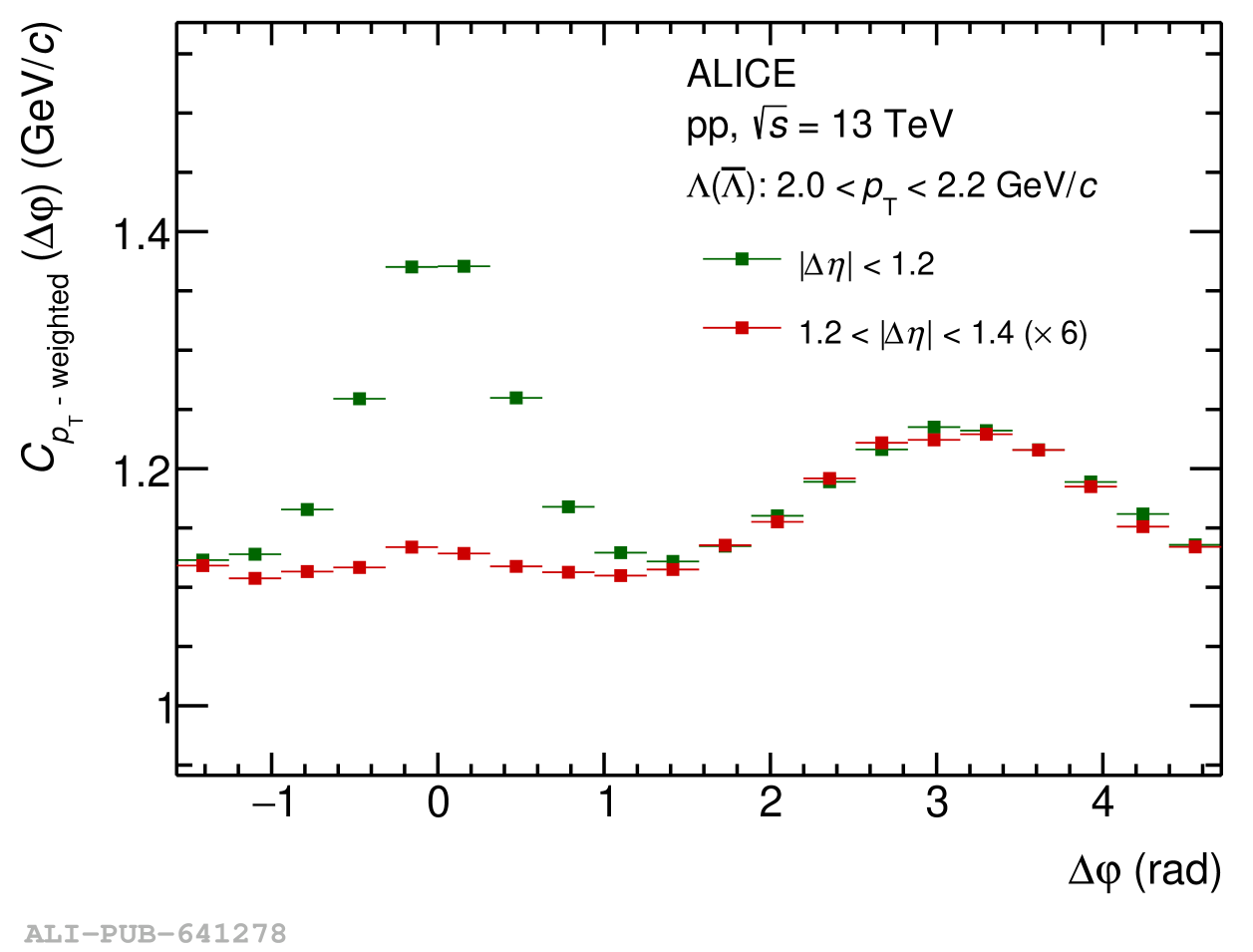 |
Figure 3
The average transverse-momentum fraction ($\langle z \rangle$) for $\Lambda$ ($\bar{\Lambda}$) (blue) and K$^0_{\rm S}$ (red) as a function of $p_{\rm T}^{\rm S}$ in minimum bias pp collisions at $\sqrt{s}=13$ TeV. The $p_{\rm T}^{\rm S}$ ranges from 0.6 to 20 GeV/$c$. Statistical and systematic uncertainties of $\langle z \rangle$ are represented by vertical error bars and empty boxes, respectively. Data points are drawn at the corresponding average $p_{\rm T}^{\rm S}$ values in each interval. The horizontal bars represent the $p_{\rm T}^{\rm S}$ interval widths. The statistical and systematic uncertainties of the average $p_{\rm T}^{\rm S}$ values are negligible. | 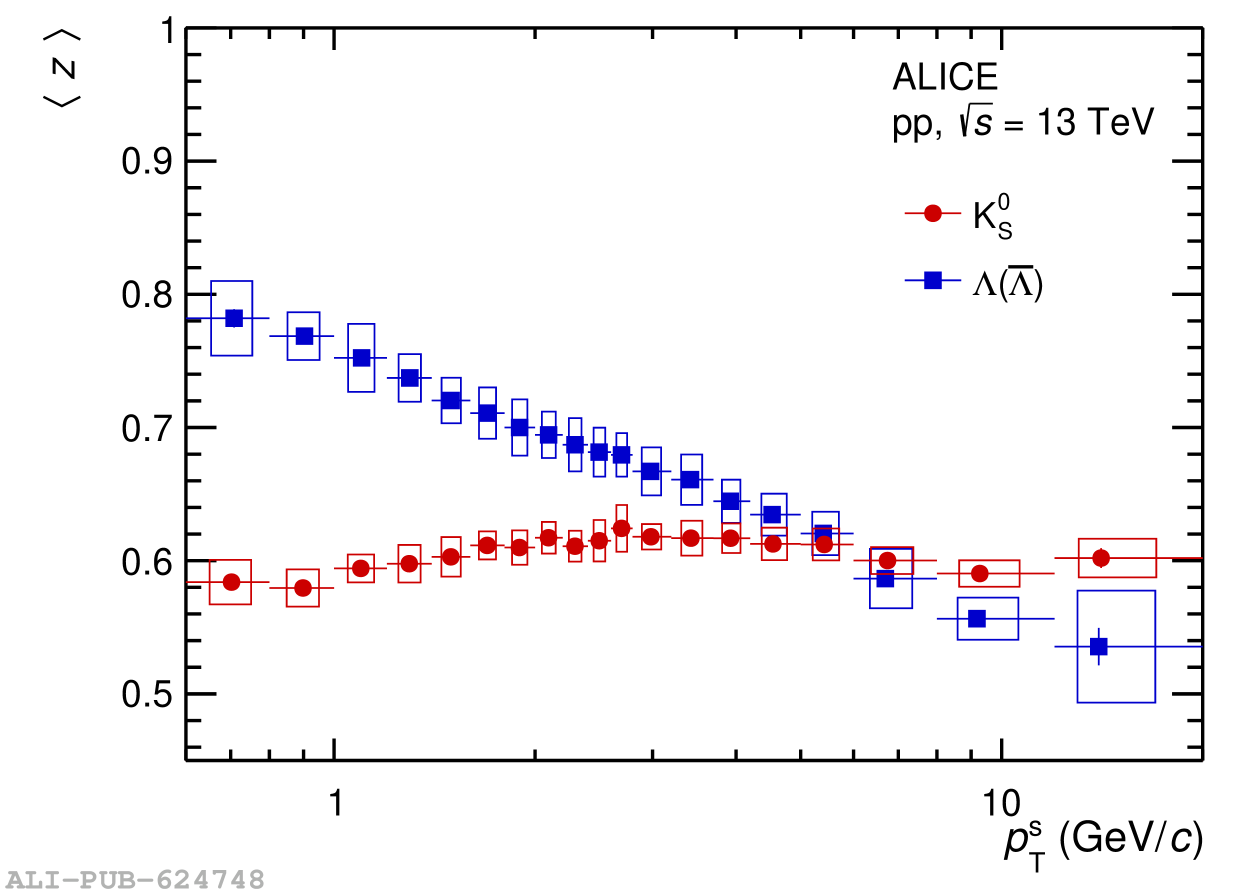 |
Figure 4
The average transverse-momentum fraction ($\langle z \rangle$) for K$^0_{\rm S}$ (top) and $\Lambda$ ($\bar{\Lambda}$) (bottom) in data compared with model calculations. The data are compared to PYTHIA 8 with the Monash tune (red band), the Color Rope tune (green band) and the AMPT model with the string melting (blue band). For both PYTHIA 8 tunes, the hatched bands represent the results excluding K$^0_{\rm S}$ triggers coming from decays of the resonances ${\rm K}^{*}(892)^{0}$, ${\rm K}^{*}(892)^{\pm}$, and $\phi(1020)$, and $\Lambda$ ($\bar{\Lambda}$) triggers coming from decays of $\Sigma^{\pm}$, $\Xi^{-}$, $\Omega^{-}$ and their corresponding antiparticles. | 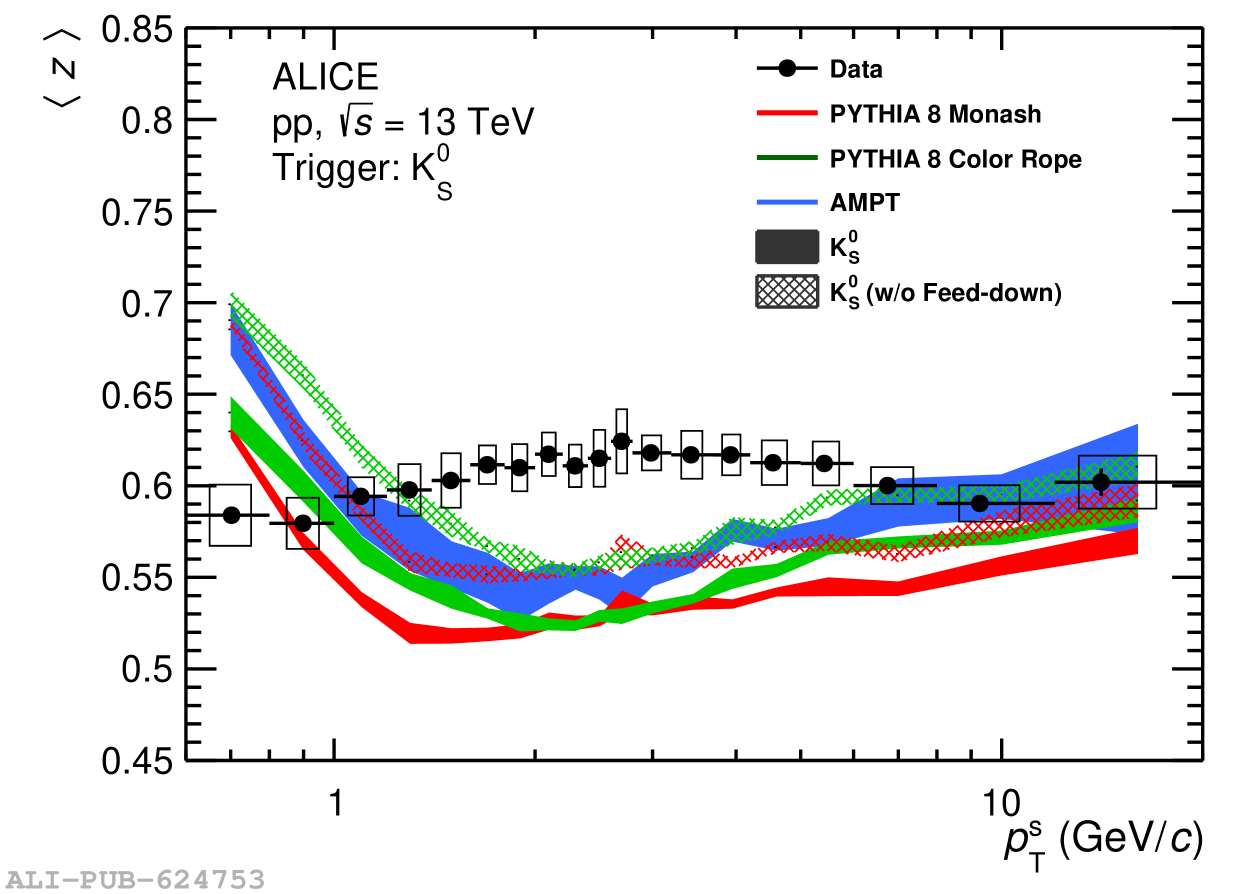 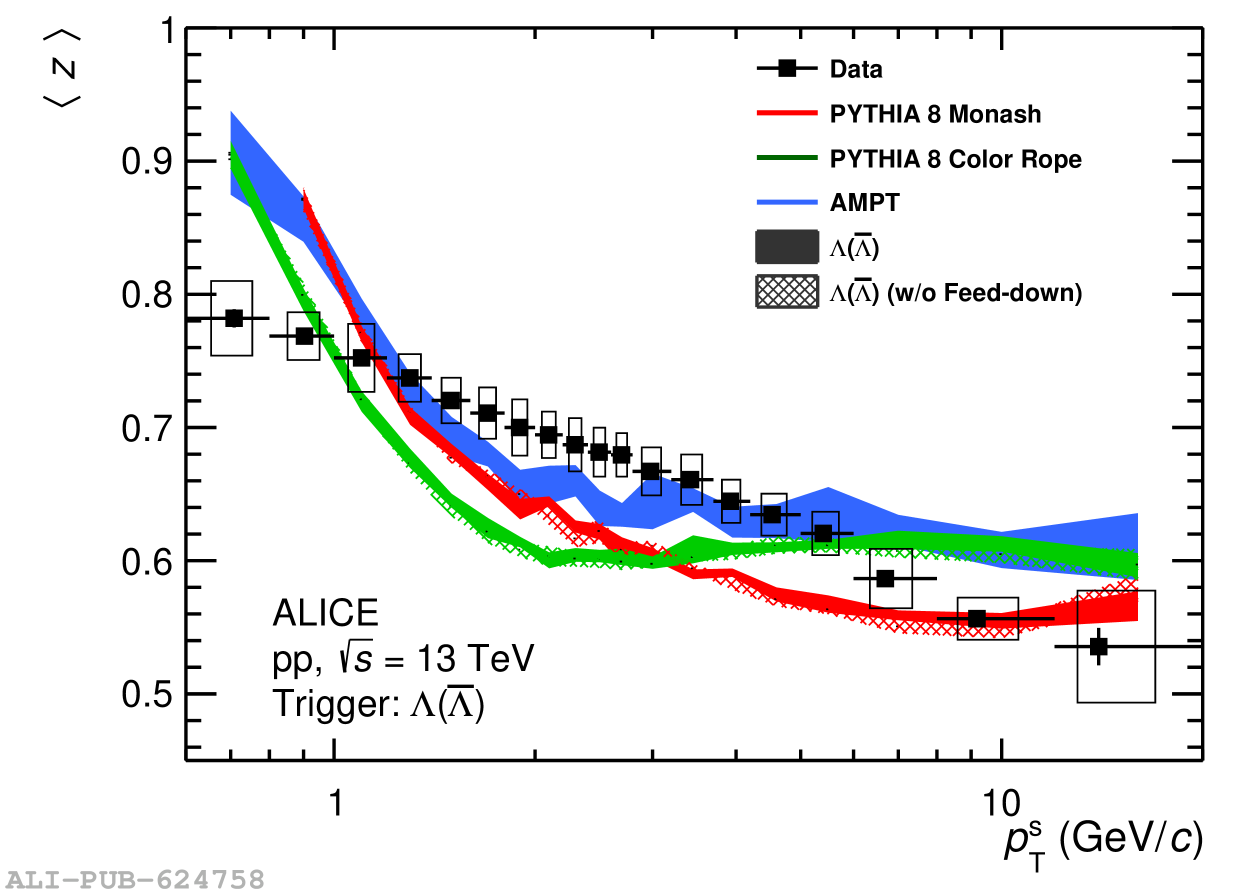 |