
Quantum Chromodynamics predicts a phase transition from hadronic matter to quark$-$gluon plasma (QGP) at high temperatures and energy densities, where quarks and gluons (partons) are no longer confined within hadrons. The QGP forms in ultrarelativistic heavy-ion collisions. Anisotropic flow coefficients, quantifying the azimuthal expansion of produced matter, probe QGP properties. Flow measurements in high-energy heavy-ion collisions show a distinctive grouping of anisotropic flow for baryons and mesons at intermediate transverse momentum $-$ a feature associated with flow imparted at the quark level, confirming QGP existence. The observation of QGP-like features in proton$-$proton and proton$-$ion collisions has sparked debate about QGP formation in smaller systems. For the first time, we demonstrate the distinctive grouping of anisotropic flow for baryons and mesons in high-multiplicity proton$-$lead and proton$-$proton collisions at the Large Hadron Collider (LHC). These results are described by a model including hydrodynamic flow followed by hadron formation via quark coalescence, consistent with the formation of partonic flowing systems in these collisions.
Nature Commun. 17 (2026) 1, 2585
HEP Data
e-Print: arXiv:2411.09323 | PDF | inSPIRE
CERN-EP-2024-299
Figure group
Figure 1
Illustration of the overlap region [12]. A schematic representation of the overlap region in a collision is shown in gray, along with overall particle emission patterns in the transverse (x-y) plane, represented by large arrows. a) Non-flow sources: These are independent emissions, such as those from resonance decays or jets, where jets are collimated streams of hadrons created when a high-energy quark or gluon fragments after a collision. These effects lead to few-particle correlations but are not related to collective behavior in the system and have been subtracted from the final anisotropic flow measurements (see A.4 methods subsection for details). b) Anisotropic flow: This illustrates the development of anisotropic flow in a partonic system, propagated to the level of hadrons via the quark coalescence process, which describes the experimental measurements in the intermediate \pt range ($\sim$3--8 GeV/c). In this process, two or three flowing partons coalesce to form mesons or baryons, which then interact with each other. The large arrows represent the overall anisotropy of particle emission in the transverse plane, with stronger expansion along the short (x) axis. | 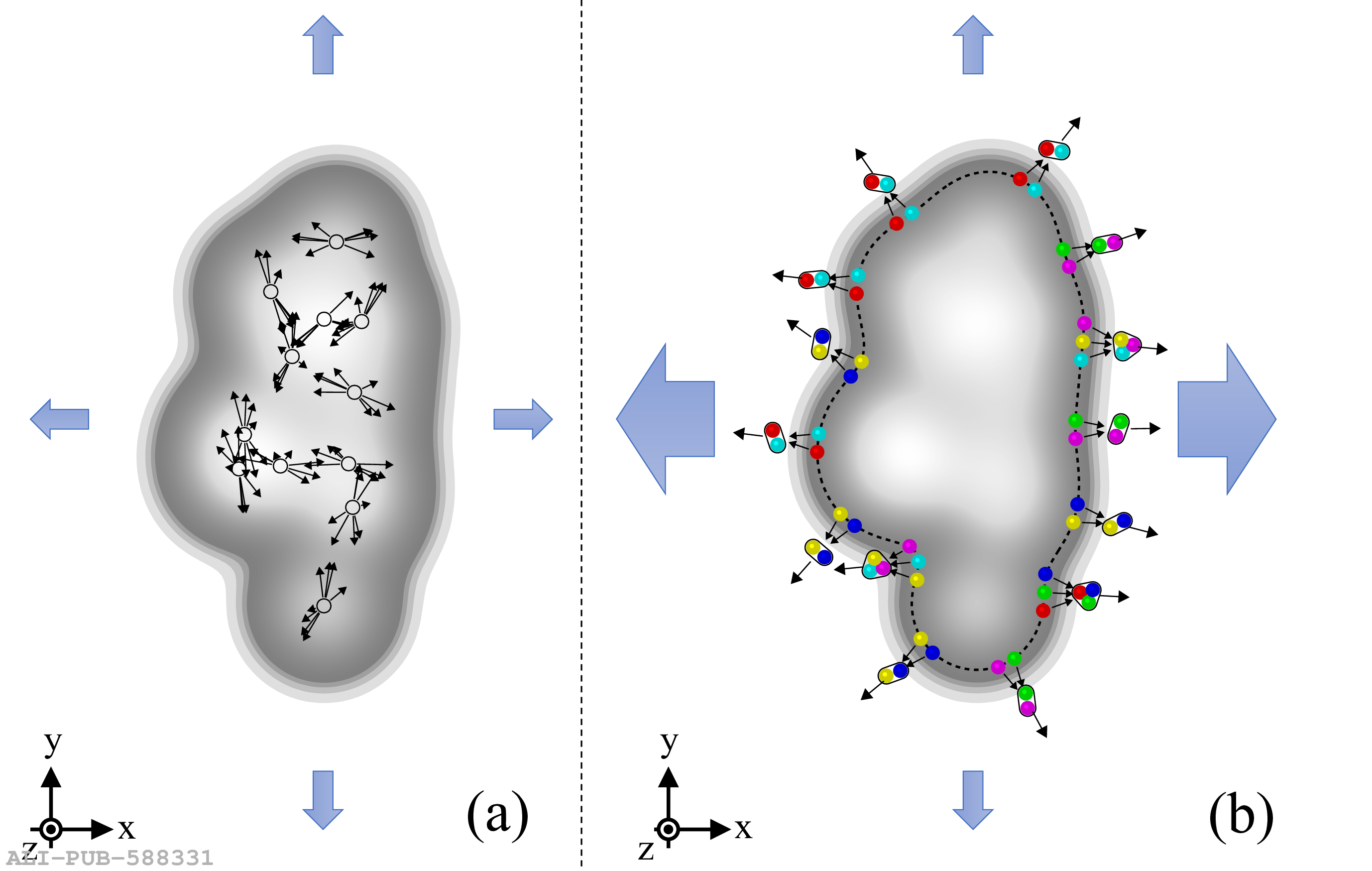 |
Figure 2
$p_{\rm T}$-differential $v_2$ measured with the two-particle correlation method for mesons ($\pi^\pm$, ${\rm K}^\pm$, ${\rm K}^0_{\rm S}$) and baryons (${\rm p}^+\bar{\rm p}$, $\Lambda+\bar{\Lambda}$). Left: results for semicentral Pb--Pb collisions at $\sqrt{s_{\mathrm{NN}}} = 5.02$ TeV. Middle: results in high-multiplicity p--Pb collisions at $\sqrt{s_{\mathrm{NN}}} = 5.02$ TeV. Right: Same for pp collisions at $\sqrt{s} = 13$ TeV. $\langle N_{\rm ch} \rangle$ is the average number of reconstructed, efficiency-corrected charged particles with $0.2 < p_{\rm T} < 3.0$ GeV/$c$ at midrapidity ($|\eta| < 0.8$). Horizontal bars (boxes) represent the statistical (systematic) uncertainties. |  |
Figure 3
$v_2$ in high-multiplicity p--Pb collisions. $p_{\rm T}$-differential $v_2$ measured with two-particle correlation for mesons ($\pi^\pm$, ${\rm K}^\pm$, ${\rm K}^0_{\rm S}$) and baryons (${\rm p}^+\bar{\rm p}$, $\Lambda+\bar{\Lambda}$) in high-multiplicity p--Pb collisions at $\sqrt{s_{\mathrm{NN}}} = 5.02$ TeV. Horizontal bars (boxes) represent the statistical (systematic) uncertainties. Comparisons with the calculations from the Hydro-Coal-Frag model (left) and the Hydro-Frag model (right) are also presented. Only statistical uncertainties are shown for the calculations. |  |
Figure 4
$v_2$ in high-multiplicity pp collisions. $p_{ rm T}$-differential $v_2$ measured with two-particle correlation for mesons ($\pi^\pm$, ${\rm K}^\pm$, ${\rm K}^0_{\rm S}$) and baryons (${\rm p}^+\bar{\rm p}$, $\Lambda+\bar{\Lambda}$) in high-multiplicity pp collisions at $\sqrt{s} = 13$ TeV. Horizontal bars (boxes) represent the statistical (systematic) uncertainties. Comparisons with the calculations from the Hydro-Coal-Frag model (left) and the Hydro-Frag model (right) are also presented. Only statistical uncertainties are shown for the calculations. | 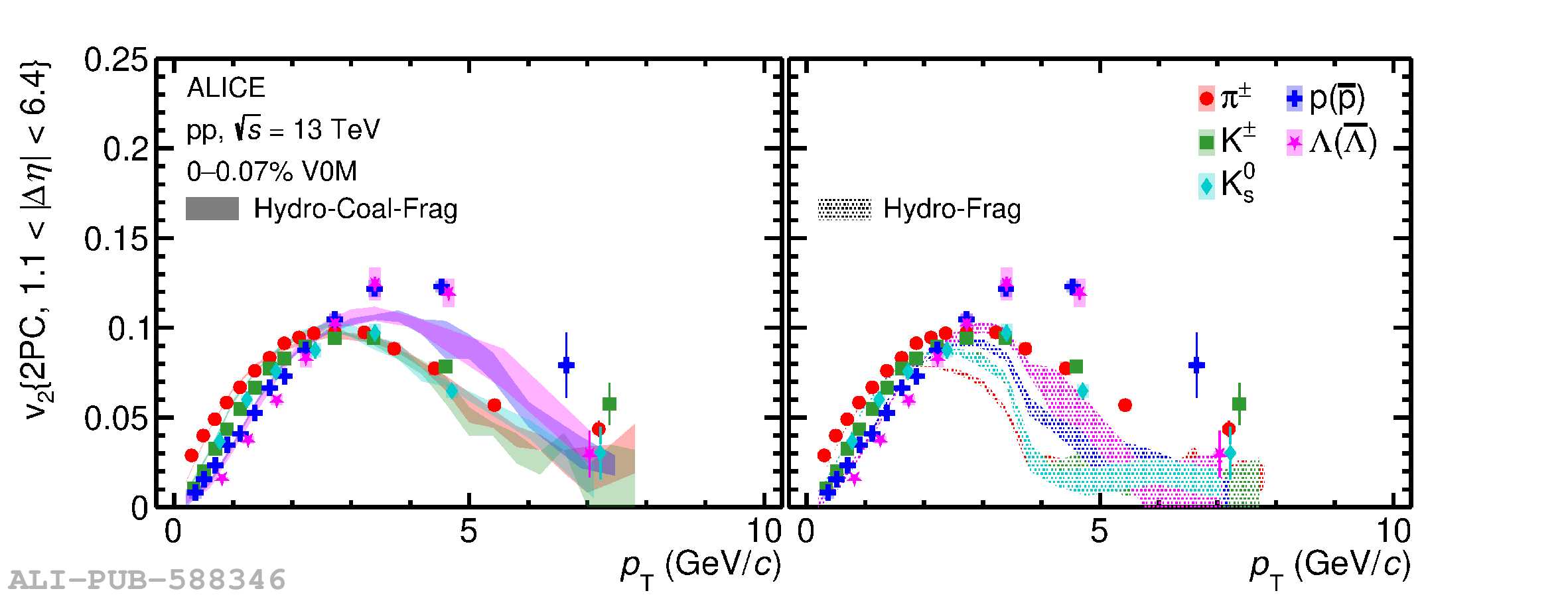 |
Figure A.1
$v_2$ in high-multiplicity p--Pb collisions compared with AMPT calculations. $p_{\rm T}$-differential $v_2$ measured with two-particle correlation for mesons ($\pi^\pm$, ${\rm K}^\pm$, ${\rm K}^0_{\rm S}$) and baryons (${\rm p}^+\bar{\rm p}$, $\Lambda+\bar{\Lambda}$) in high-multiplicity p--Pb collisions at $\sqrt{s_{\mathrm{NN}}} = 5.02$ TeV. Horizontal bars (boxes) represent the statistical (systematic) uncertainties. Comparison with the calculations from the AMPT String-melting model is also presented. The AMPT curves are obtained by applying the same template fit method to the correlation distributions as used in the data analysis. Only statistical uncertainties are shown for the AMPT calculations. | 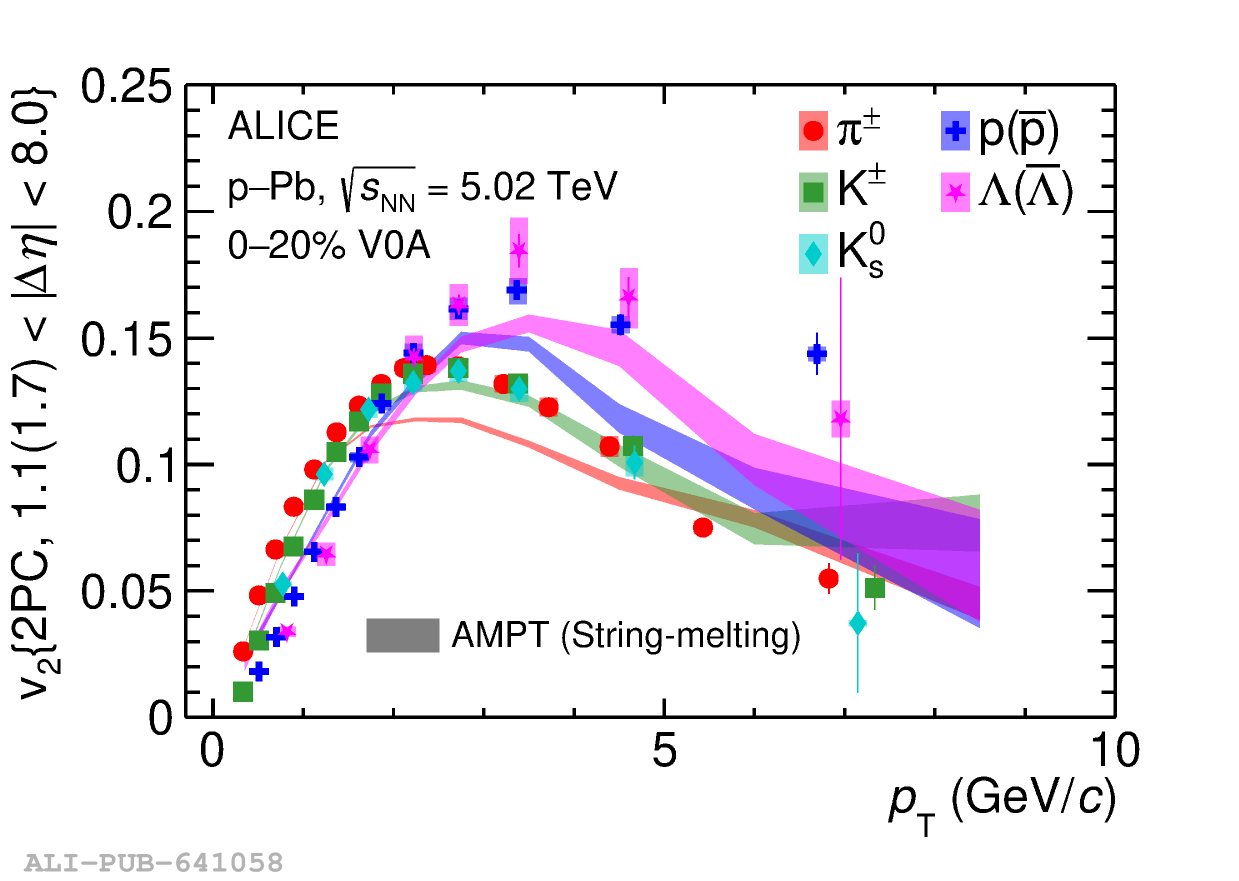 |