
The nuclear modification factor $R_\mathrm{AA}$ of charm jets, identified by the presence of a D$^0$ meson among the jet constituents, has been measured for the first time in Pb-Pb collisions at a centre-of-mass energy per nucleon pair $\sqrt{s_{\rm NN}} = 5.02$ TeV with the ALICE detector at the LHC. The D$^0$ mesons and their charge conjugates are reconstructed from the hadronic decay D$^0\to \mathrm K^{-}π^{+}$. Jets are reconstructed from D$^0$-meson candidates and charged particles using the anti-$k_\mathrm{T}$ algorithm with jet resolution parameter $R=0.3$, in the jet transverse momentum ($p_\mathrm{T}$) range 5 $<~ p_\mathrm{T}^\mathrm{ch~jet}<~$ 50 GeV/$c$ and pseudorapidity $|η^\mathrm{ch~jet}| <~ 0.6$. A hint of reduced suppression in the charm-jet $R_\mathrm{AA}$ is observed in comparison to inclusive jets in central Pb-Pb collisions with a significance of about 2$σ$ in 20 $<~ p_\mathrm{T}^\mathrm{ch~jet}<~$ 50 GeV/$c$, suggesting the in-medium energy loss to depend on both the difference between quark and gluon coupling strength (Casimir colour-charge effect) and quark mass (dead-cone effect). The data are compared with model calculations that include mass effects in the in-medium energy loss. Several state-of-the-art models are consistent with the data, with the LIDO model providing the best description of the data in the common kinematic range of inclusive and D$^0$-tagged jets, highlighting the role of mass effects in interpreting the results.
Phys. Lett. B 875 (2026) 140299
HEP Data
e-Print: arXiv:2409.11939 | PDF | inSPIRE
CERN-EP-2024-240
Figure group
Figure 1
Transverse-momentum differential yields of charm jets tagged with prompt \Dzero mesons in central (0--10\%) Pb--Pb collisions at $\snn\ = 5.02$ TeV (red circles) and cross section in pp collisions at $\s\ = 5.02$ TeV (blue squares) scaled by the nuclear overlap function $\left \langle T_\mathrm{AA} \right \rangle$ for the considered centrality interval.The vertical lines and boxes represent the statistical and systematic uncertainties, respectively. | 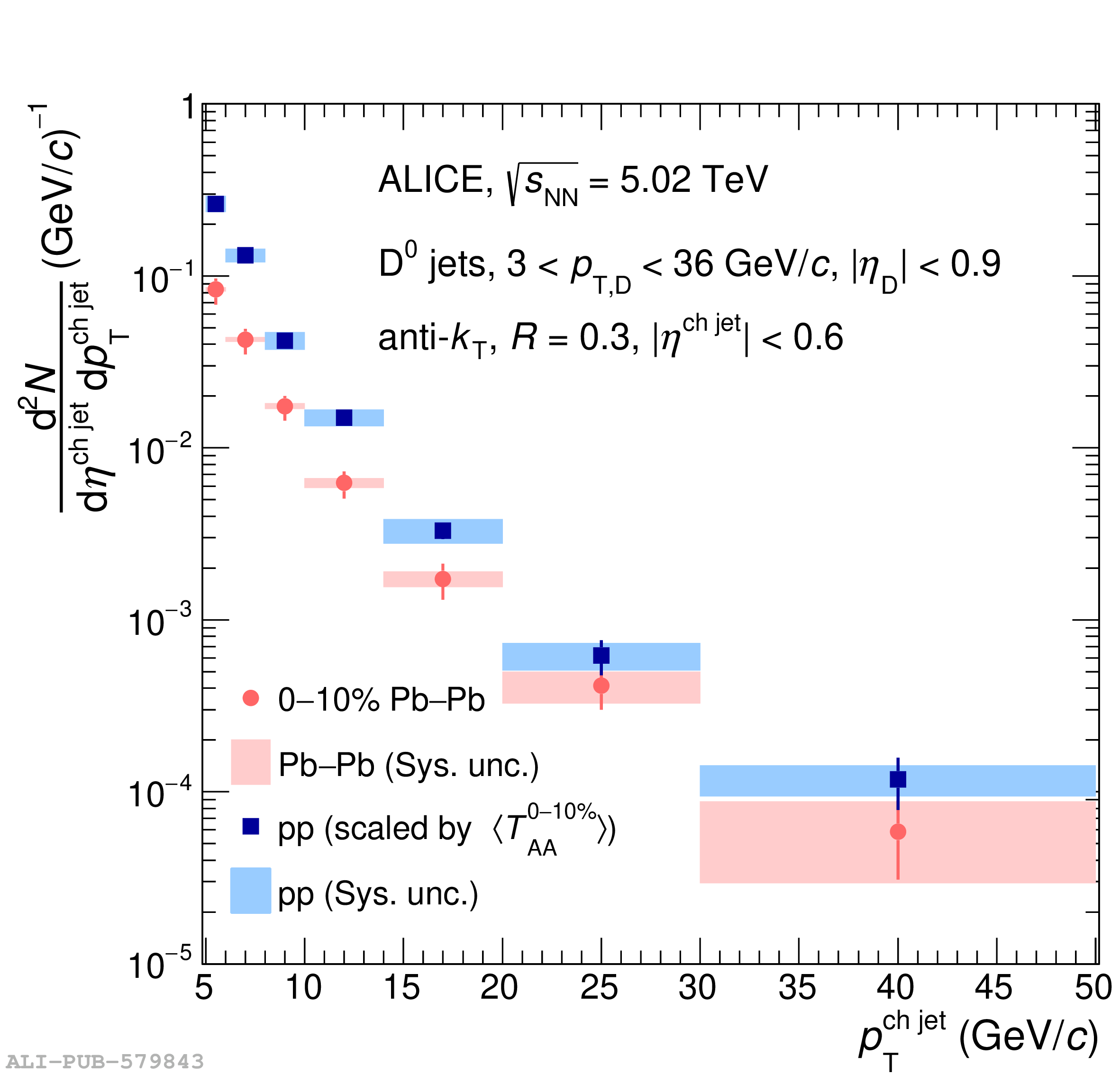 |
Figure 2
Nuclear modification factor of \Dzero-tagged jets (red markers) and inclusive jets with resolution parameter $R=0.2$ (light blue) and $R=0.4$ (blue markers) Statistical and systematic uncertainties are shown as vertical error bars and boxes, respectively. The global uncertainty originated from the $\left \langle T_\mathrm{AA} \right \rangle$ normalisation and the luminosity is displayed as a box around unity. | 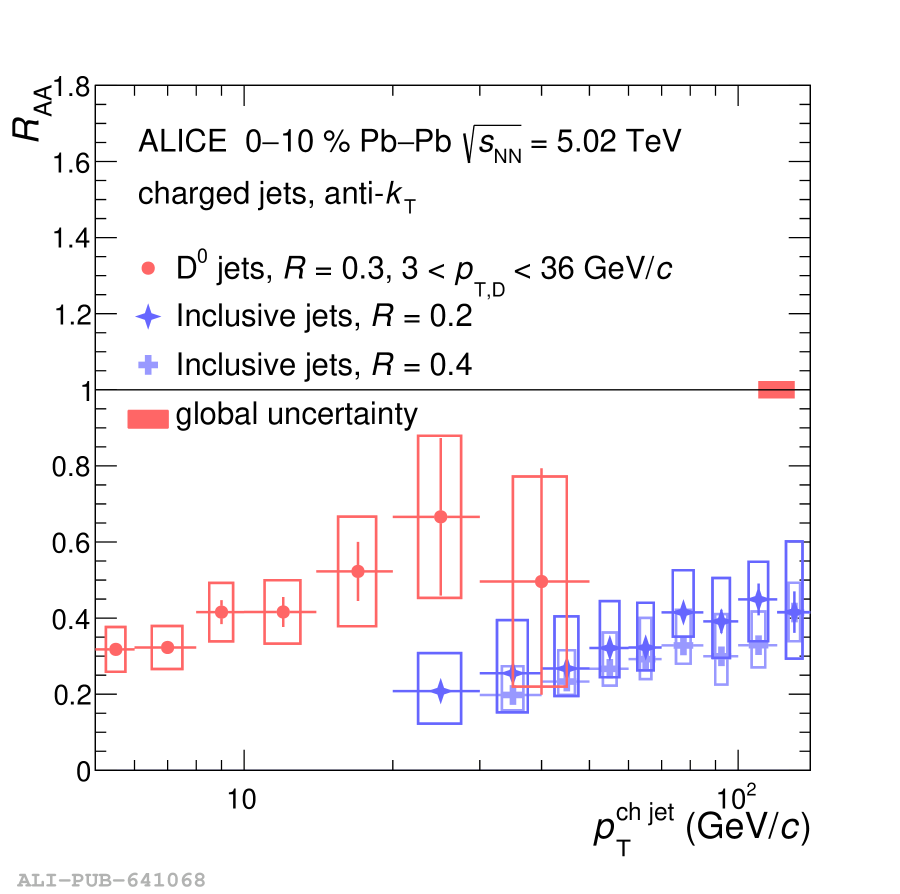 |
Figure 3
Transverse momentum distributions of \Dzero mesons (green markers) , inclusive jets with jet resolution parameter 0.2 (light blue) and 0.4 (blue markers) , and \Dzero-tagged jets (red markers) in pp collisions at $\sqrt{s} = 5.02$ TeV (see text for details about the normalisation). Statistical and systematic uncertainties are shown as vertical error bars and boxes, respectively. The function $\alpha/p_{\rm{T}}^{\rm{\beta}}$ was fitted to each of the distributions (solid lines) to compare their steepness. |  |
Figure 4
Left: comparison of the nuclear modification factor of \Dzero-tagged jets (and inclusive jets) with predictions from JETSCAPE and Dai et al. . The bands of the theory curves represent the systematic uncertainties on the model predictions Right: comparison to the LIDO predictions for \Dzero-tagged jets with and without dead-cone effect and predictions for inclusive jets. | 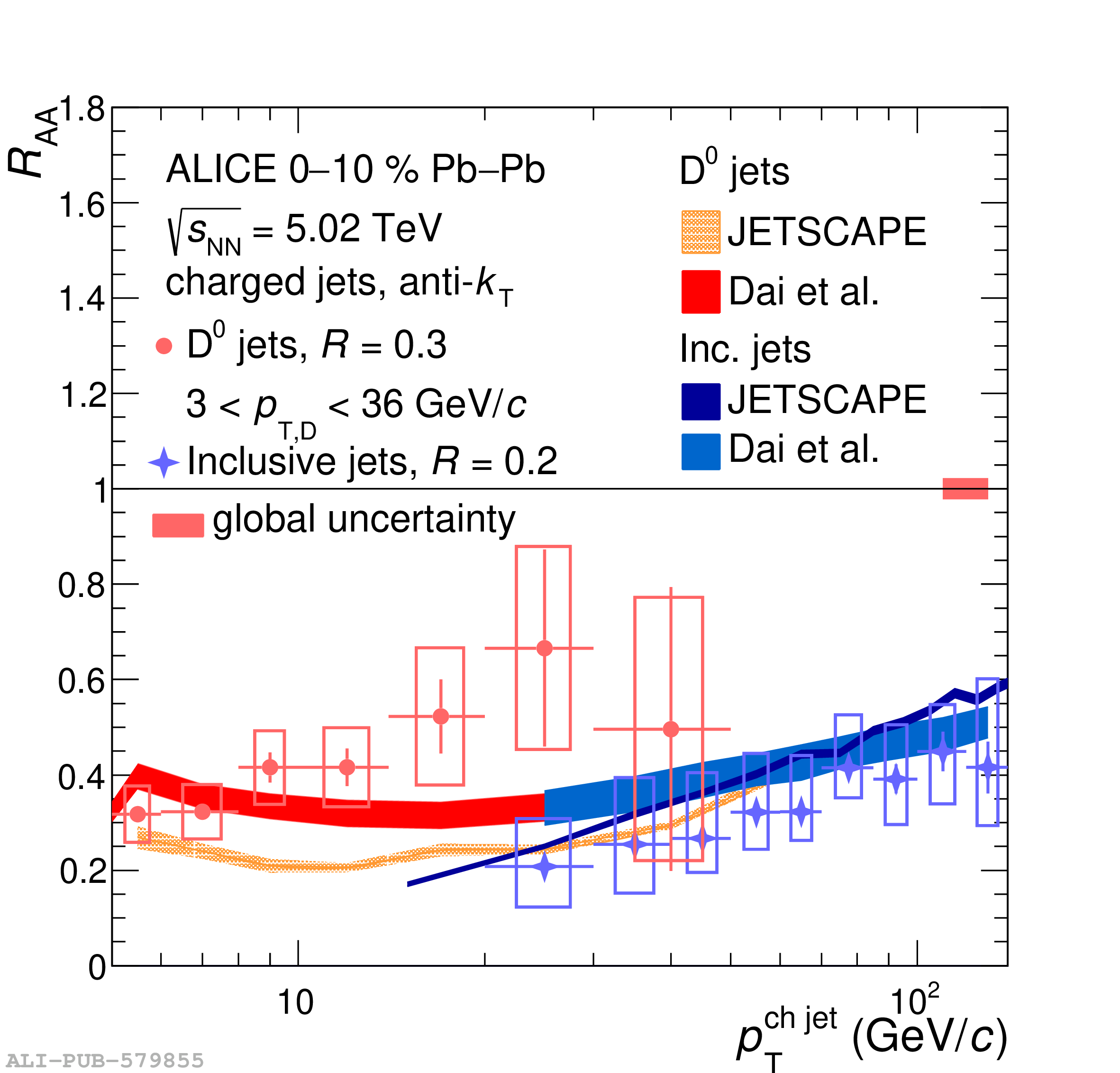 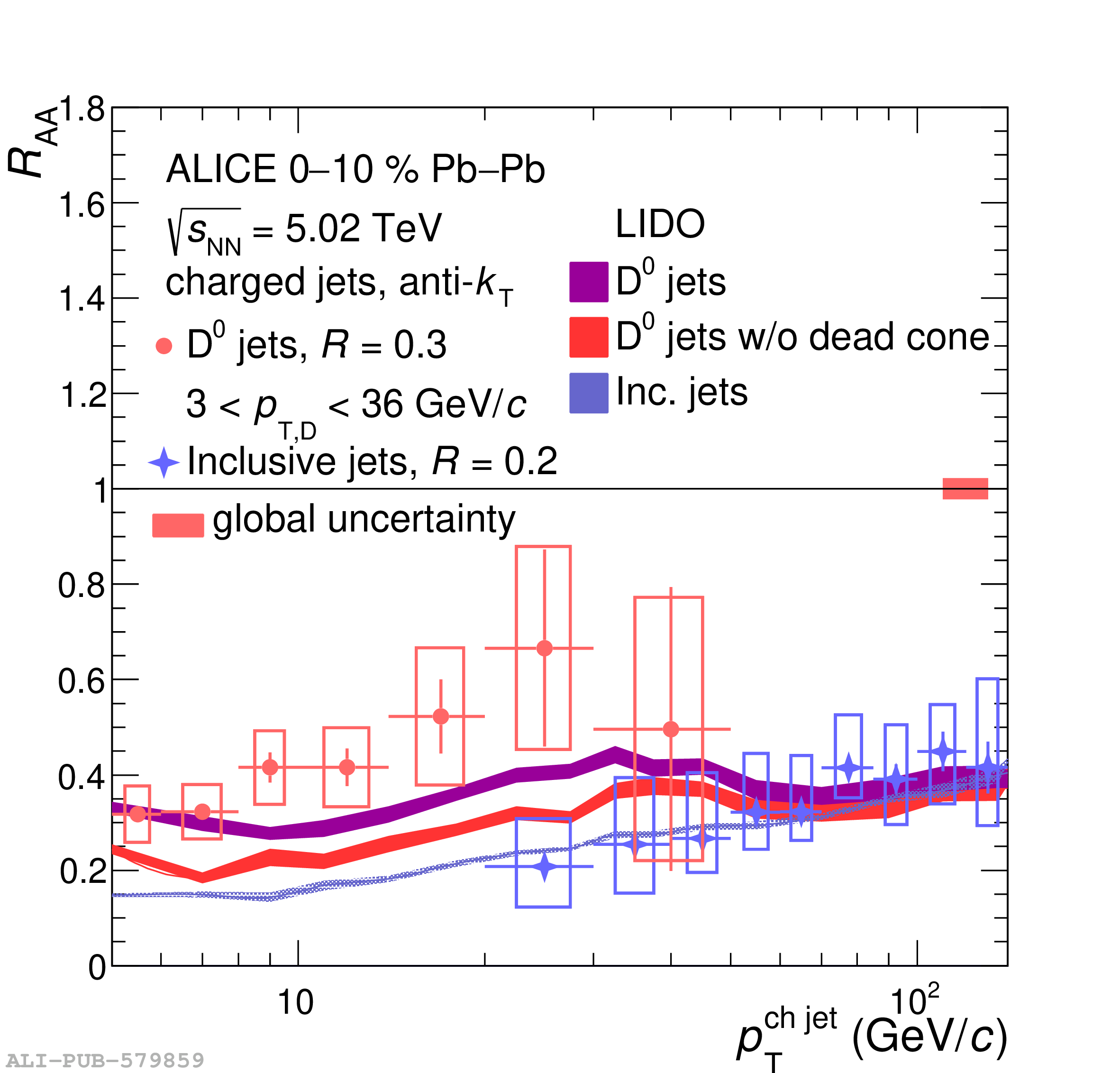 |