Two-particle angular correlations probe particle production mechanisms and the underlying event-wide phenomena present in hadronic collisions. The correlations are examined as a function of rapidity and azimuthal-angle differences ($Δy, Δ\varphi$) for pairs of like- and unlike-sign pions, kaons, and (anti-)protons produced in pp collisions at $\sqrt{s}$ = 13 TeV, measured by the ALICE experiment. Two-particle correlation functions are provided together with $Δy$ and $Δ\varphi$ projections and compared to Monte Carlo (MC) model predictions. For the first time, the measurement is performed as a function of the event's charged-particle density. Previous studies conducted for pp collisions at $\sqrt{s}$ = 7 TeV at ALICE revealed a near-side anticorrelation for baryon$-$baryon and antibaryon$-$antibaryon pairs, whose origin remains unresolved. Here, an additional approach is introduced to study the multiplicity dependence and the expected inverse multiplicity scaling of the correlation function. This method highlights qualitative differences in the underlying sources of correlations, such as quantum-statistics effects, final-state interactions, and resonance decays. The puzzling near-side anticorrelation in baryon$-$baryon measurements is observed across all multiplicity classes and continues to challenge current particle-production models. Furthermore, the multiplicity dependence of the correlations between mesons provides an independent probe of the sensitivity of current MC models to soft-QCD effects and hadronization dynamics. The presented measurements, together with the baryon results, enrich the experimental picture of two-particle correlations in pp collisions and serve as valuable input for ongoing theoretical developments.
Eur.Phys.J.C 86 (2026) 7, 756
HEP Data
e-Print: arXiv:2511.10399 | PDF | inSPIRE
CERN-EP-2025-253
Figure group
Figure 1
The ($\Delta y,\Delta\varphi$) correlation functions for like-sign pions, kaons, and protons pairs (top-to-bottom) in the highest (0--0.17\%), the middle (30--40\%), and lowest (90--100\%) multiplicity classes (left-to-right) of pp collisions at $\sqrt{s} = 13$ TeV using the $C_{\rm{R}}$ definition. | 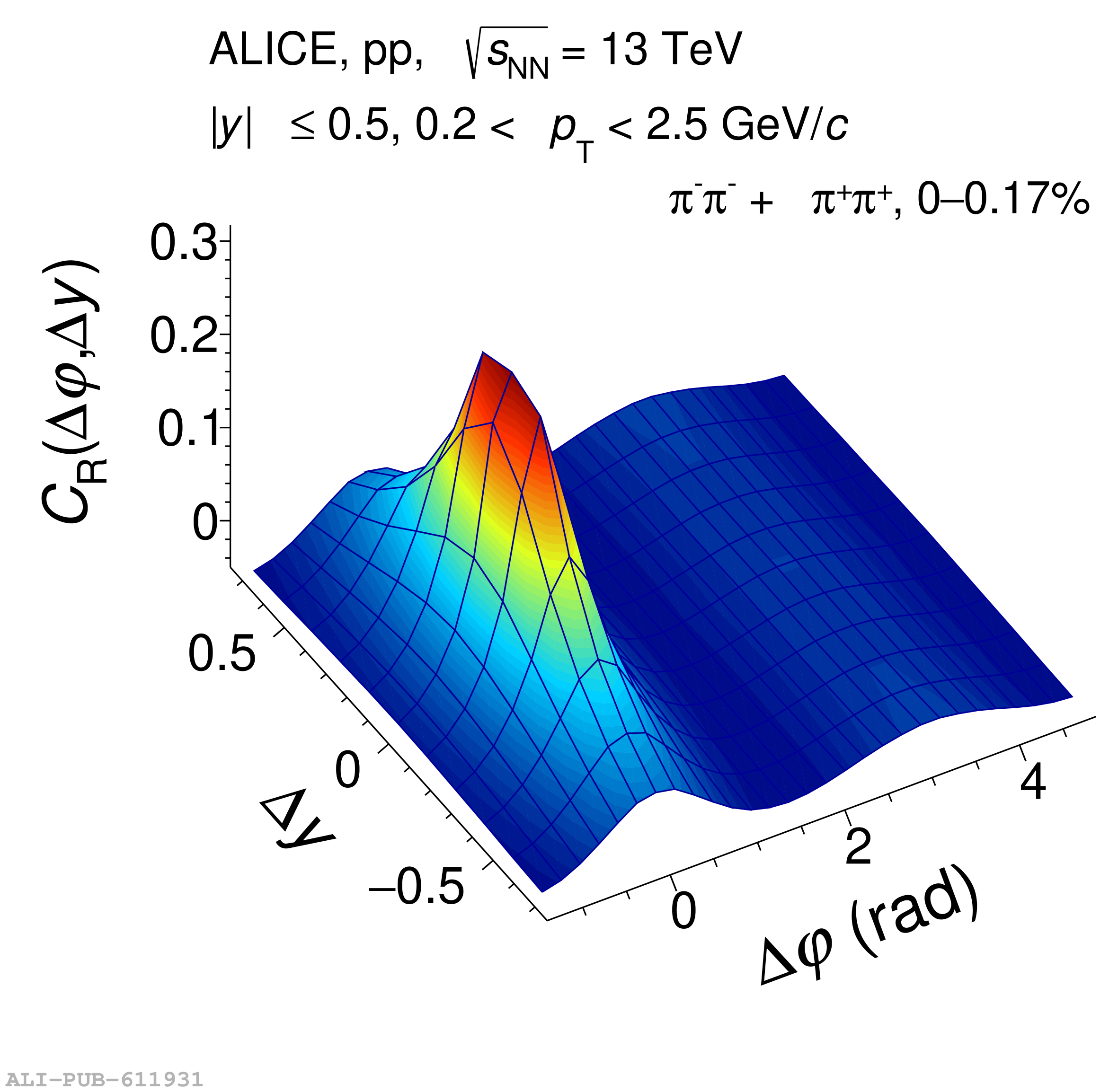 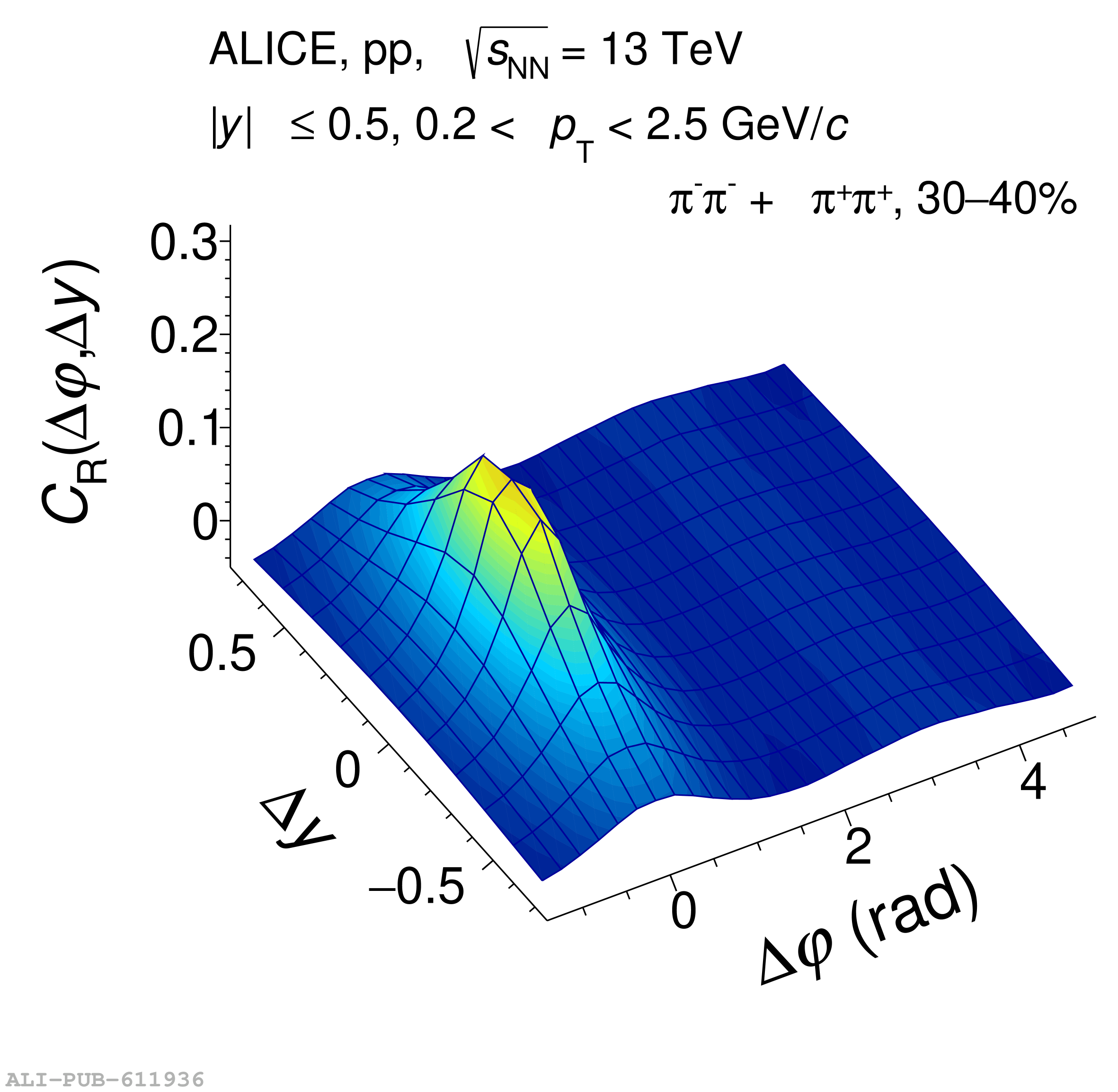 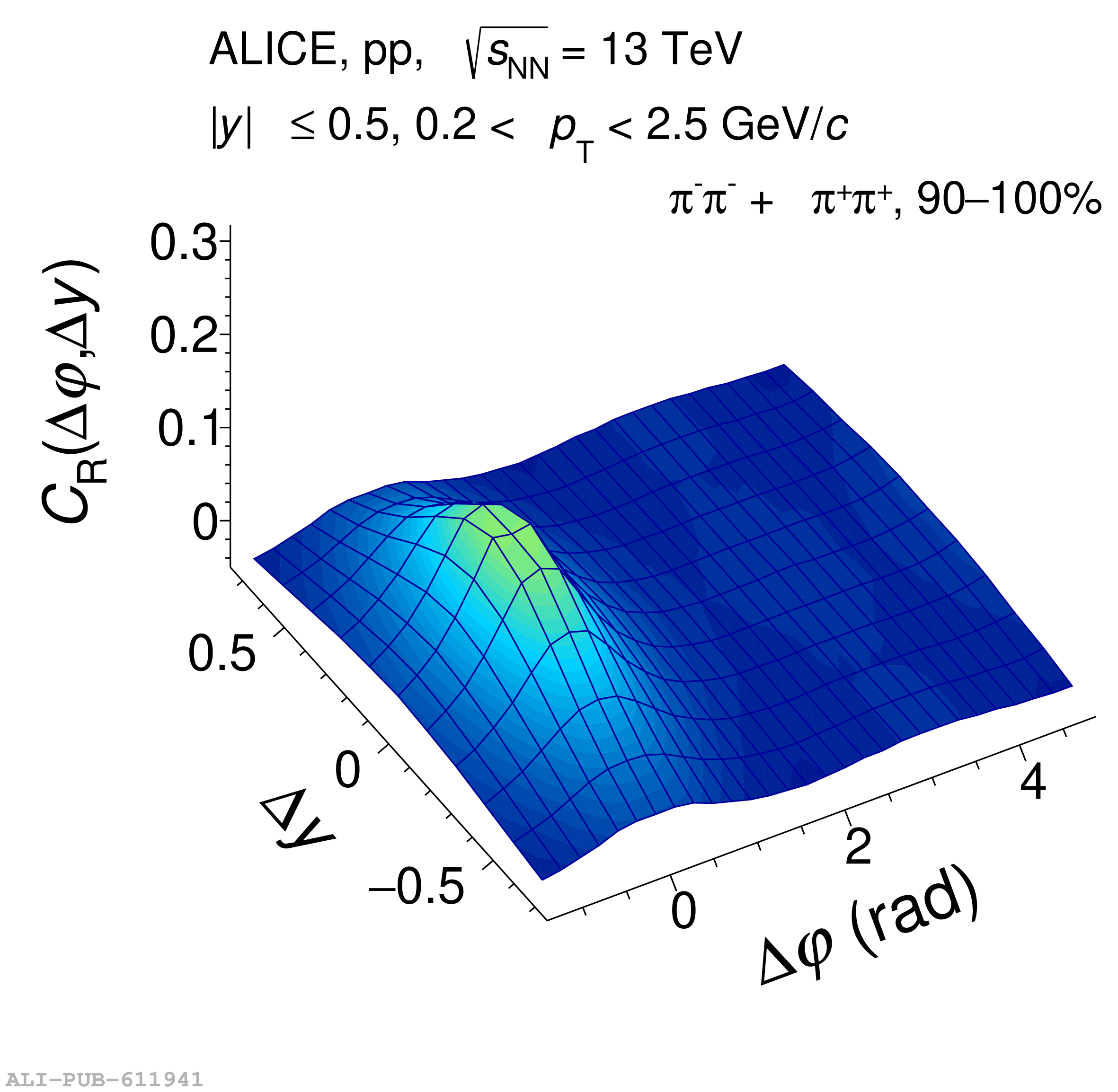 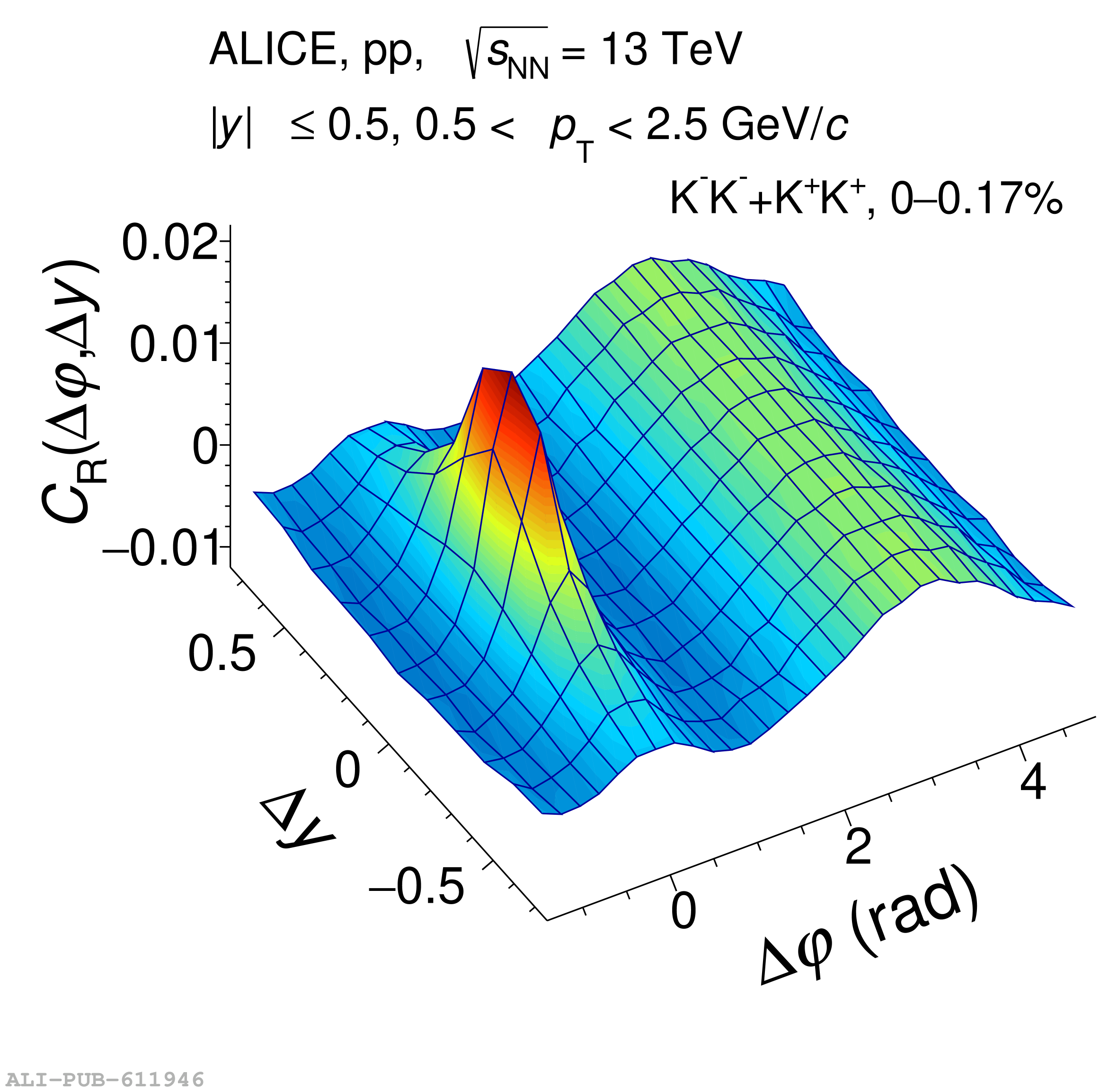 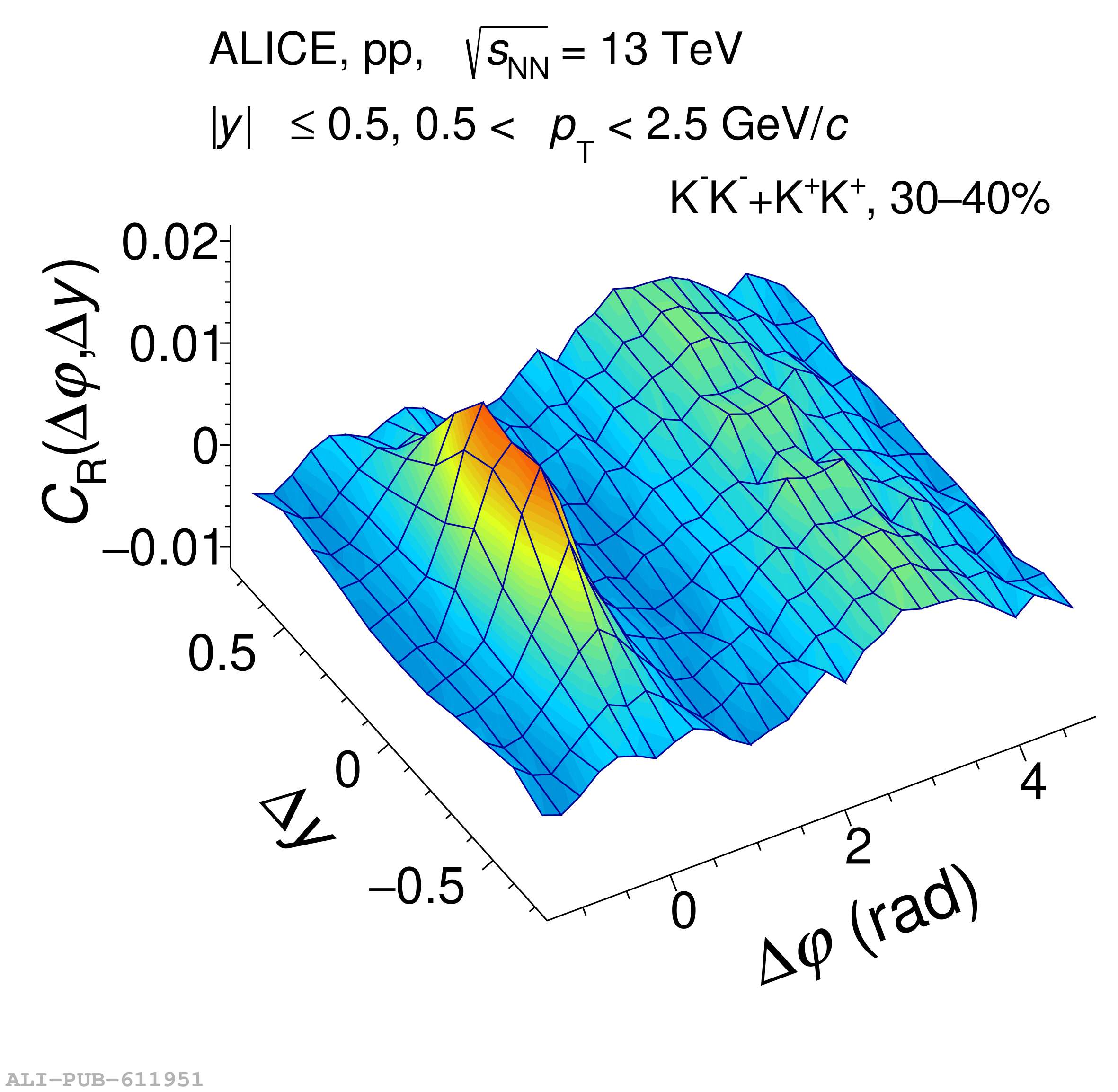 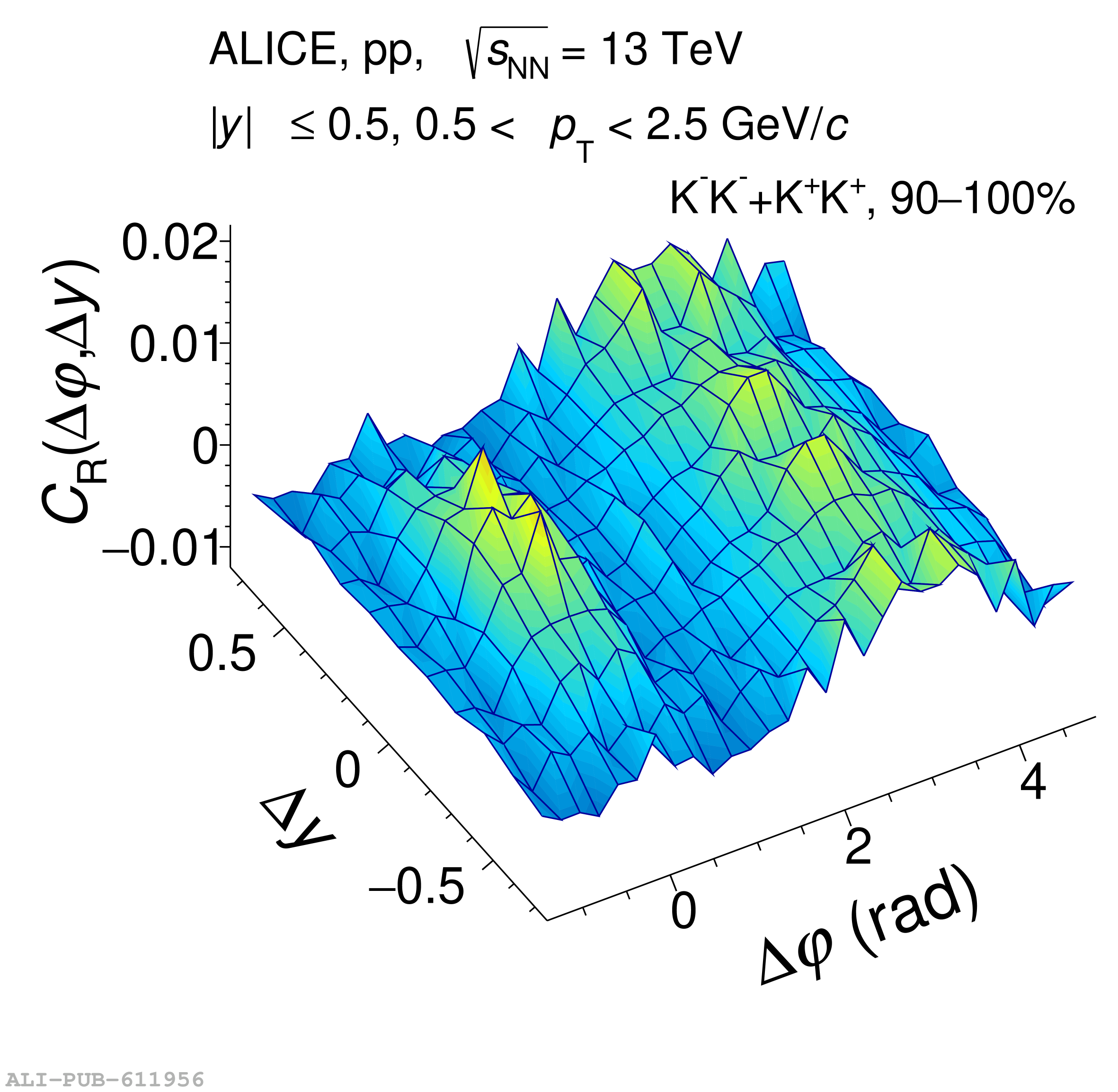 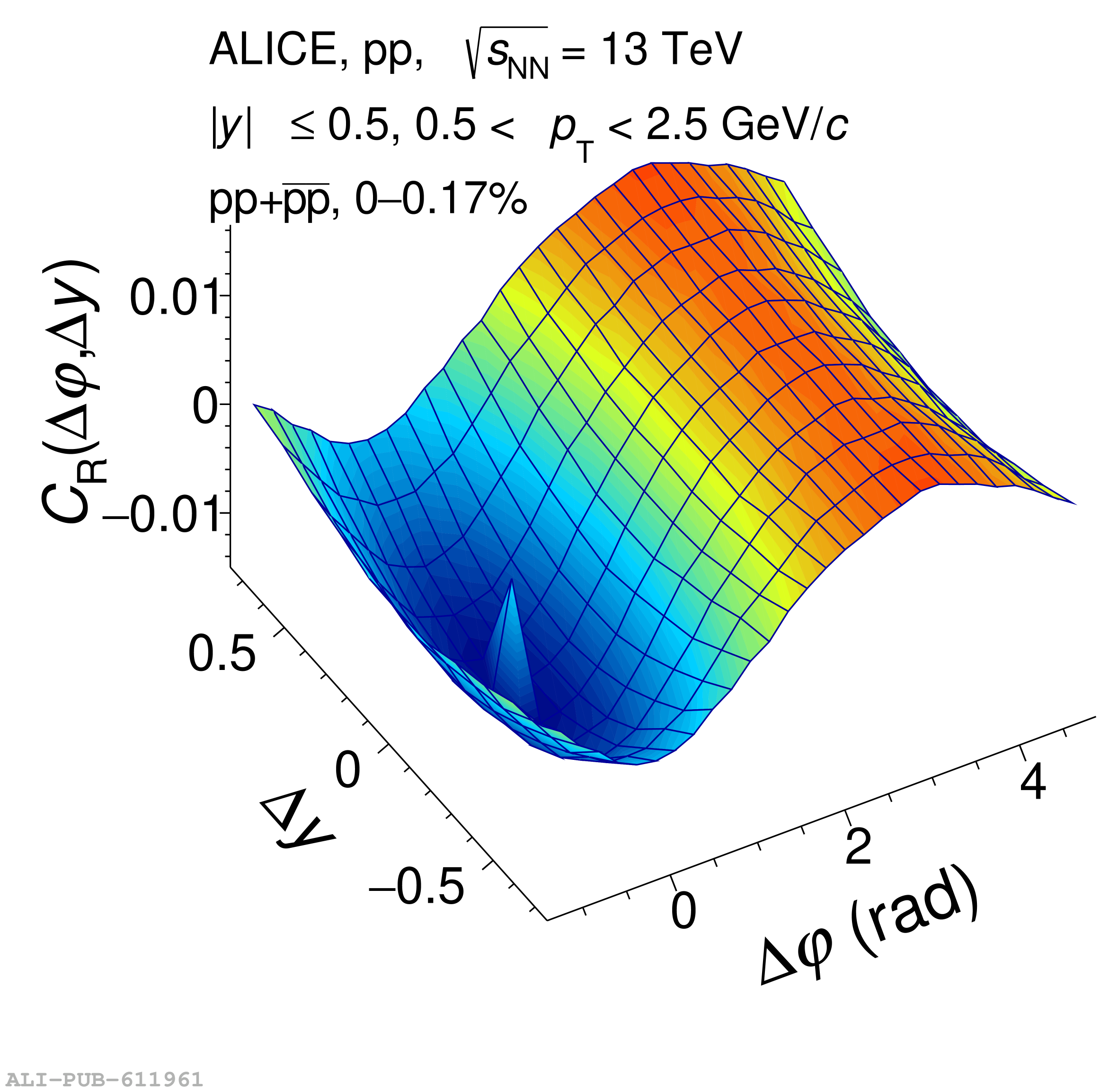 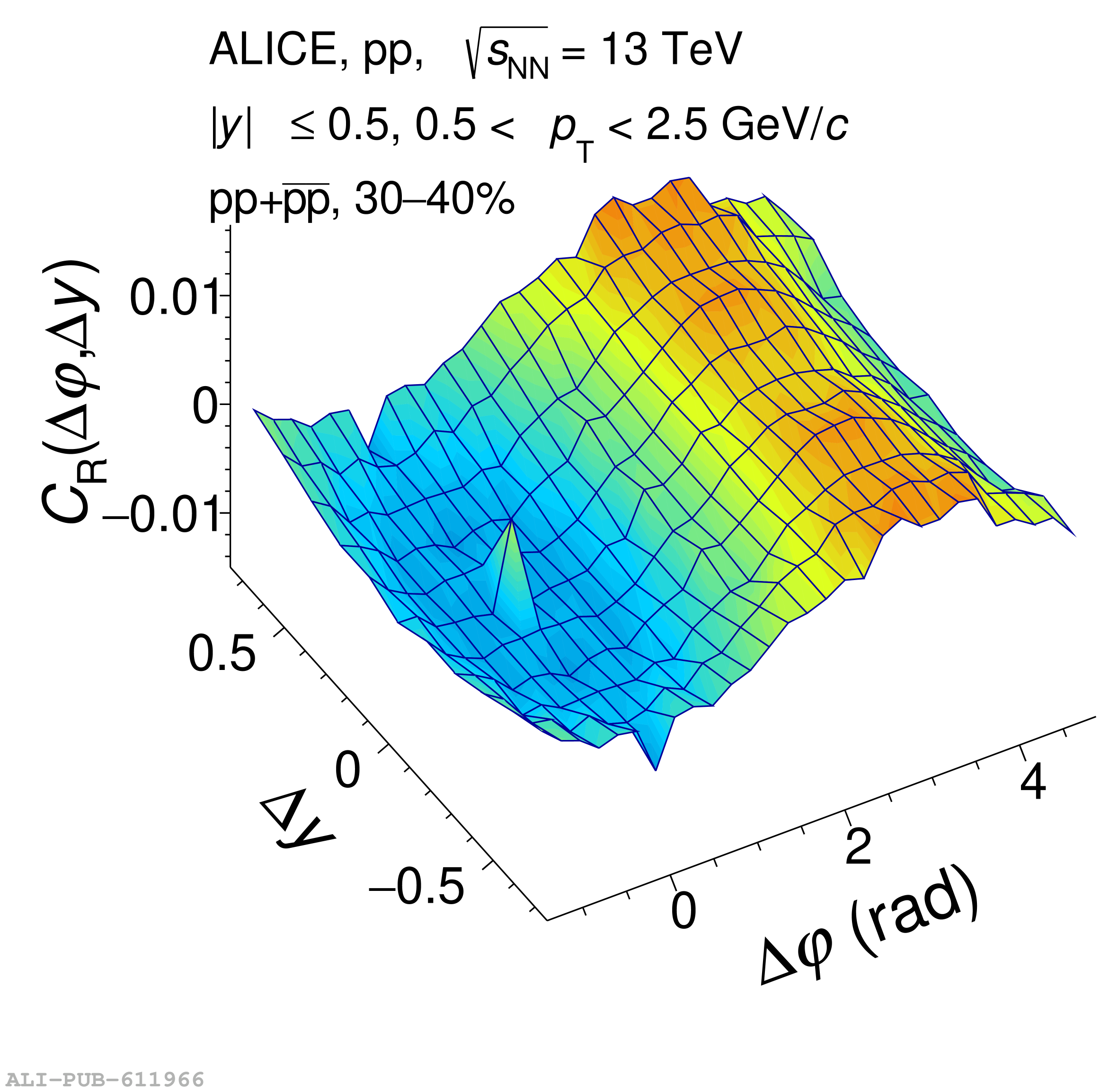 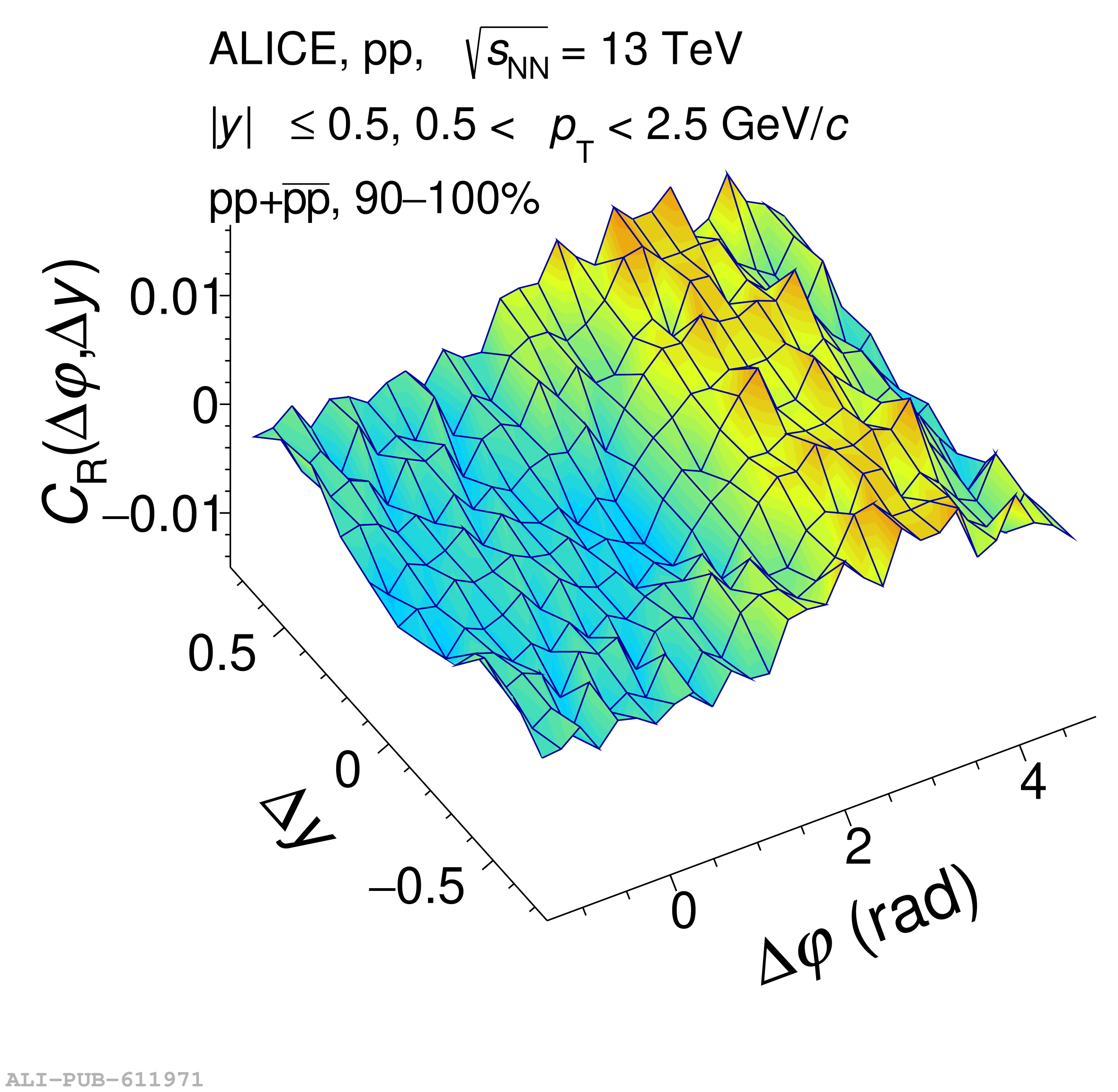 |
Figure 2
The ($\Delta y,\Delta\varphi$) correlation functions for unlike-sign pions, kaons, and protons pairs (top-to-bottom) in the highest (0--0.17\%), the middle (30--40\%), and lowest (90--100\%) multiplicity classes (left-to-right) of pp collisions at $\sqrt{s} = 13$ TeV using the $C_{\rm{R}}$ definition. | 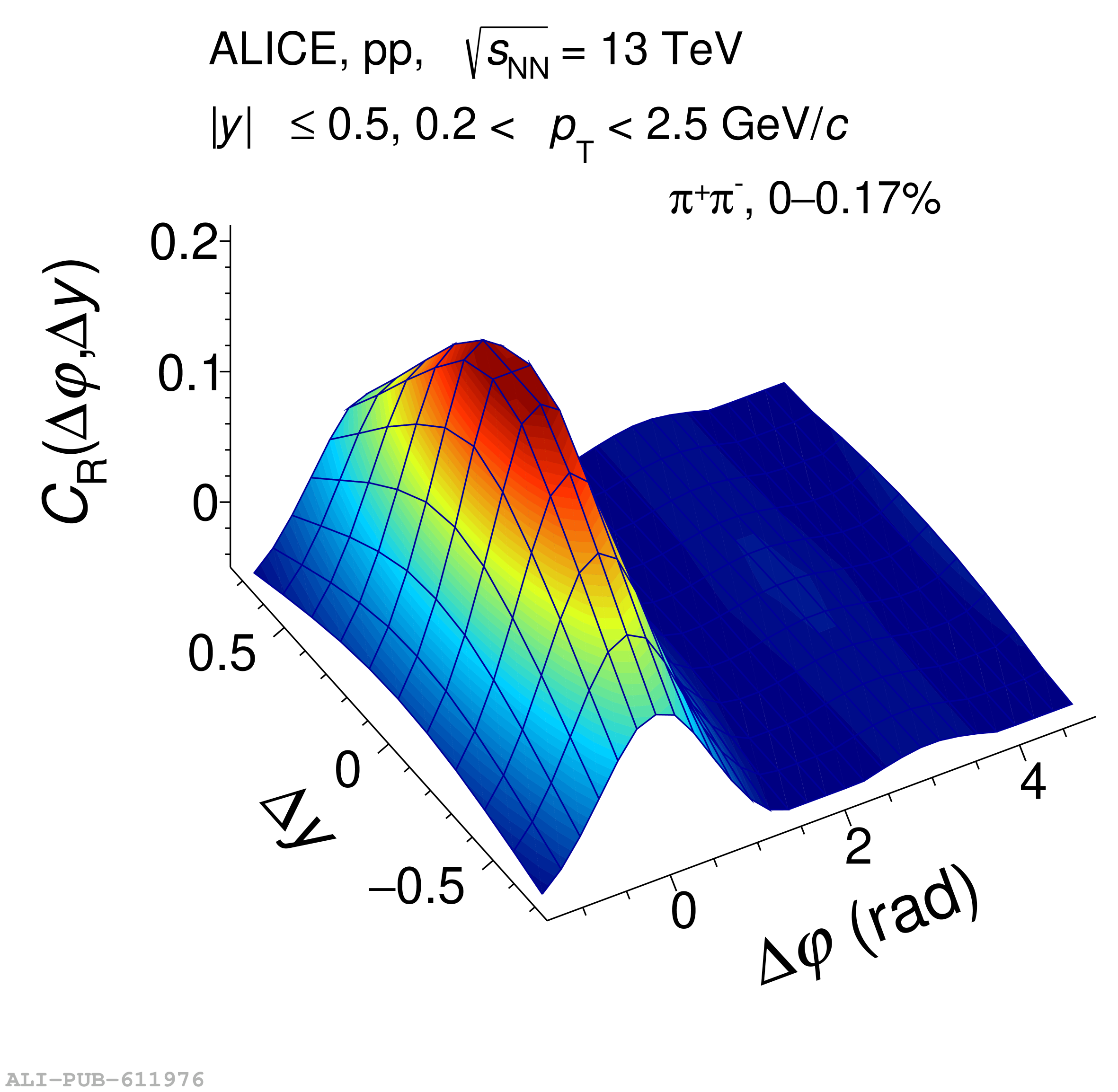 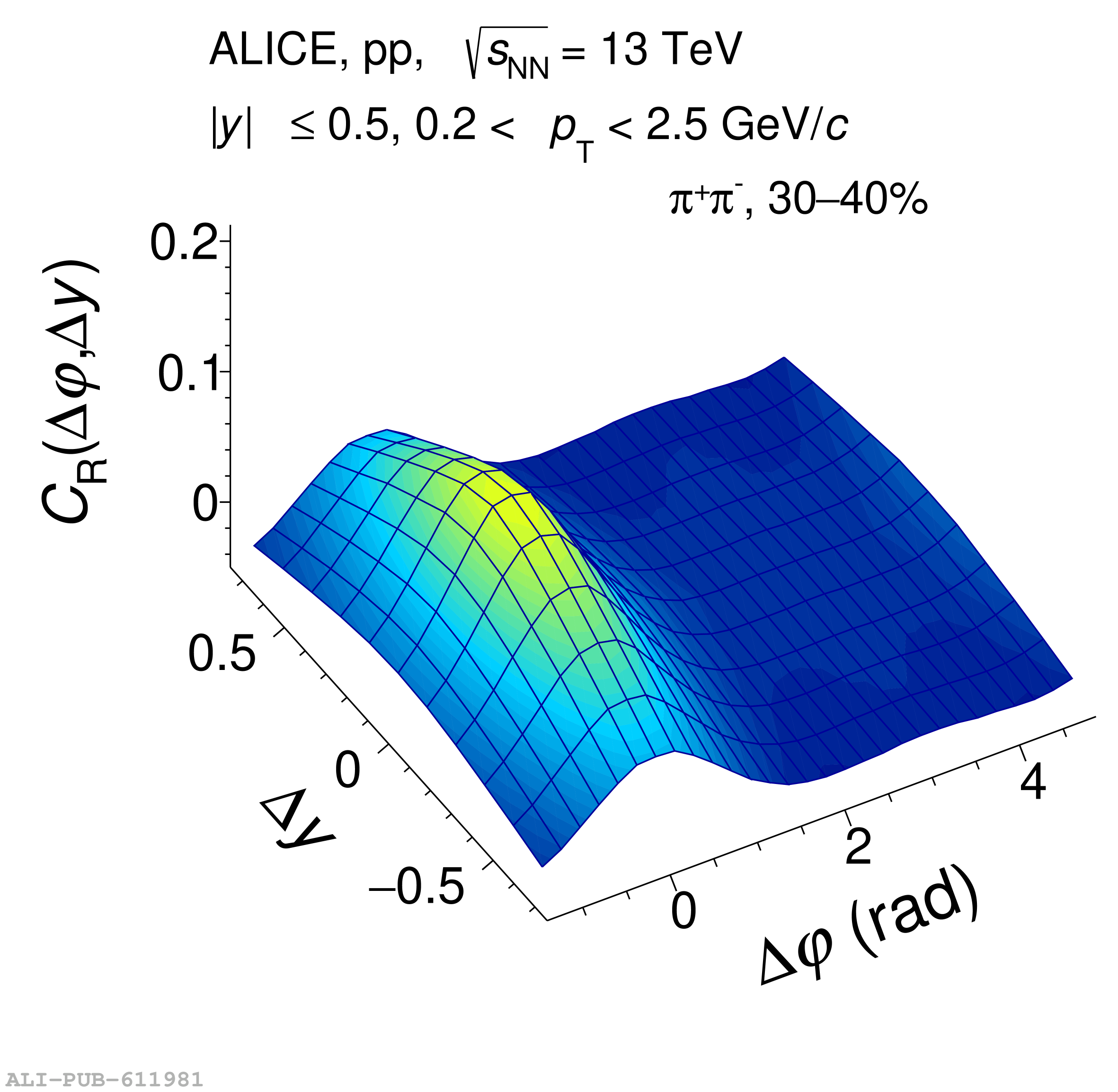 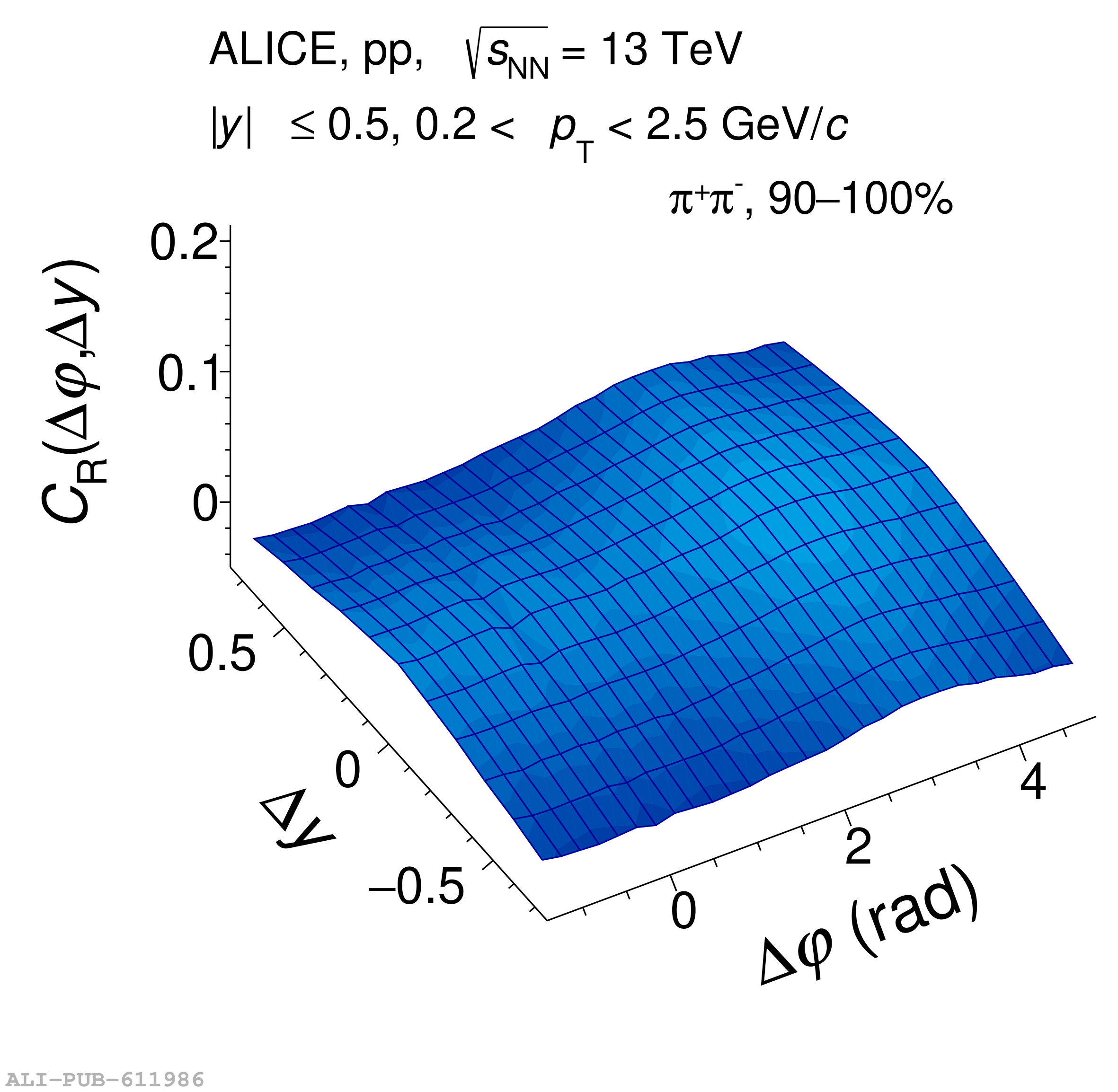 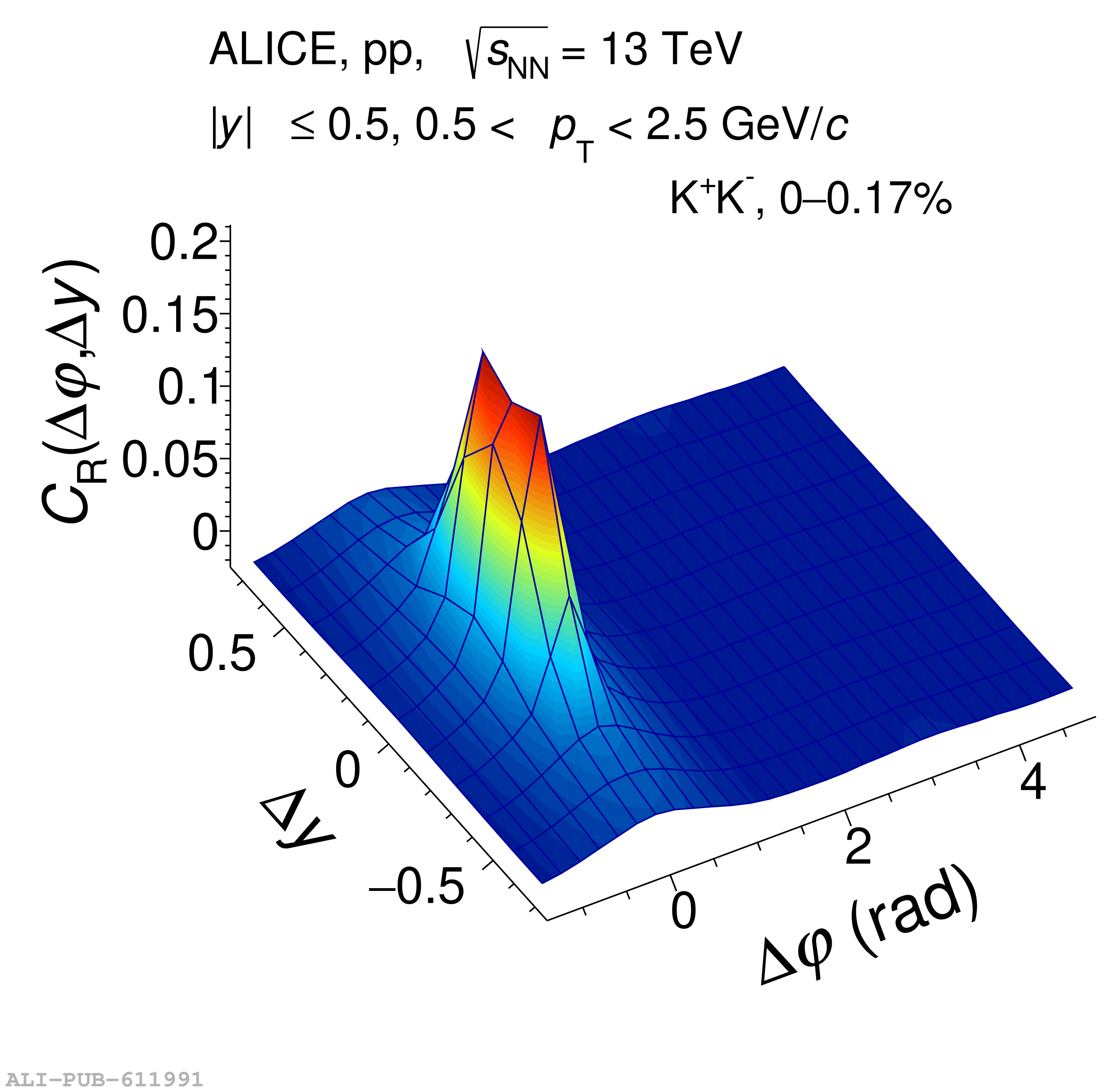 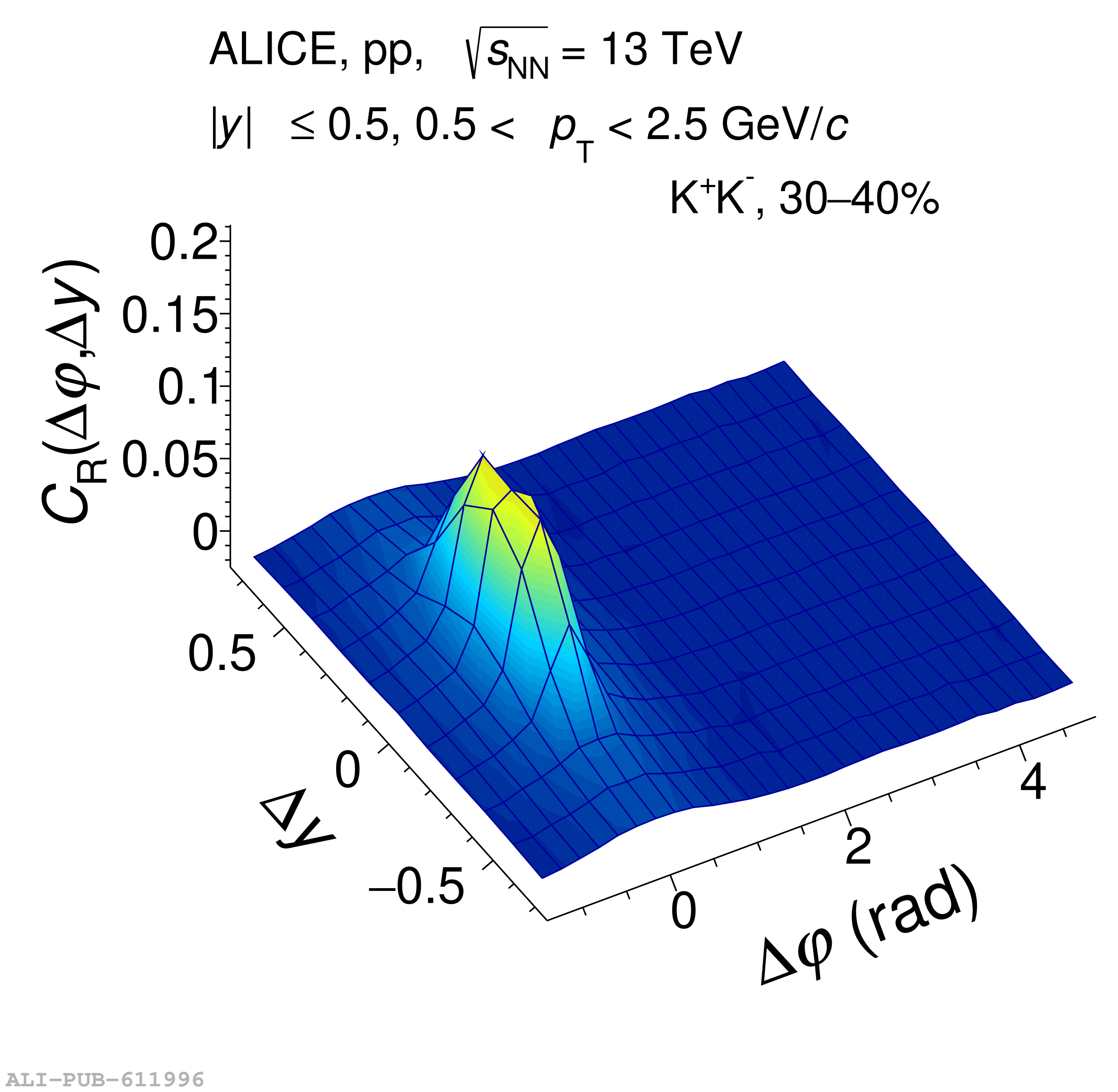 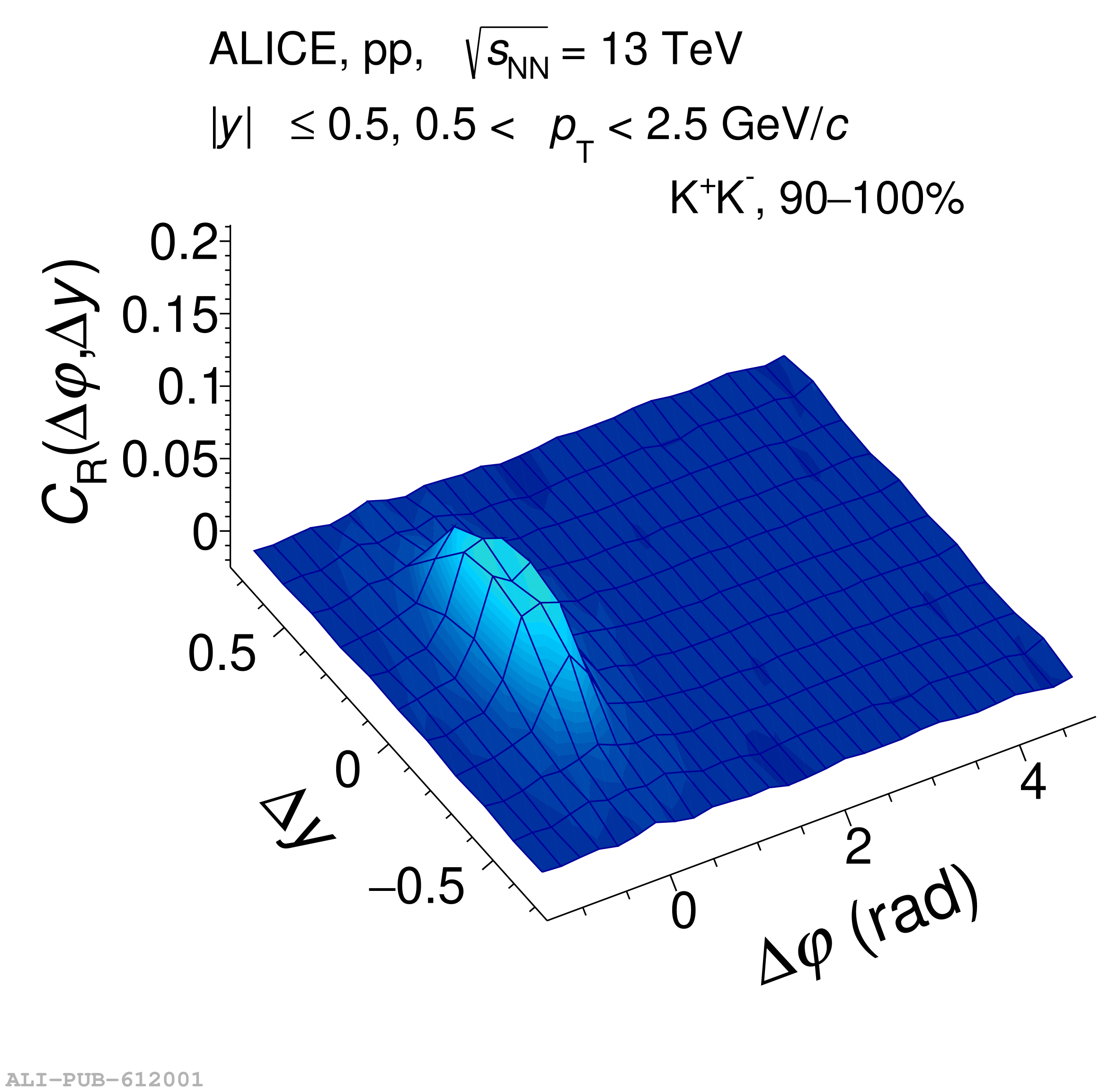  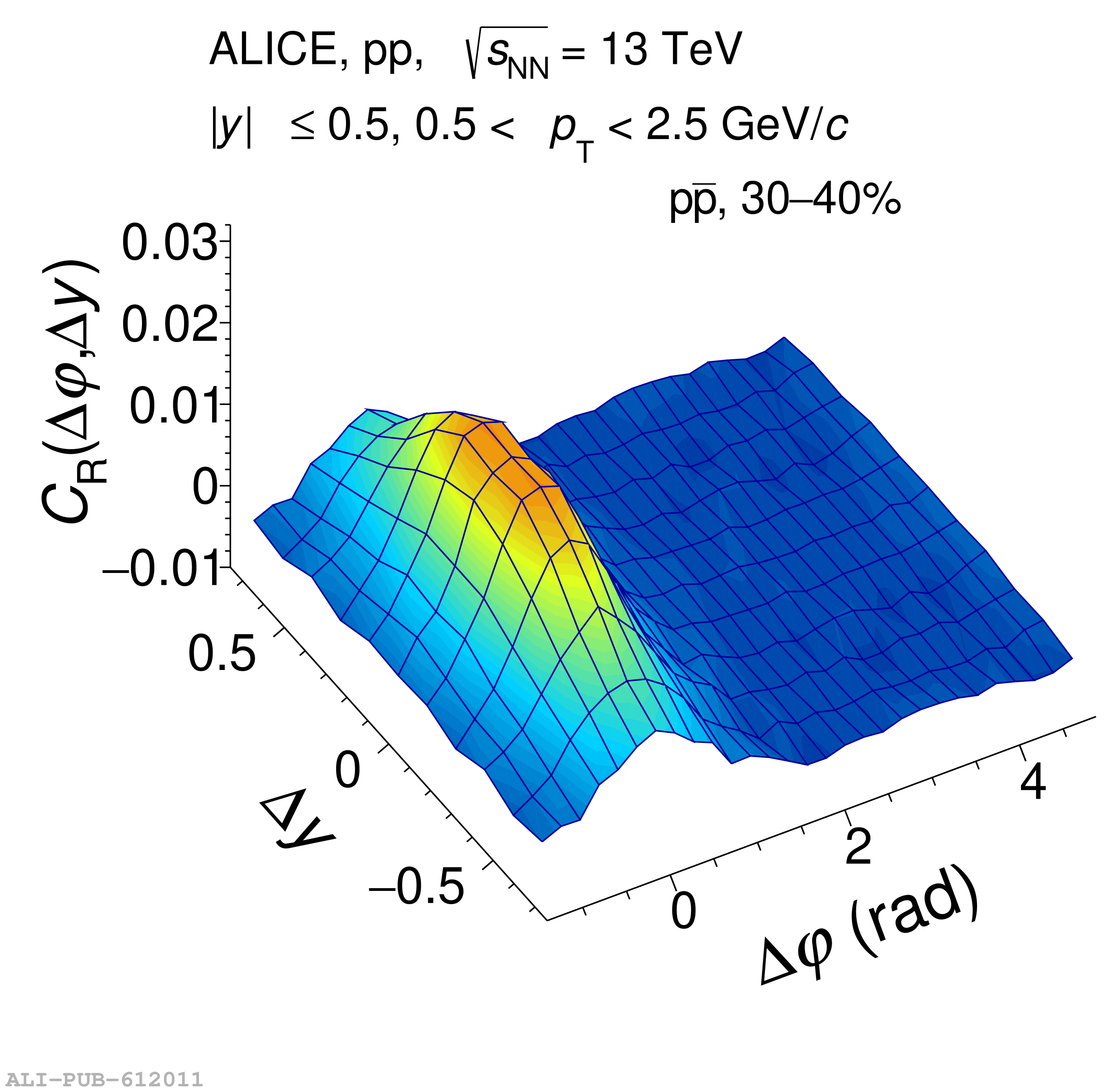 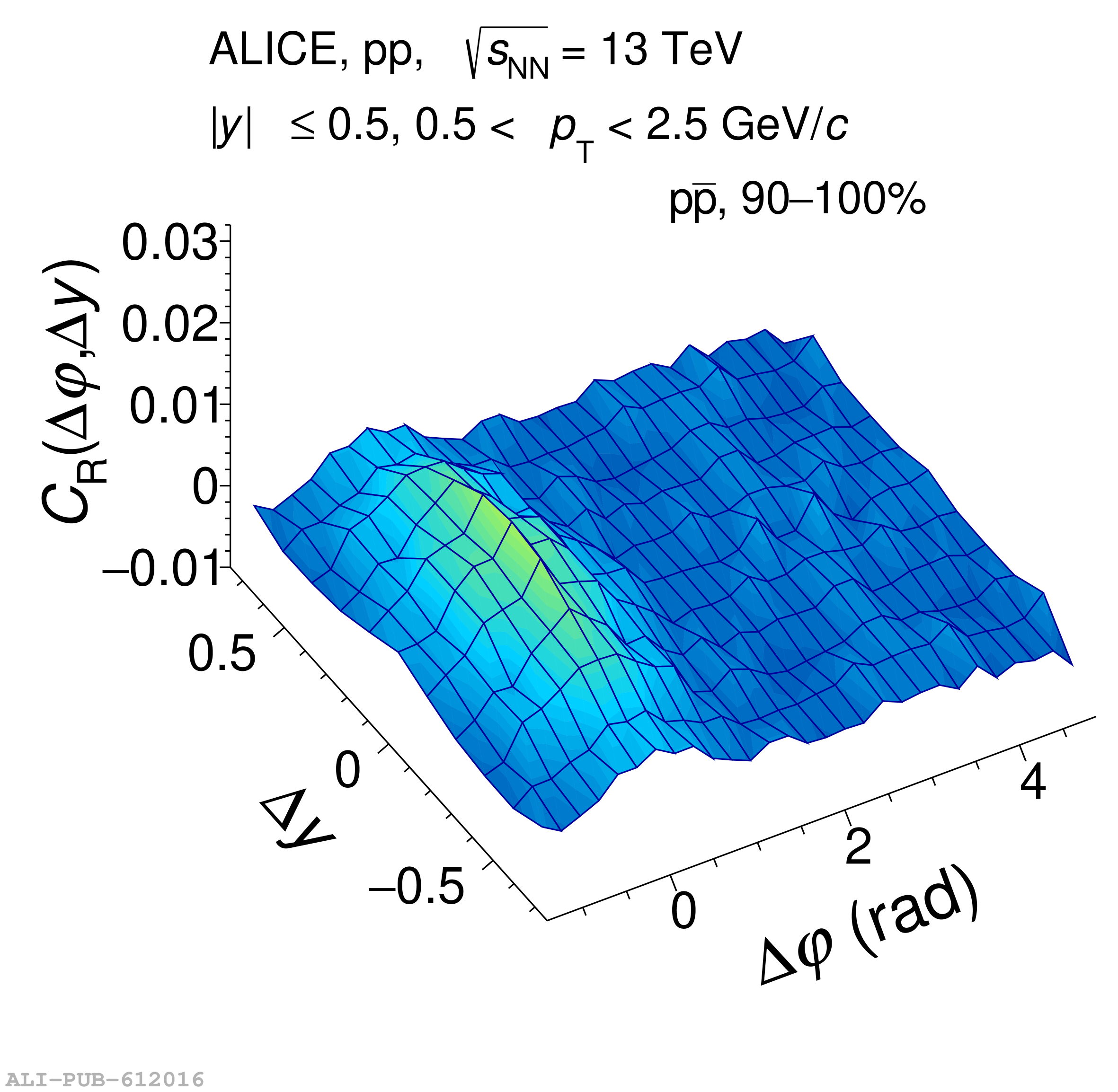 |
Figure 3
$\Delta\varphi$ projections of correlation functions within $\abs{\Delta y} 1$ for like- and unlike-sign pions, kaons, and protons in multiplicity classes, using the $C_{\rm{P}}$ definition. Statistical uncertainties (bars) and systematic uncertainties (boxes) are both drawn with the color associated with the corresponding multiplicity class. | 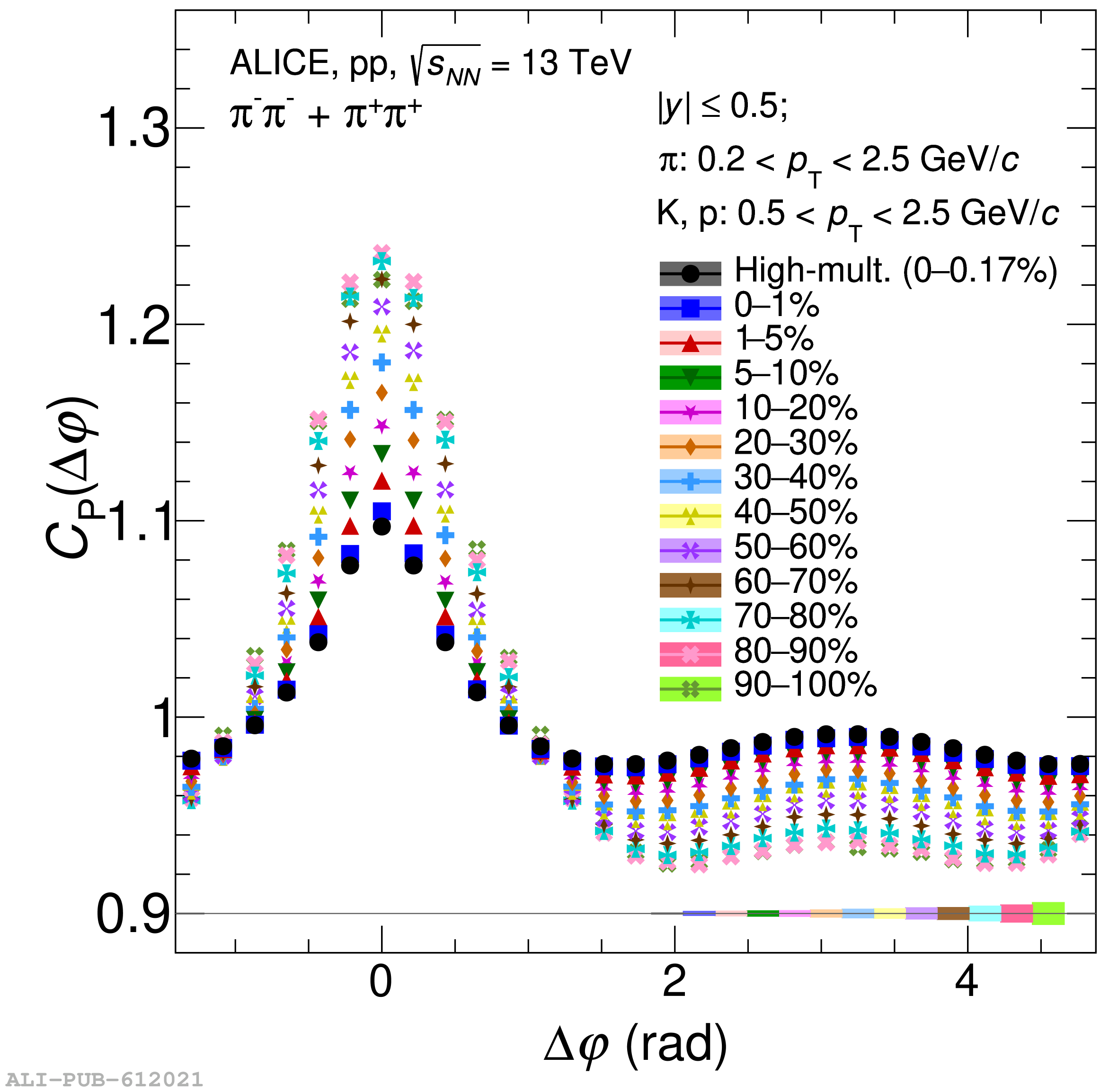 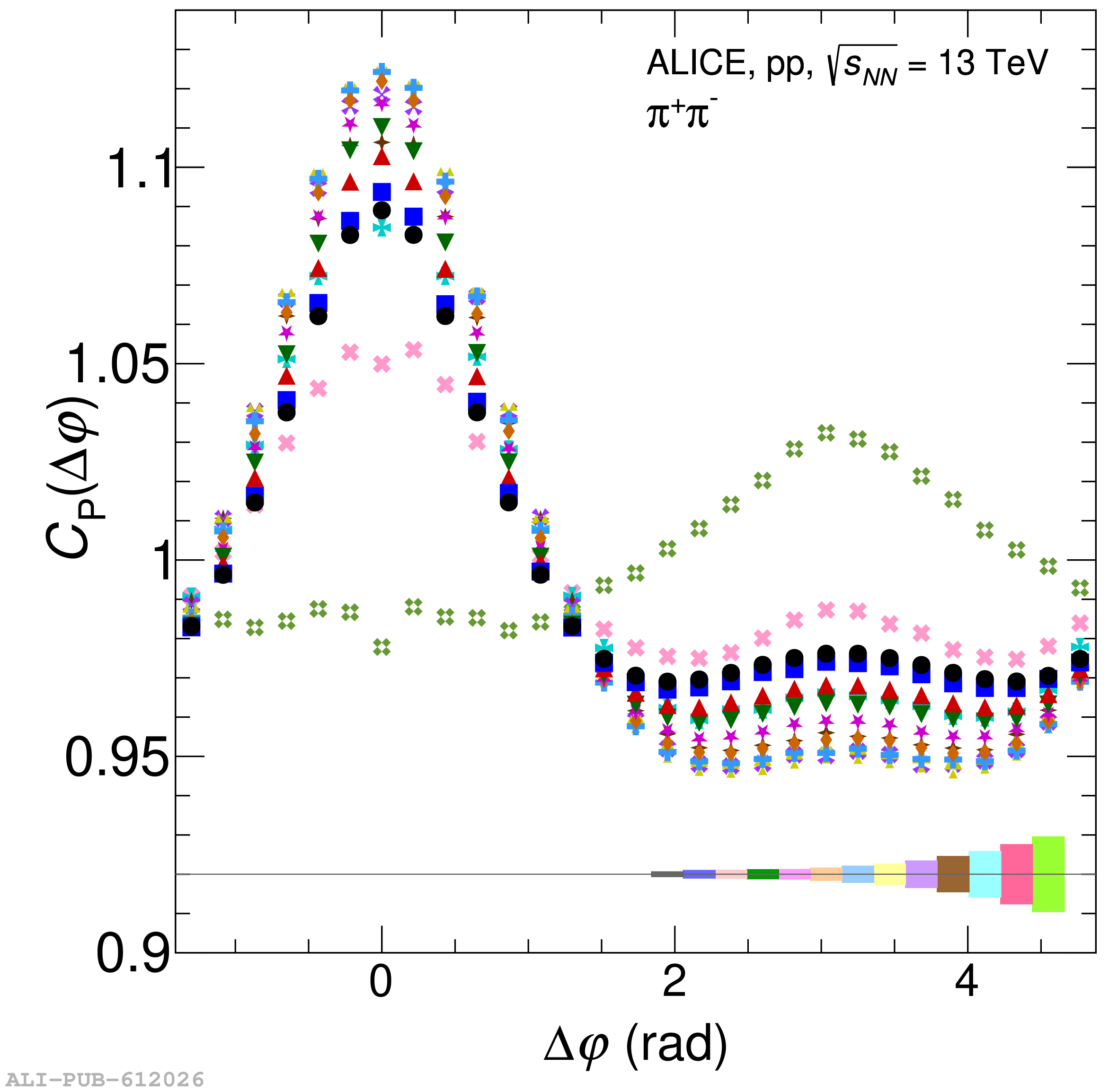 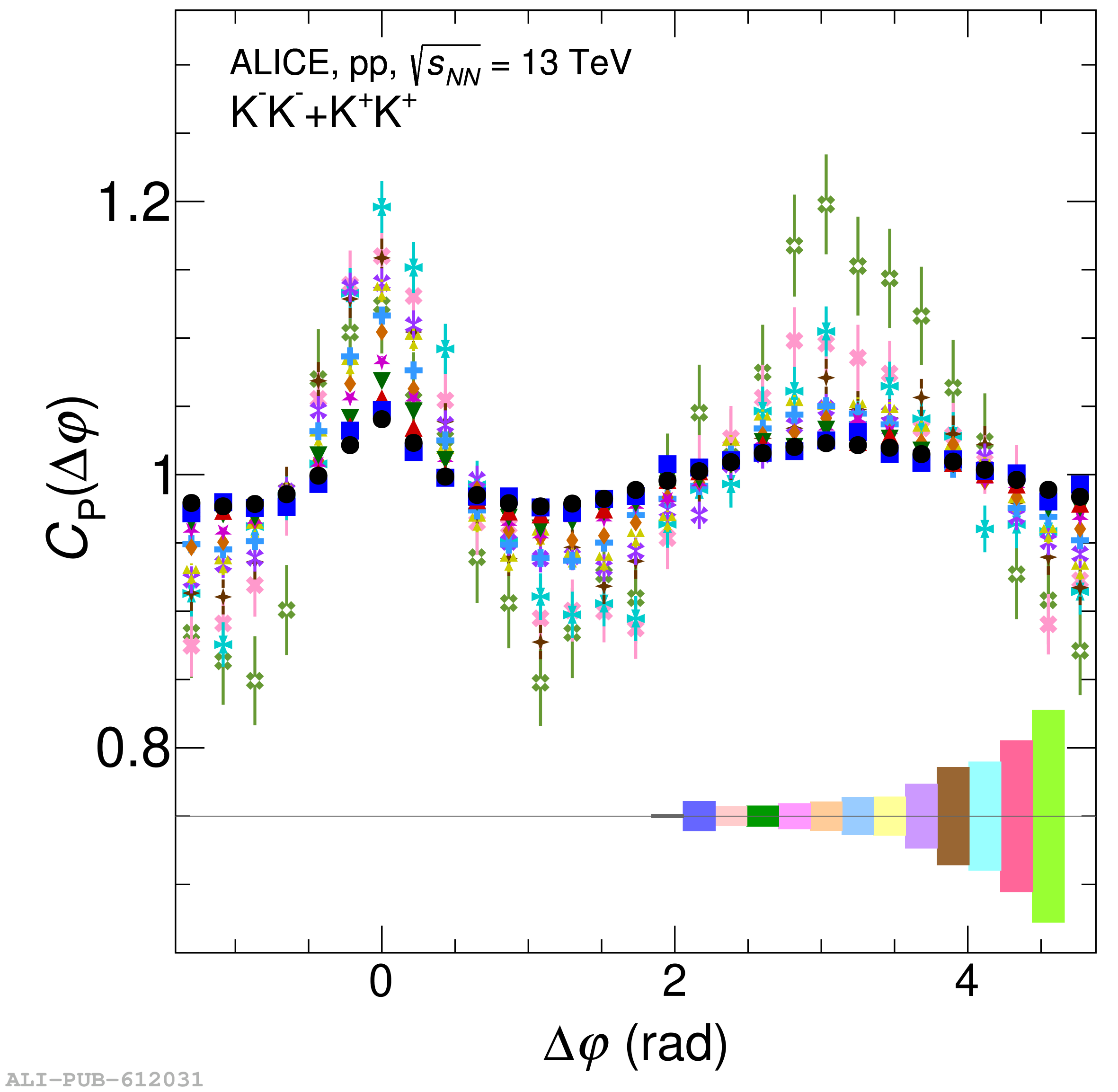 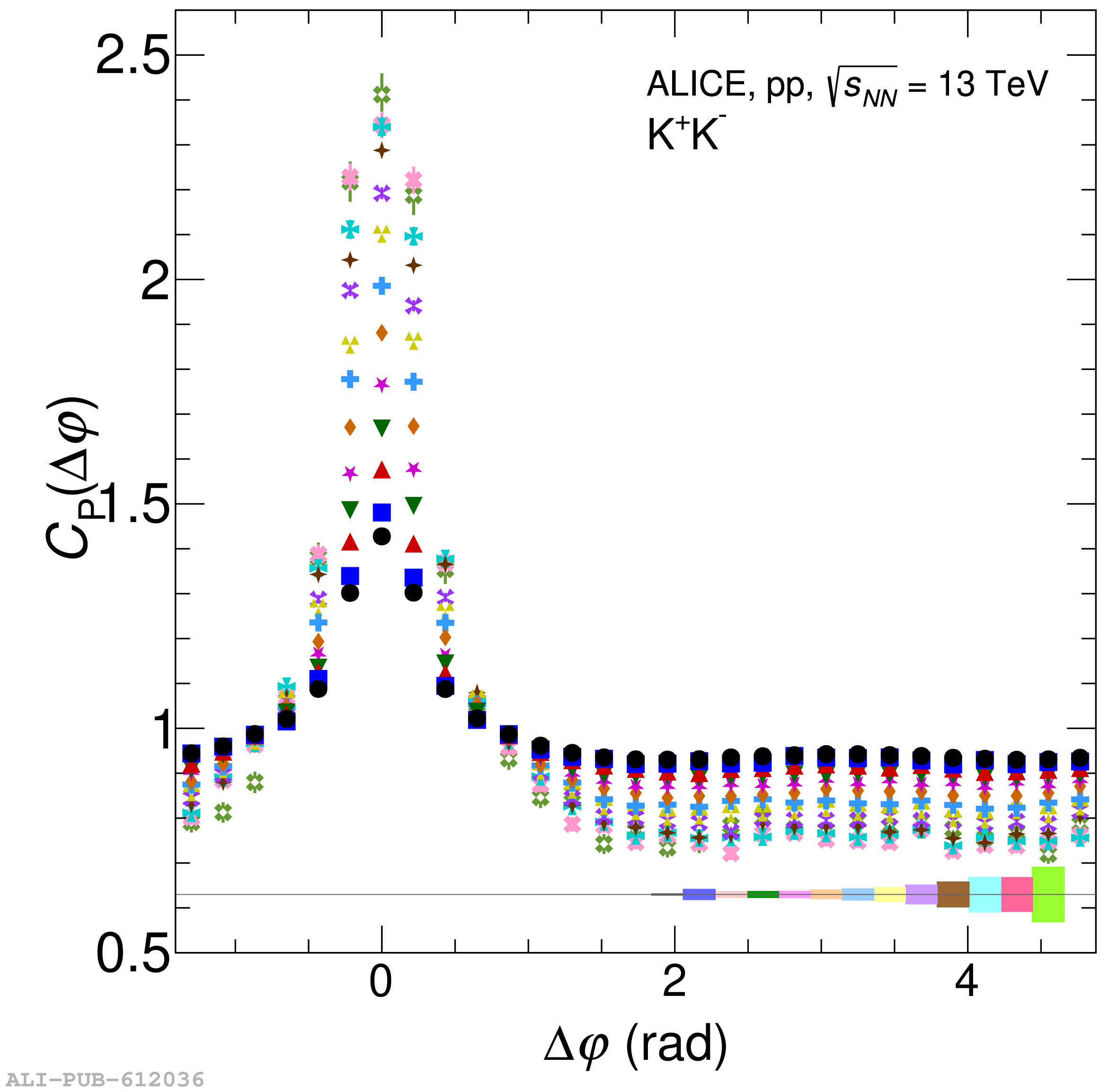 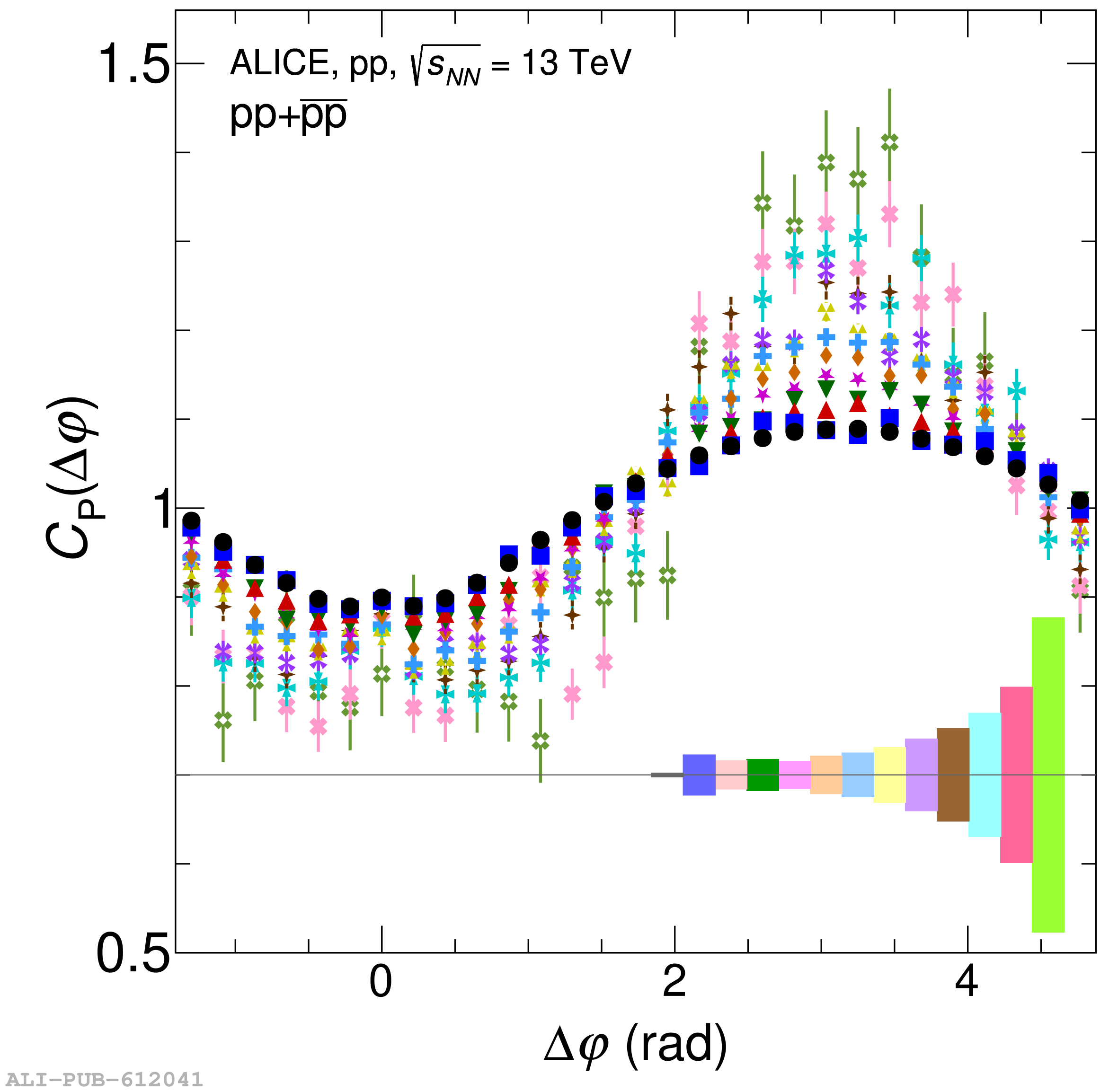 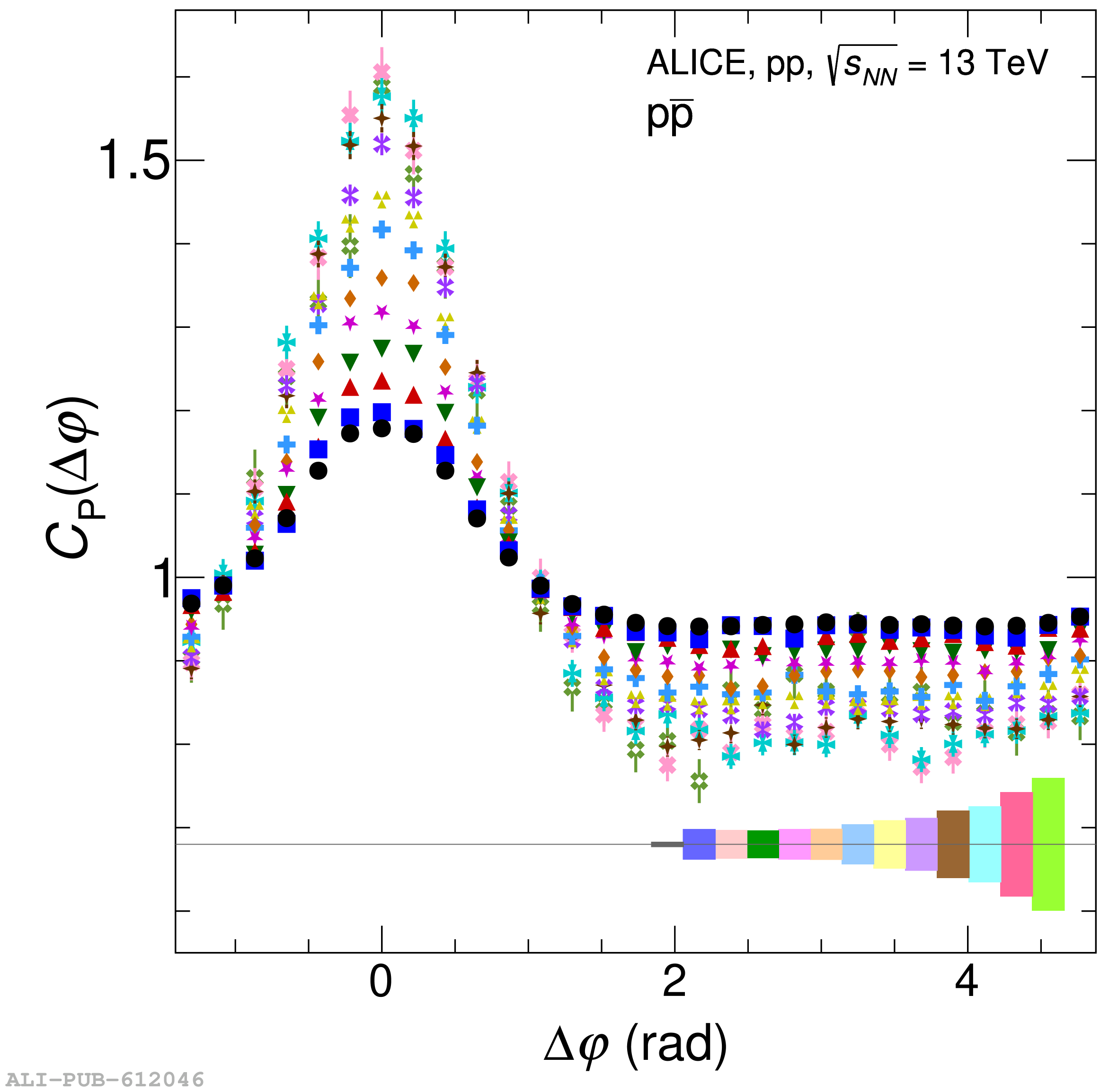 |
Figure 4
$\Delta\varphi$ projections of correlation functions within $\abs{\Delta y} 1$ for like- and unlike-sign pions, kaons, and protons in multiplicity classes, using the $C_{\rm{R}}$ definition. Statistical uncertainties (bars) and systematic uncertainties (boxes) are both drawn with the colour associated with the corresponding multiplicity class. | 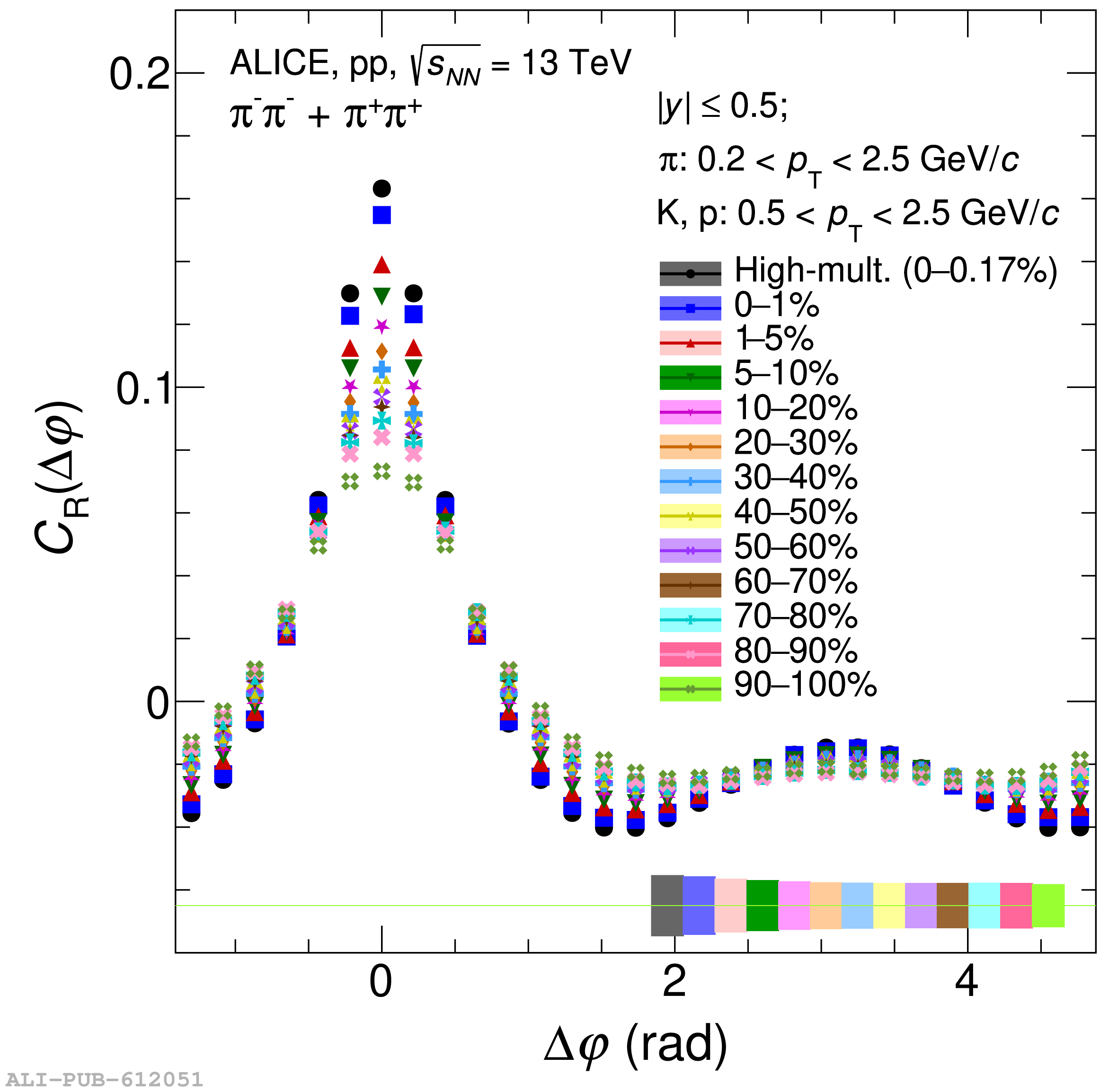 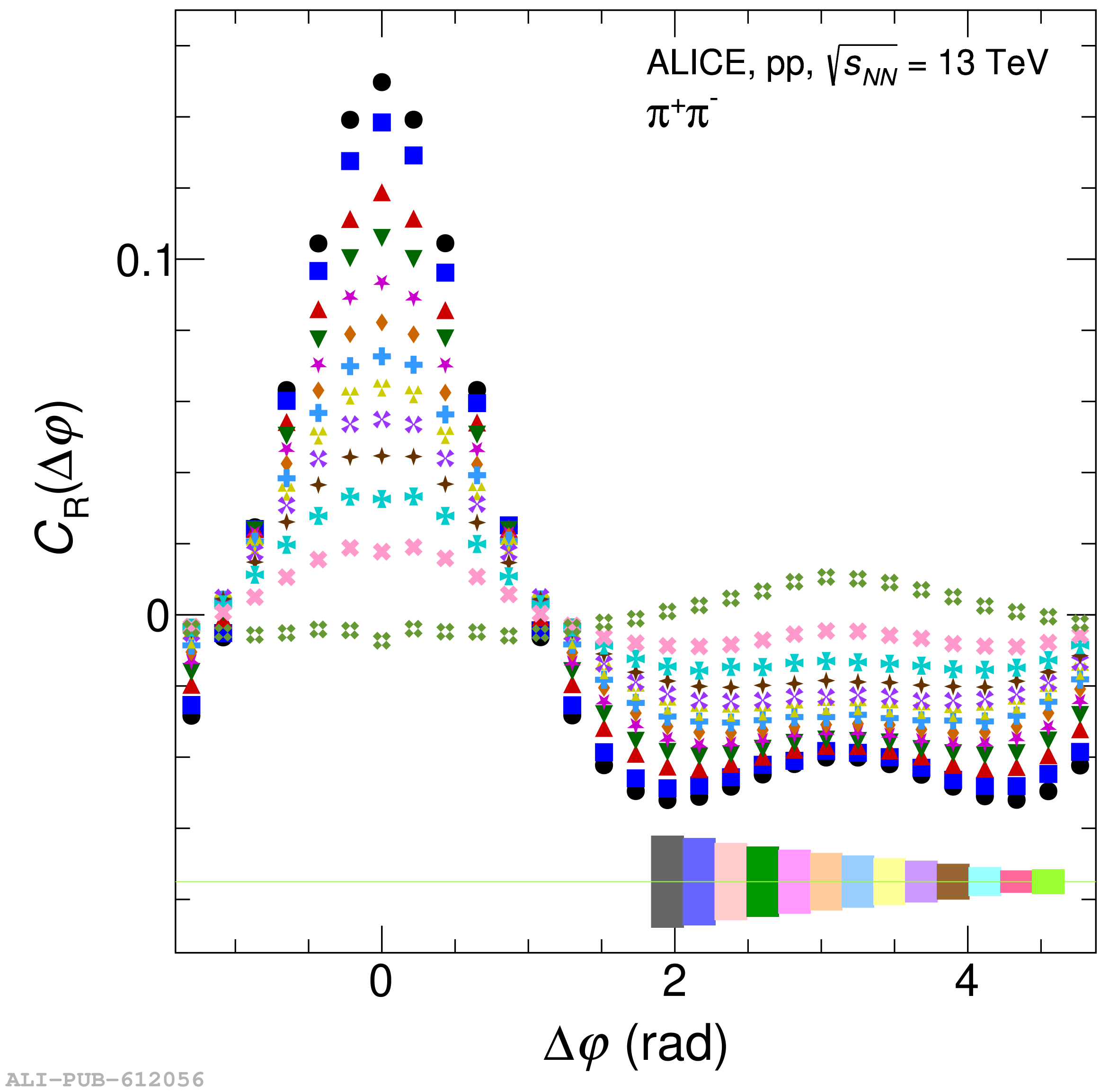 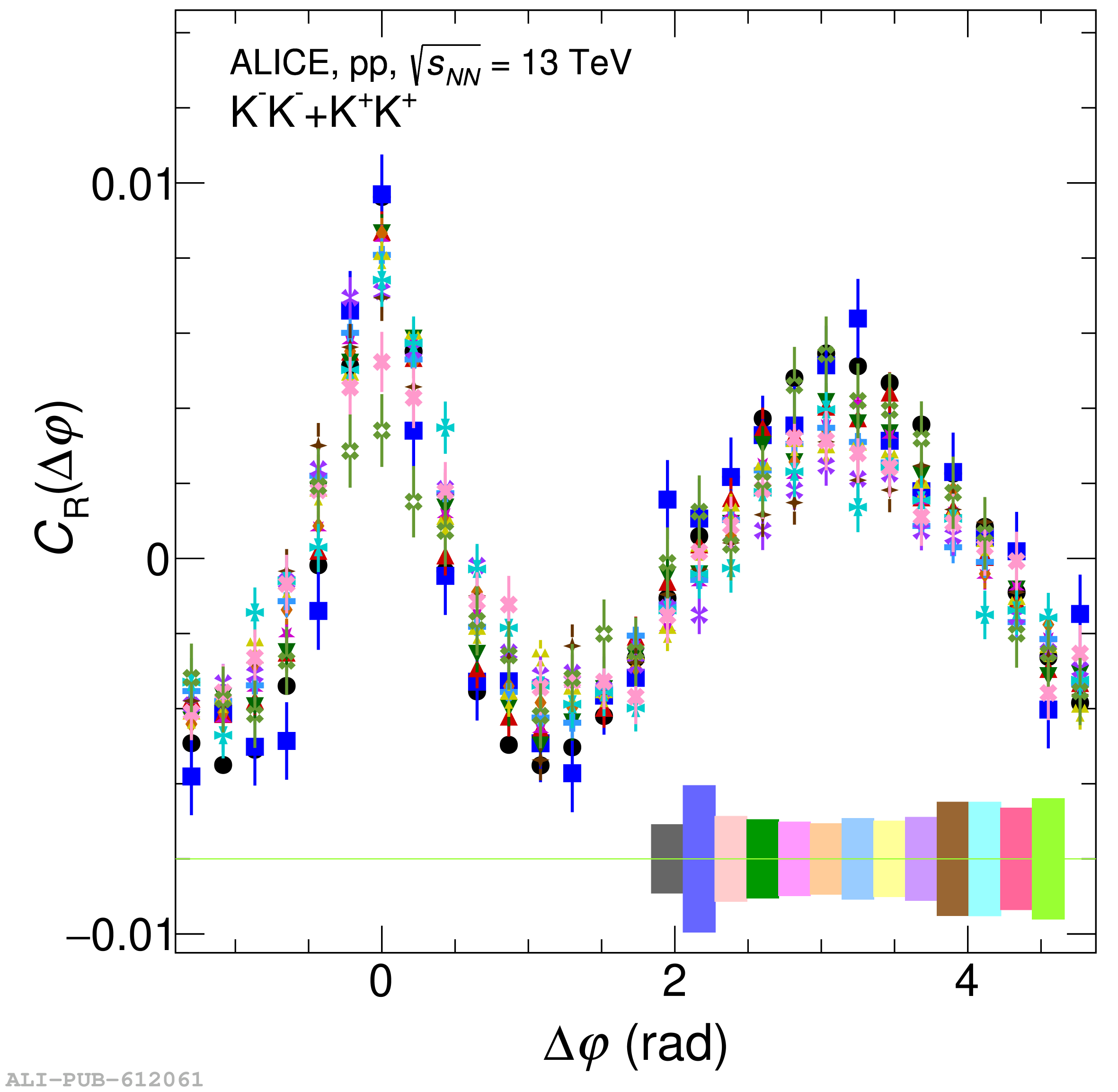 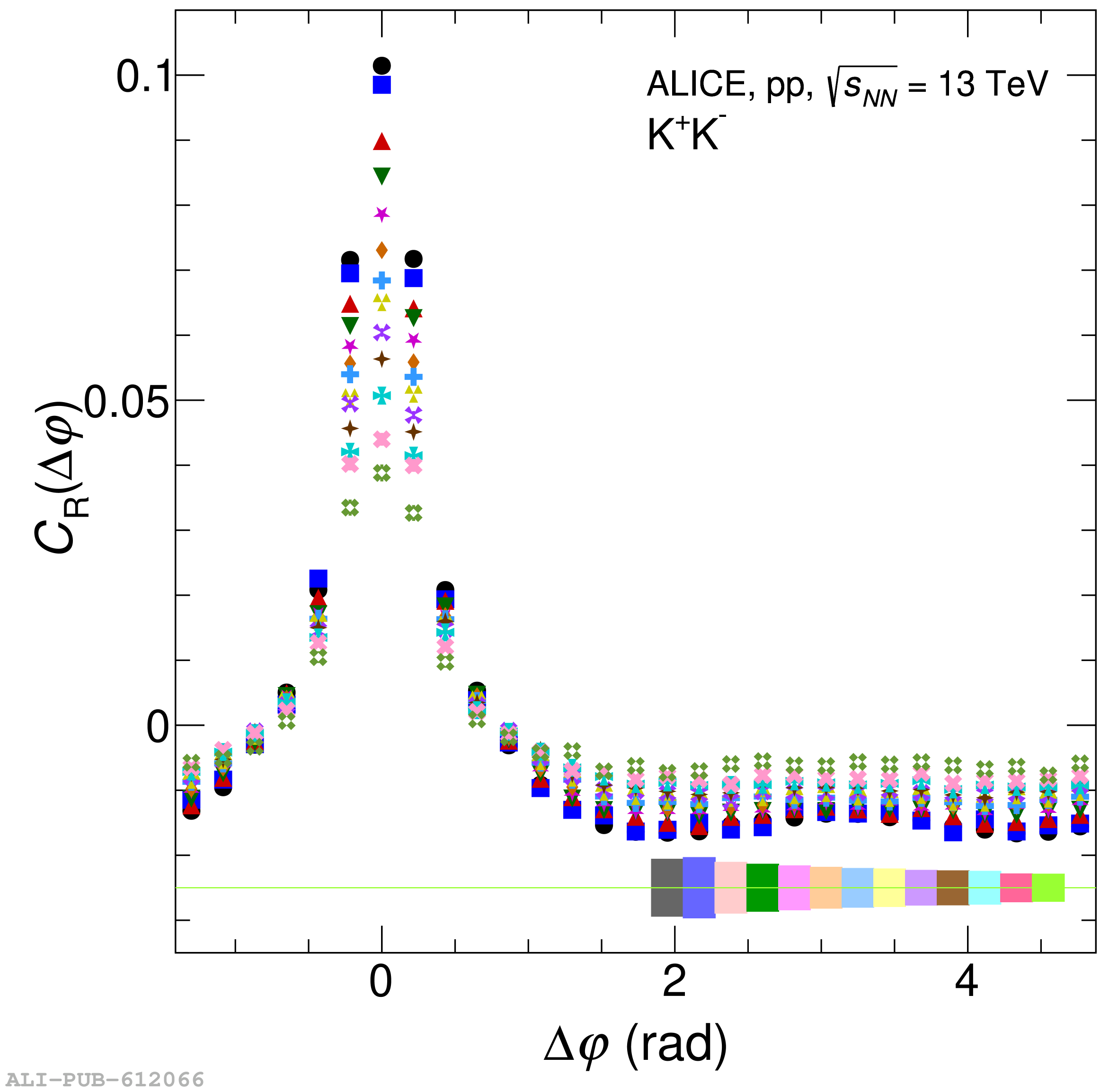 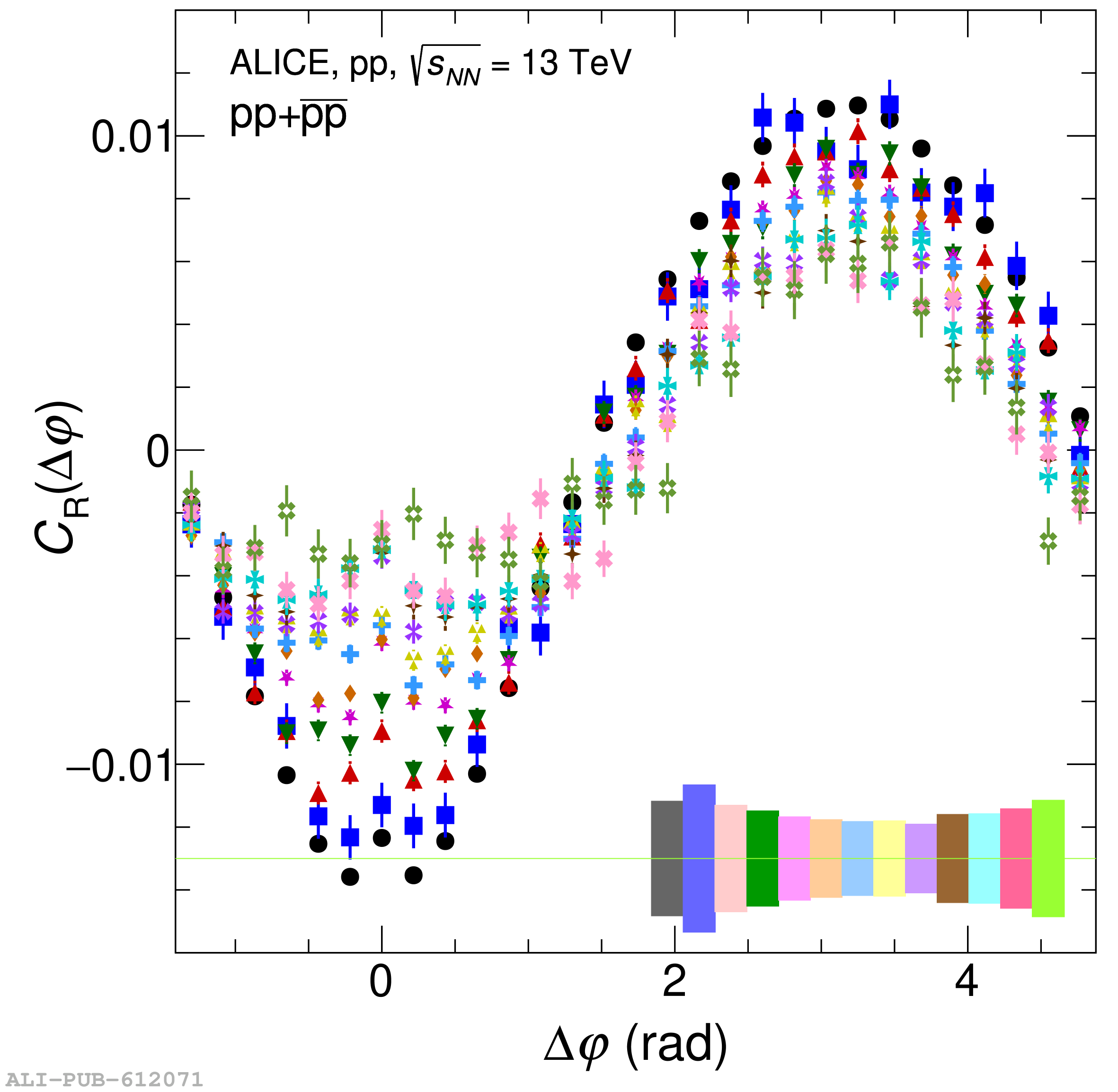 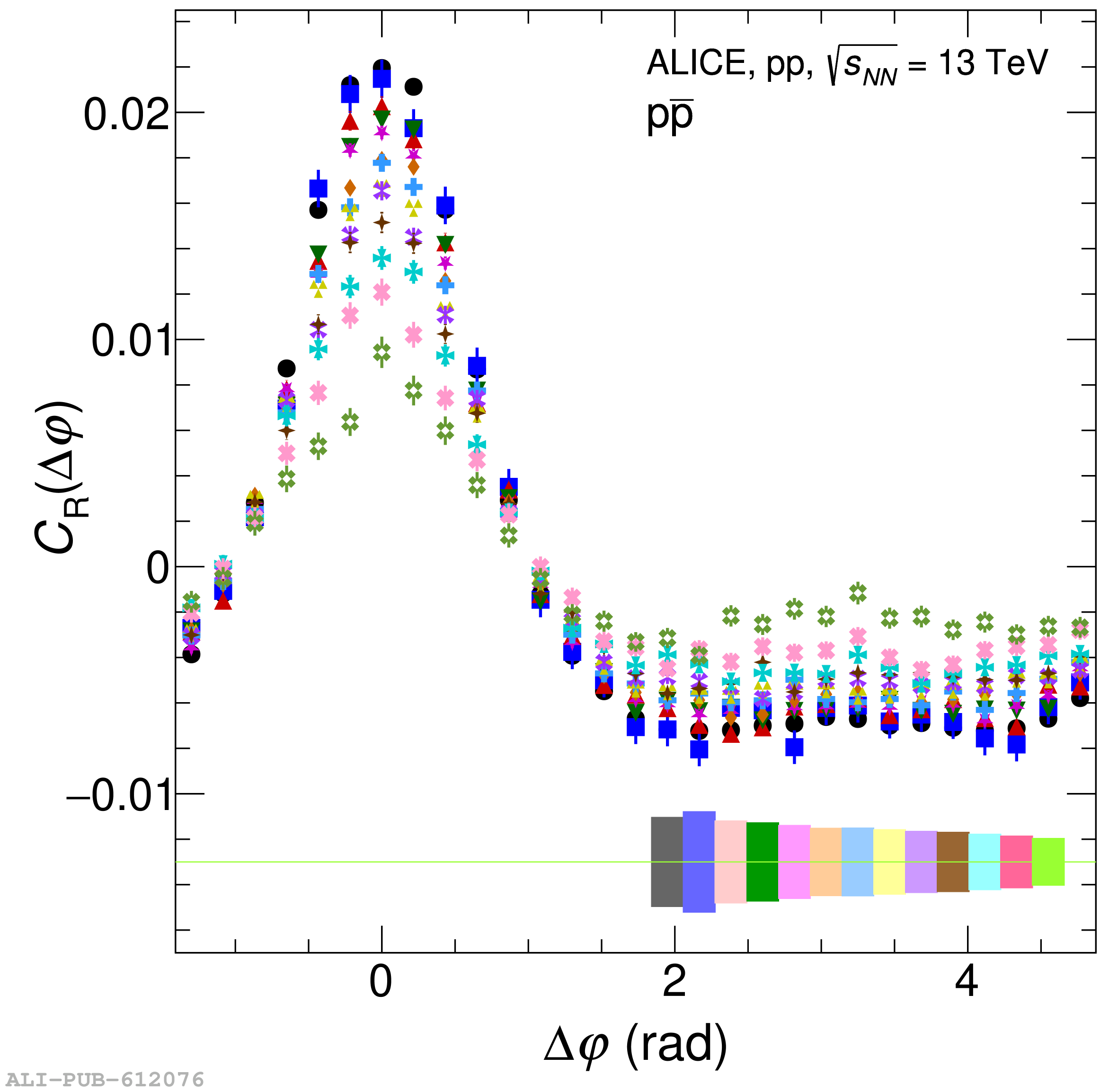 |
Figure 5
Comparison between $\Delta\varphi$-correlation functions and MC models (PYTHIA8 Monash 2013 in blue, EPOS LHC in red, EPOS4 in green, and PYTHIA 8.315 in magenta) in pp collision at $\sqrt{s} = 13$ TeV by using the $C_{\rm{R}}$ definition for like-sign pions, kaons, and protons pairs (top-to-bottom) for the highest (0--1\%), middle (30--40\%), and lowest (90--100\%) multiplicity classes (left-to-right). | 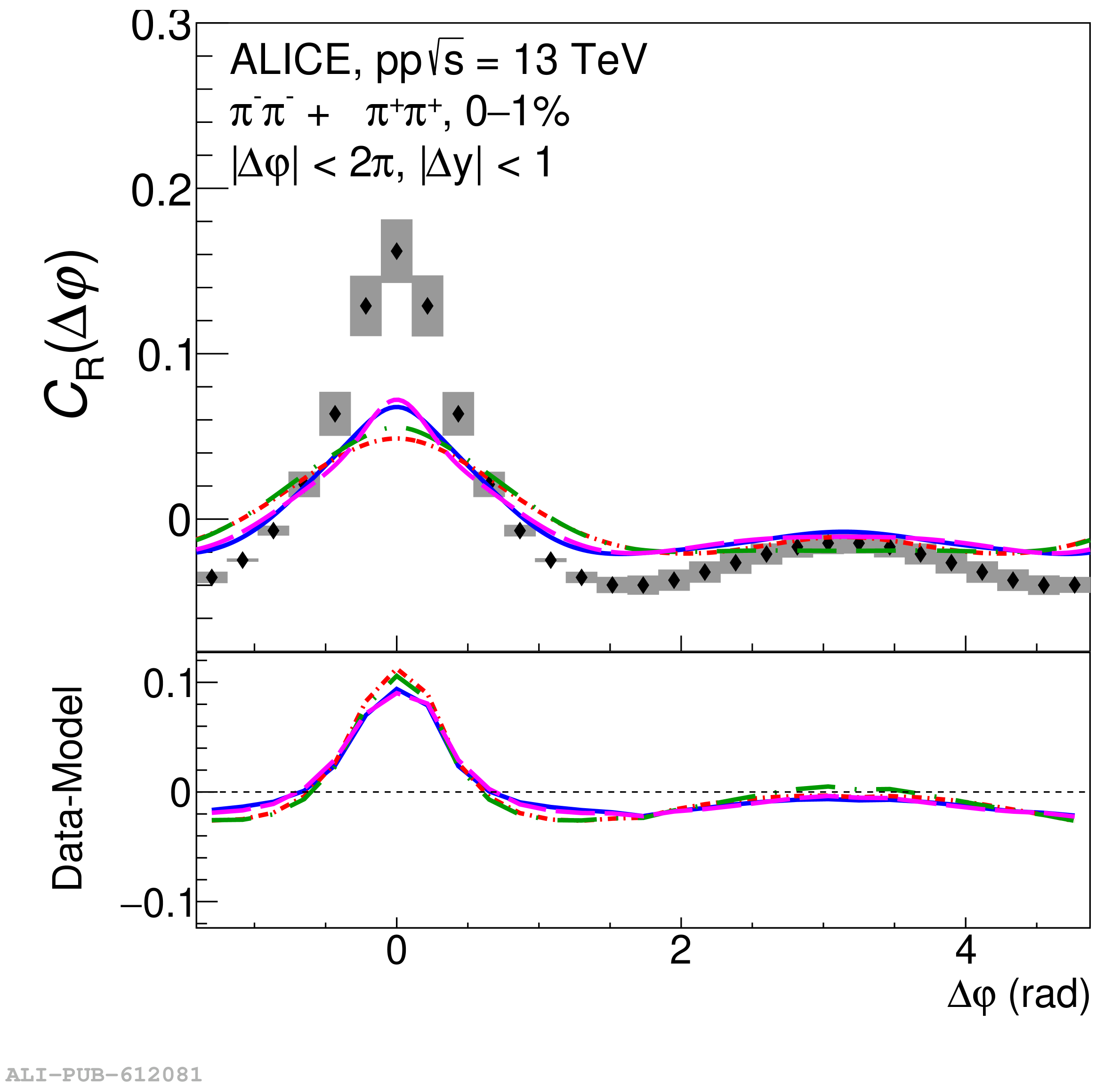 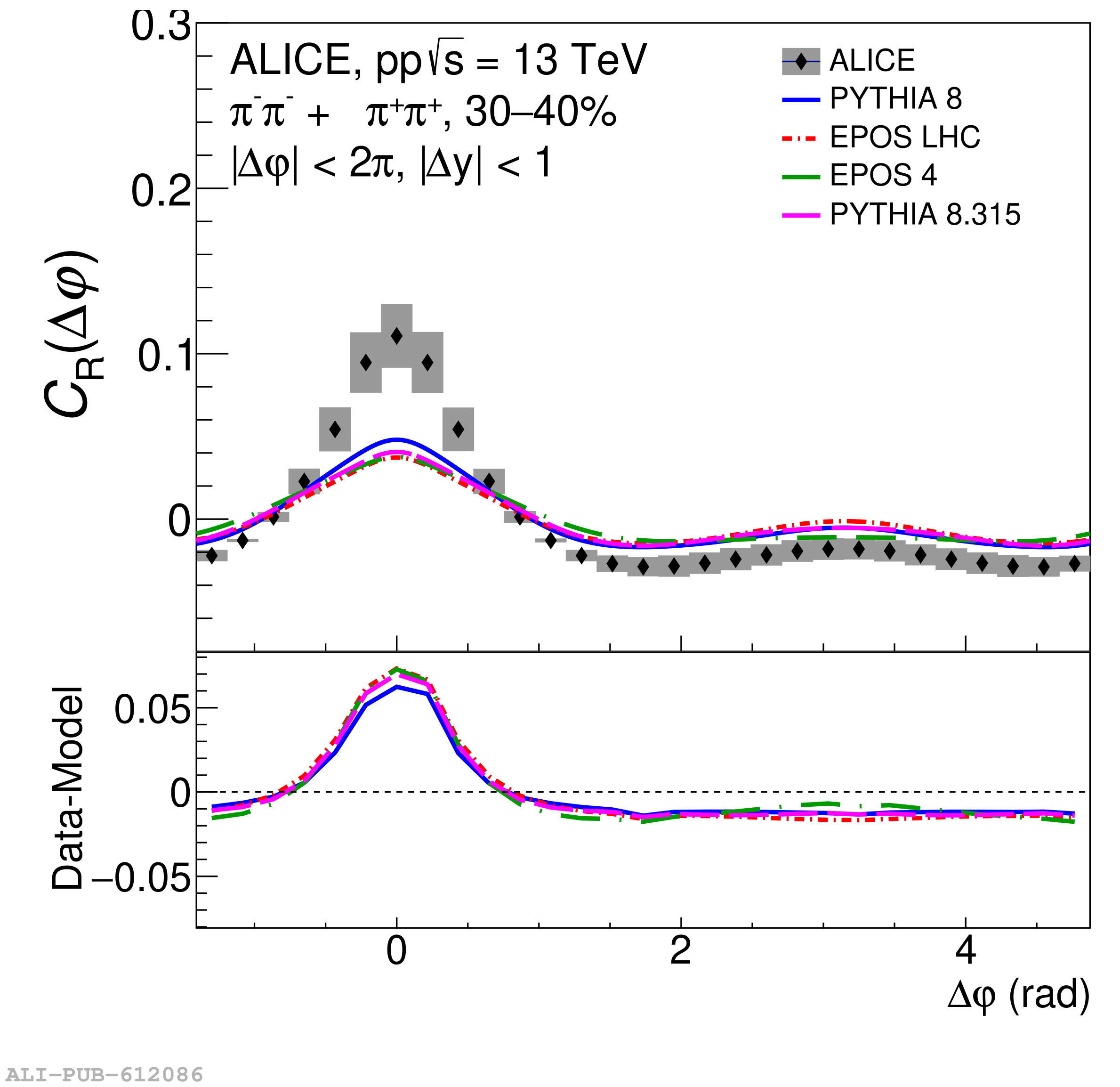 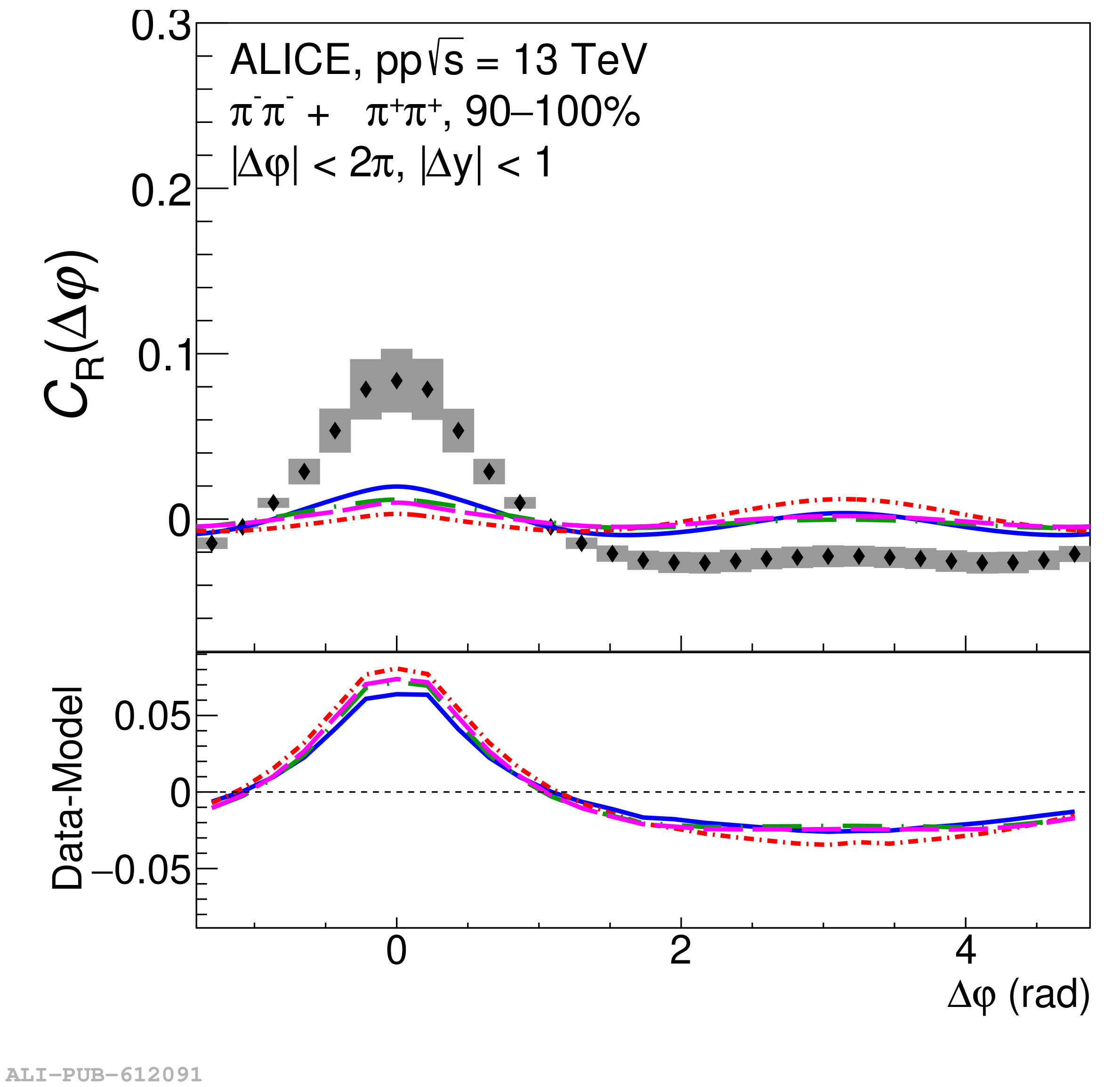 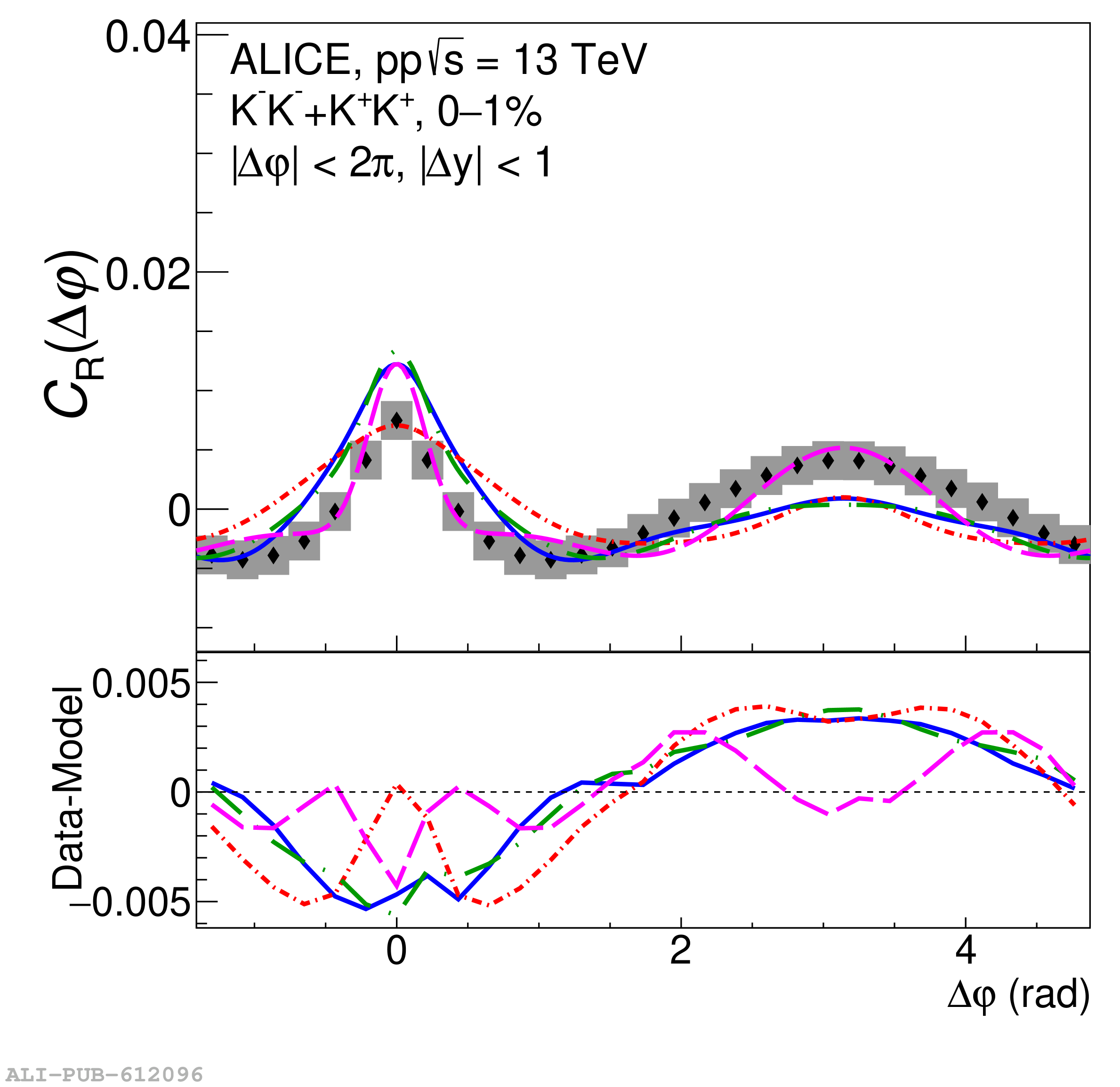 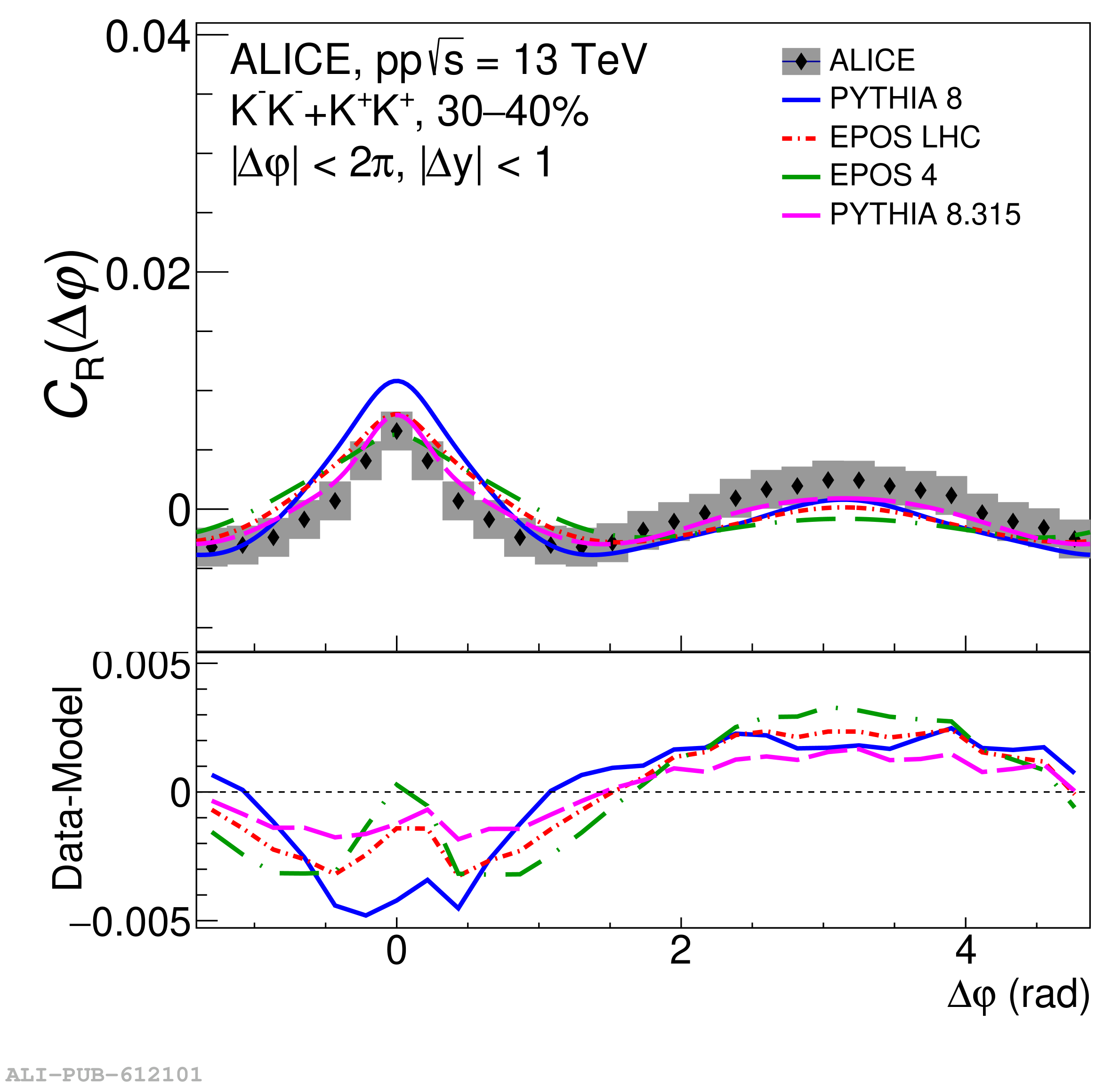 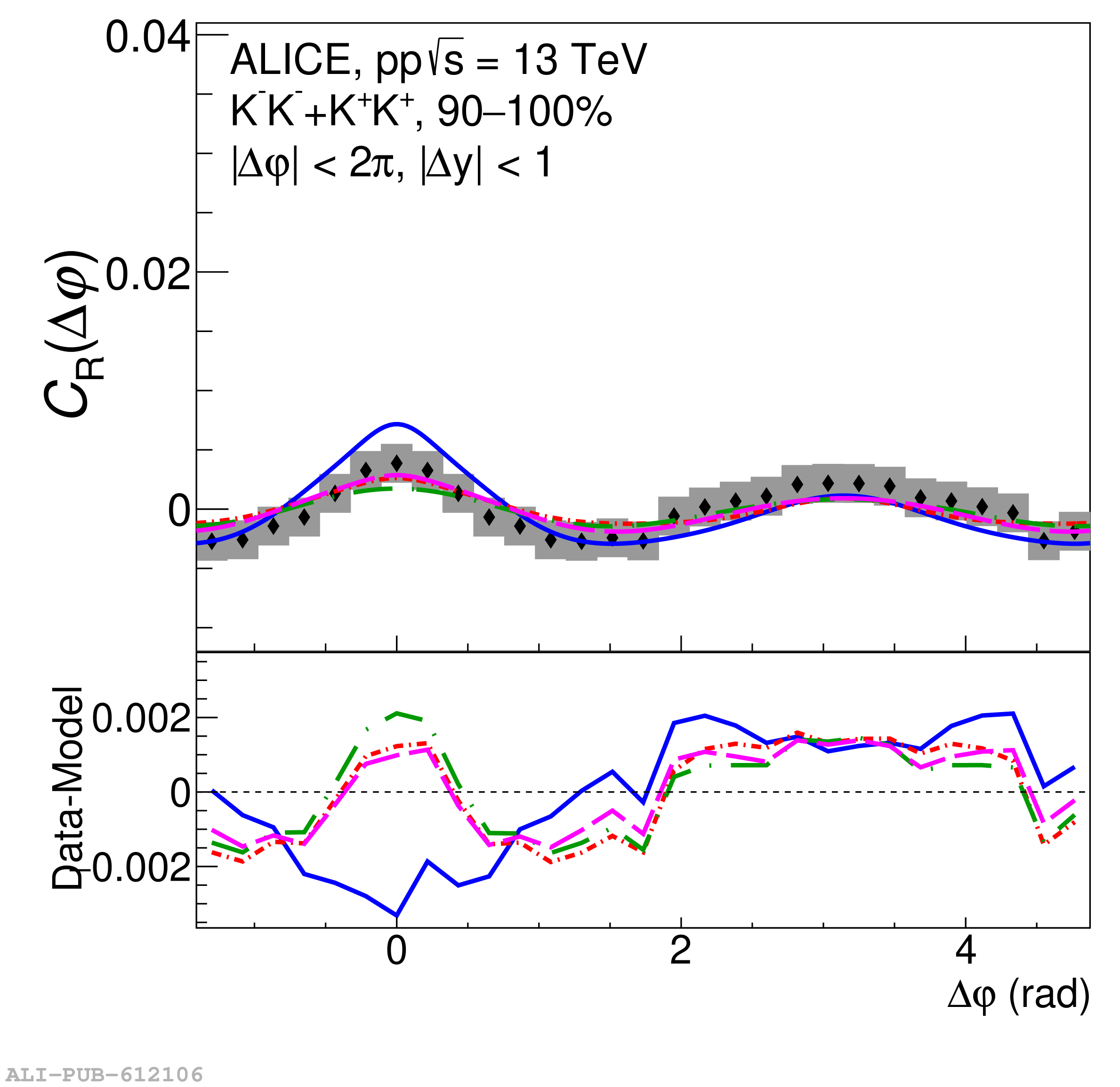 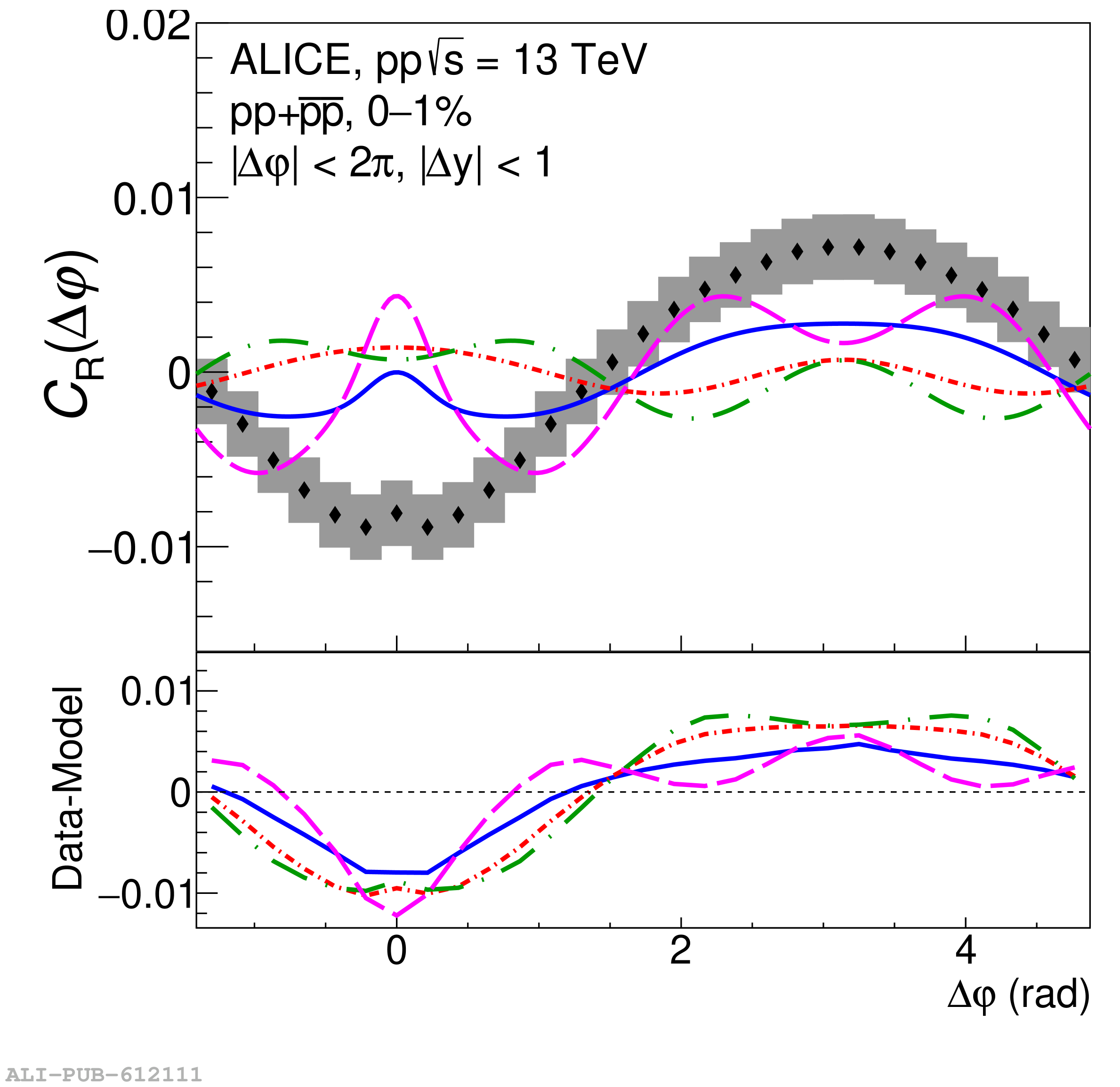 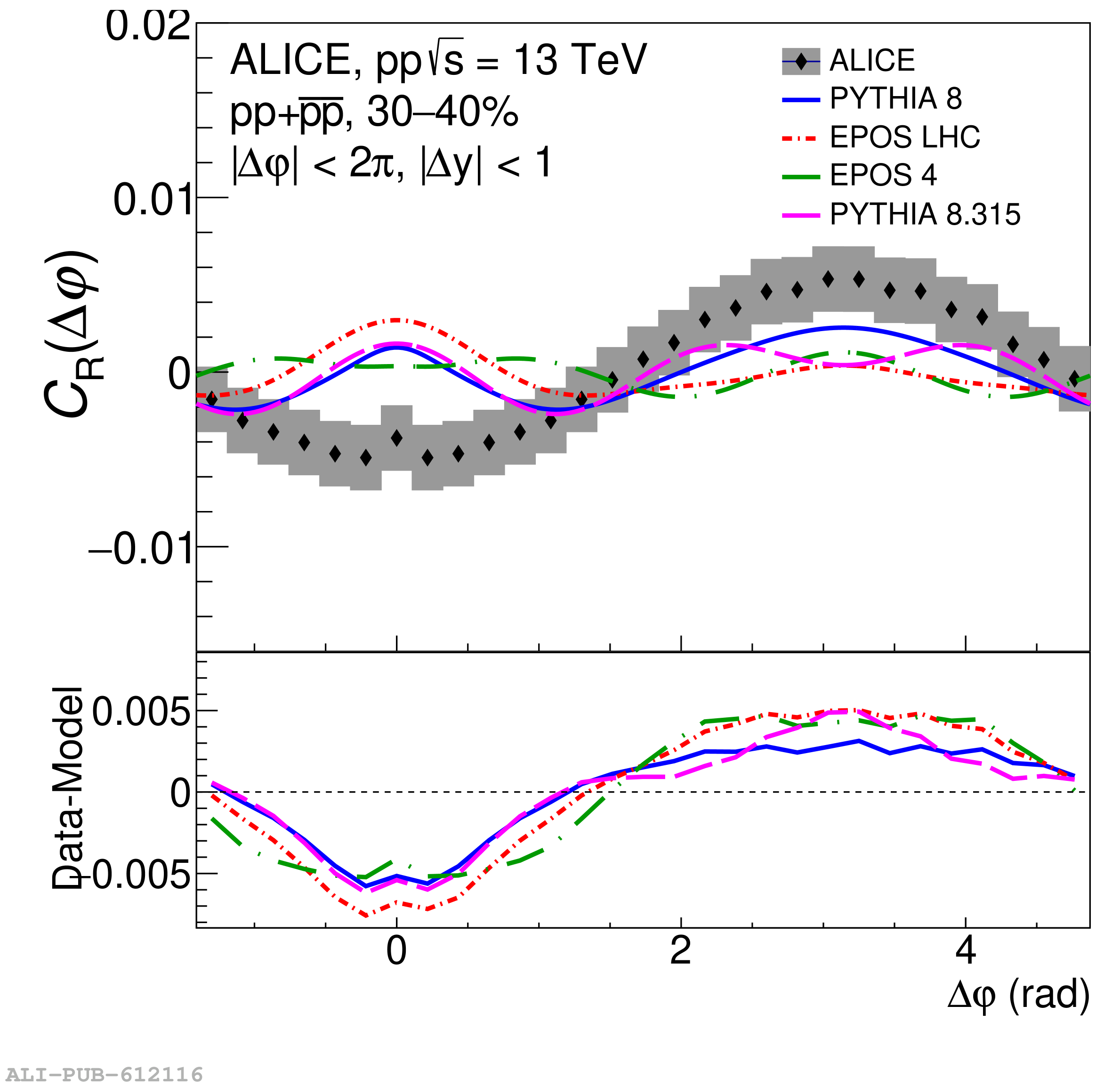 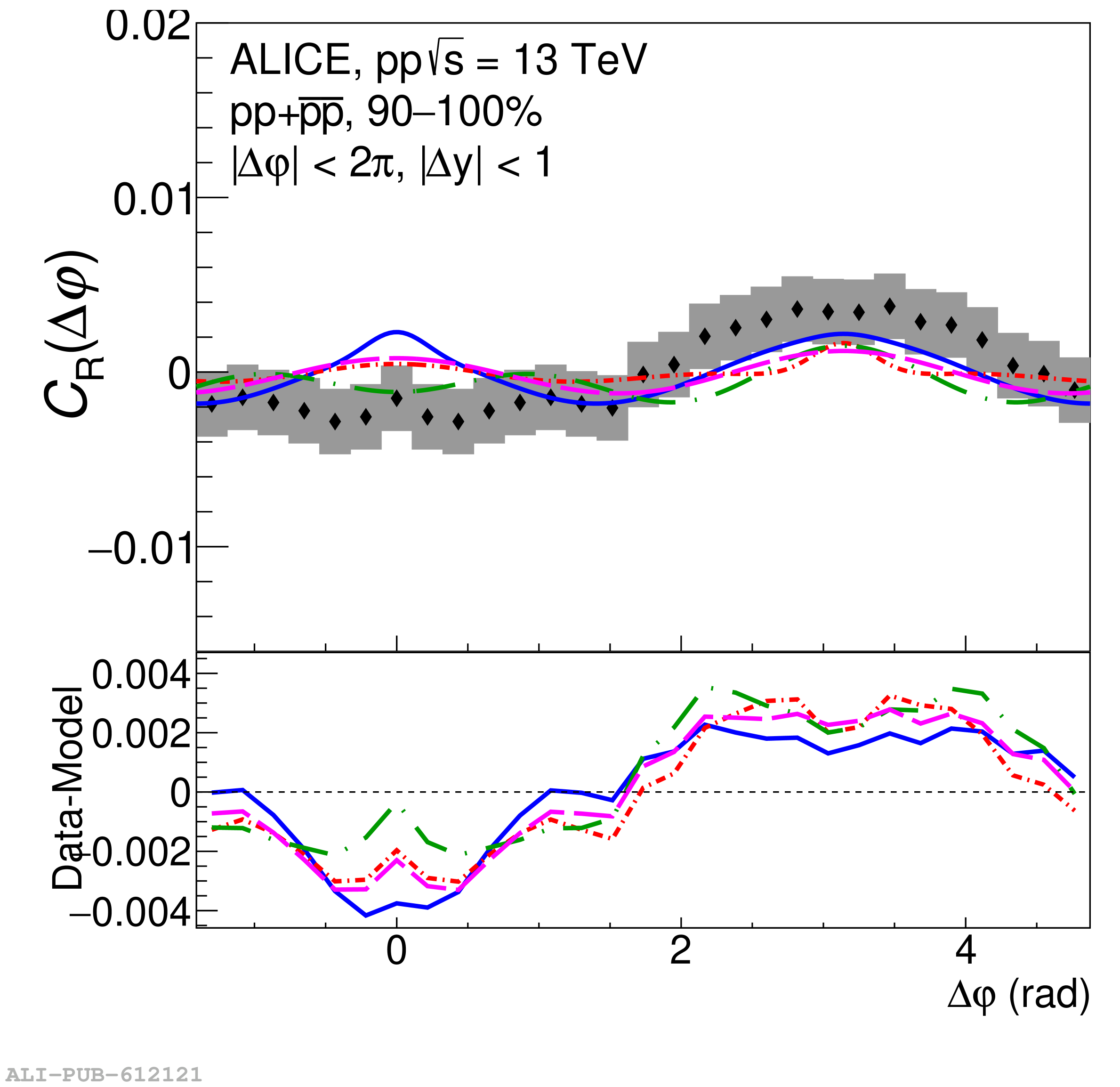 |
Figure 6
Comparison between $\Delta\varphi$-correlation functions and MC models (PYTHIA8 Monash 2013 in blue, EPOS LHC in red, EPOS4 in green, and PYTHIA 8.315 in magenta) in pp collision at $\sqrt{s} = 13$ TeV by using the $C_{\rm{R}}$ definition for unlike-sign pairs of pions, kaons, and protons (top-to-bottom) for the highest (0--1\%), middle (30--40\%), and lowest (90--100\%) multiplicity classes (left-to-right). | 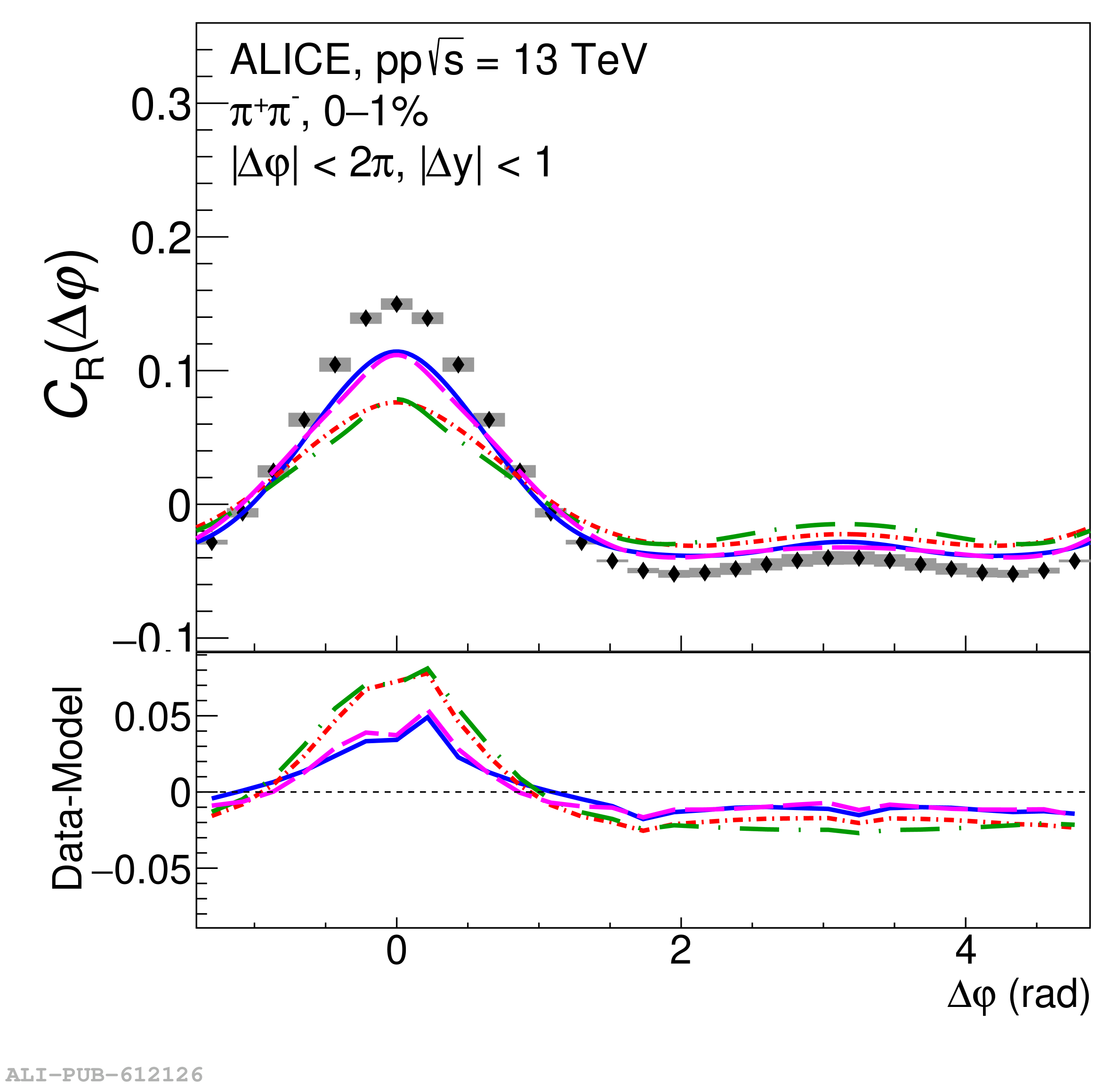 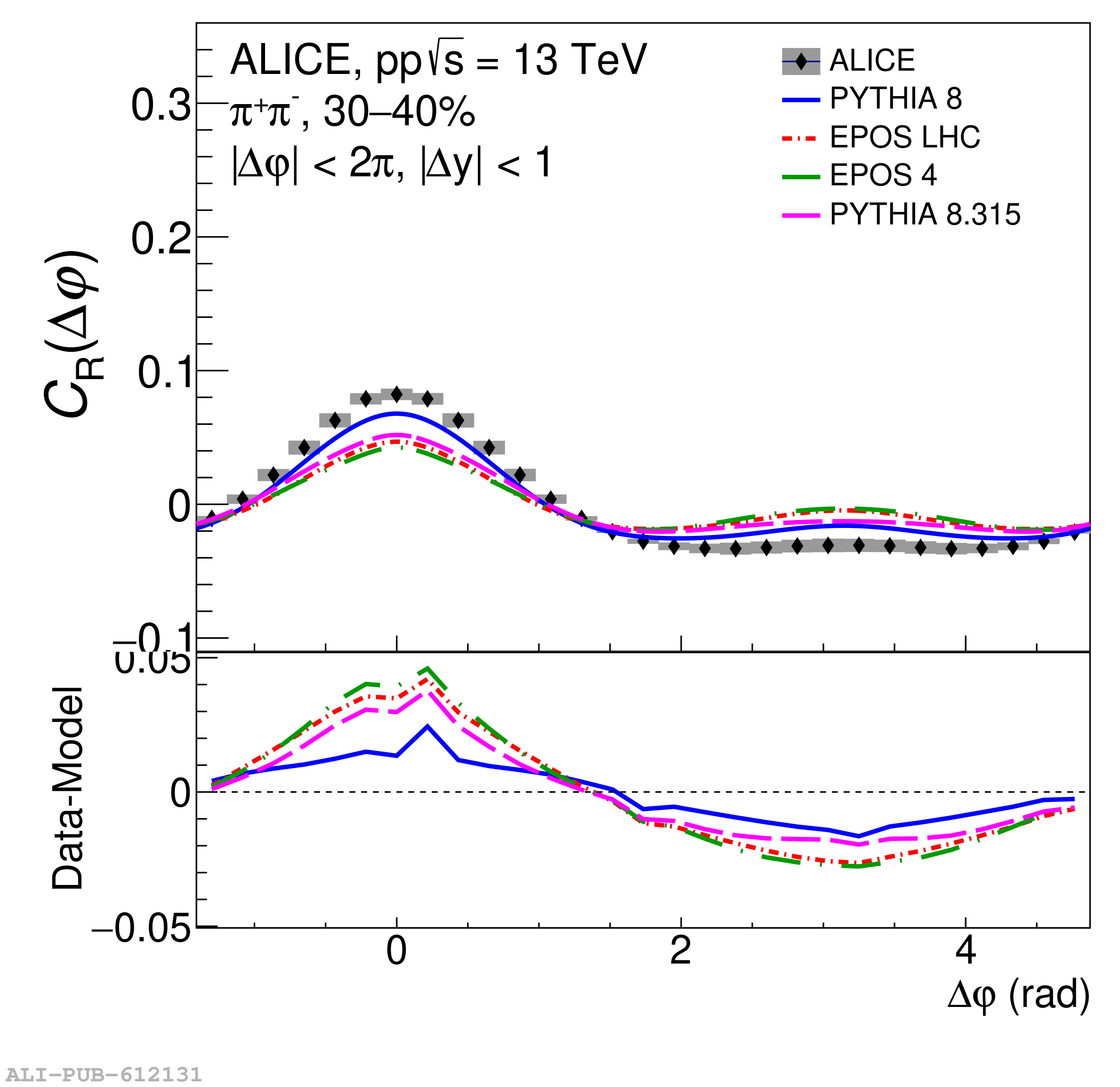 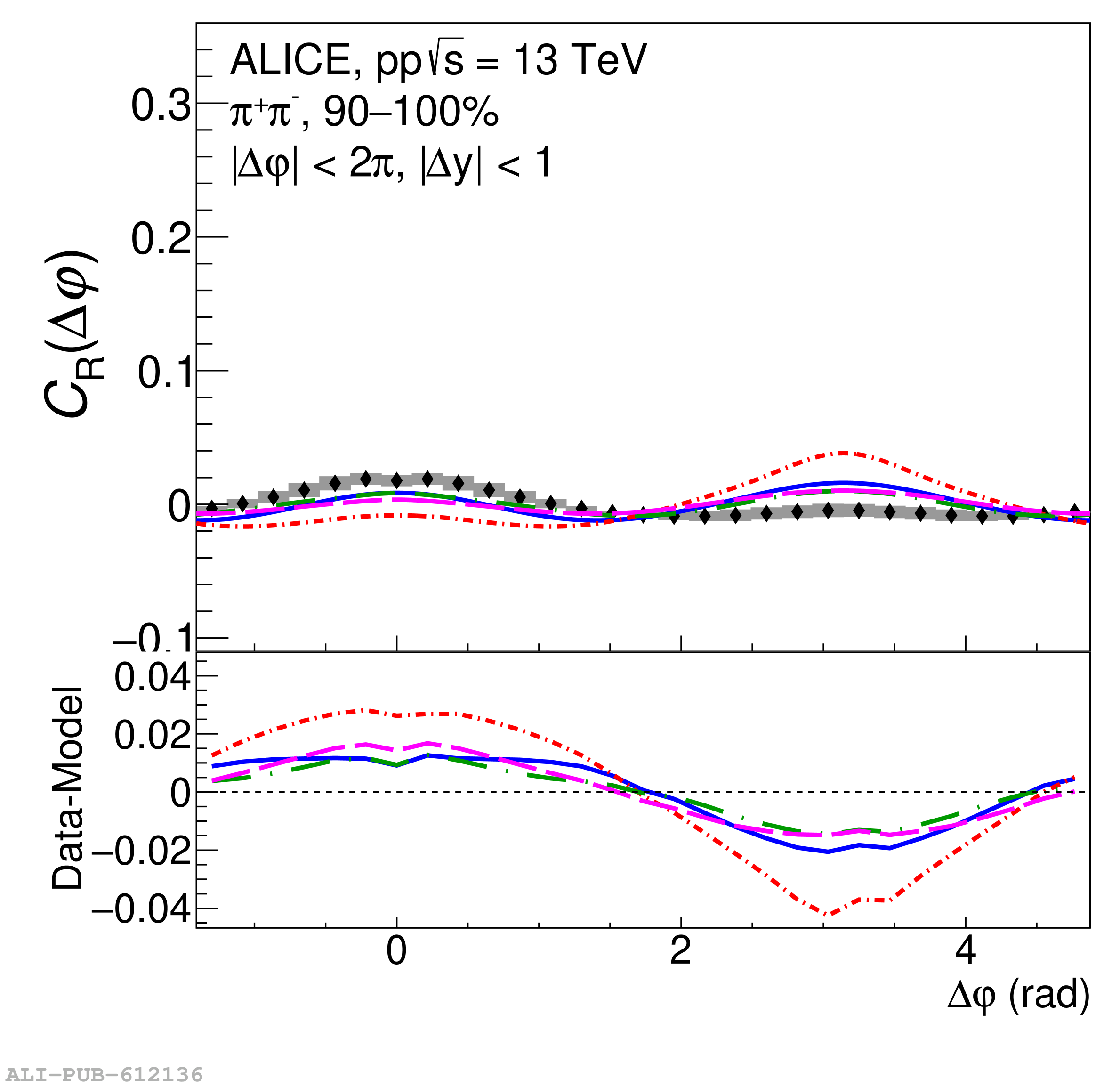 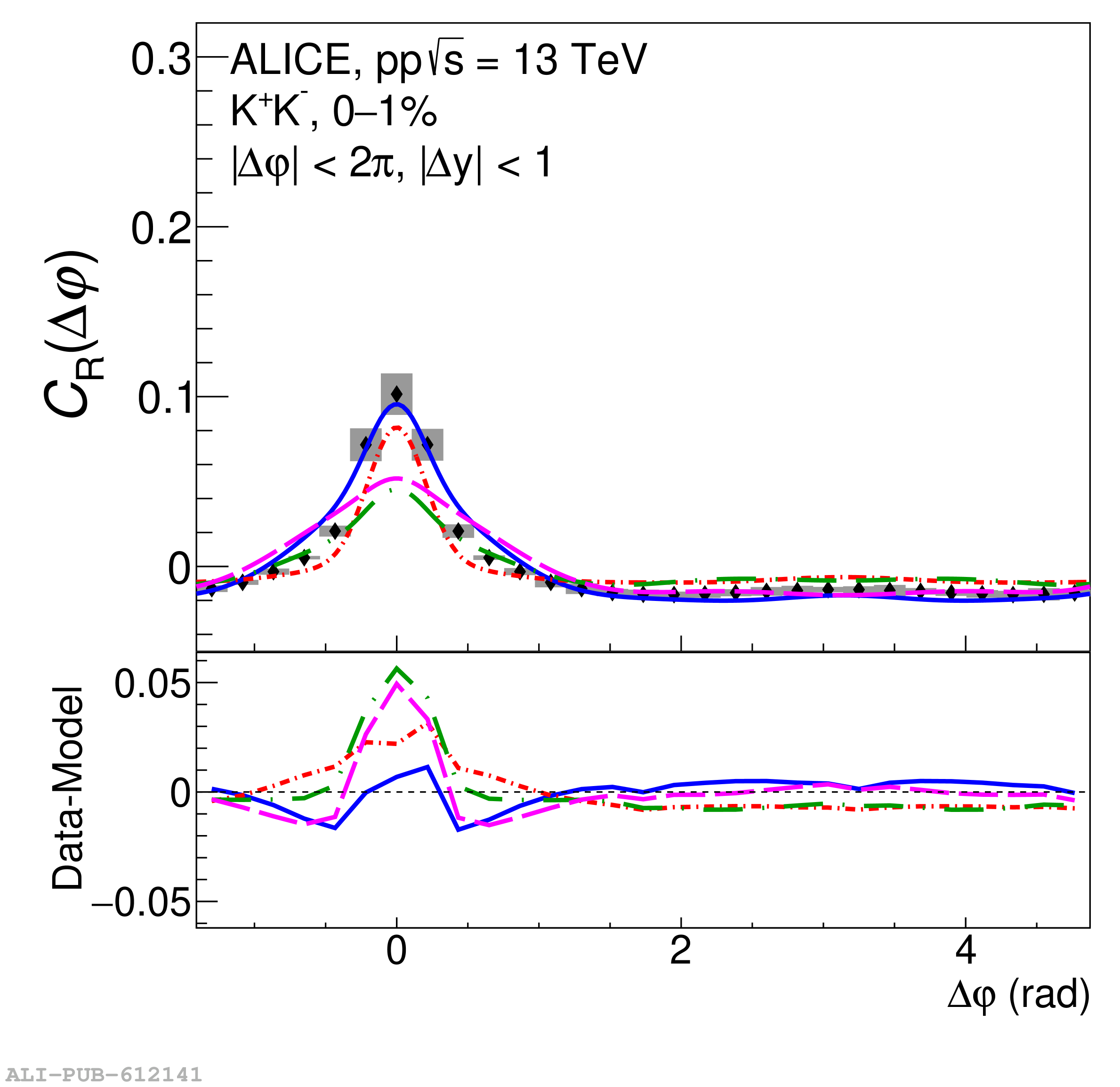 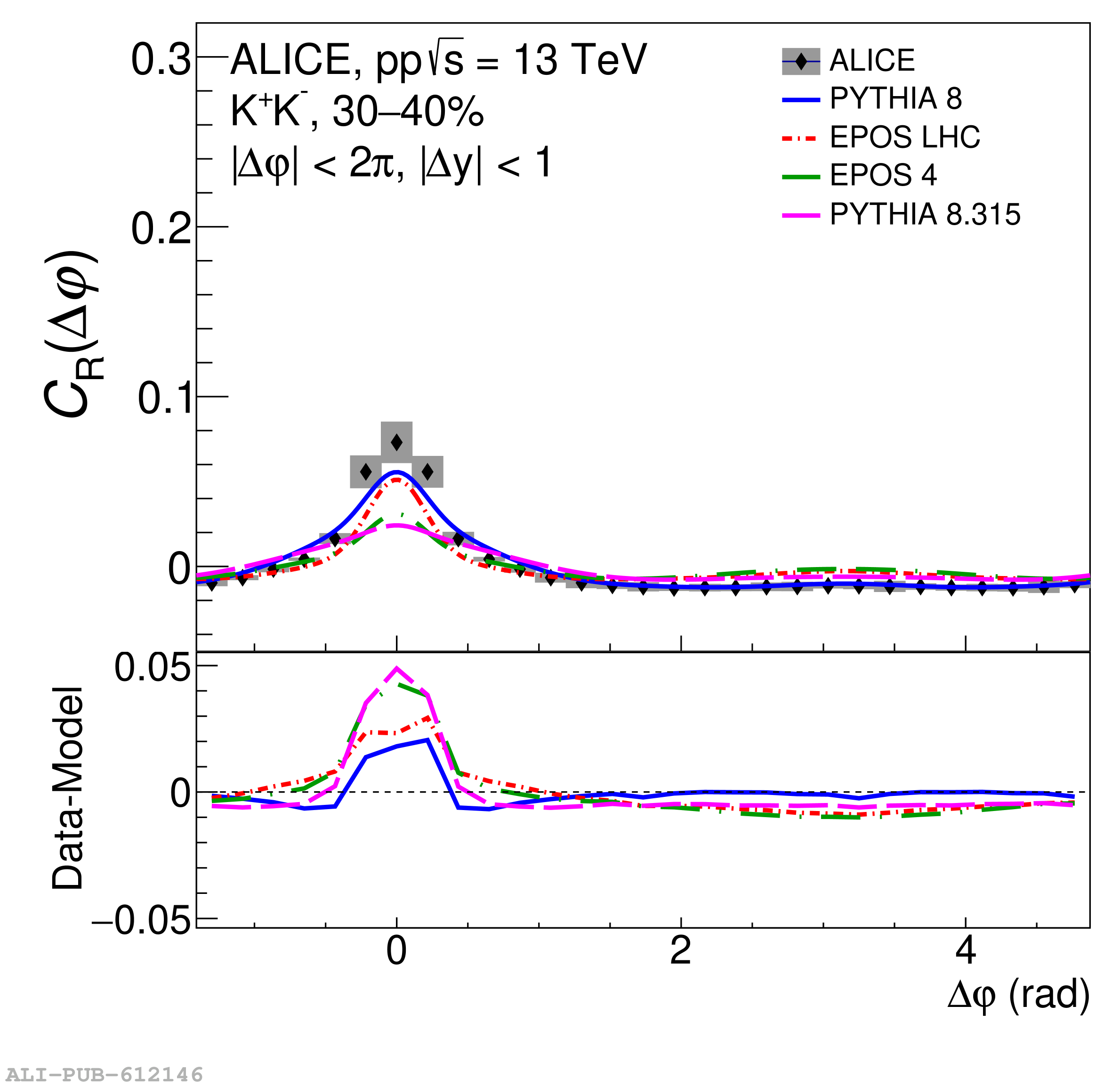 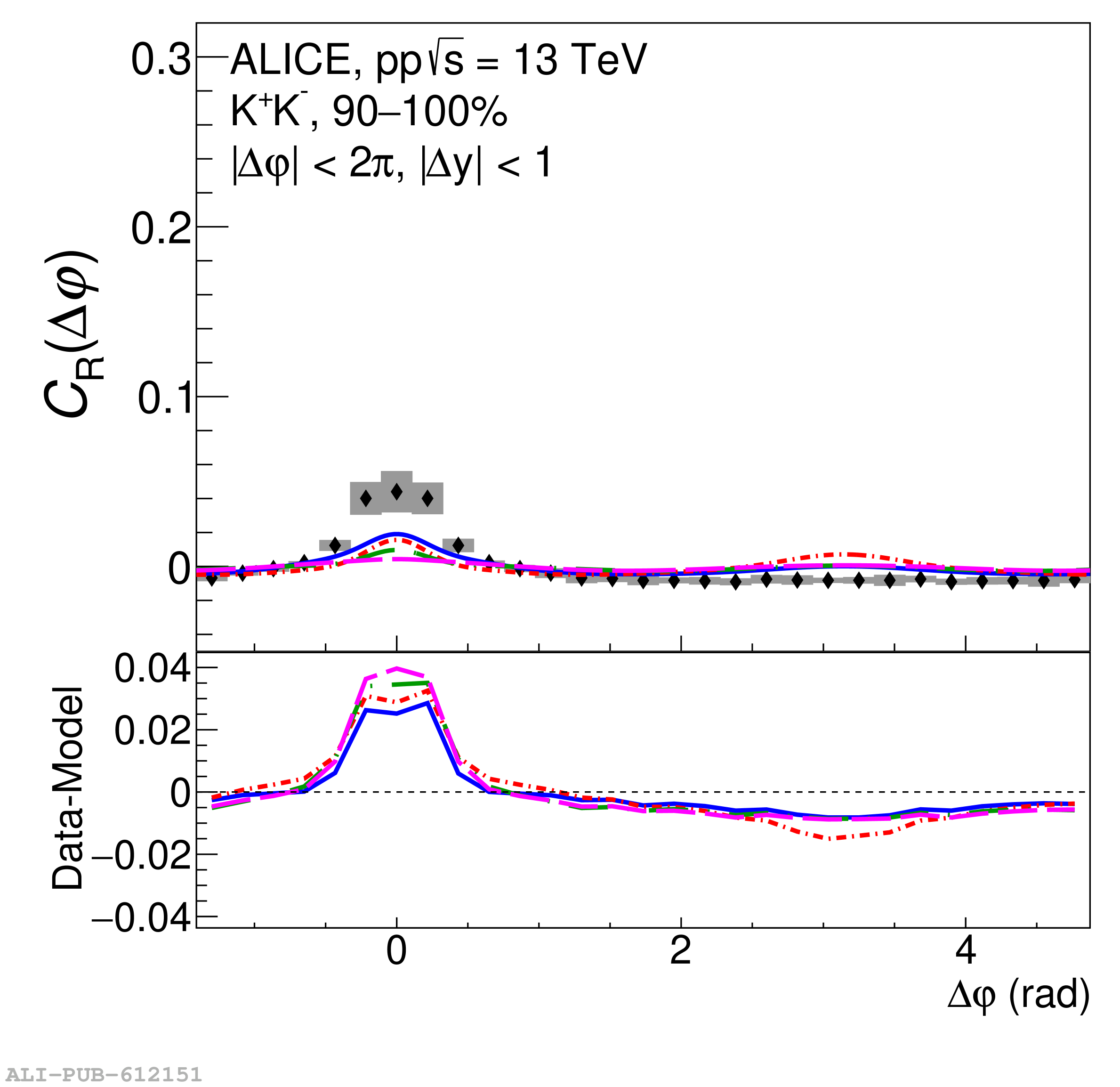 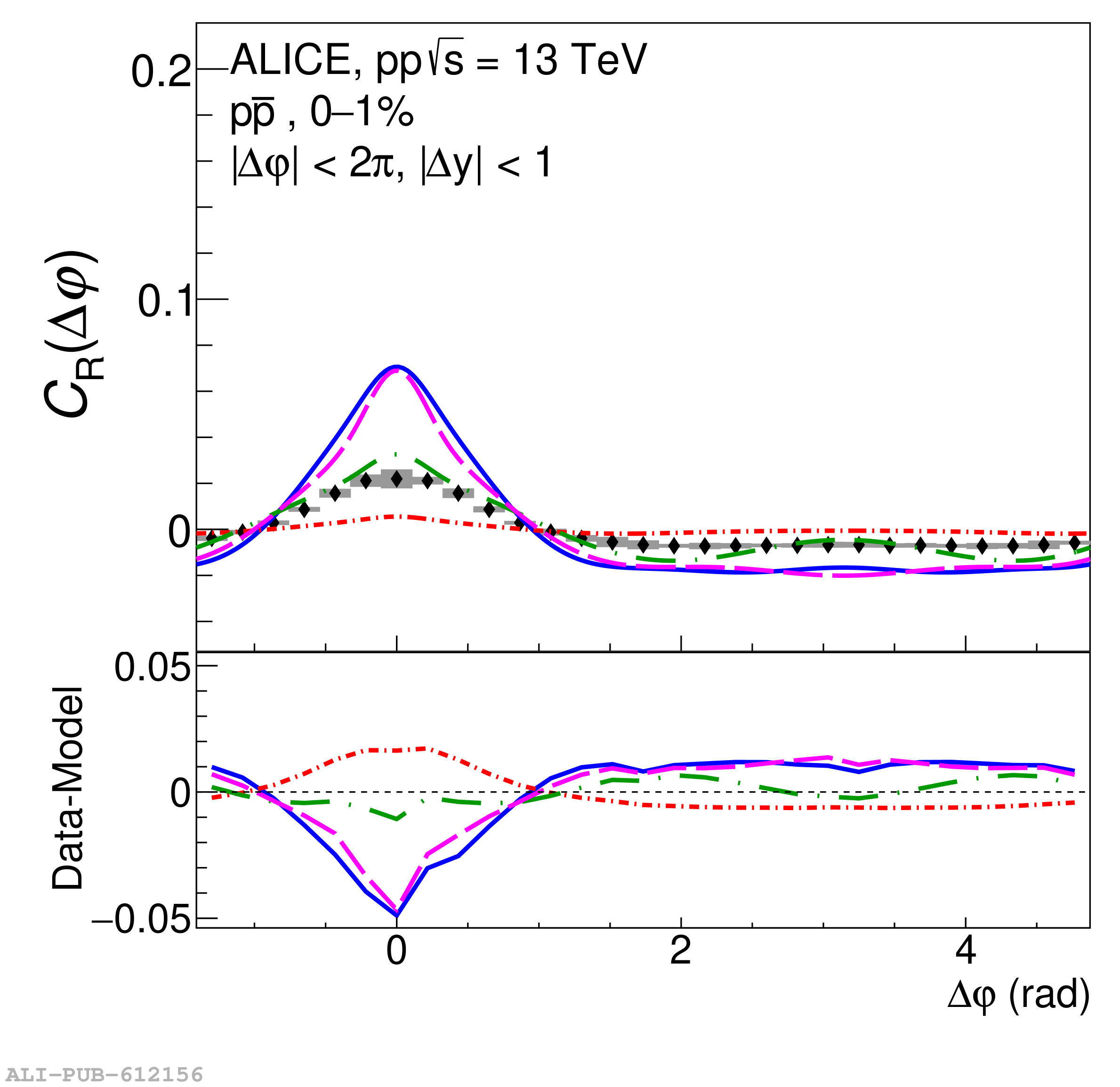 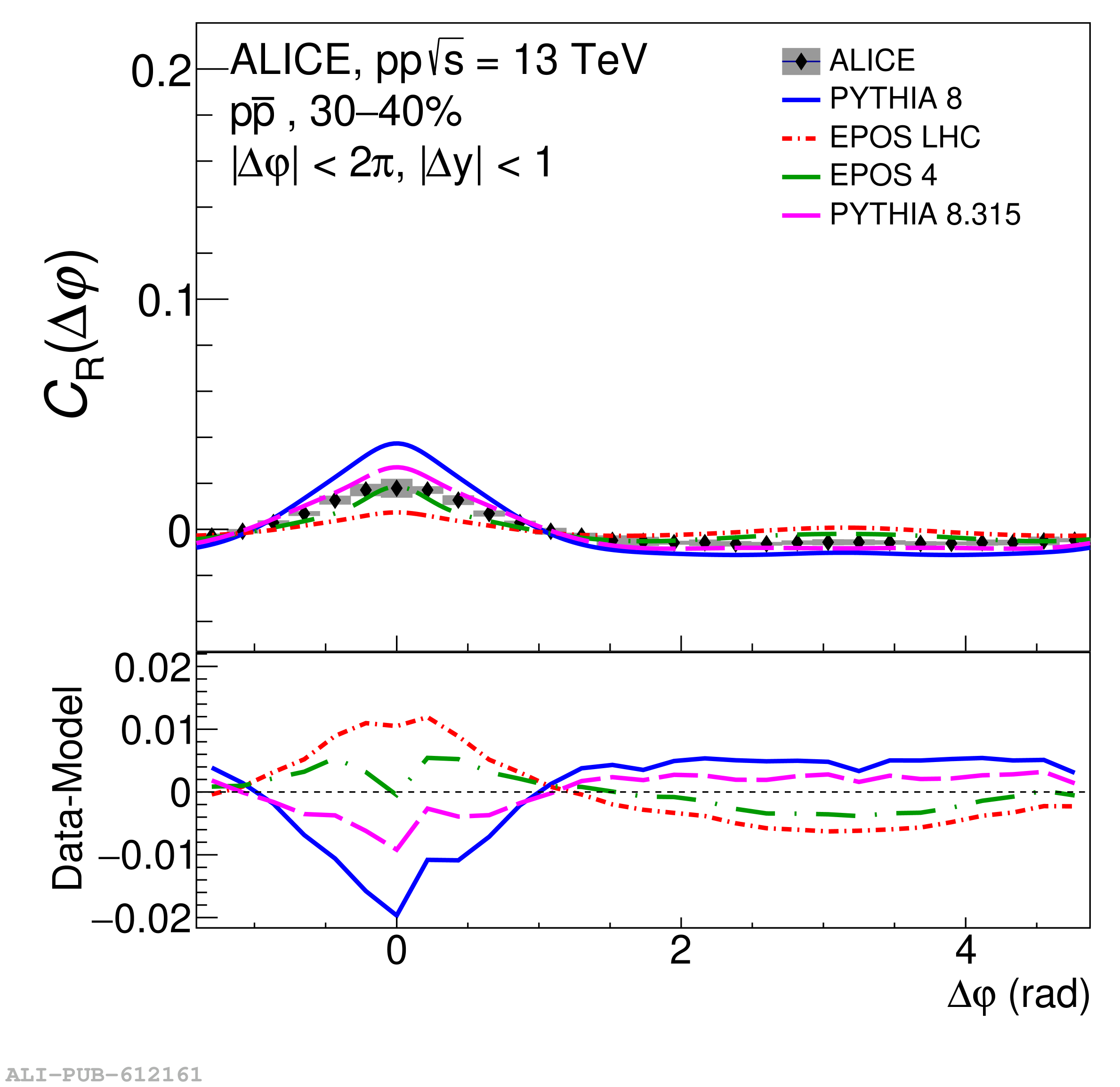 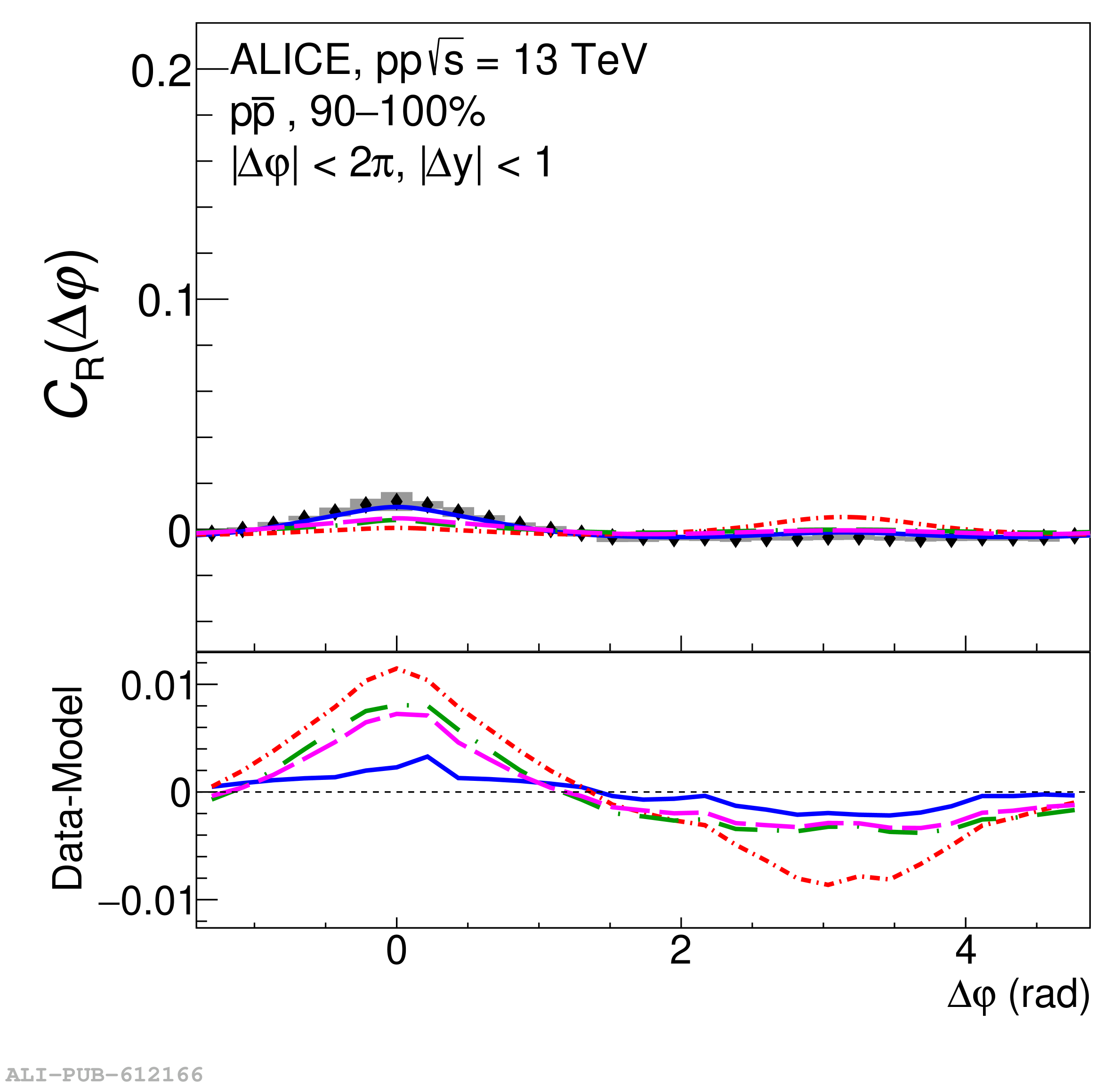 |
Figure 7
$\Delta y$-correlation function distribution compared with MC models (PYTHIA8 Monash 2013 in blue, EPOS LHC in red, EPOS4 in green, and PYTHIA 8.315 in magenta) in pp collision at $\sqrt{s} = 13$ TeV by using the $C_{\rm{R}}$ definition for like-sign pions, kaons, and protons (top-to-bottom) and for the highest (0--1\%), middle (30--40\%), and lowest (90--100\%) multiplcity classes (left-to-right). | 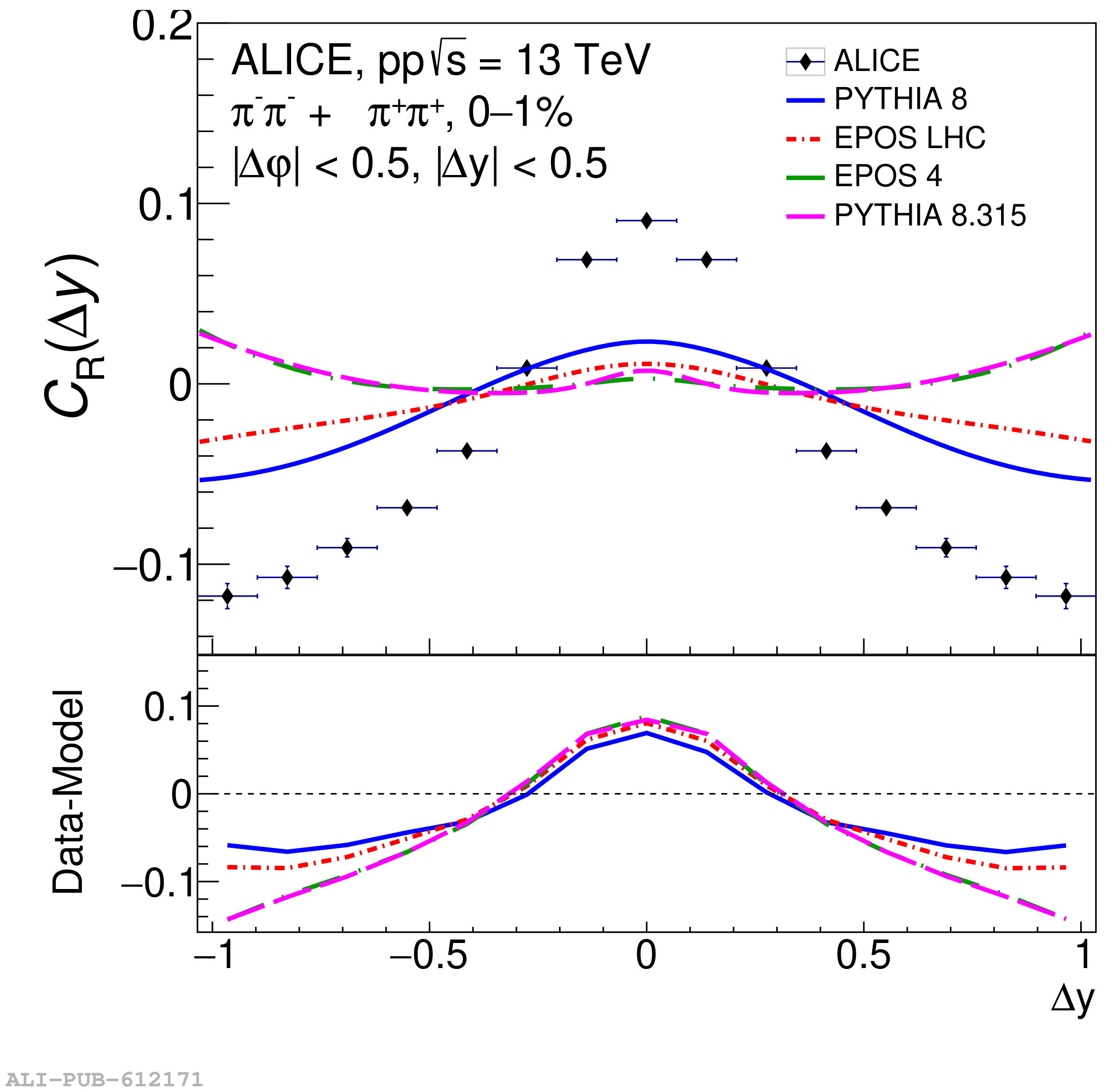 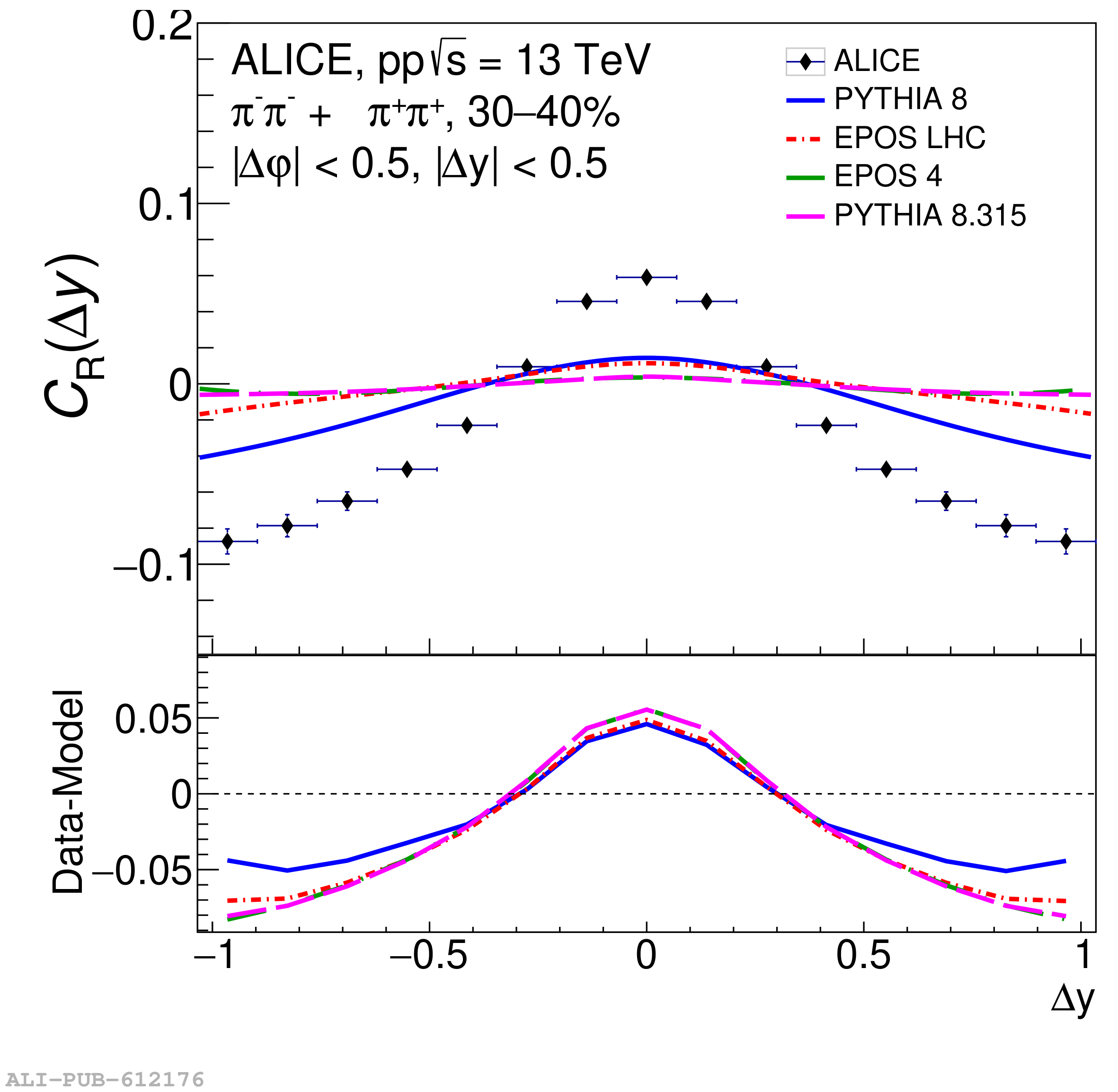 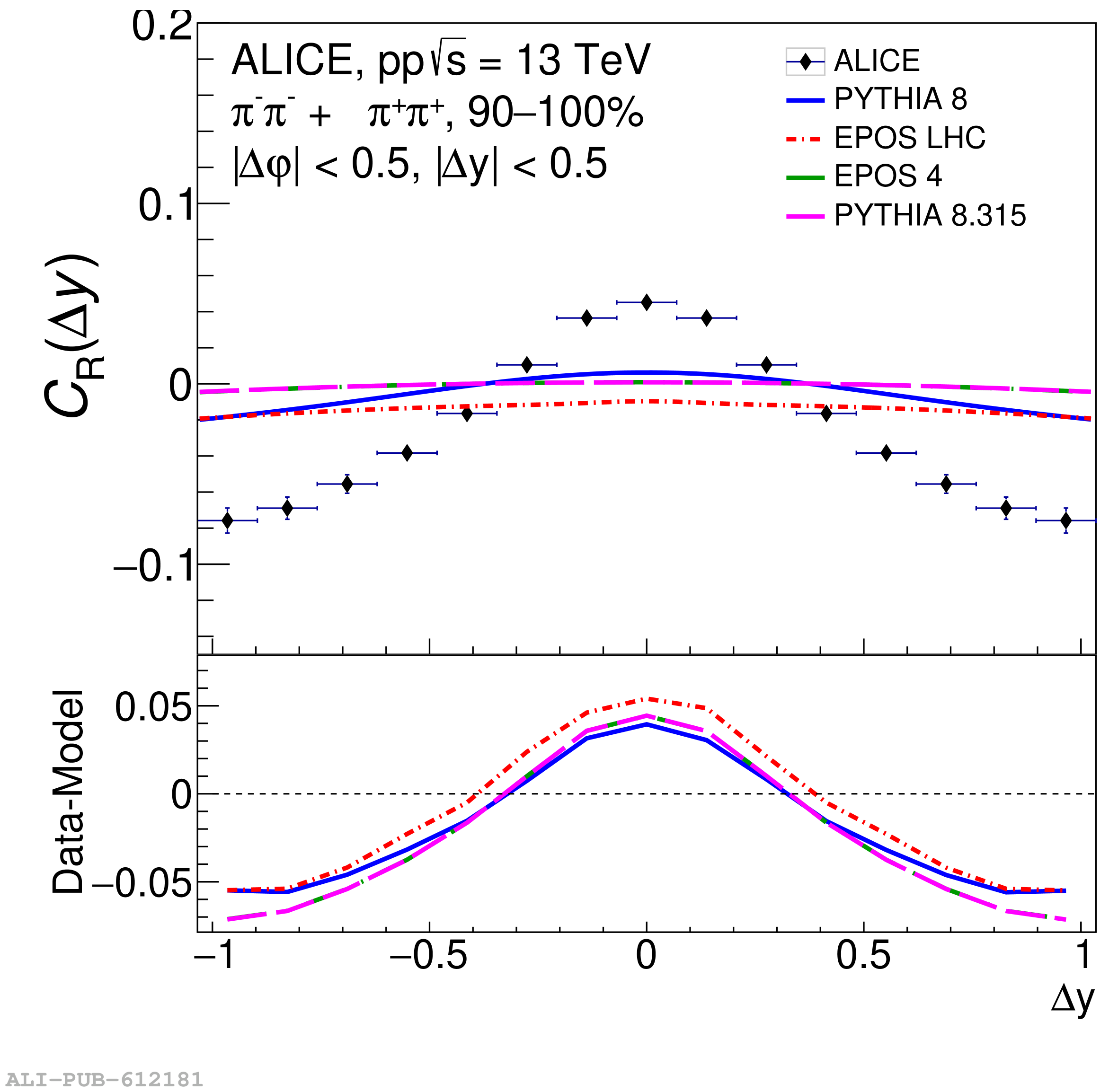 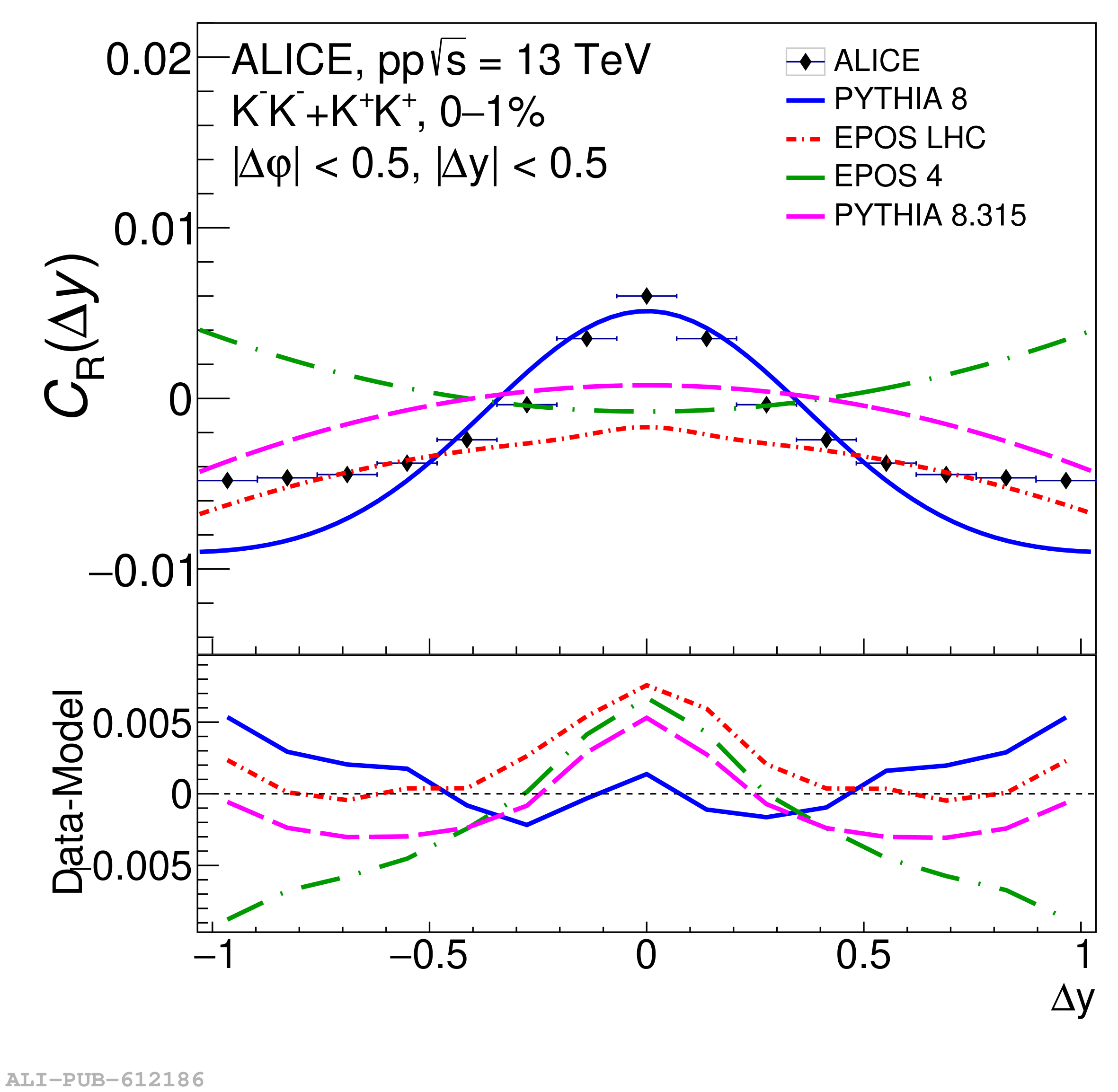 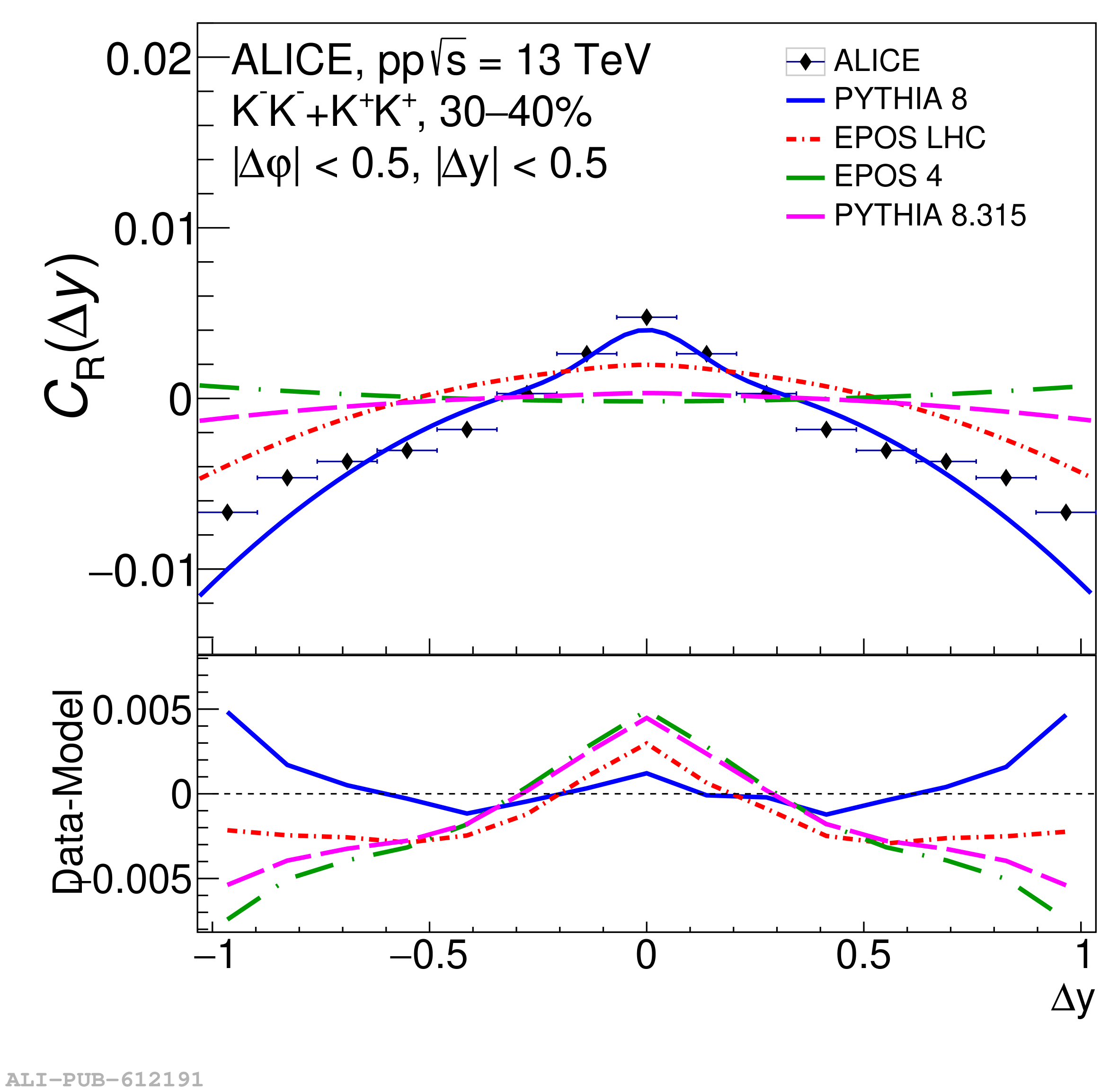 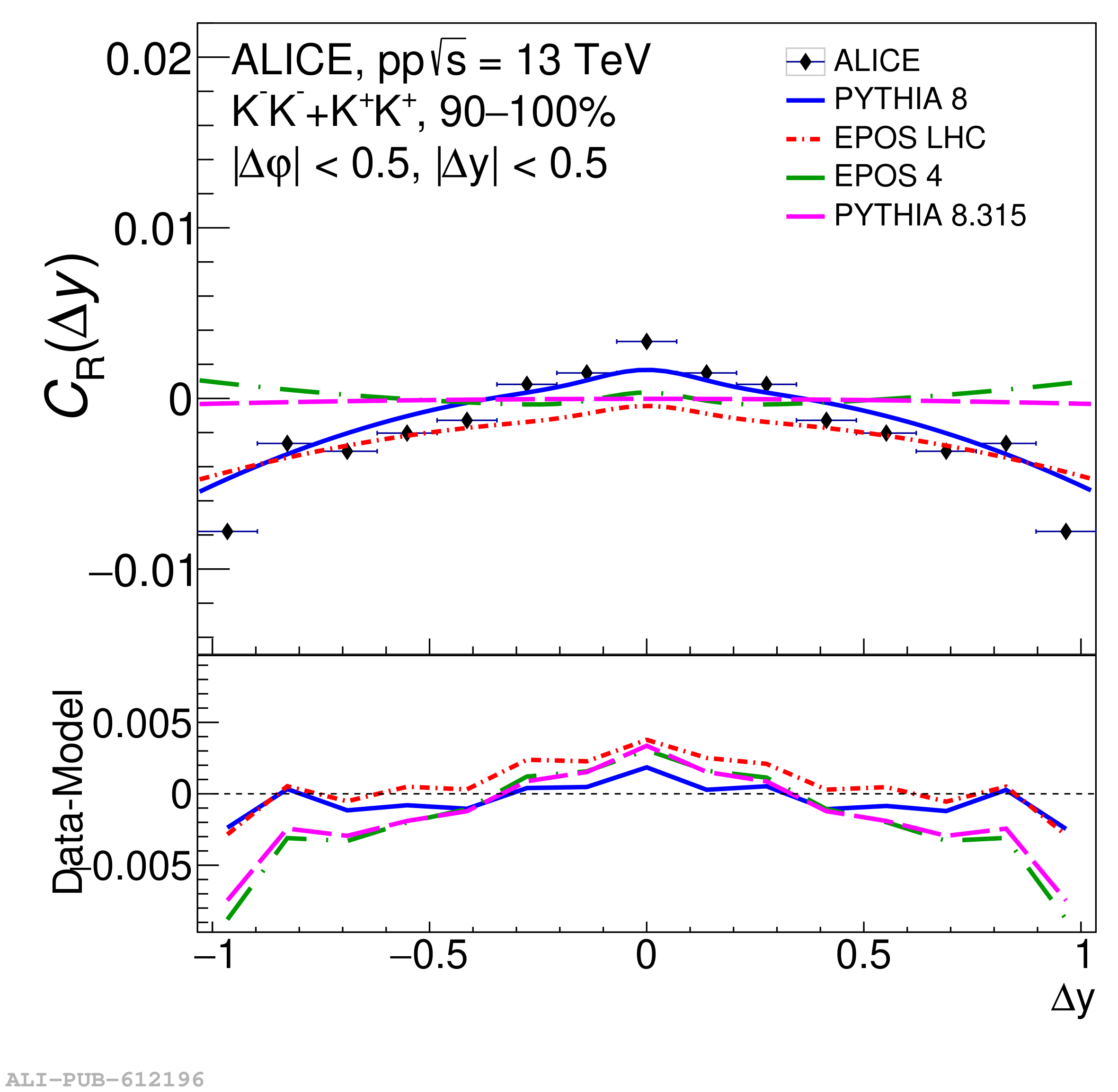 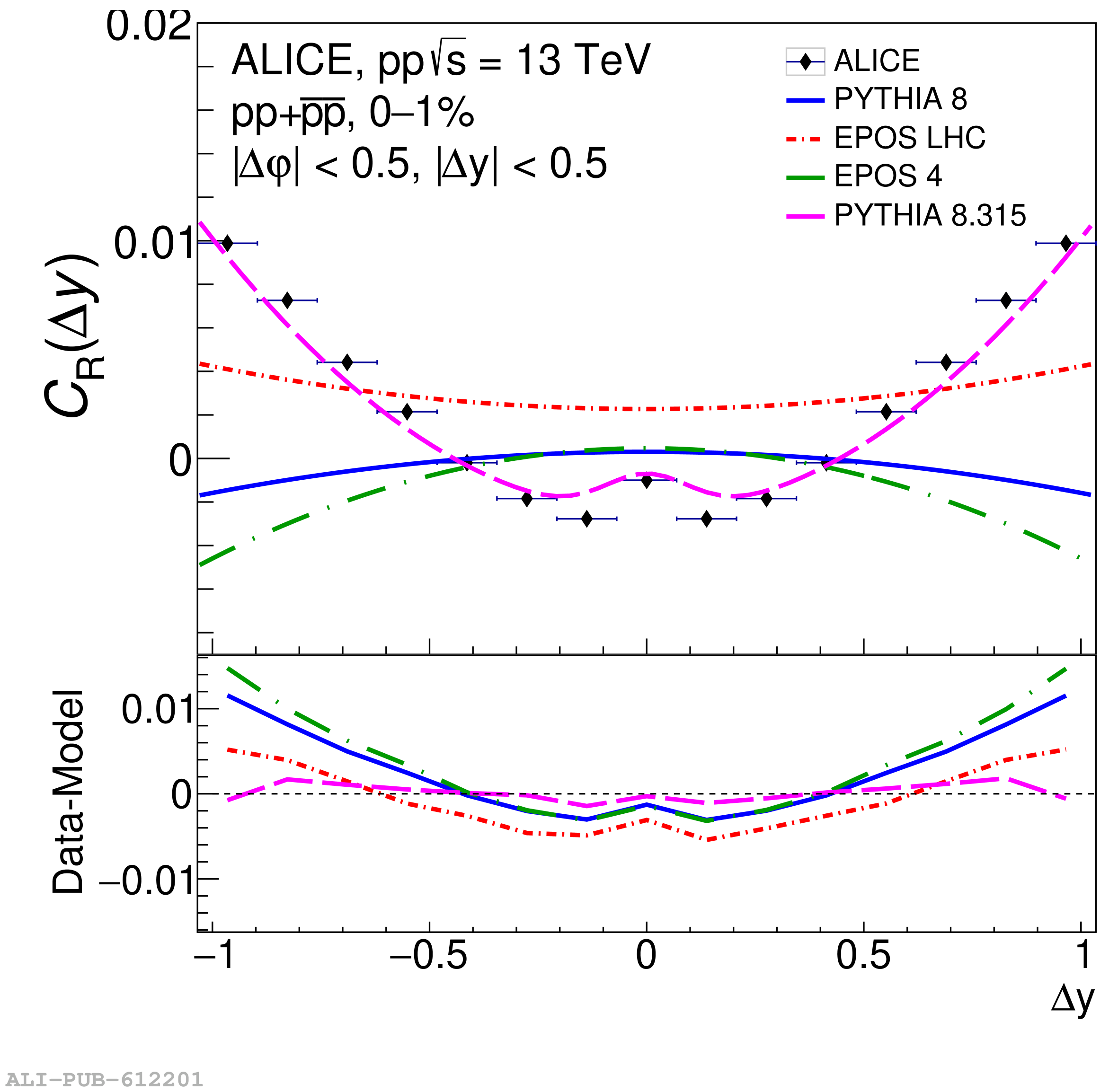 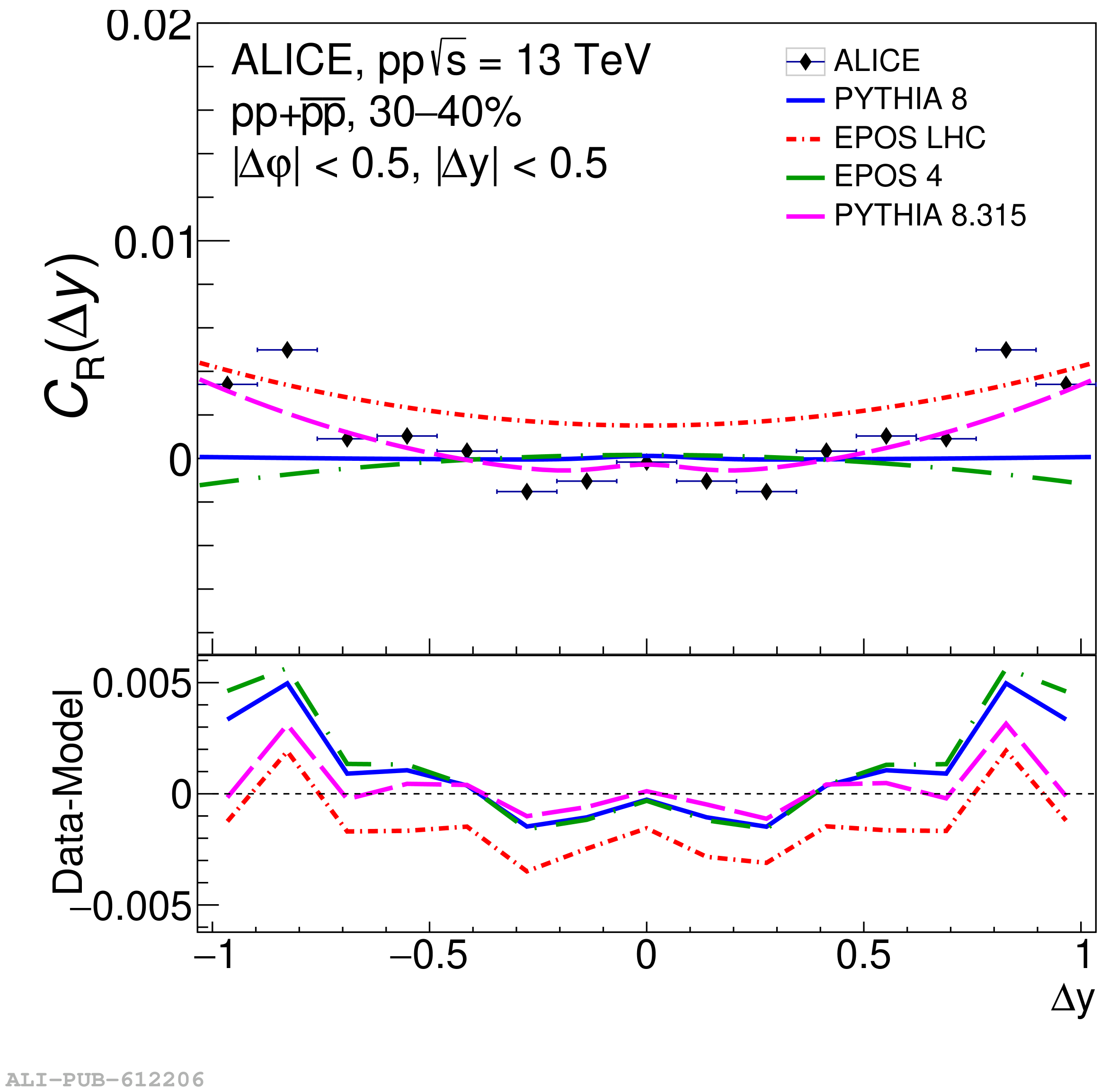 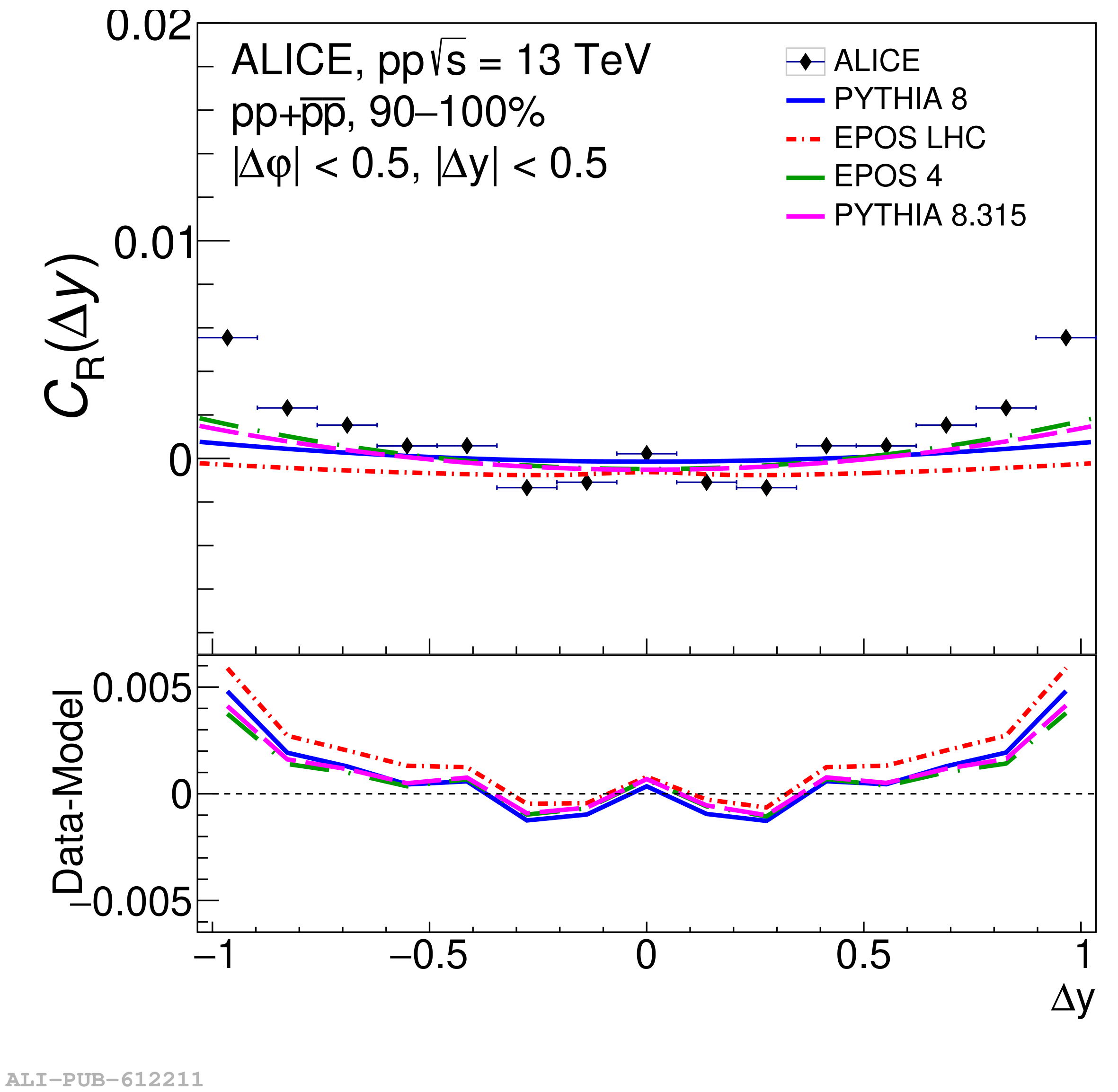 |
Figure 8
$\Delta y$-correlation function distribution compared with MC models (PYTHIA8 Monash 2013 in blue, EPOS LHC in red, EPOS4 in green, and PYTHIA 8.315 in magenta) in pp collision at $\sqrt{s} = 13$ TeV by using the $C_{\rm{R}}$ definition for unlike-sign pions, kaons, and protons (top-to-bottom) for the highest (0--1\%), middle (30--40\%), and lowest (90--100\%) multiplicity classes (left-to-right). | 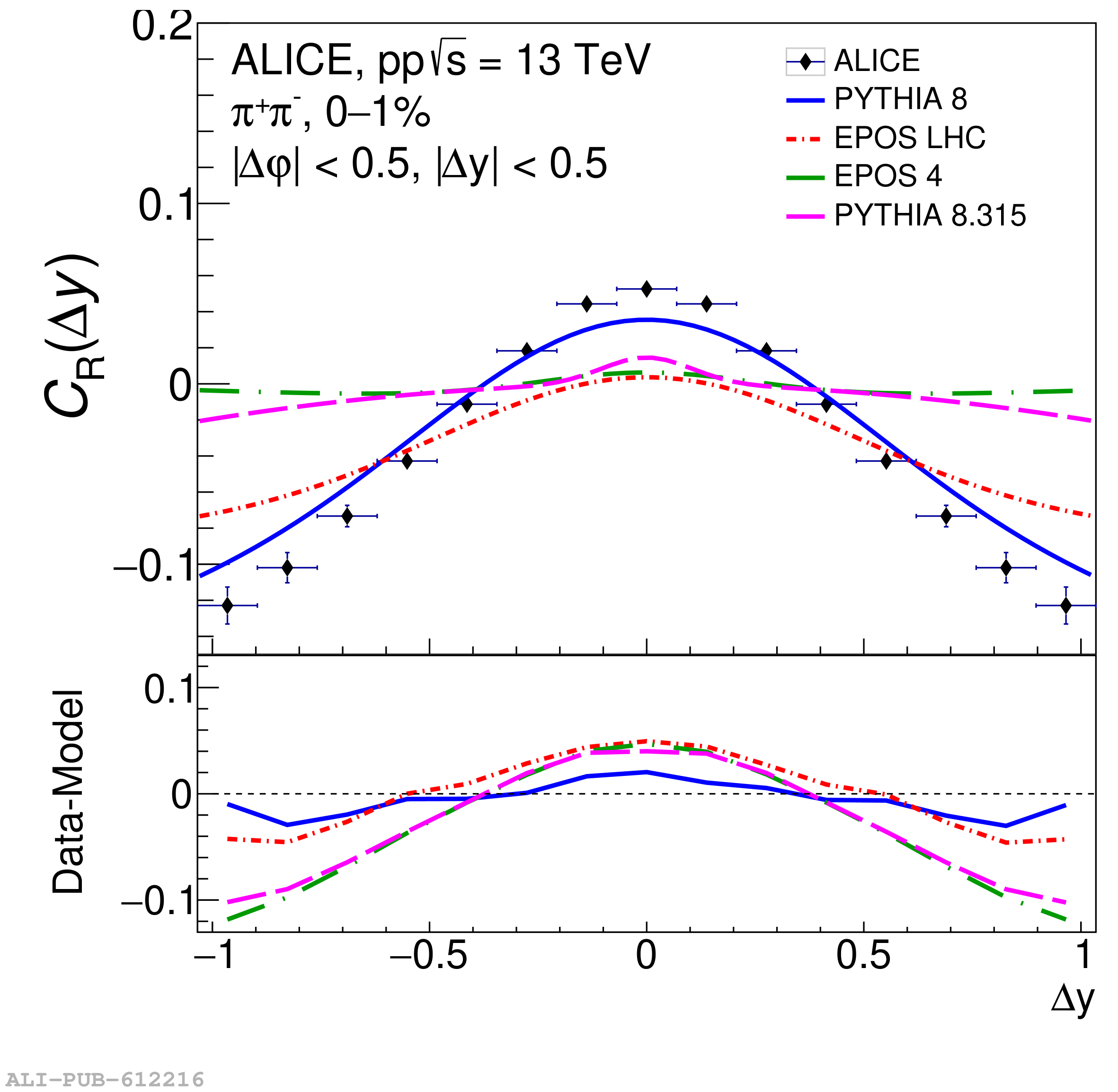 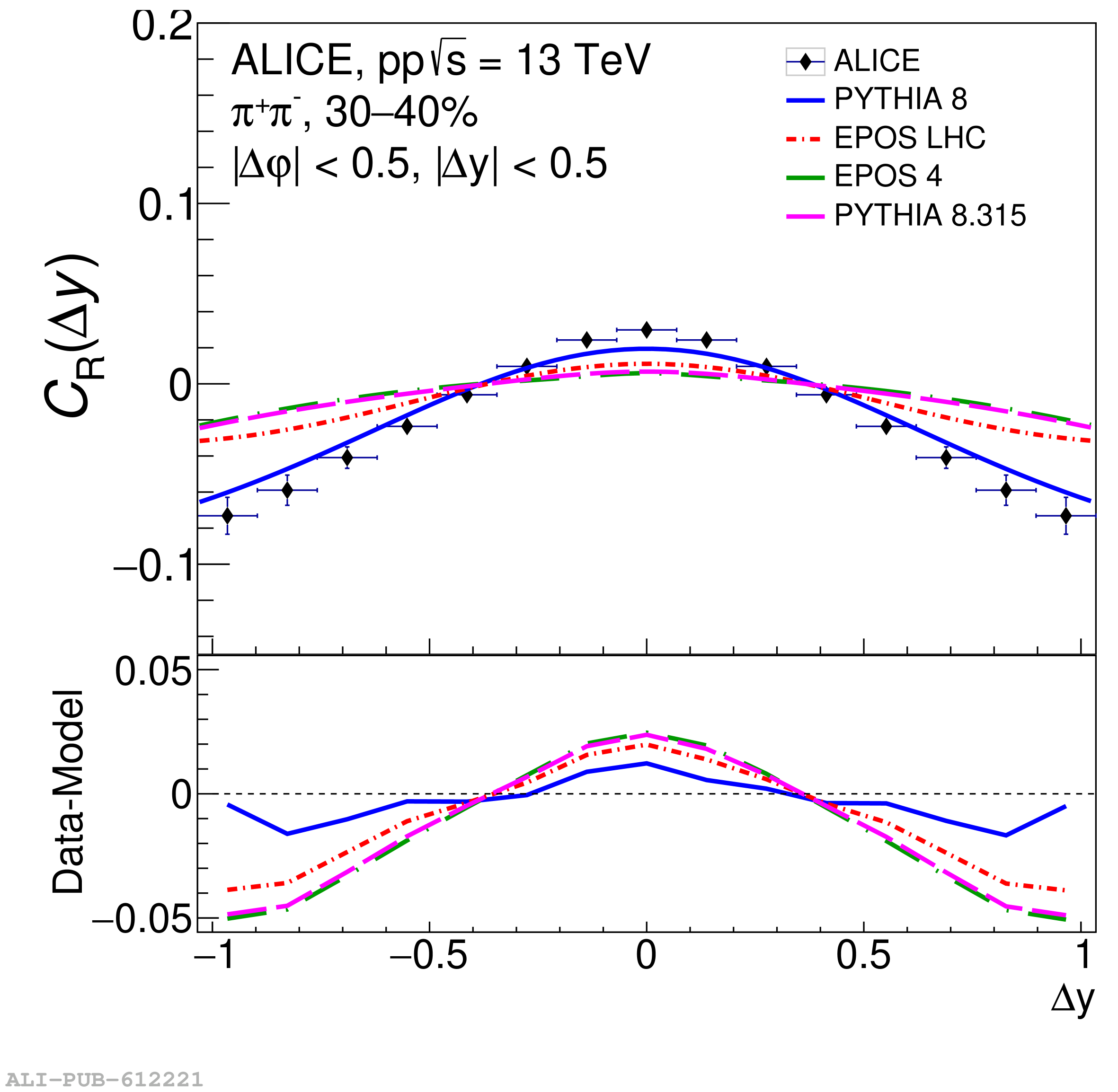 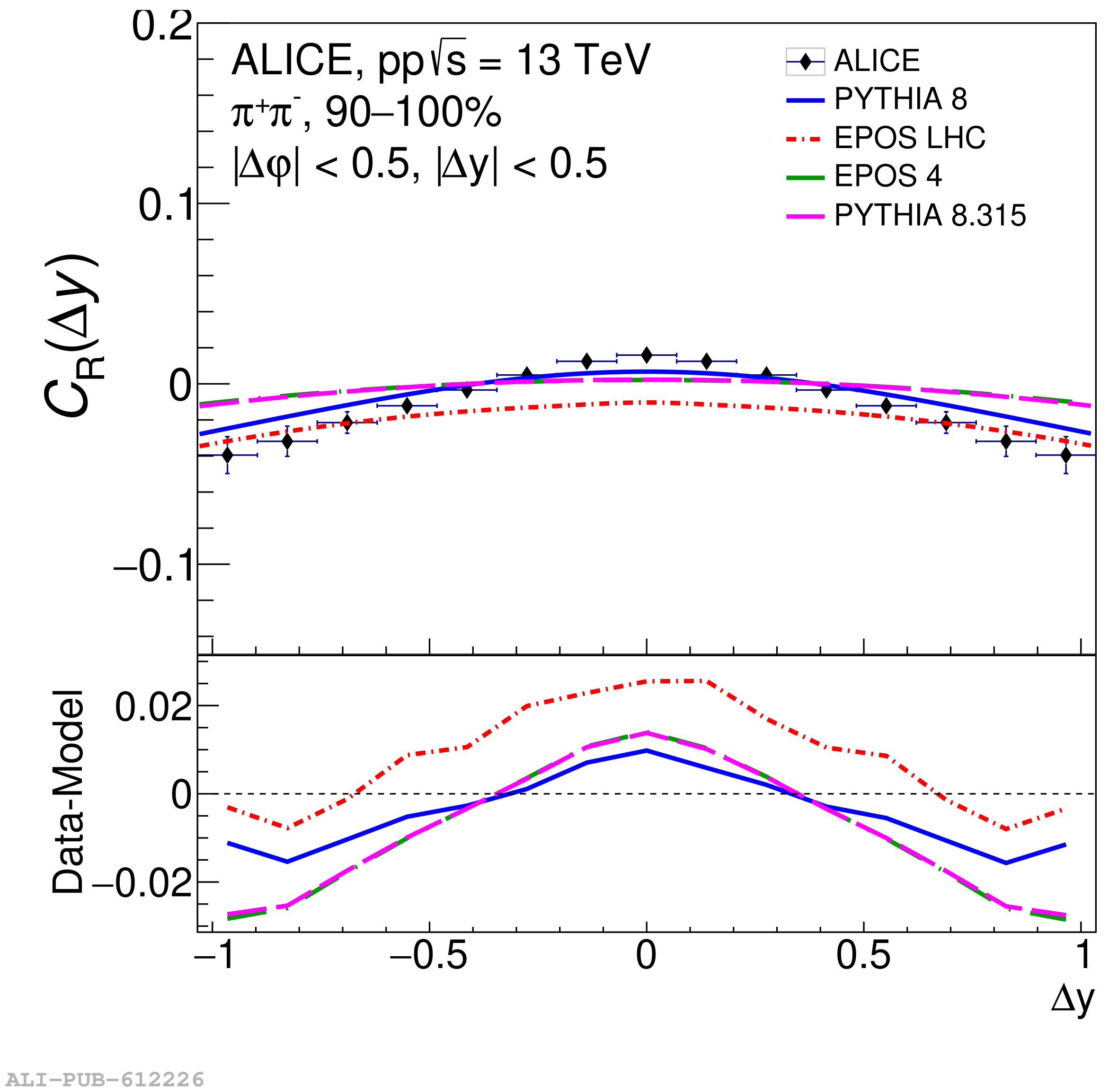 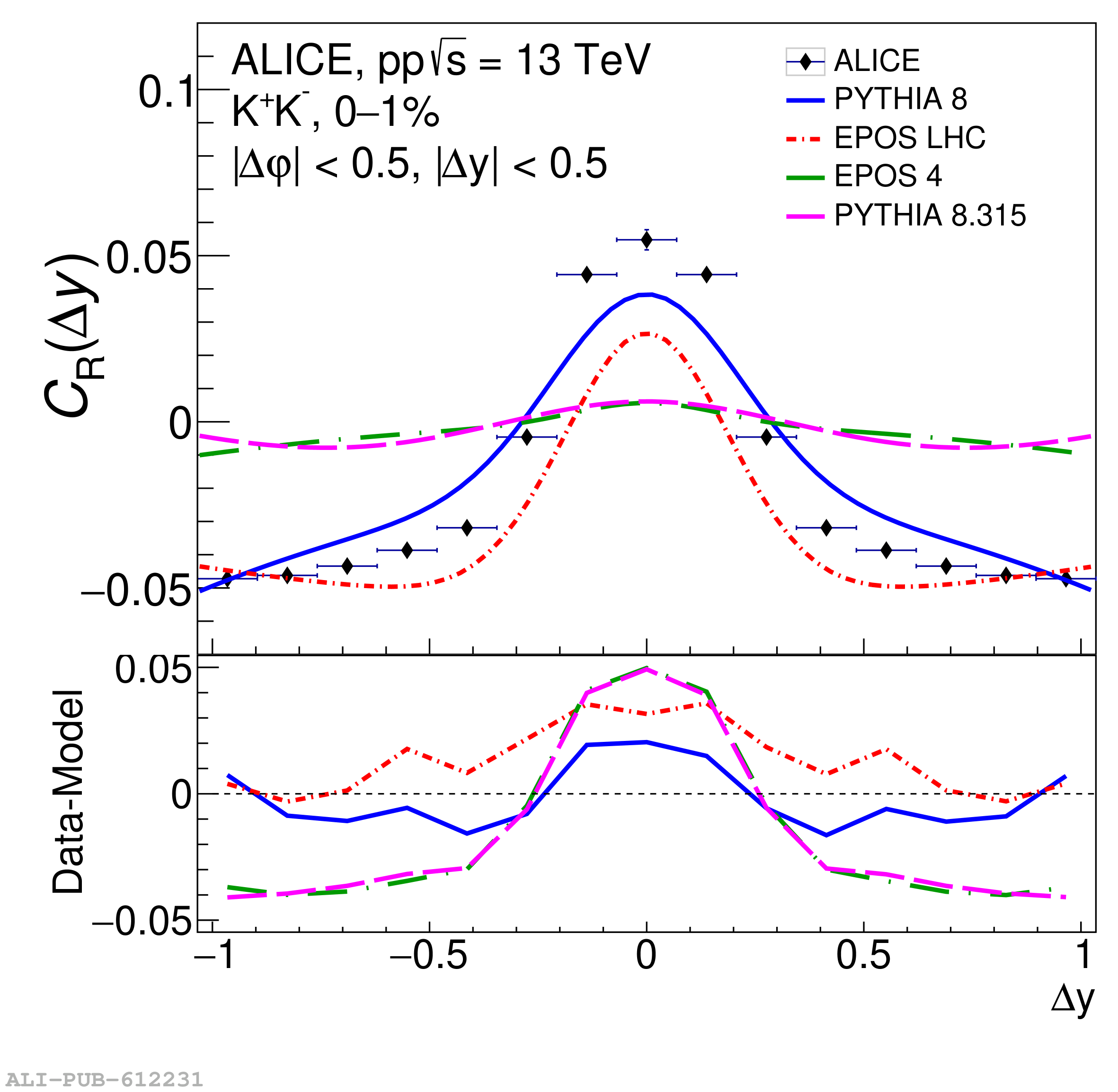 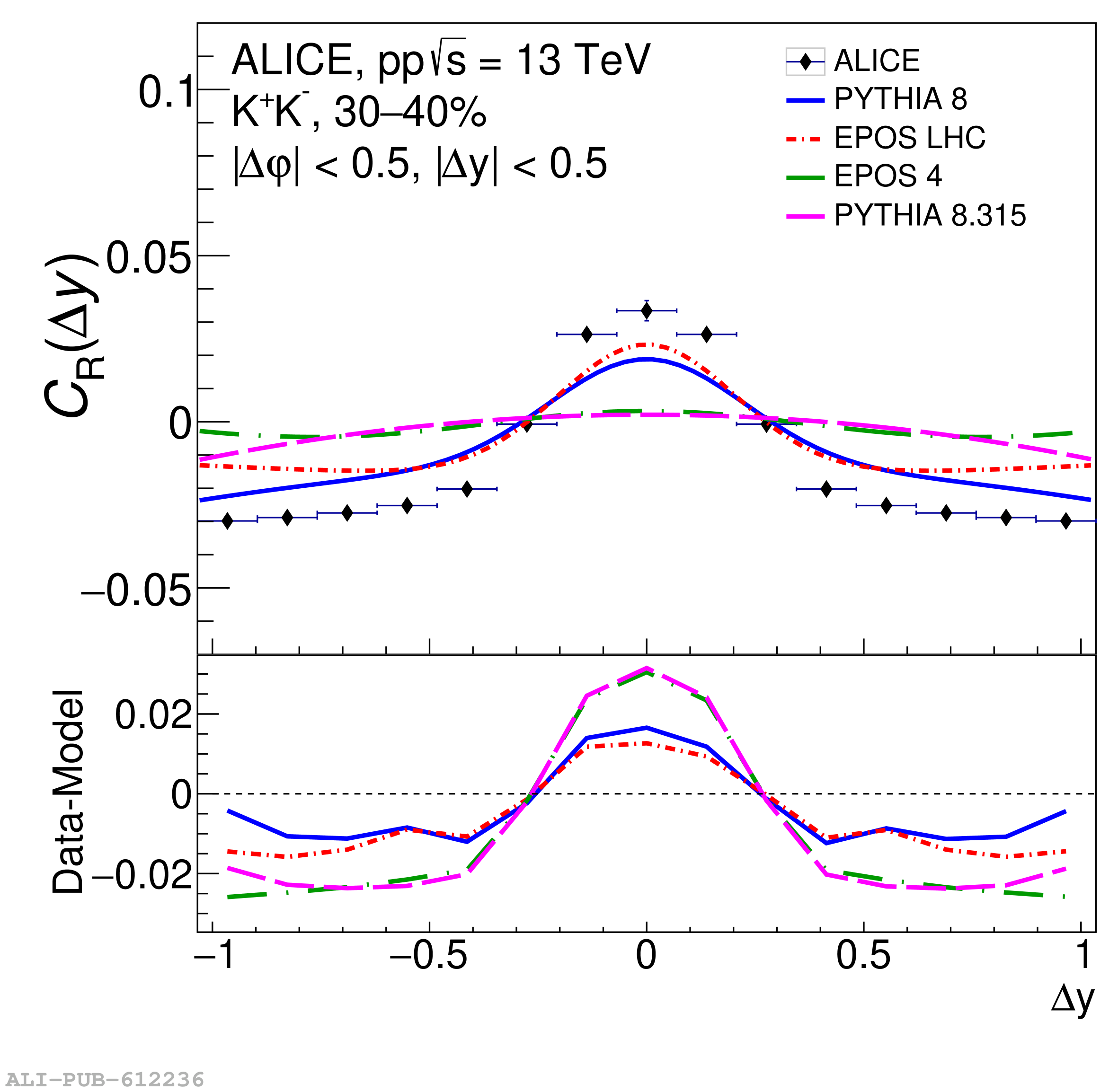 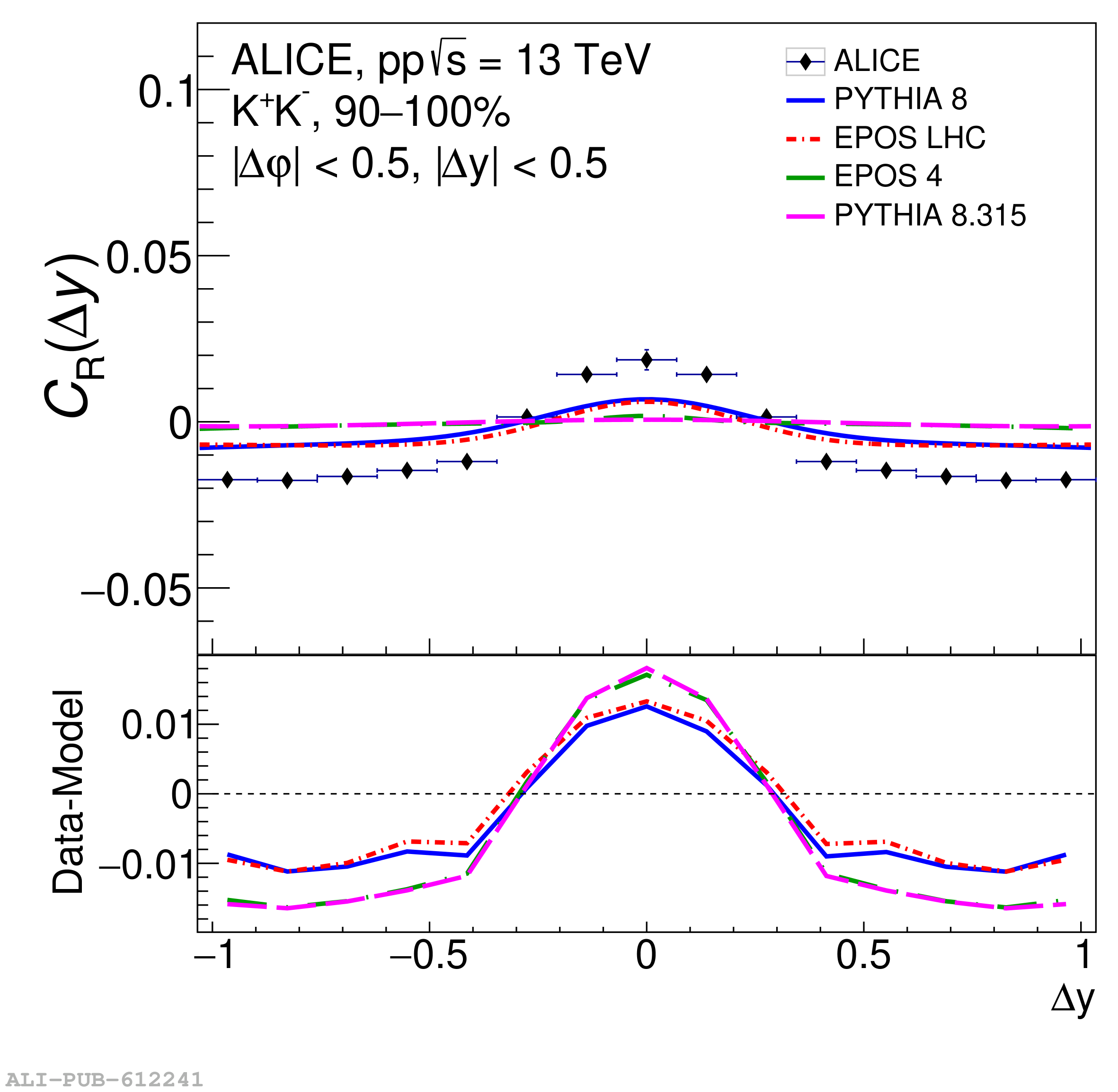 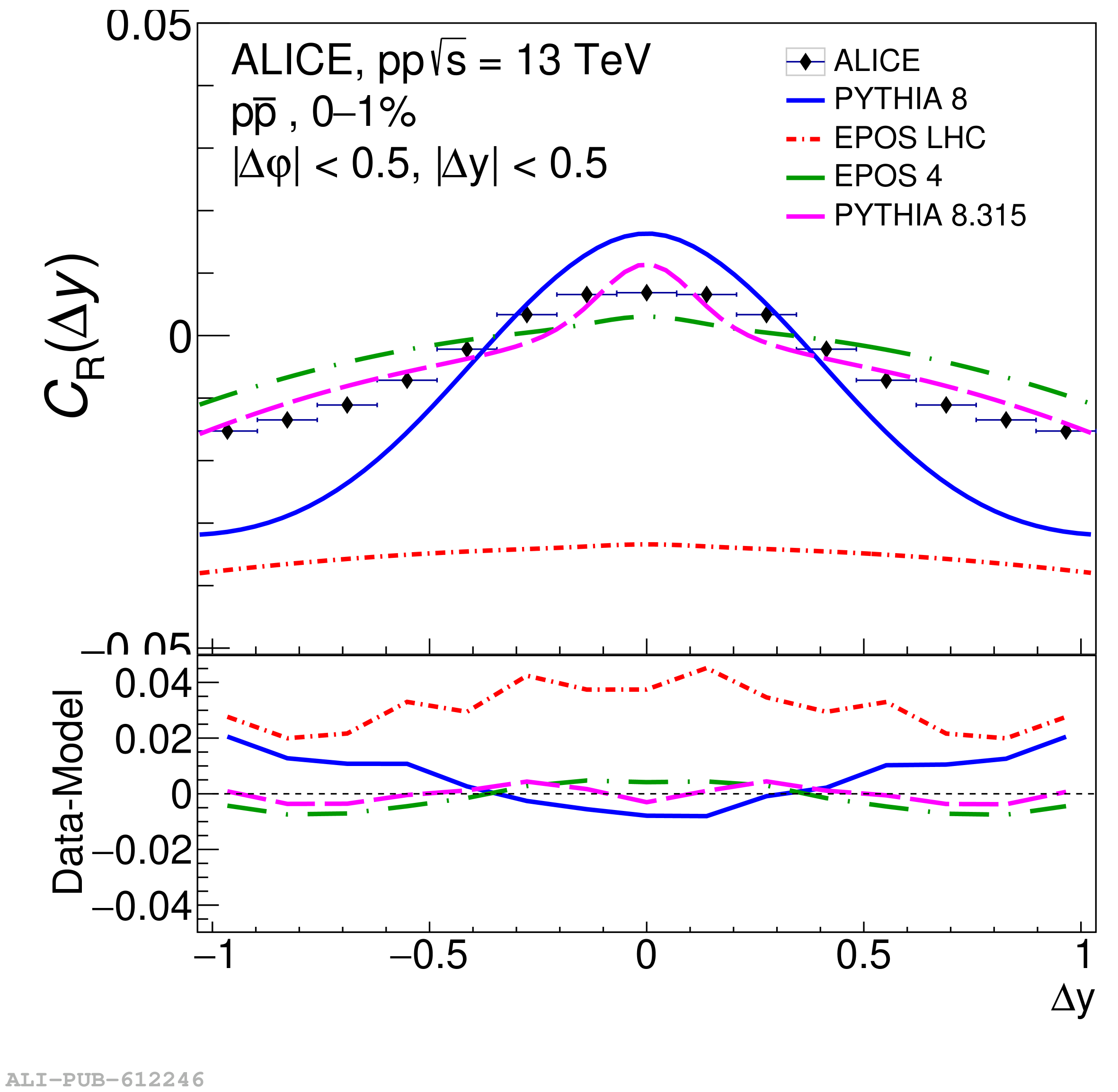 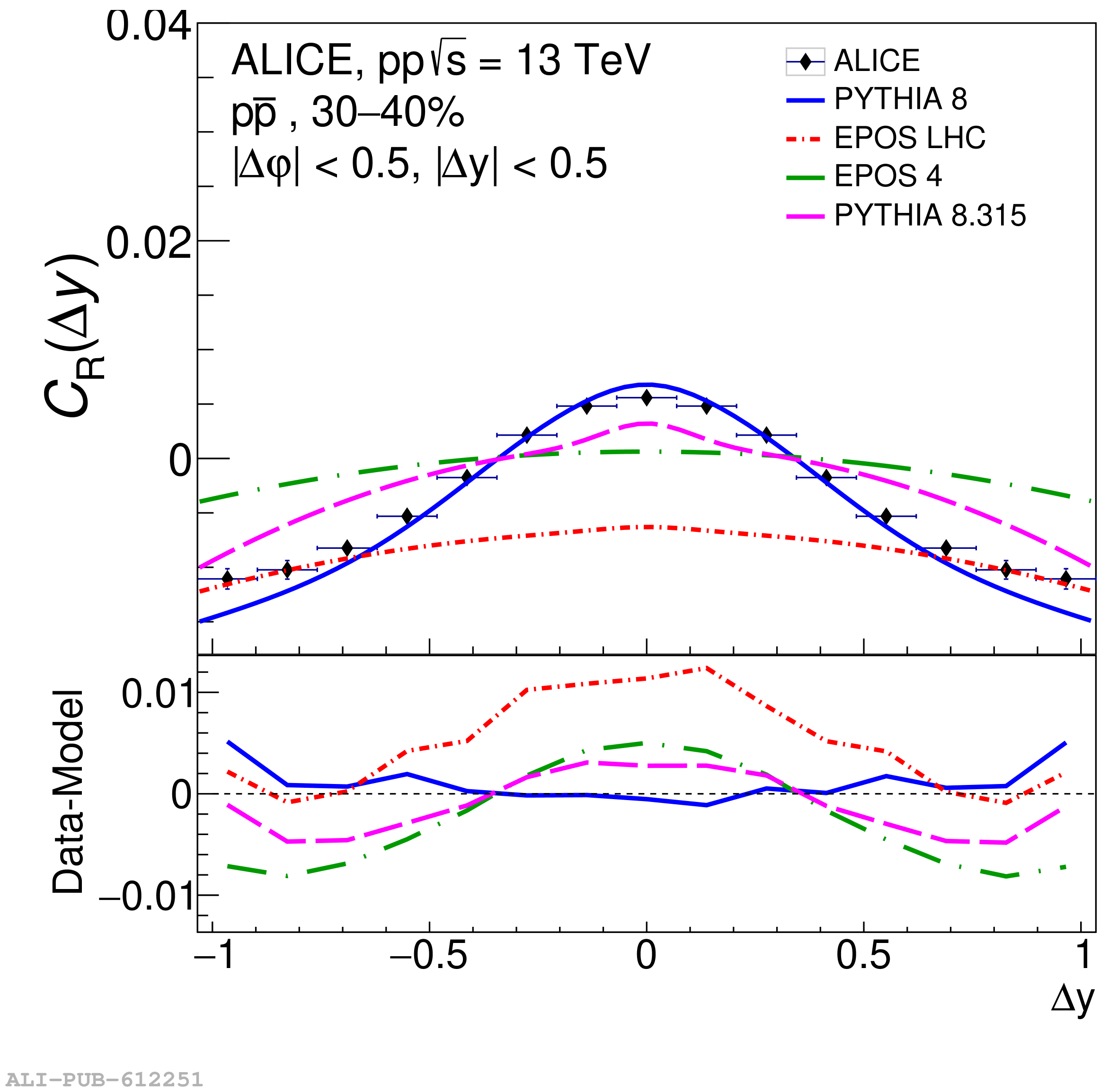 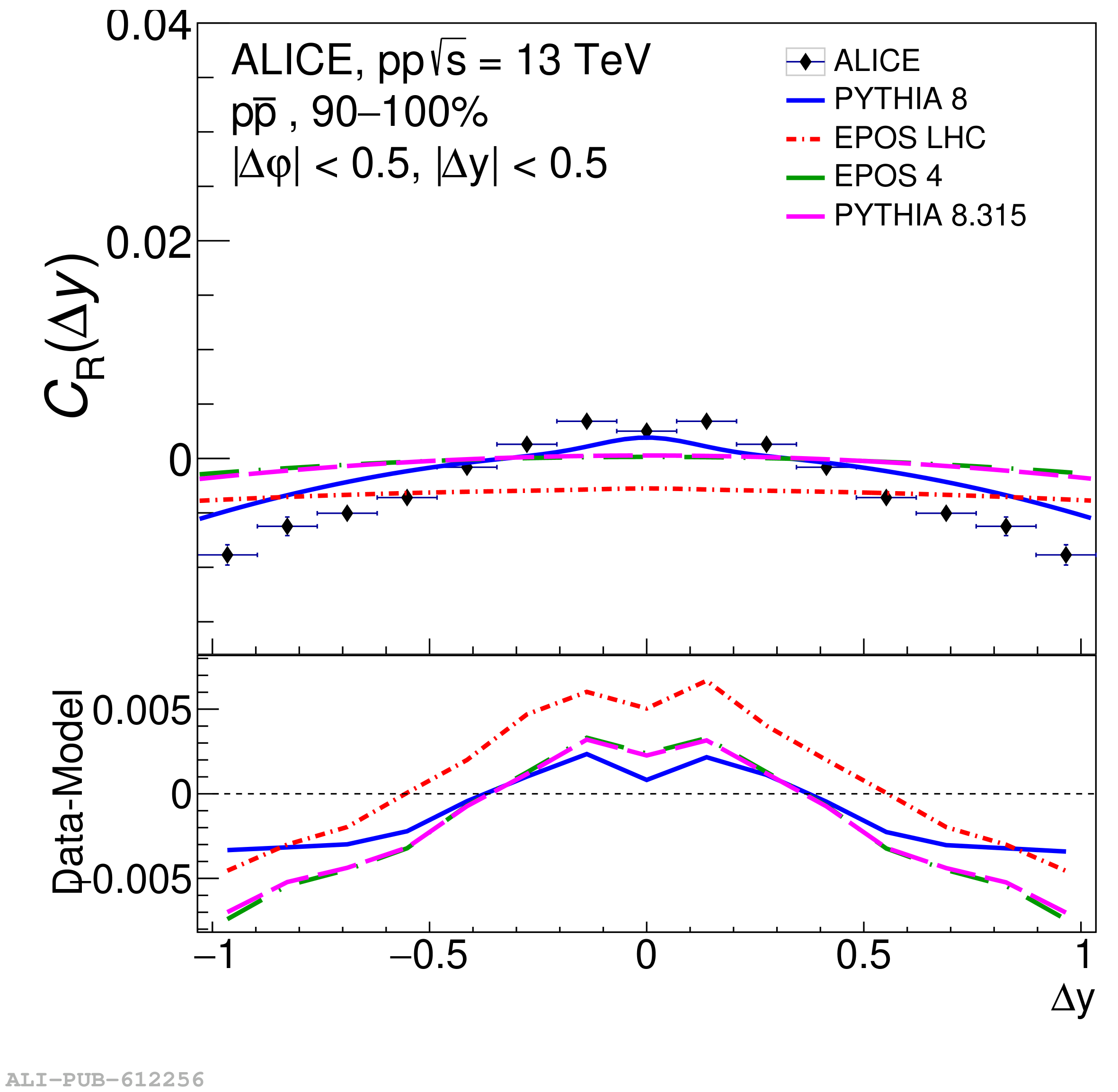 |
Figure 9
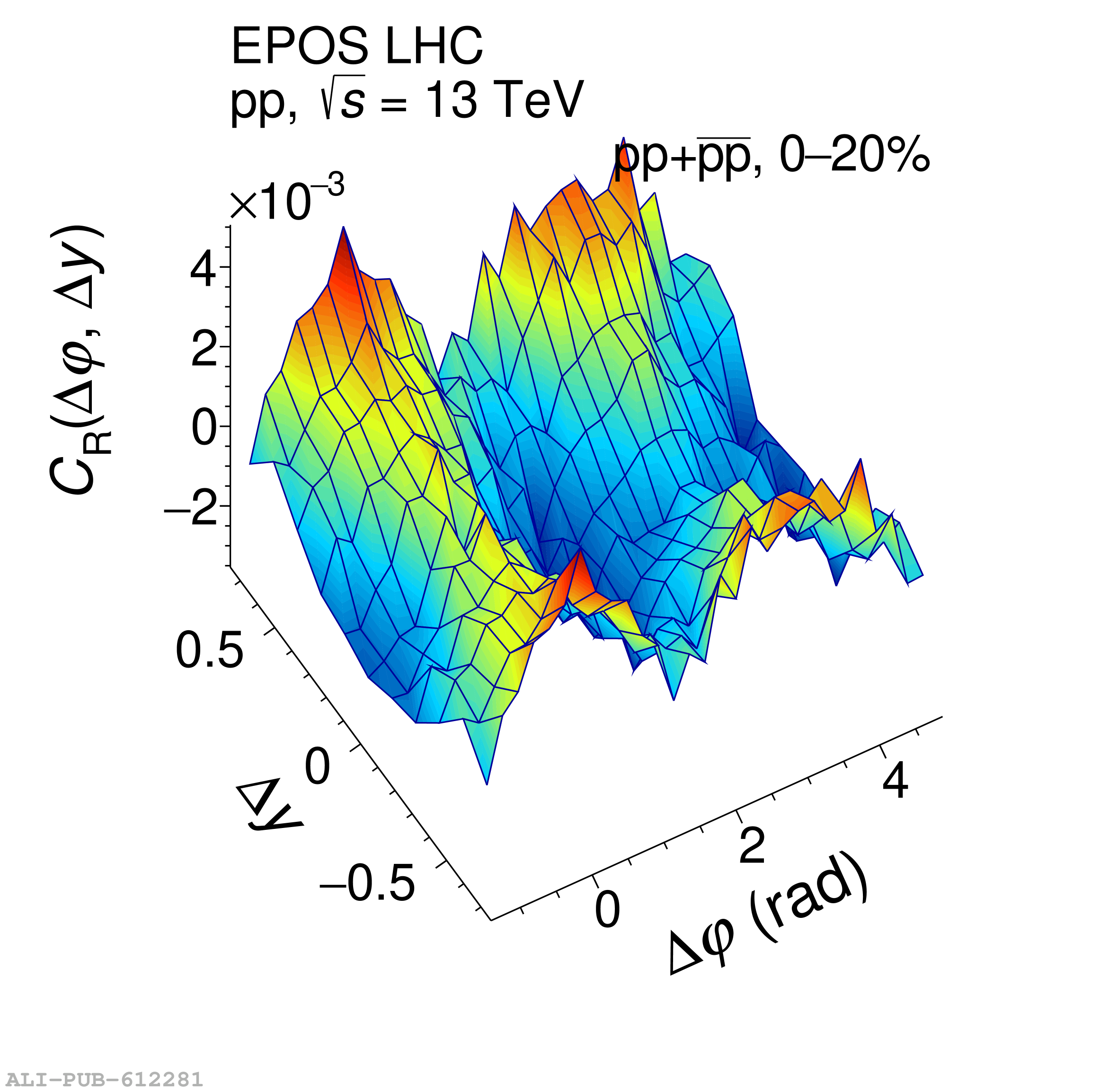
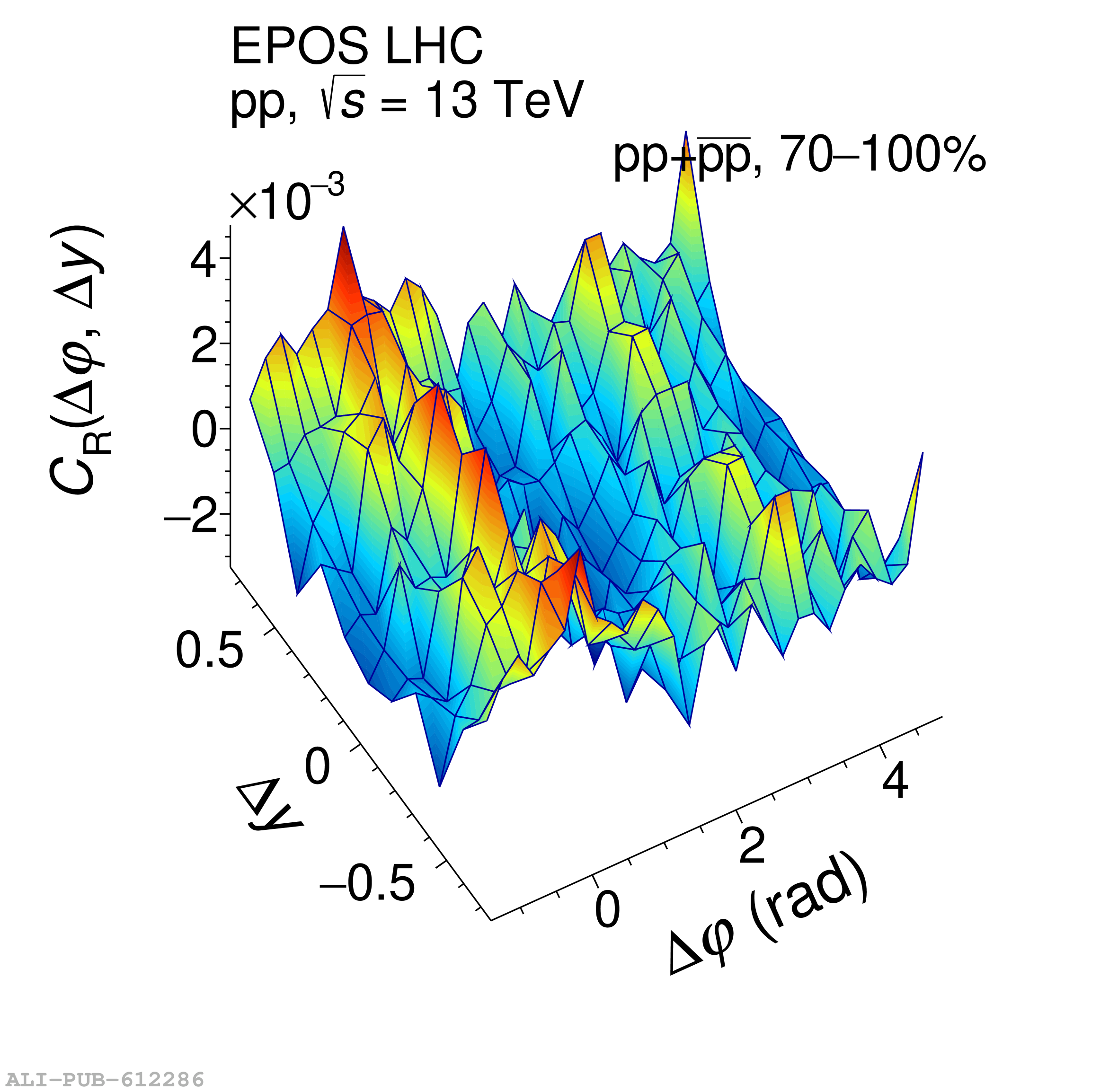
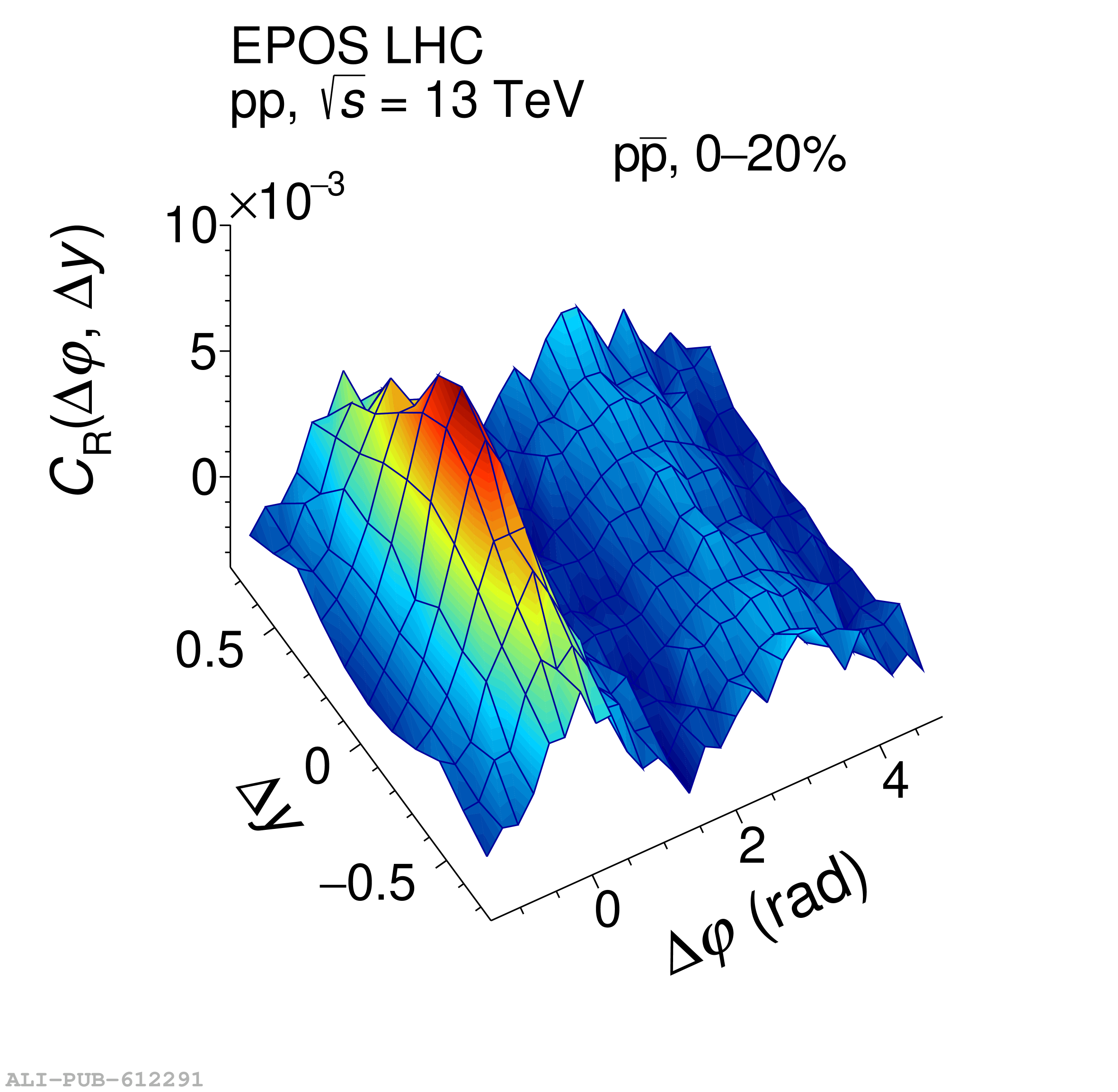
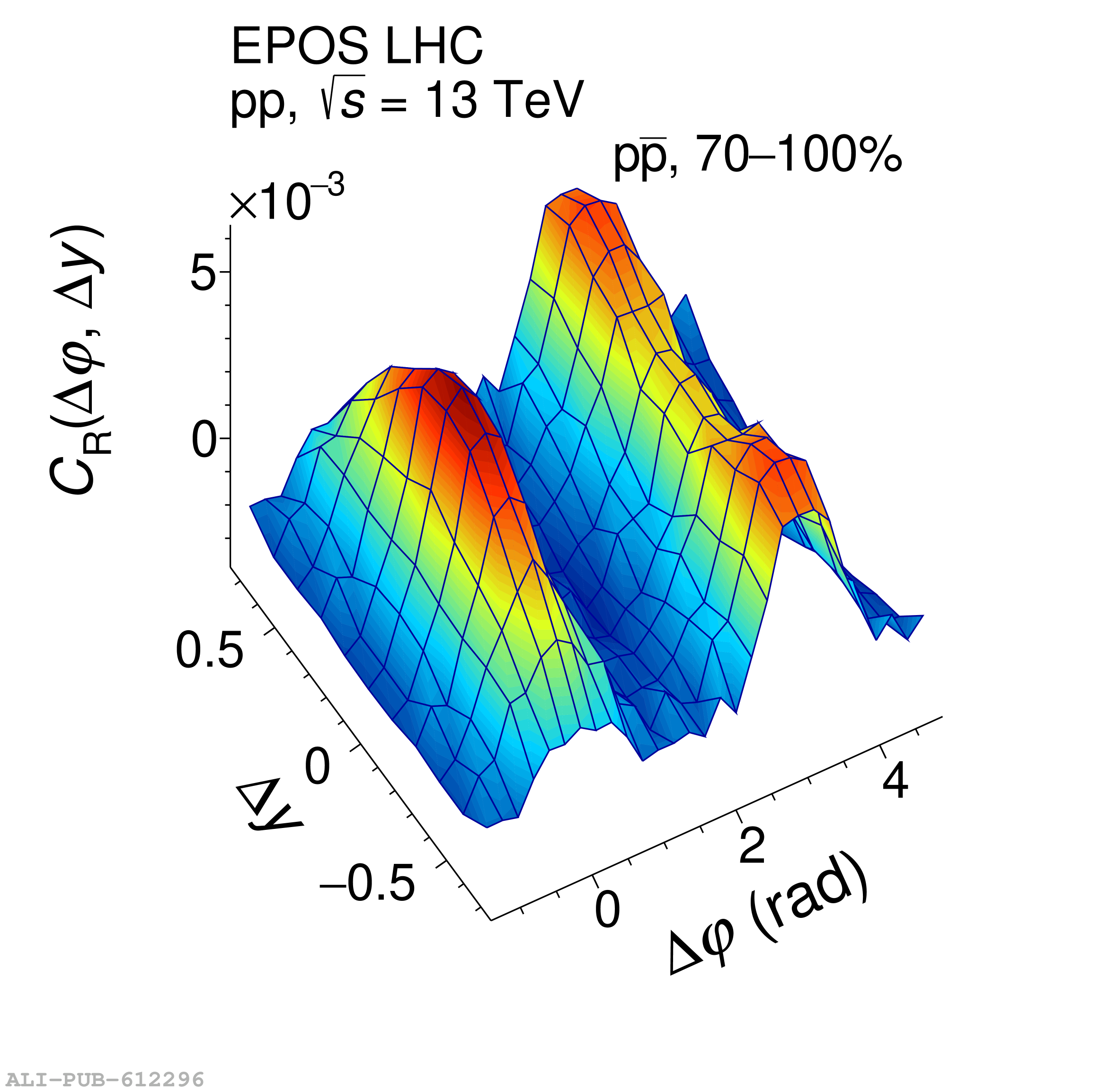
The ($\Delta y,\Delta\varphi$)-correlation functions for PYTHIA8--Monash2013 for like- and unlike-sign protons pairs in the 0--20\% and 70--100\% multiplicity classes in pp collisions at $\sqrt{s} = 13$ TeV using the $C_{\rm{R}}$ definition. | 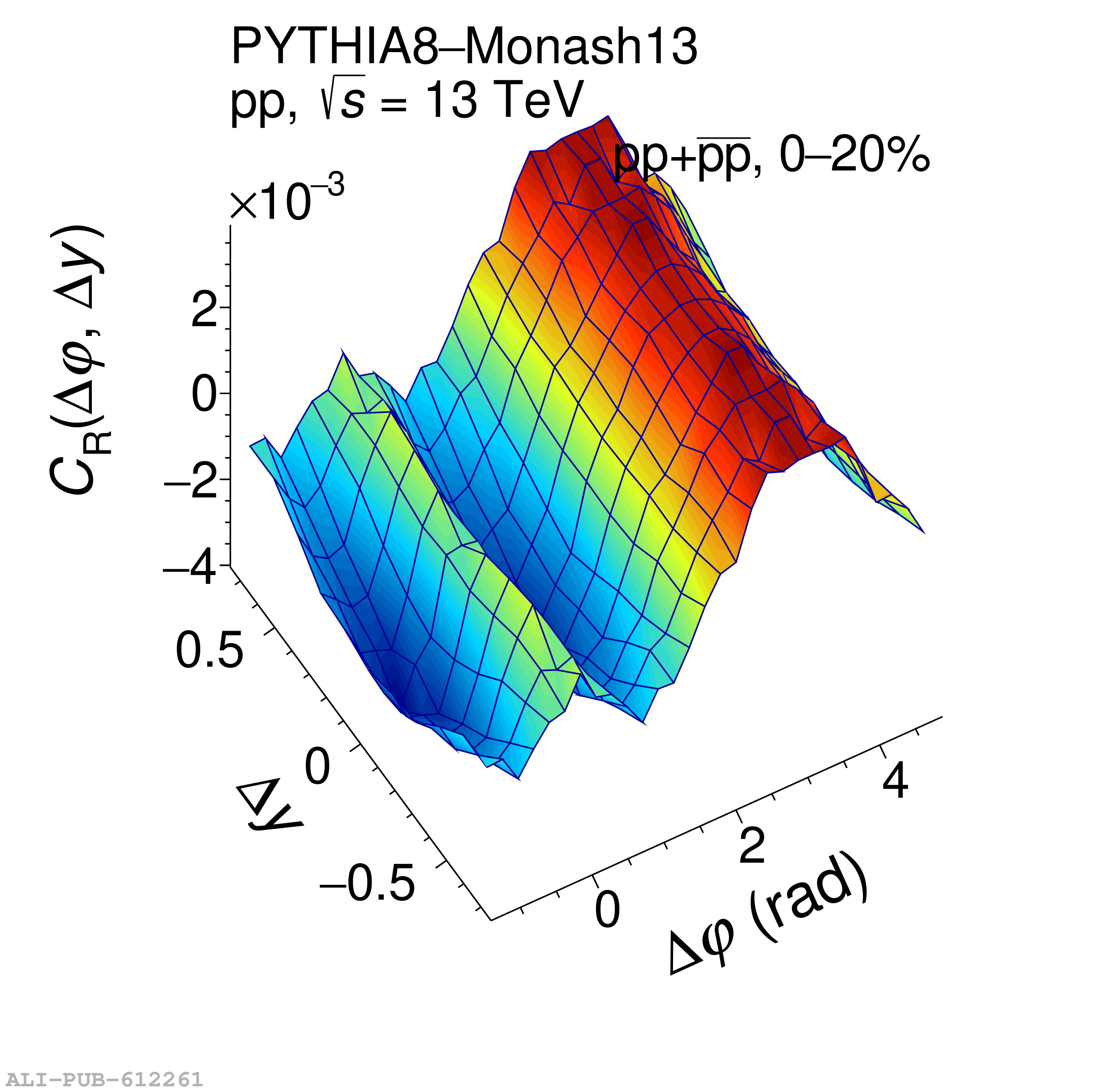 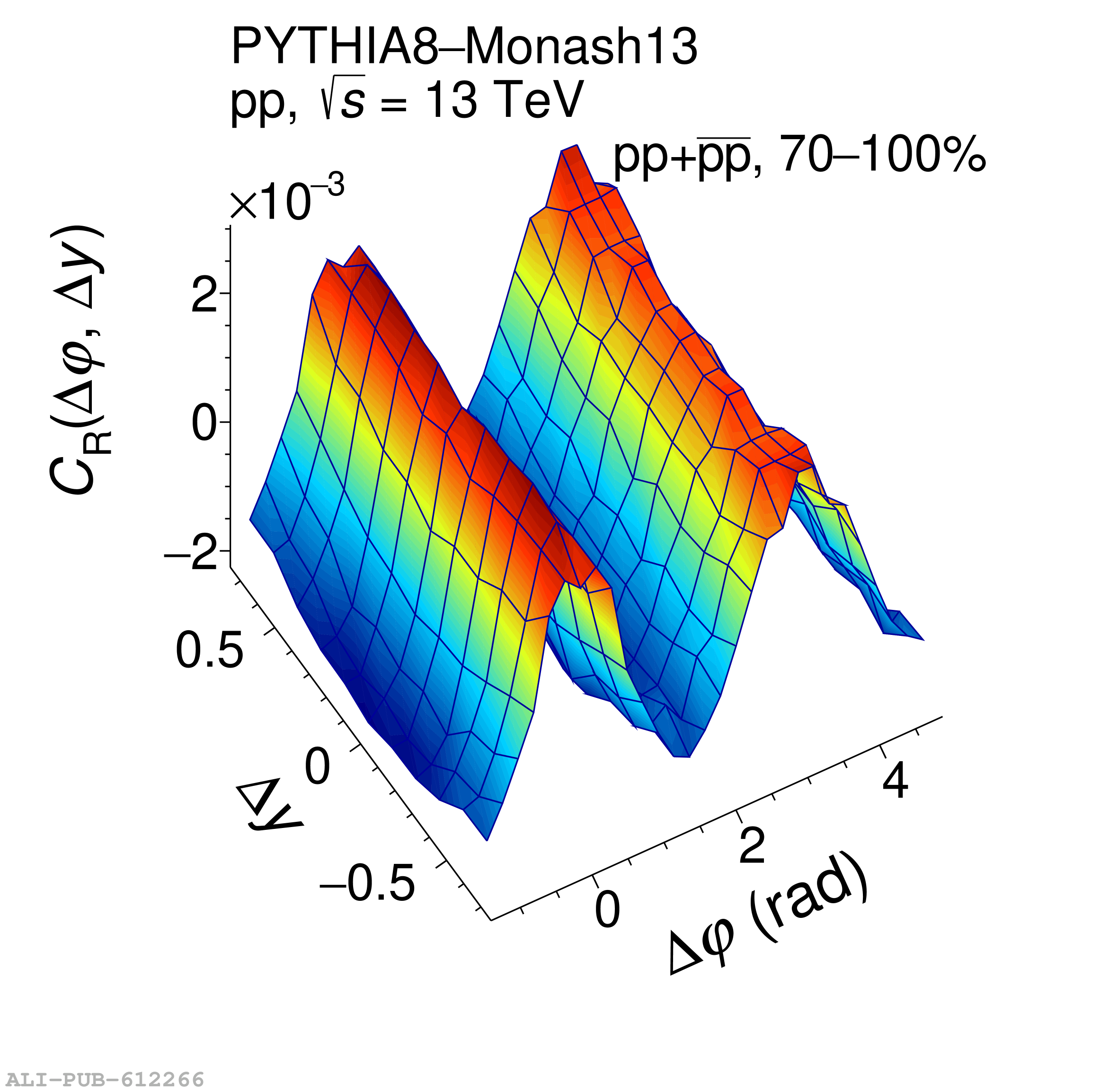 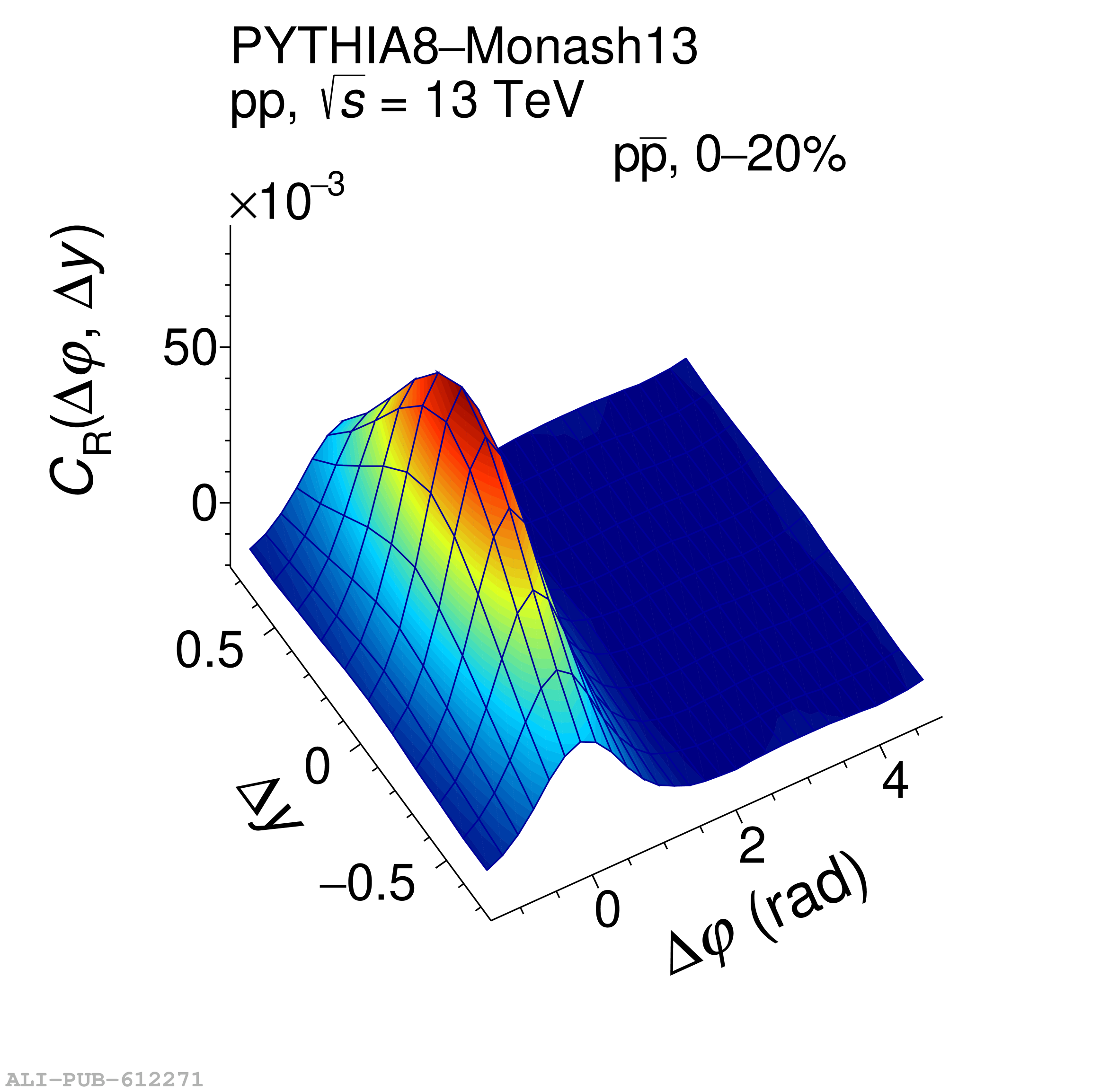 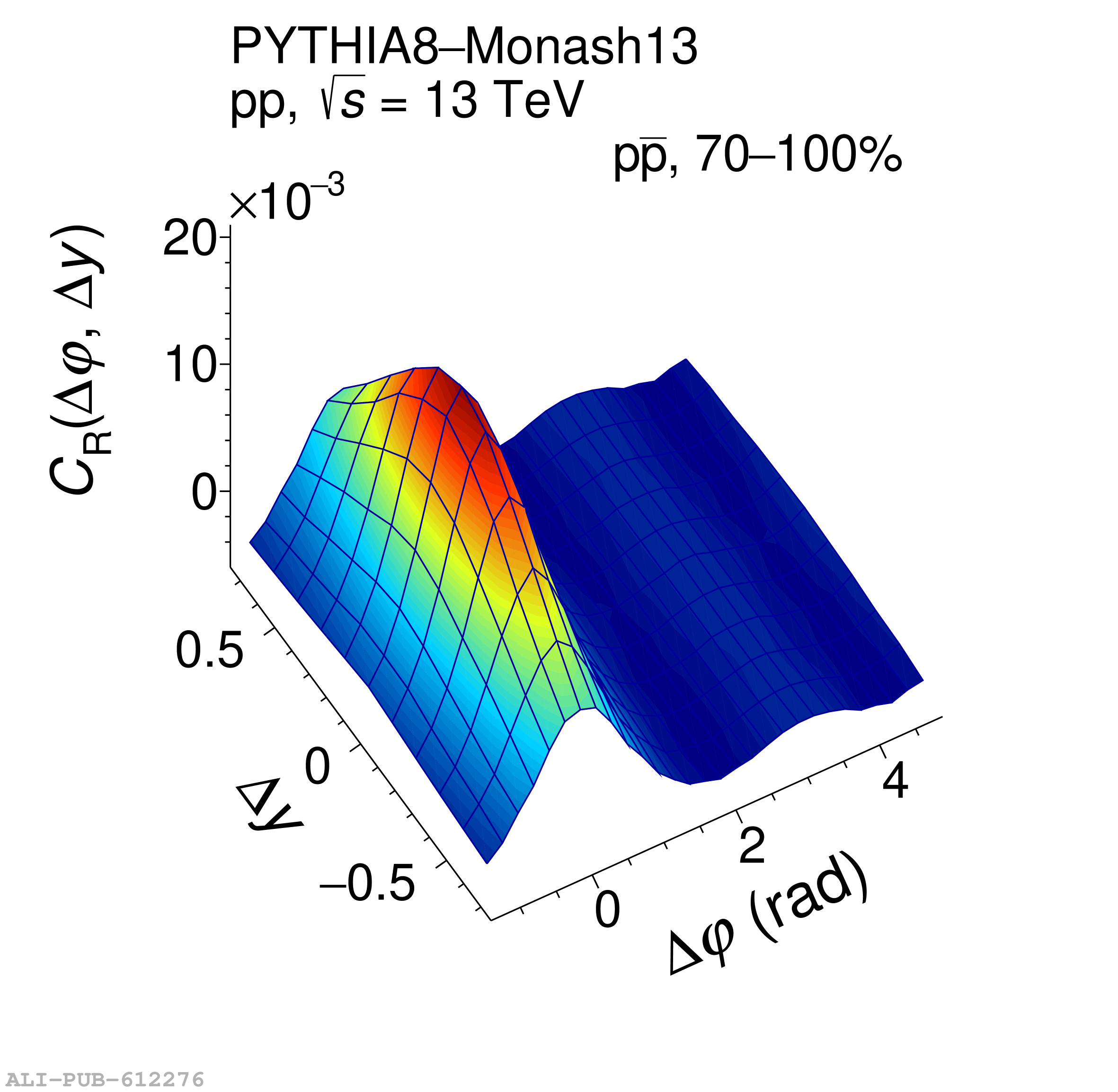 |