
The ALICE Collaboration reports the first measurement of the production of prompt $Ξ_{\mathrm c}^{0}$ baryons in nucleus$-$nucleus collisions by analyzing data from $\mathrm{Pb}-\mathrm{Pb}$ collisions at $\sqrt{s_{\mathrm{NN}}}~=5.02~\mathrm{TeV}$. The production and transverse-momentum ($p_{\mathrm T}$) differential spectra of $Ξ_{\mathrm c}^{0}$ are particularly sensitive to the hadronization process and to strangeness production in the quark--gluon plasma formed in high-energy heavy-ion collisions. The $Ξ_{\mathrm c}^{0}$ baryons are reconstructed at midrapidity ($|y|<~0.5$) in the transverse-momentum intervals $3<~p_{\mathrm T}~<~12~\mathrm{GeV}/c$ and $4<~p_{\mathrm T}~<~12~\mathrm{GeV}/c$ in the 0$-$10\% and 30$-$50\% centrality intervals, respectively. The nuclear modification factor ($R_{\mathrm{AA}}$) reaches values up to 3 in the interval $3<~p_{\mathrm T}~<~4~\mathrm{GeV}/c$, which is the largest value measured so far for charm hadrons. Model predictions are compatible with the measured $R_{\mathrm{AA}}$, while, in the measured $p_{\mathrm T}$ intervals, they underestimate the production yield as well as the measured $Ξ_{\mathrm c}^{0}/\mathrm{D}^{0}$, $Ξ_{\mathrm c}^{0}/Λ_{\mathrm c}^{+}$, and $Ξ_{\mathrm c}^{0}/\mathrm{D}^{+}_{\mathrm s}$ yield ratios.
Submitted to: PRL
e-Print: arXiv:2607.17903 | PDF | inSPIRE
CERN-EP-2026-204
Figure group
Figure 1
Corrected yield (left panel) and nuclear modification factor (right panel) of prompt \xiczero baryons as a function of \pt in 0--10\% central (blue) and 30--50\% semicentral (red) \PbPb collisions at $\sqrtsNN=5.02$ \Tev, compared to predictions from QCM , TAMU , EPOS4HQ , and POWLANG models. | 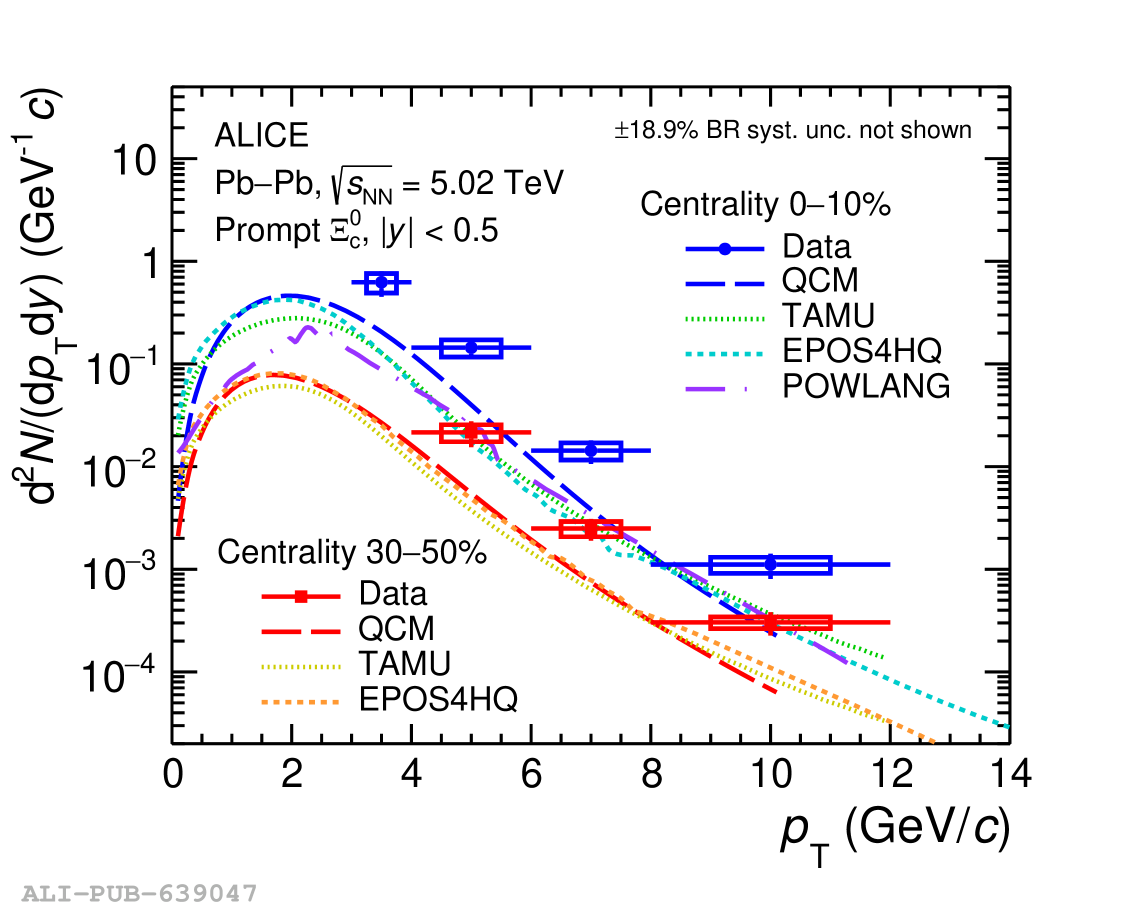 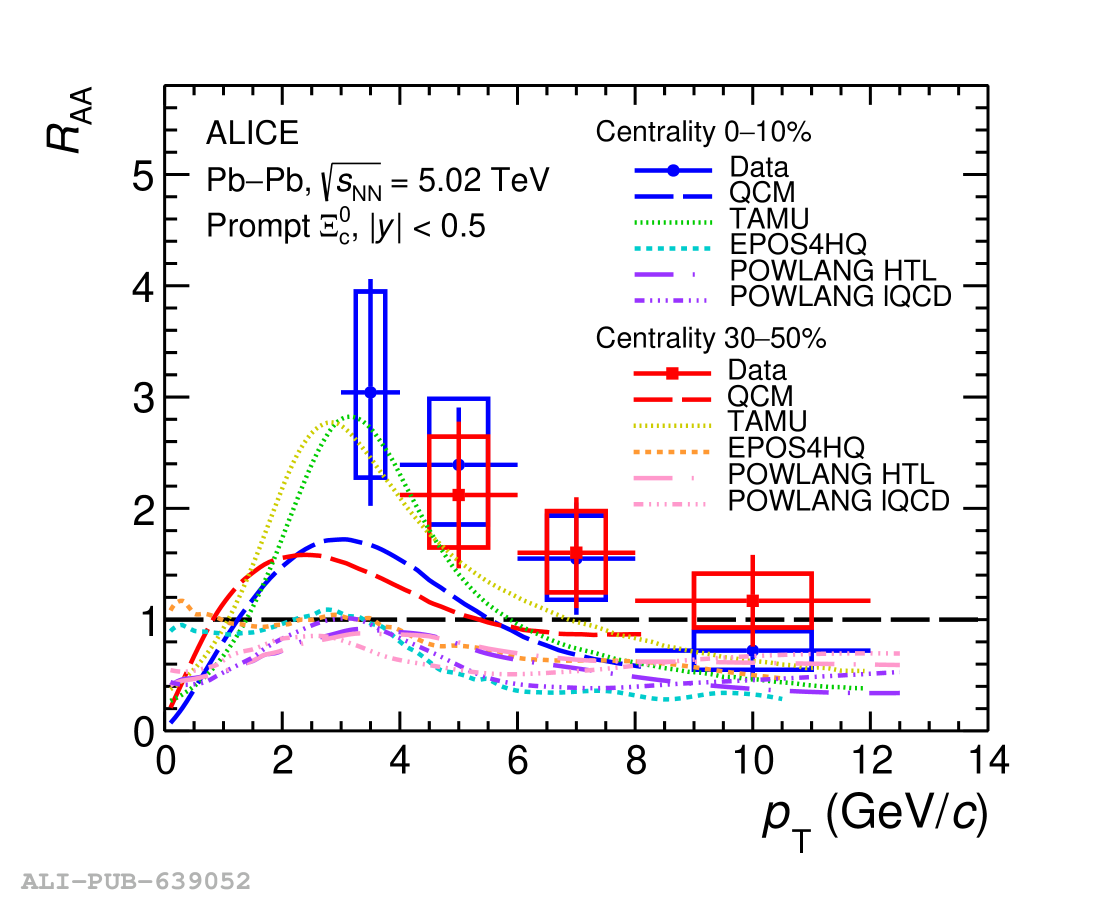 |
Figure 2
$\xiczero/\dzero$, $\xiczero/\dsp$, and $\xiczero/\lcp$ yield ratios in central (blue) and semicentral (red) \PbPb collisions at $\sqrtsNN=5.02$ \Tev compared to measurements in pp collisions and predictions from QCM , TAMU , EPOS4HQ , and POWLANG models. | 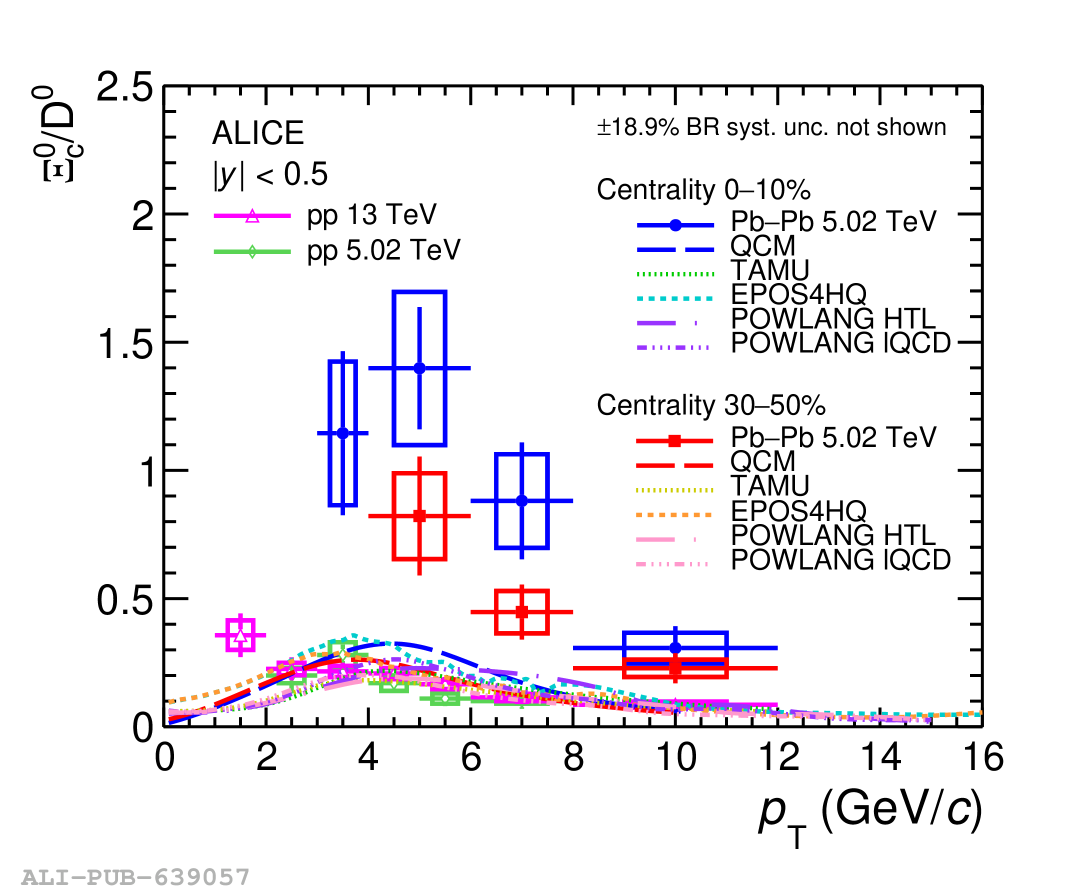 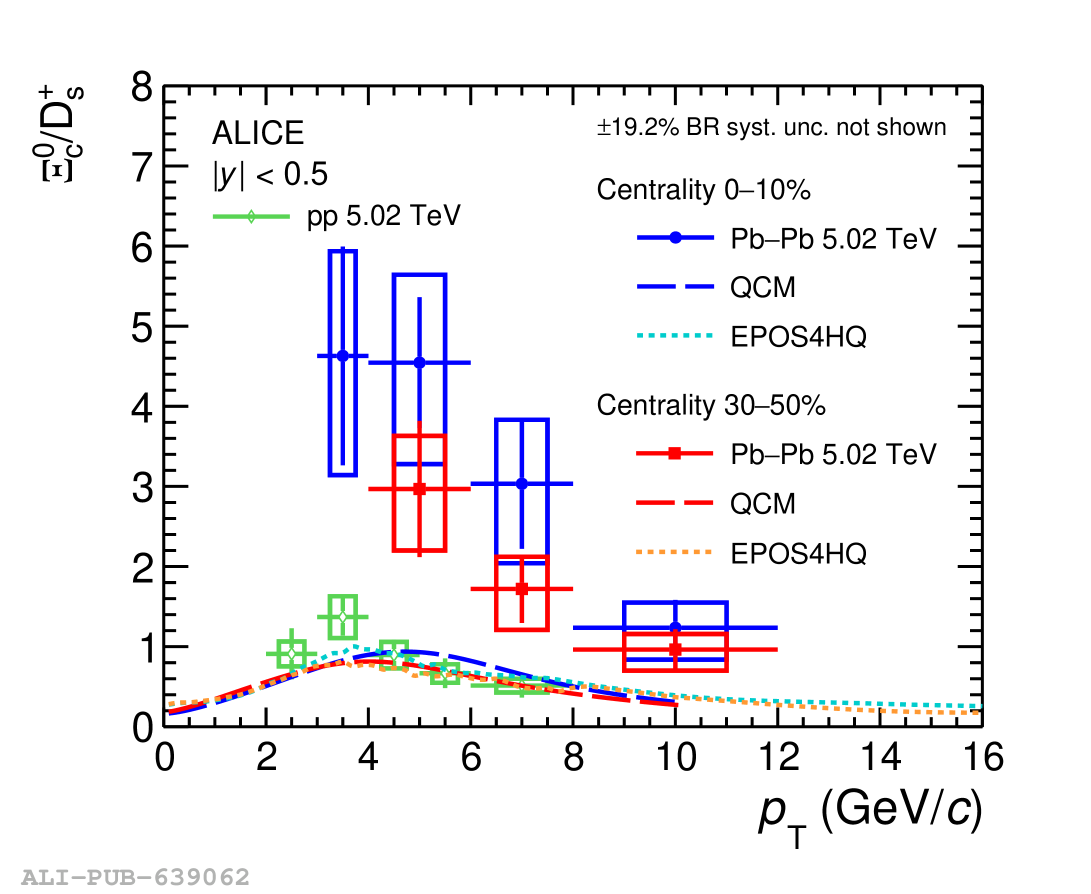 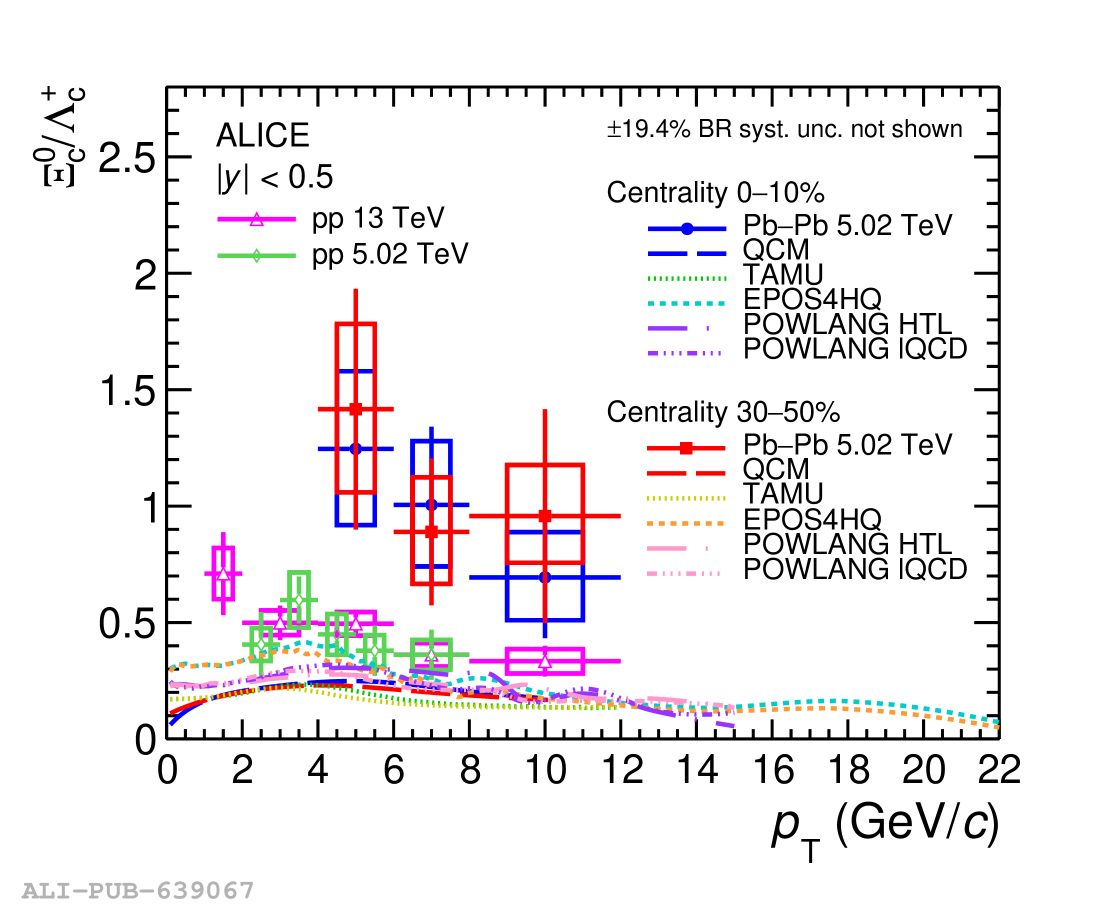 |
Figure A.1
Invariant-mass distributions (top panels) of $\xiczero\rightarrow\xim\pionp$ candidates and their charge conjugates reconstructed in the transverse-momentum intervals $3\pt12$ \gevc for 0--10\% centrality (left panel) and $4\pt12$ \gevc for 30--50\% centrality (right panel). The bottom panels display the distributions of the residuals obtained by subtracting the background evaluated with the fit function. |   |