
The ALICE Collaboration presents the first measurements of the jet-energy flow ($Δp_{\rm T}$) observable in proton-proton and heavy-ion collisions. Jets are excellent probes for the quark$-$gluon plasma, a deconfined state of matter produced in heavy-ion collisions. The jet-energy flow observable characterizes the radial distribution of energy from the jet axis in an infrared and collinear-safe way and is sensitive to medium-induced parton-shower modifications. Inclusive charged jets are measured in Pb$-$Pb collisions at $\sqrt{s_{\rm NN}} = 5.02$ TeV for the transverse-momentum interval 60$-$80 GeV/$c$. For pp collisions at $\sqrt{s}=13$ TeV, measurements include the 40$-$60 and 60$-$80 GeV/$c$ intervals, where the latter serves as the reference for investigating medium-induced modifications. Results show that most parton energy is concentrated in the jet core, with a clear suppression of energy flow in heavy-ion collisions at larger radii (significance 3.5$-$4.5$σ$) indicating a narrowing of the energy flow. While all models -- PYTHIA 8, HERWIG, JEWEL, and JETSCAPE -- reproduce the pp results with only small deviations in the tails, the relative modification in Pb$-$Pb collisions is well described by JEWEL without recoil. Conversely, JEWEL with recoil (medium response) and JETSCAPE show significant deviations, exhibiting increasing or more constant trends with radius that are disfavored by the data.
Submitted to: PRC
e-Print: arXiv:2606.20061 | PDF | inSPIRE
CERN-EP-2026-175
Figure group
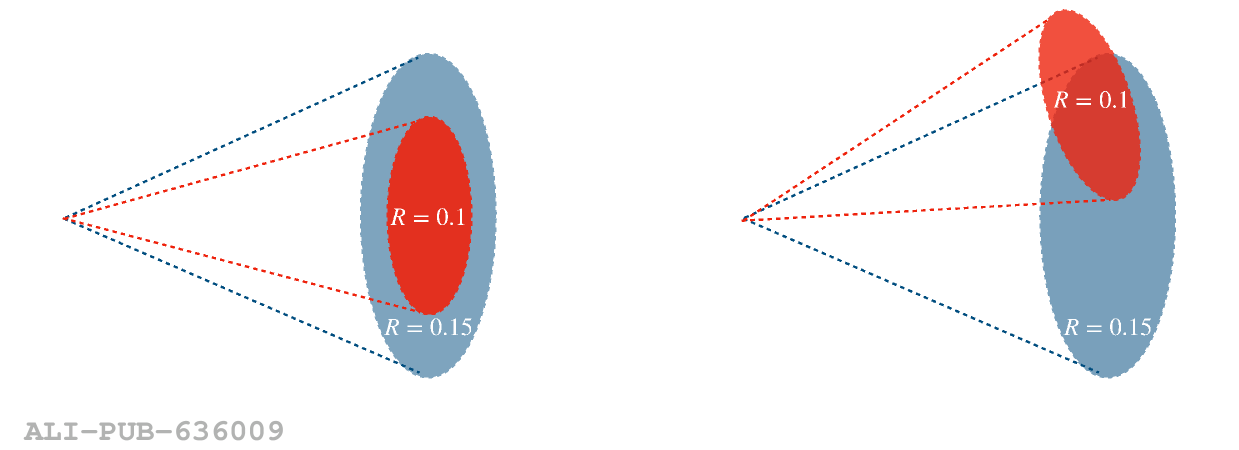
Figure 2
JEF distributions in \jetptrange{40}{60} (left) and \jetptrange{60}{80} (right) for each of the seven jet pairs with radii of [0.05, 0.1], [0.1, 0.15], [0.15, 0.2], [0.2, 0.25], [0.25, 0.3], [0.3, 0.35], and [0.35, 0.4] in pp collisions at $\sqrt{s}=13$ TeV. For certain radius-pair \dpt distributions, the statistical uncertainties are smaller than the marker size. | 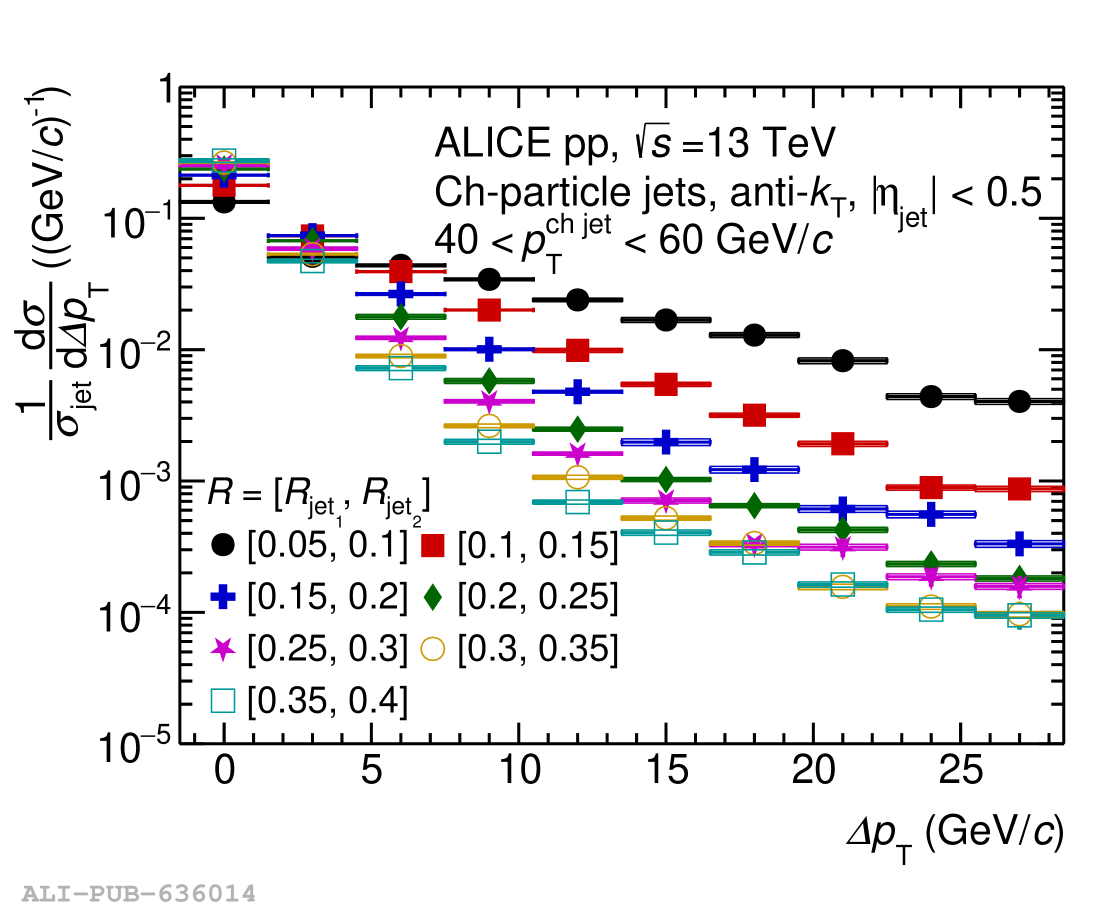 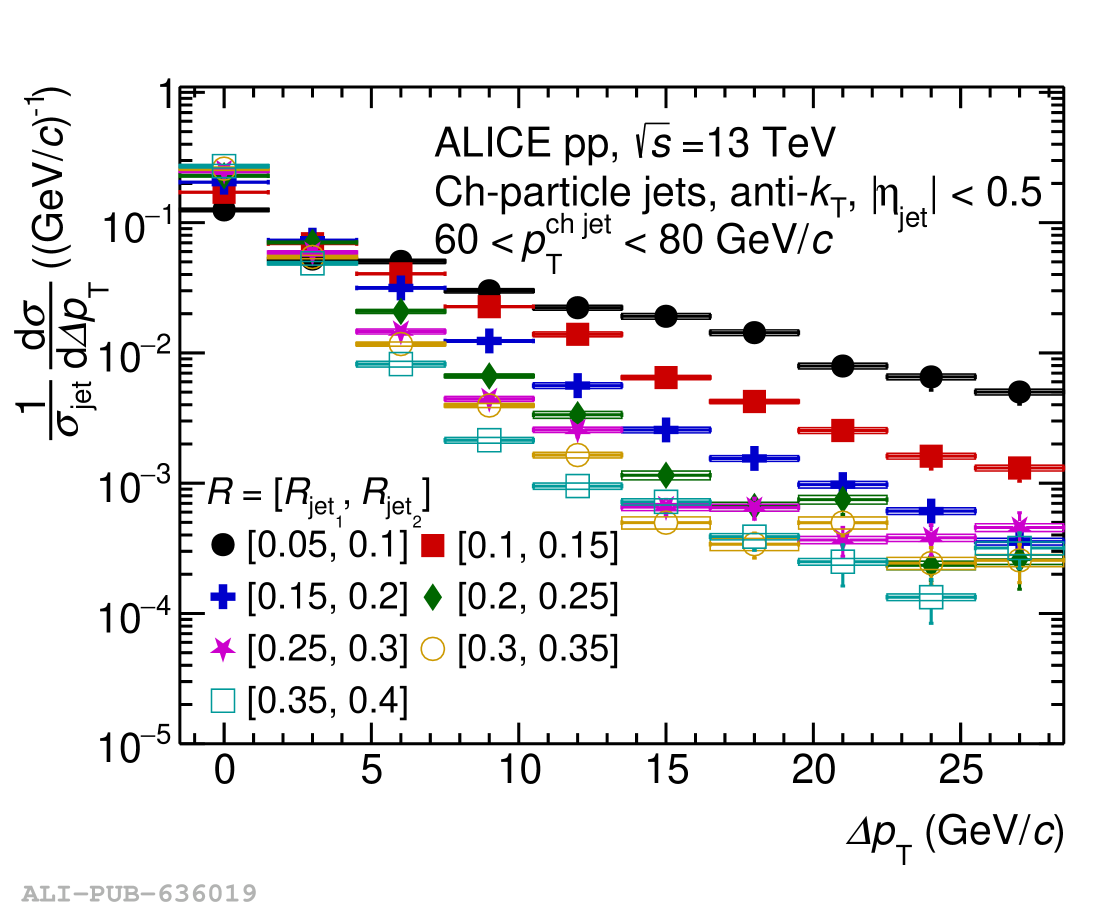 |
Figure 3
JEF distribution in \jetptrange{60}{80} for three jet pairs with radii of [0.05, 0.1] (top left), [0.15, 0.20] (top right), and [0.2, 0.25] (bottom) compared to PYTHIA, HERWIG, JEWEL pp and JETSCAPE (PP19 tune) in pp collisions at $\sqrt{s}=13$ TeV. The bottom panels of each figure show the ratio of MC to data, and the gray band represents the systematic uncertainty of the data. | 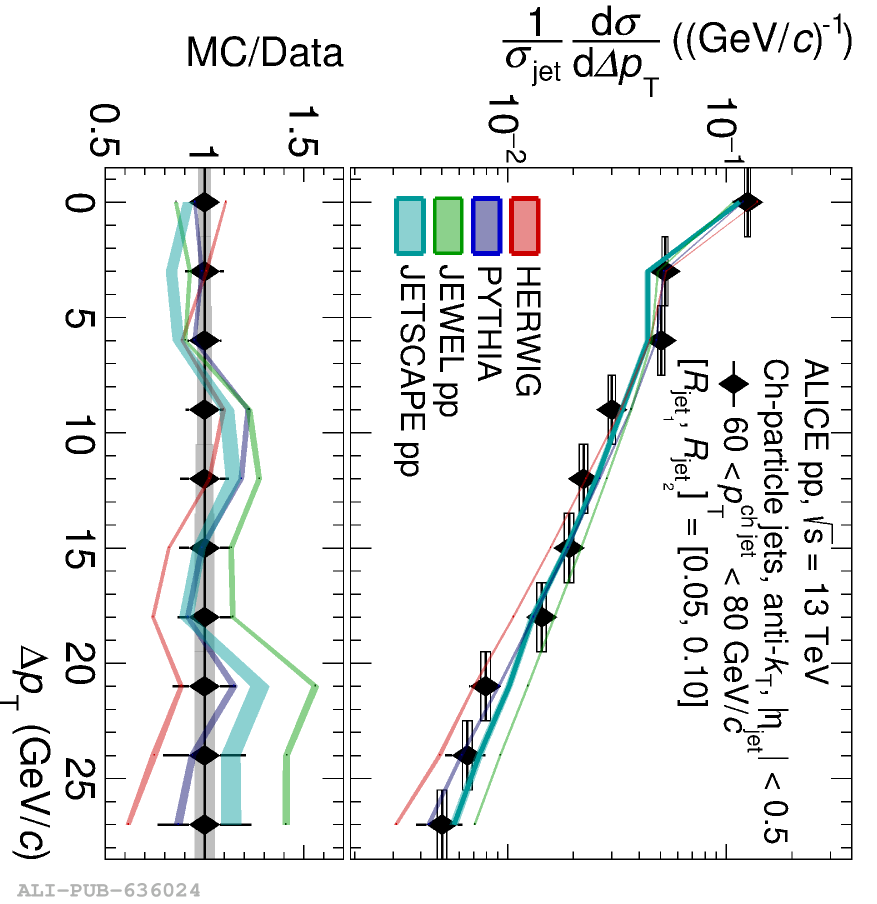 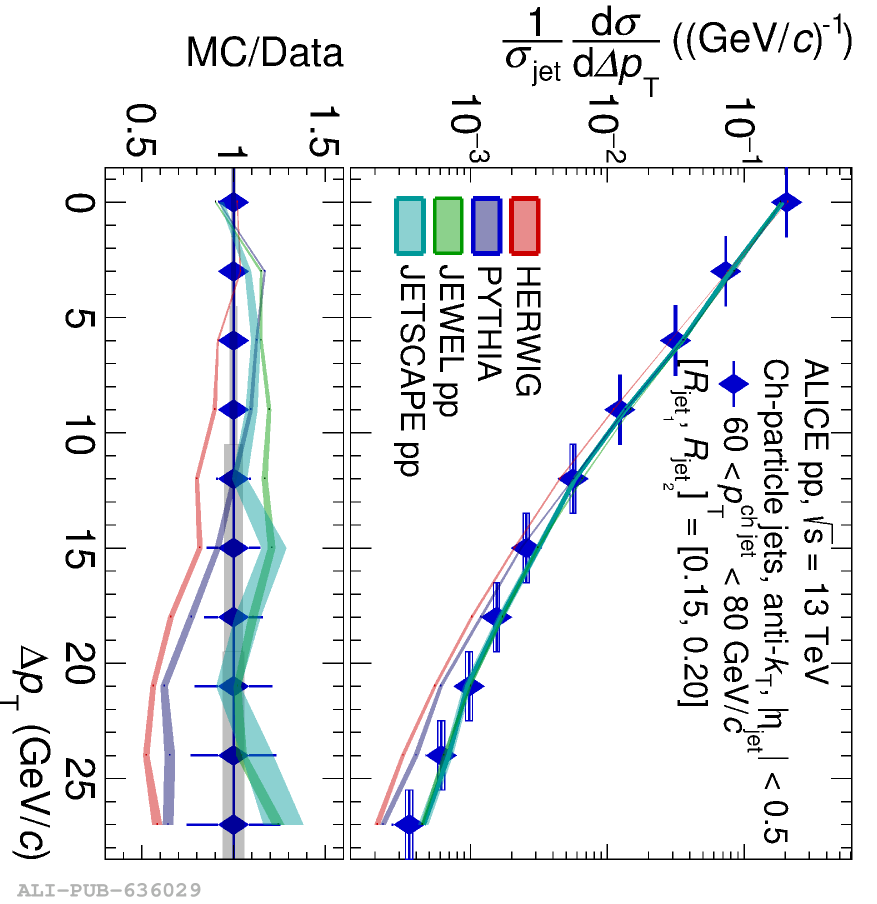 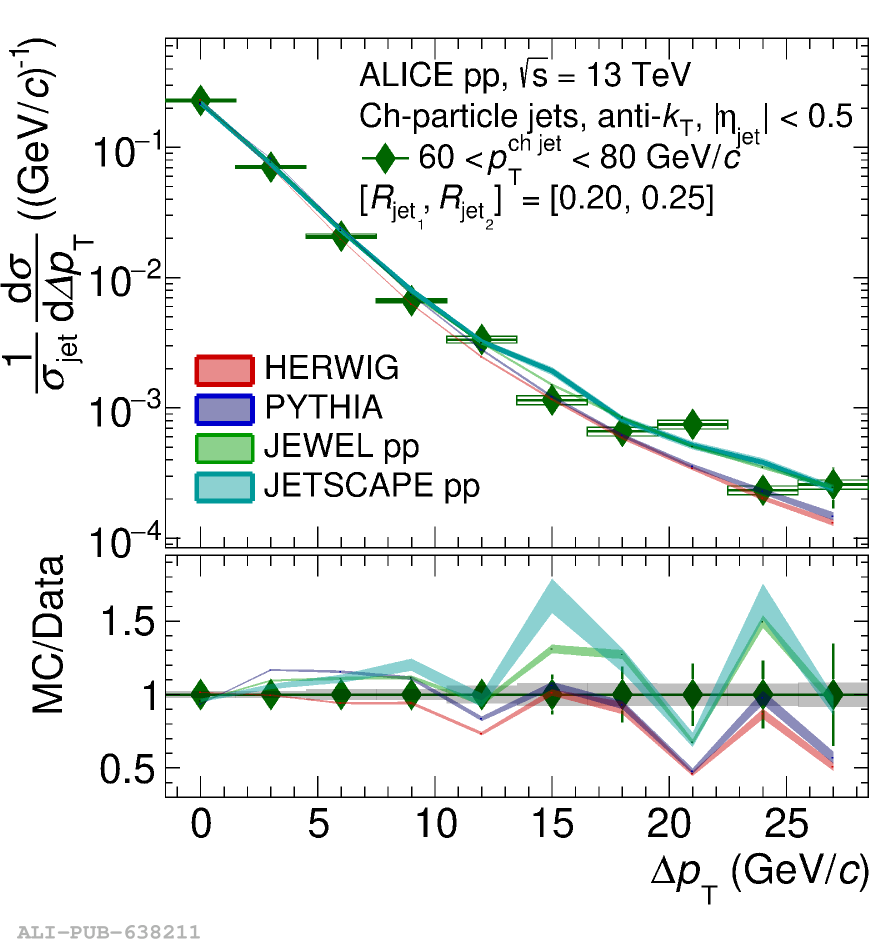 |
Figure 4
Mean JEF in the \jetptrange{40}{60} (left) and \jetptrange{60}{80} (middle) jet-\pt intervals, and its jet-\pt dependence (right), as a function of the smaller jet radius, $R_{\rm jet_1}$, compared with PYTHIA, HERWIG, JEWEL, and JETSCAPE predictions for pp collisions at $\sqrt{s}=13 $TeV. | 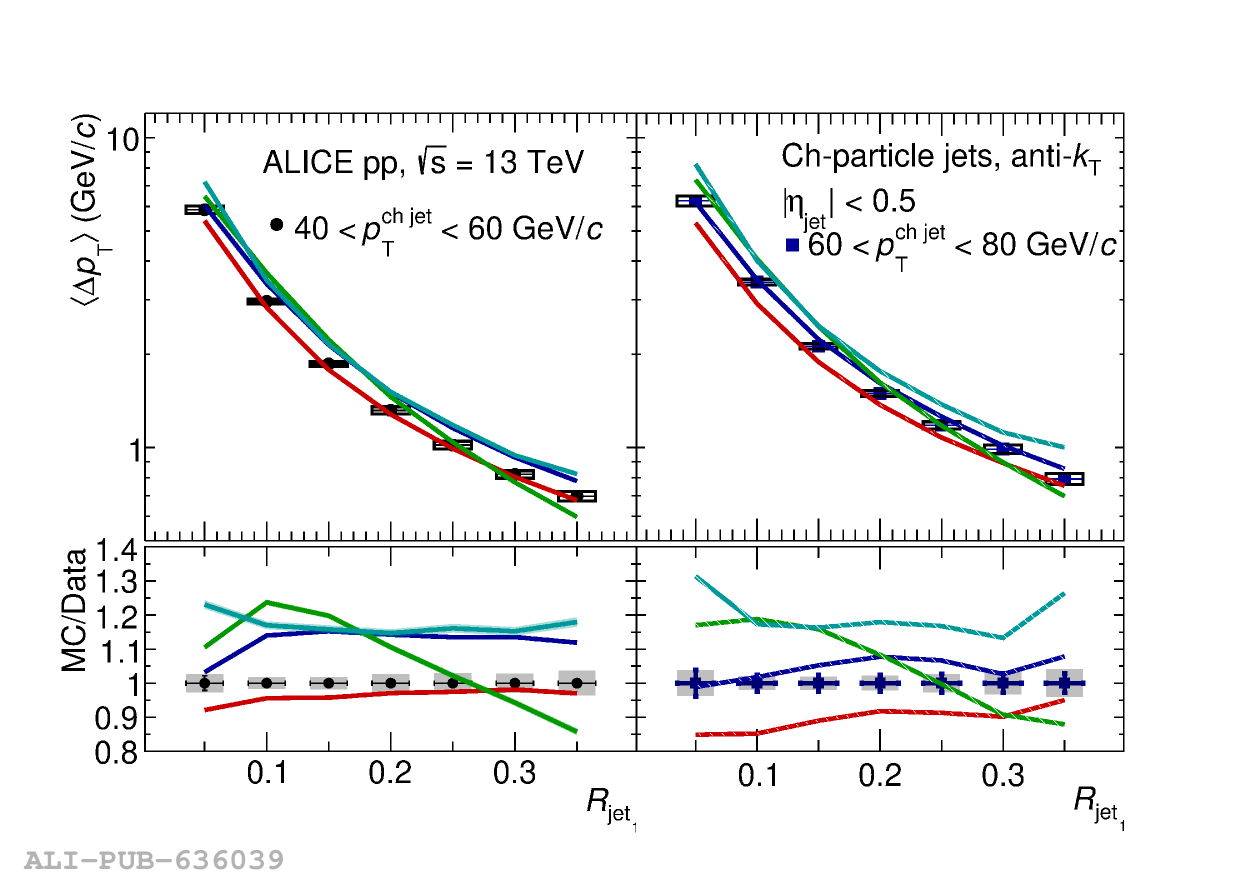 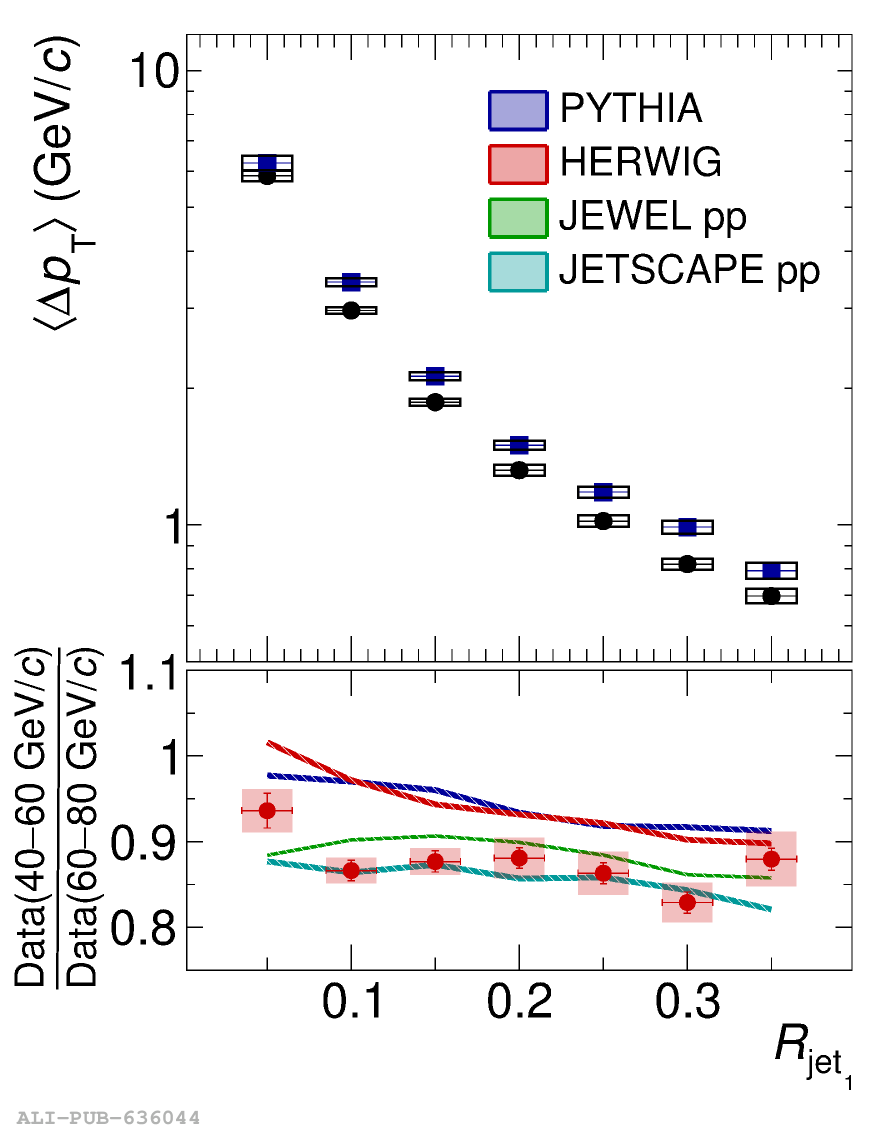 |
Figure 5
JEF distributions in \jetptrange{60}{80} for jet pairs with radii [0.05, 0.1], [0.1, 0.15], [0.15, 0.2], and [0.2, 0.25], in Pb--Pb collisions at $\sqrt{s_{\rm NN}} = 5.02 \mathrm{TeV}$. The lines represent the statistical uncertainties, and the boxes represent the systematic uncertainties. | 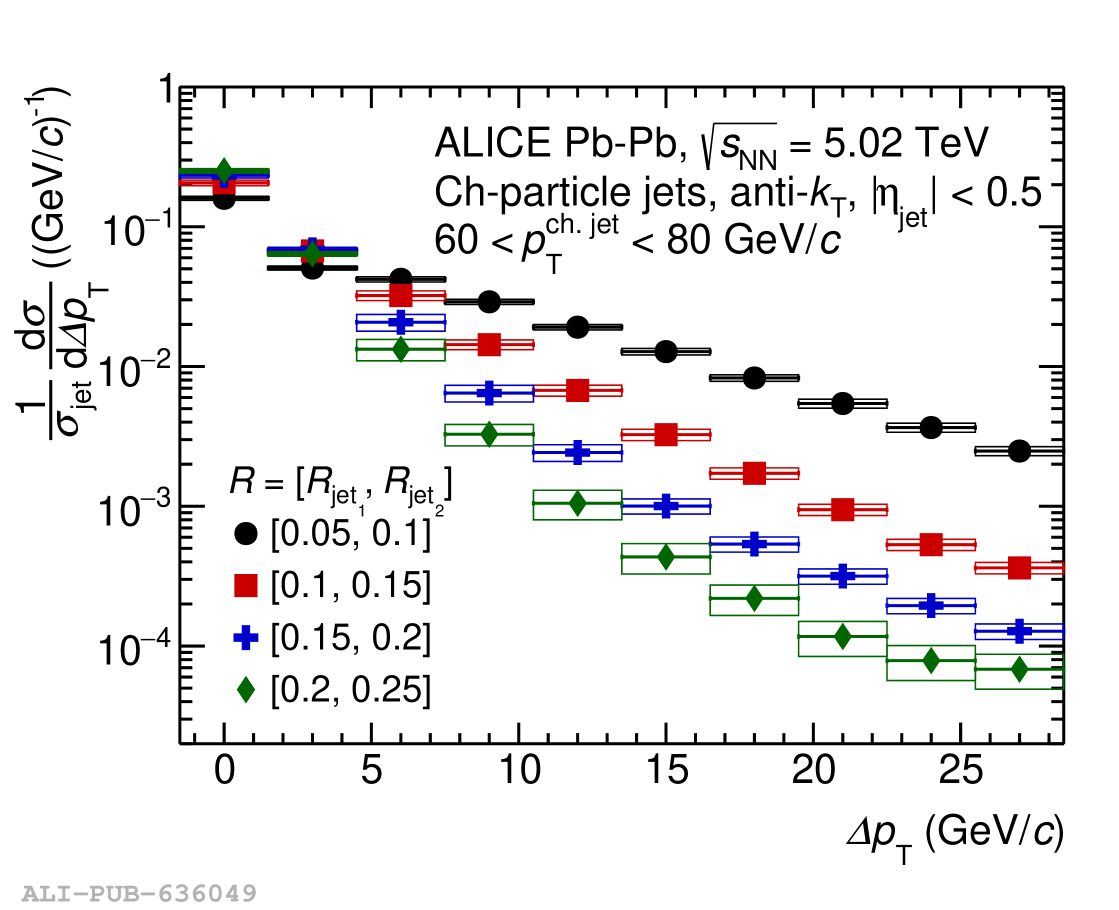 |
Figure 6
JEF distributions in the \jetptrange{60}{80} interval for pp collisions at $\sqrt{s}=13 \mathrm{TeV}$ and Pb--Pb collisions at $\sqrt{s_{\rm NN}}=5.02 \mathrm{TeV}$ are shown for jet pairs with radii [0.05, 0.1] (top left), [0.1, 0.15] (top right), [0.15, 0.2] (bottom left), and [0.2, 0.25] (bottom right). The bottom panels show the ratio of JEF in Pb--Pb collisions to pp collisions, compared to JETSCAPE and JEWEL (with recoil on and off) models. The Pythia baseline is shown as the magenta band in the bottom panels. | 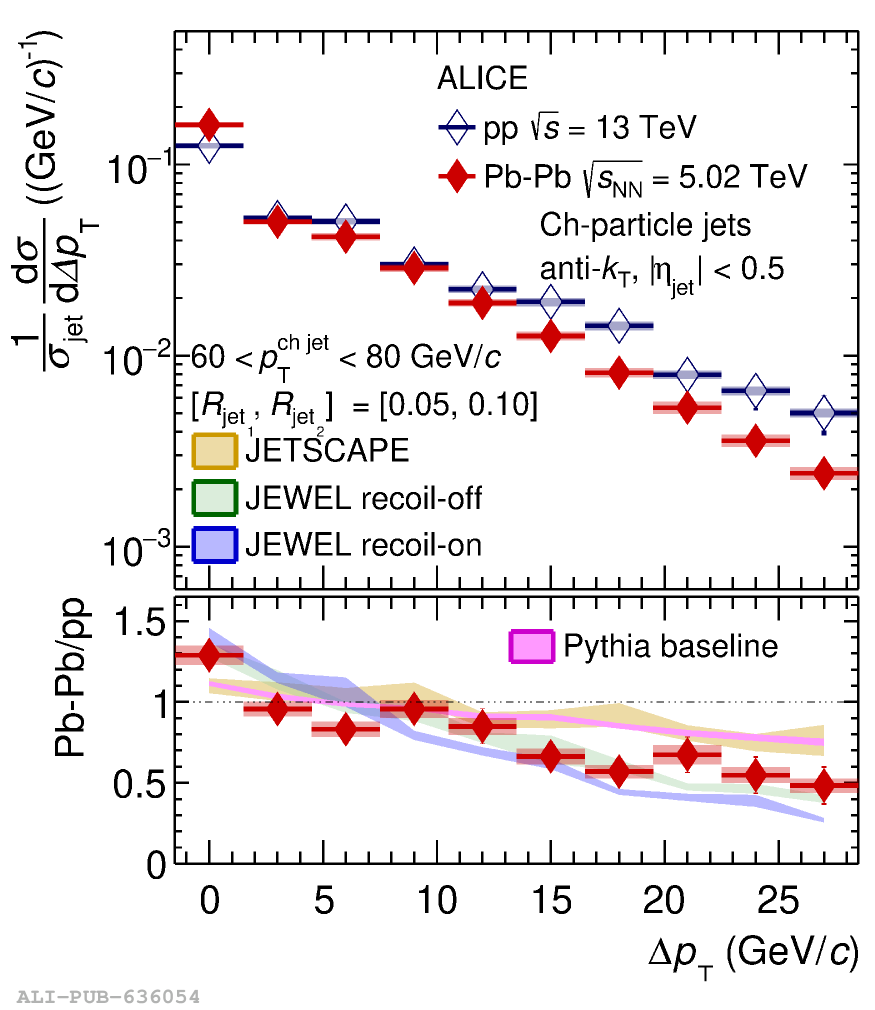 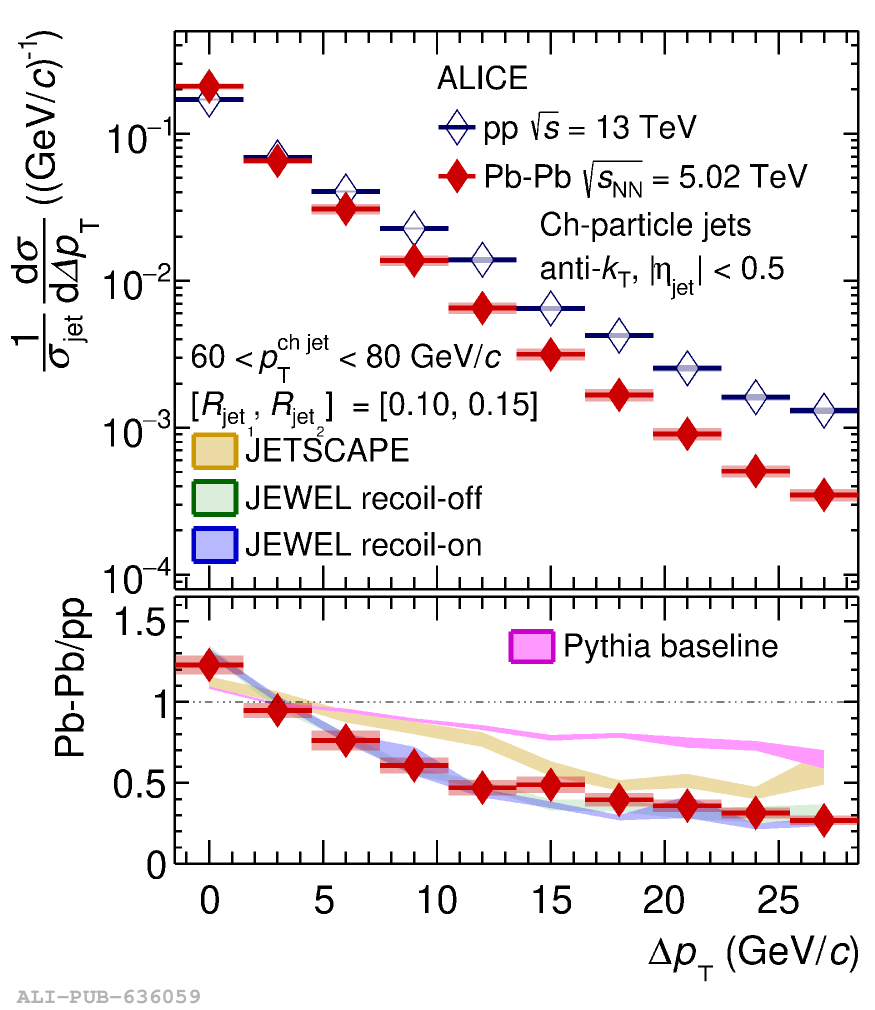 |
Figure 7
Top: Comparison of the mean energy flow for jet pairs with radii between \Rjet{0.05} and \Rjet{0.4} (\Rjet{0.25} for Pb--Pb) in the {\mbox{\jetptrange{60}{80}}} interval in ALICE pp (Pb--Pb) collisions, compared to models. In the model calculations $\sqrt{s}=13 \mathrm{TeV}$ is used for pp collisions and $\sqrt{s_{\mathrm{NN}}}=5.02 \mathrm{TeV}$ for Pb--Pb collisions. Bottom: Ratio of the relative difference of Pb--Pb with respect to pp, compared to JETSCAPE and JEWEL (with recoil on and off). The Pythia baseline is shown as the magenta band in the bottom panel. | 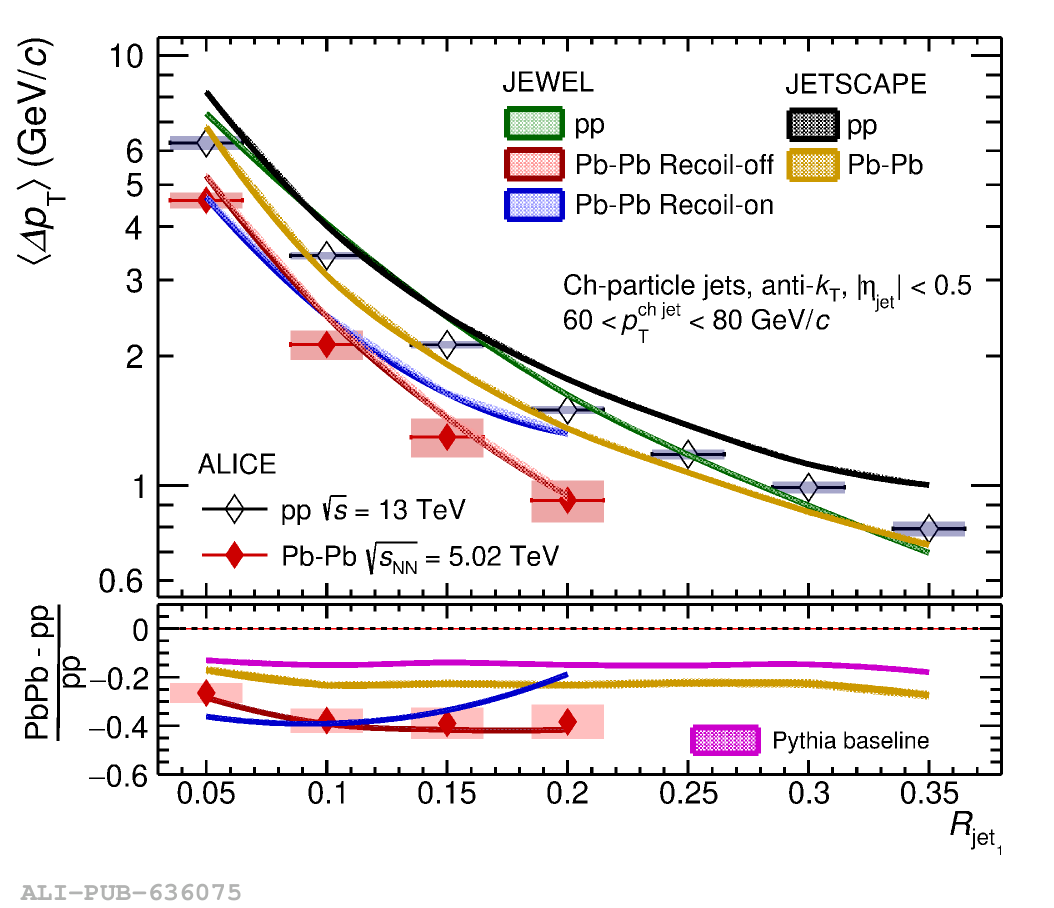 |