
The ALICE Collaboration presents the first measurements of ${\rm D}^0$-tagged jet angularities in proton$-$proton (pp) collisions at $\sqrt{s} = 5.02$ TeV. Jet angularities are powerful substructure observables that characterize the angular and momentum distributions of particles within jets via tunable weighting parameters. Varying the angular parameter in jet angularities allows for a systematic probe of the sensitivity to collinear and soft radiation, enabling the study of flavor-dependent fragmentation and hadronization through comparisons of jets initiated by different partons. This paper reports ${\rm D}^0$-tagged and inclusive (gluon-dominated) charged-particle jet angularities with a resolution parameter $R=0.4$ in the low jet transverse momentum range ($10 <~ p_{\rm T}^{\rm ch. \, jet} <~ 20$ GeV/$c$), where charm-quark mass effects are most significant. At low angular weight, which emphasizes collinear radiation, ${\rm D}^0$-tagged jets exhibit smaller angularity values than inclusive jets. This provides evidence for the radiation suppression from massive quarks -- a phenomenon known as the QCD dead-cone effect. As the angular weight increases, giving more emphasis to wide-angle radiation, the difference between ${\rm D}^0$-tagged and inclusive jet distributions decreases. This indicates that the modification is concentrated within the jet core rather than its edge. PYTHIA 8 simulations qualitatively reproduce both the angularity of ${\rm D}^0$-tagged and inclusive charged-particle jets, but reproduce the ${\rm D}^0$-tagged jet distributions better than those of inclusive jets, offering a powerful new constraint for models. These results provide insight into flavor-dependent fragmentation and establish an essential baseline for future studies of jet modifications in the quark-gluon plasma produced in heavy-ion collisions.
Submitted to: PRD
e-Print: arXiv:2606.20028 | PDF | inSPIRE
CERN-EP-2026-170
Figure group
Figure 1
Left: Invariant-mass distribution of \Dzero-jet candidates for \jetptrange{10}{20}, with \Dzero-meson candidates in \ptDrange{8}{12} and $R=0.4$ The total fit function is depicted by the dashed blue line, while the solid red line represents the background fit function. The blue and green shaded areas correspond to the signal and sideband regions, respectively. Right: The distribution of the raw \Dzero-tagged jet yields as a function of jet angularity $\lambda_{\alpha=1}$ in the signal (blue) and sideband (green) regions, along with the background-subtracted (red) yields. | 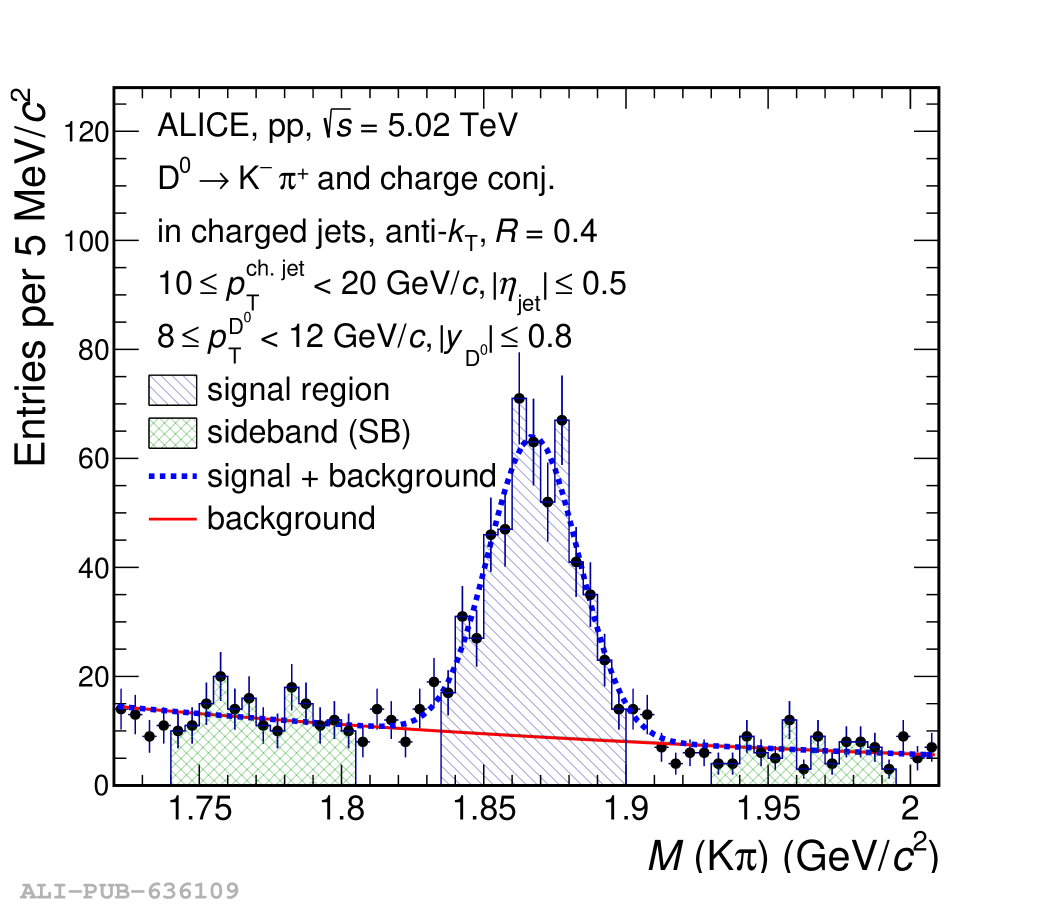 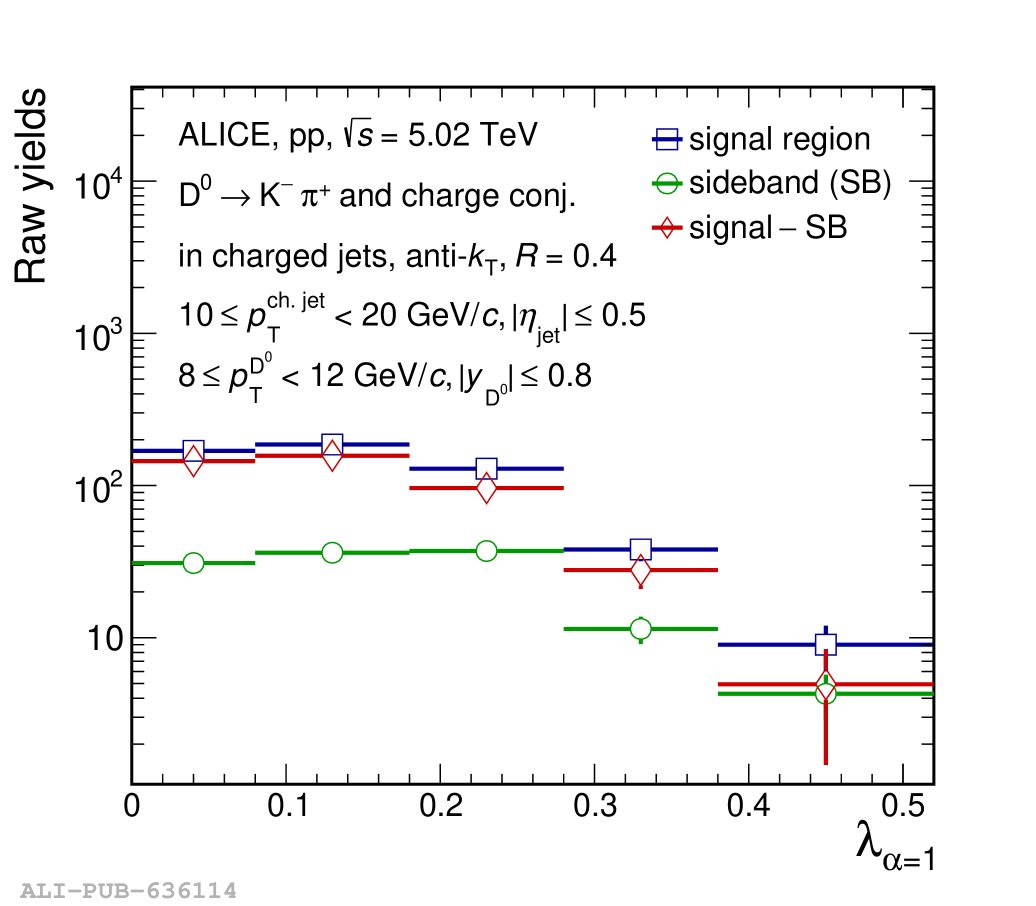 |
Figure 3
The angularity distributions, measured by ALICE in pp collisions at $\sqrt{s}=5.02$ TeV, of \Dzero-tagged jets (red) compared to inclusive charged-particle jets (blue and green) and to PYTHIA 8 simulations for $\alpha=1$, 1.5, 2, and 3 using $R=0.4$ in \jetptrange{10}{20}. The ratio of \Dzero-tagged to inclusive jet angularities is shown in the bottom panels for each value of $\alpha$. Note that the $y$-axis scale differs among the plots. | 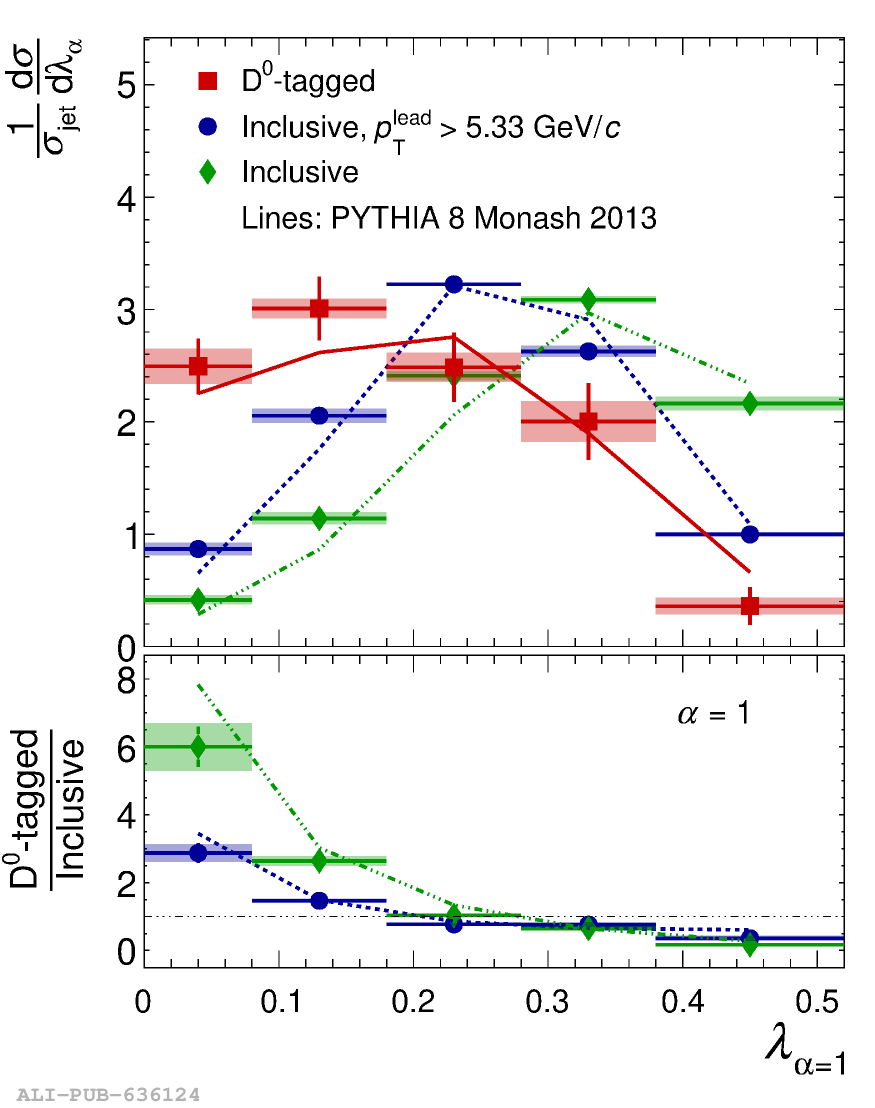 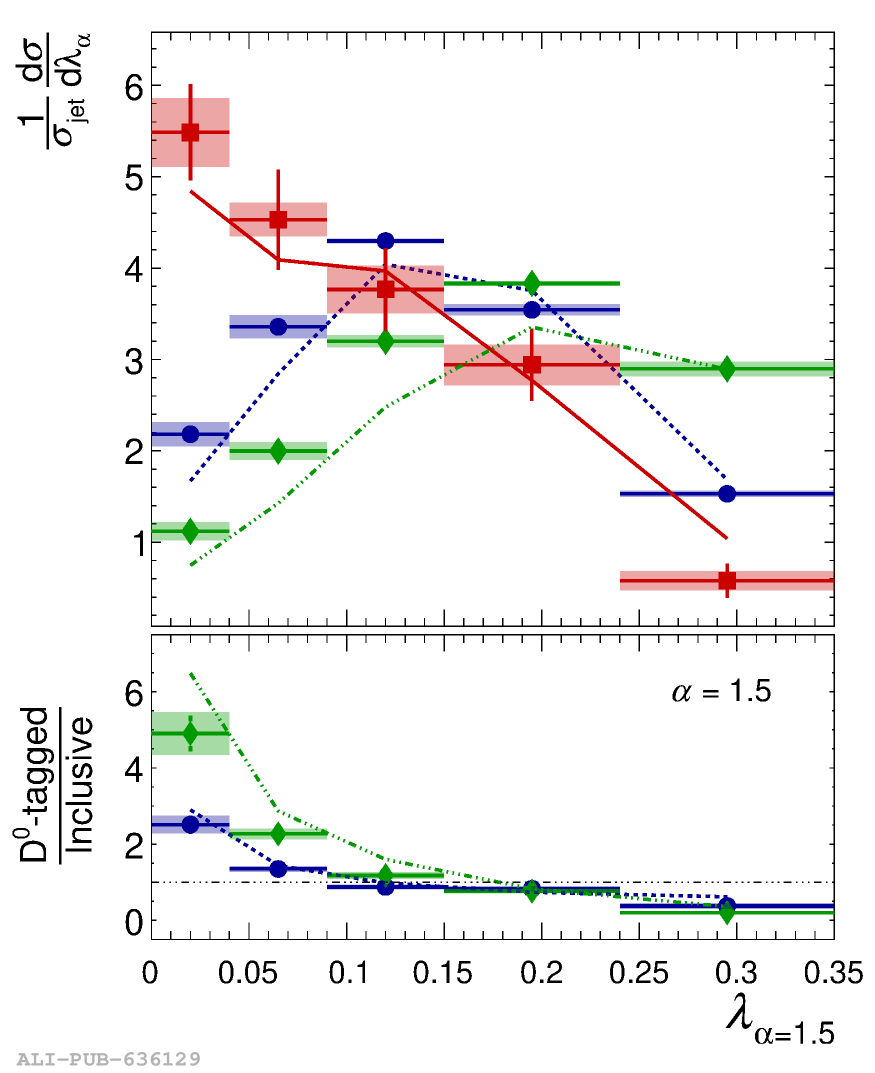 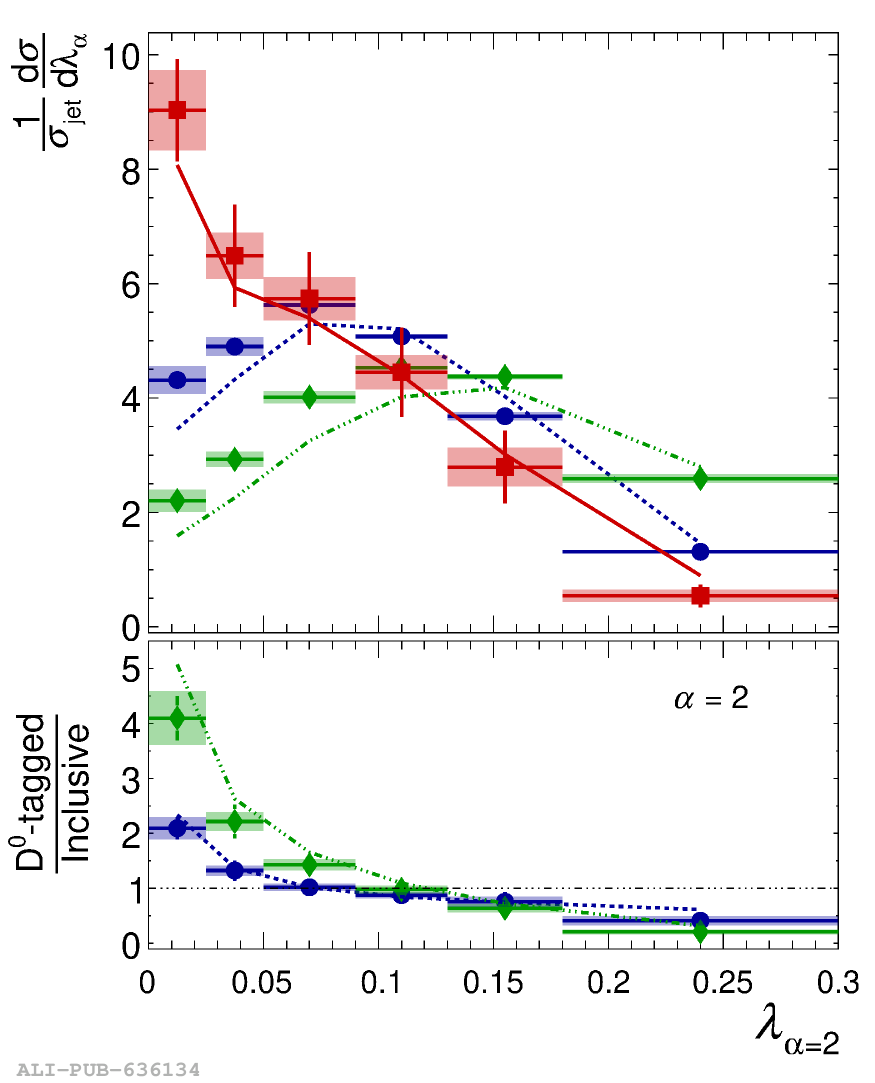 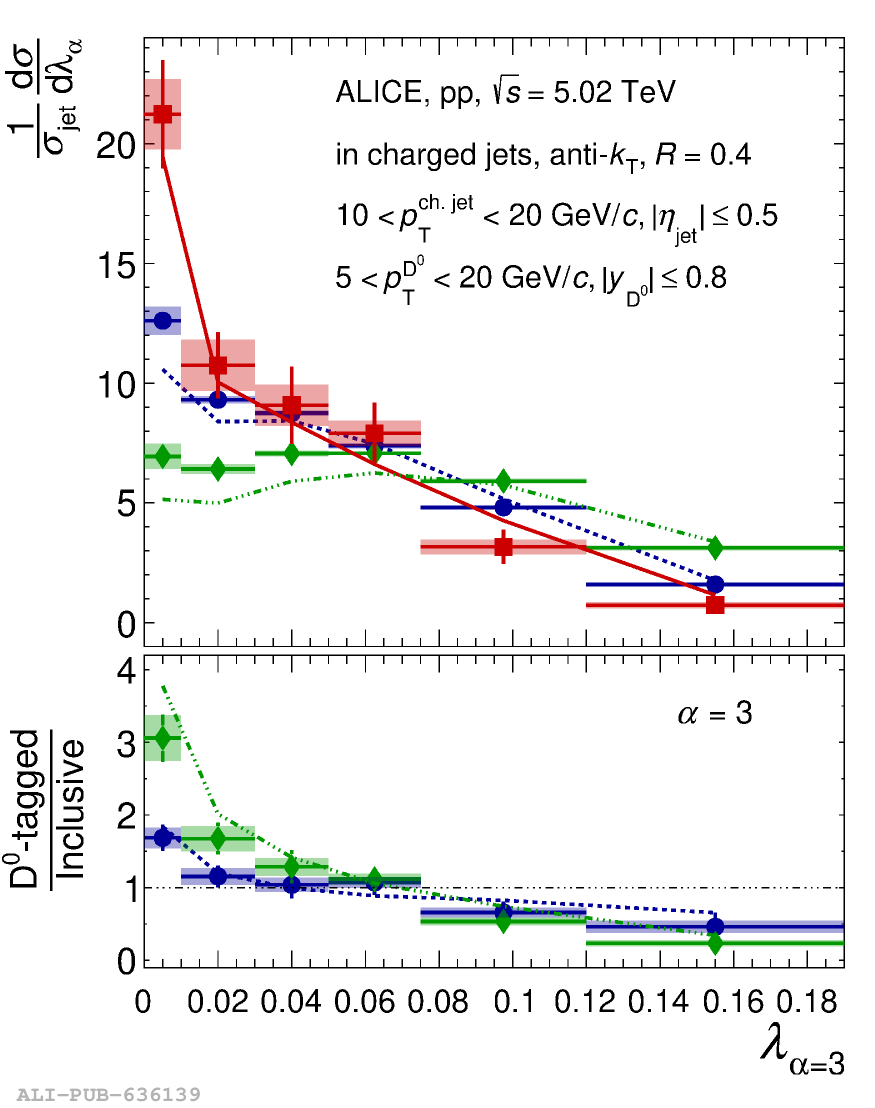 |
Figure 4
The mean (left panel) and RMS (right panel) values extracted from the angularity distributions shown in Fig. \ref{fig:alphascan_data} for \Dzero-tagged jets and inclusive jets, with and without the leading-track \pt selection, as a function of $\alpha$ using $R=0.4$ in \jetptrange{10}{20}. | 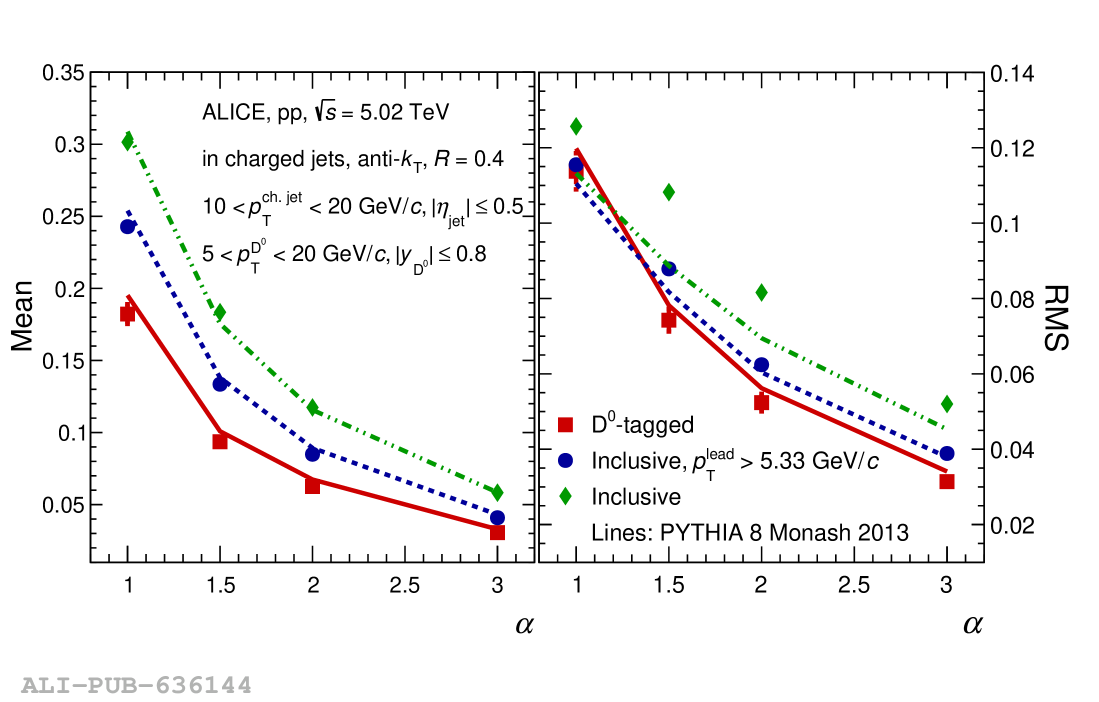 |
Figure 5
Comparison of jet angularity distributions for D$^{0}$-tagged (red), quark-initiated (blue), and gluon-initiated (green) jets from PYTHIA 8 Monash simulations with $R=0.4$ in the $10 \pTchjet 20$ \GeVc range, shown for $\lambda_{\alpha= 1}$ (left) and $\lambda_{\alpha= 3}$ (right). | 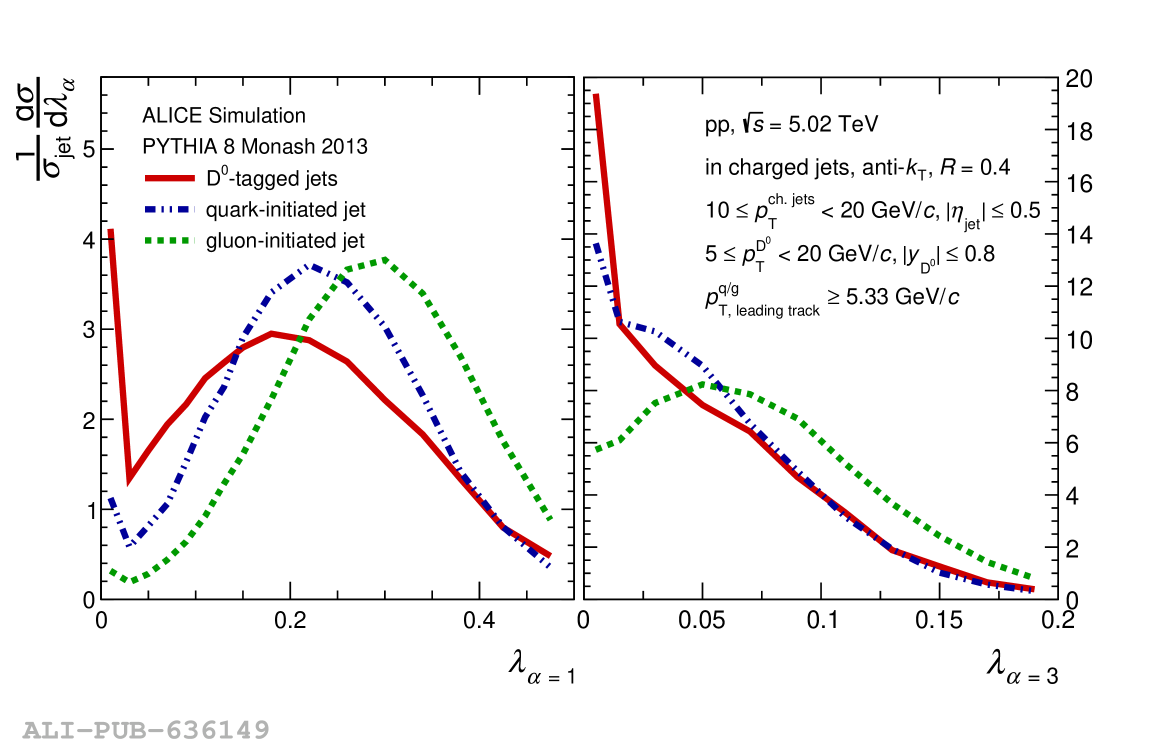 |
Figure 6
The \Dzero-tagged jet-angularity distributions, measured by ALICE in pp collisions at $\sqrt{s}=5.02$ TeV (red markers), compared to PYTHIA 8 Monash (red line), SHERPA AHADIC (green line), and SHERPA LUND (blue line) using $R=0.4$ in \jetptrange{10}{20}, for $\lambda_{\alpha= 1}$ (left) and $\lambda_{\alpha= 3}$ (right). | 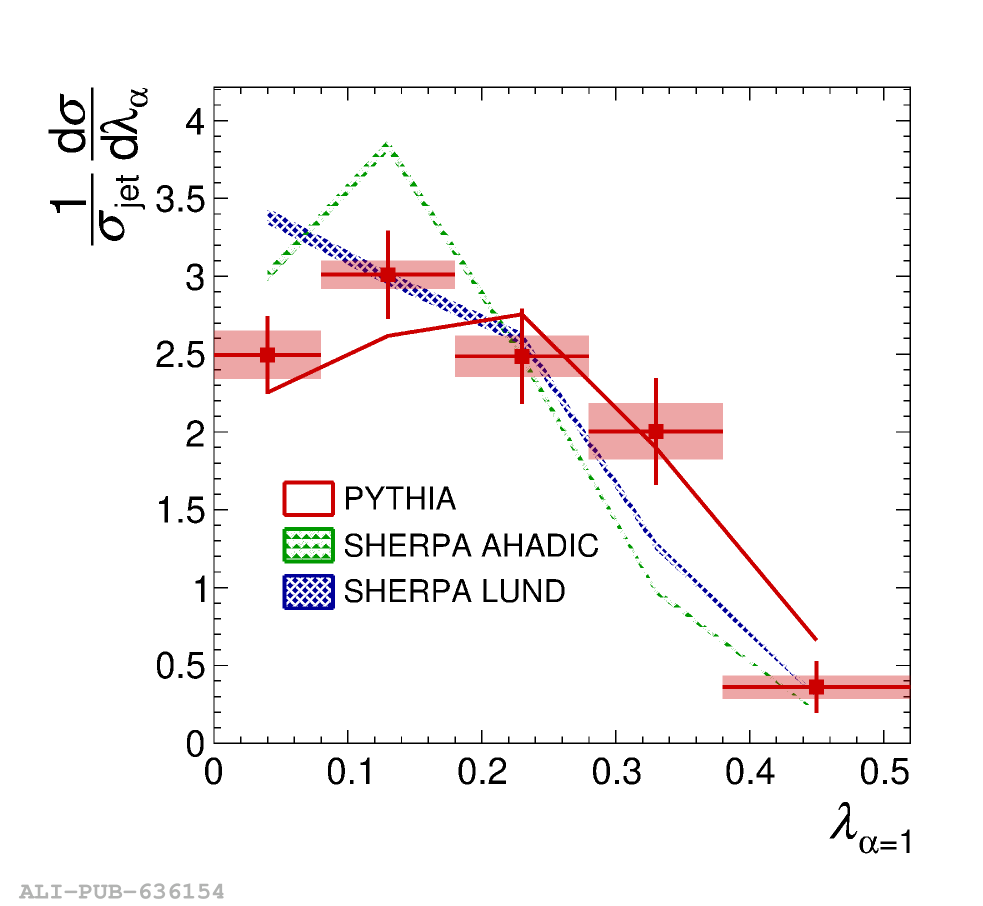 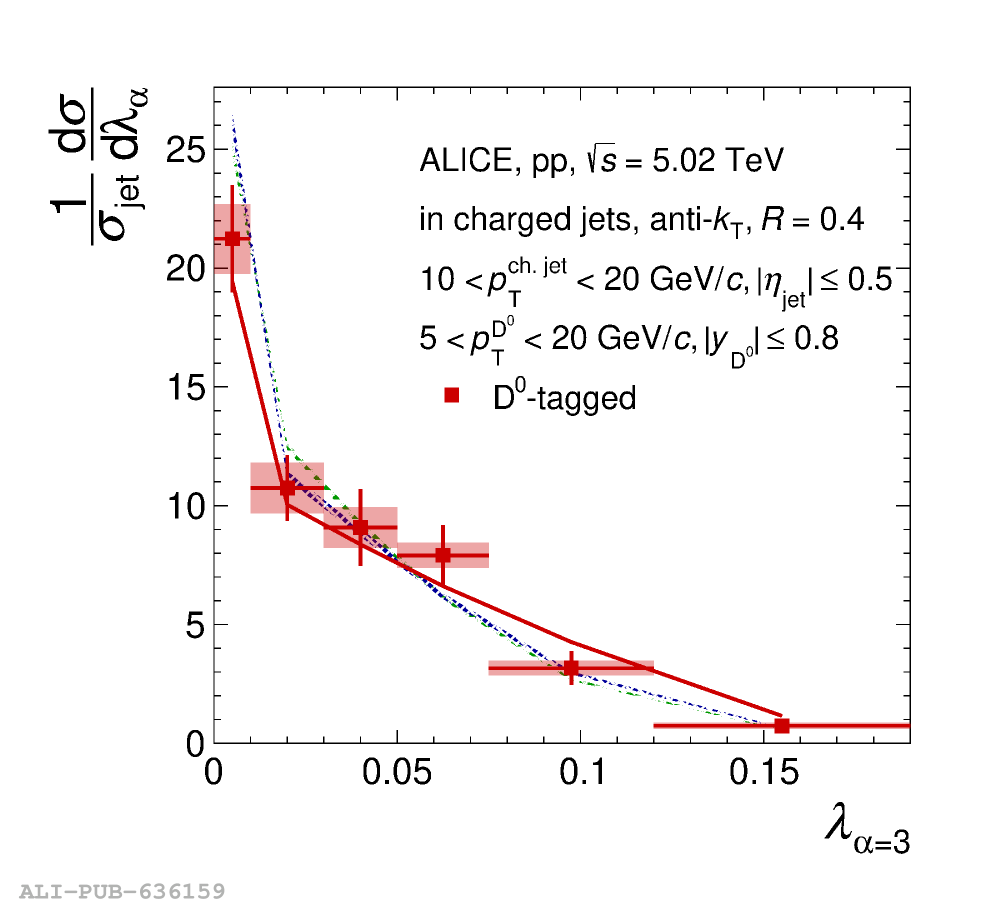 |