
The ALICE collaboration reports the azimuthal-anisotropy coefficient $v_2$ of prompt D$^0$, D$^+$, D$^+_{\rm s}$ mesons and the first measurement of $v_2$ of prompt $Λ_{\rm c}$ baryons in semicentral Pb$-$Pb collisions at a center-of-mass energy per nucleon pair of $\sqrt{s_{\rm NN}} = 5.36$ TeV. The D mesons and $Λ_{\rm c}$ baryons are reconstructed in their hadronic decays at midrapidity ($ |y|<~0.8$) in the transverse-momentum interval $0.5<~ p_{\rm T} <~ 24$ GeV/$c$. Similar $v_2$ values are measured for D$^0$ and D$^+$, while a hint of a difference ($2.6σ$) emerges between D$^0$ and D$^+_{\rm s}$ mesons in the $1 <~ p_{\rm T} <~ 5 $ GeV/$c$ interval. A larger $v_2$ for $Λ_{\rm c}$ baryons with respect to D$^0$ mesons is observed with $3.7σ$ significance for $4 <~ p_{\rm T} <~ 12$ GeV/$c$, providing evidence for the partonic origin of charm-hadron $v_2$ and hadron formation via quark coalescence. This interpretation is further supported by comparisons with theoretical calculations of charm-quark transport in a hydrodynamically expanding medium.
Submitted to: PRL
e-Print: arXiv:2603.18966 | PDF | inSPIRE
CERN-EP-2026-070
Figure group
Figure 1
Elliptic flow of prompt \Dzero, \Dplus, \Ds mesons and \Lc baryons at midrapidity (\yrange0.8) in \PbPb collisions at $\sNN = 5.36$ TeV in the 30$-$50\% centrality class as a function of the charm-hadron \pt. The \vtwo of charged pions measured at $\sNN = 5.02$ TeV in the 30$-$40\% centrality class is also shown for comparison. | 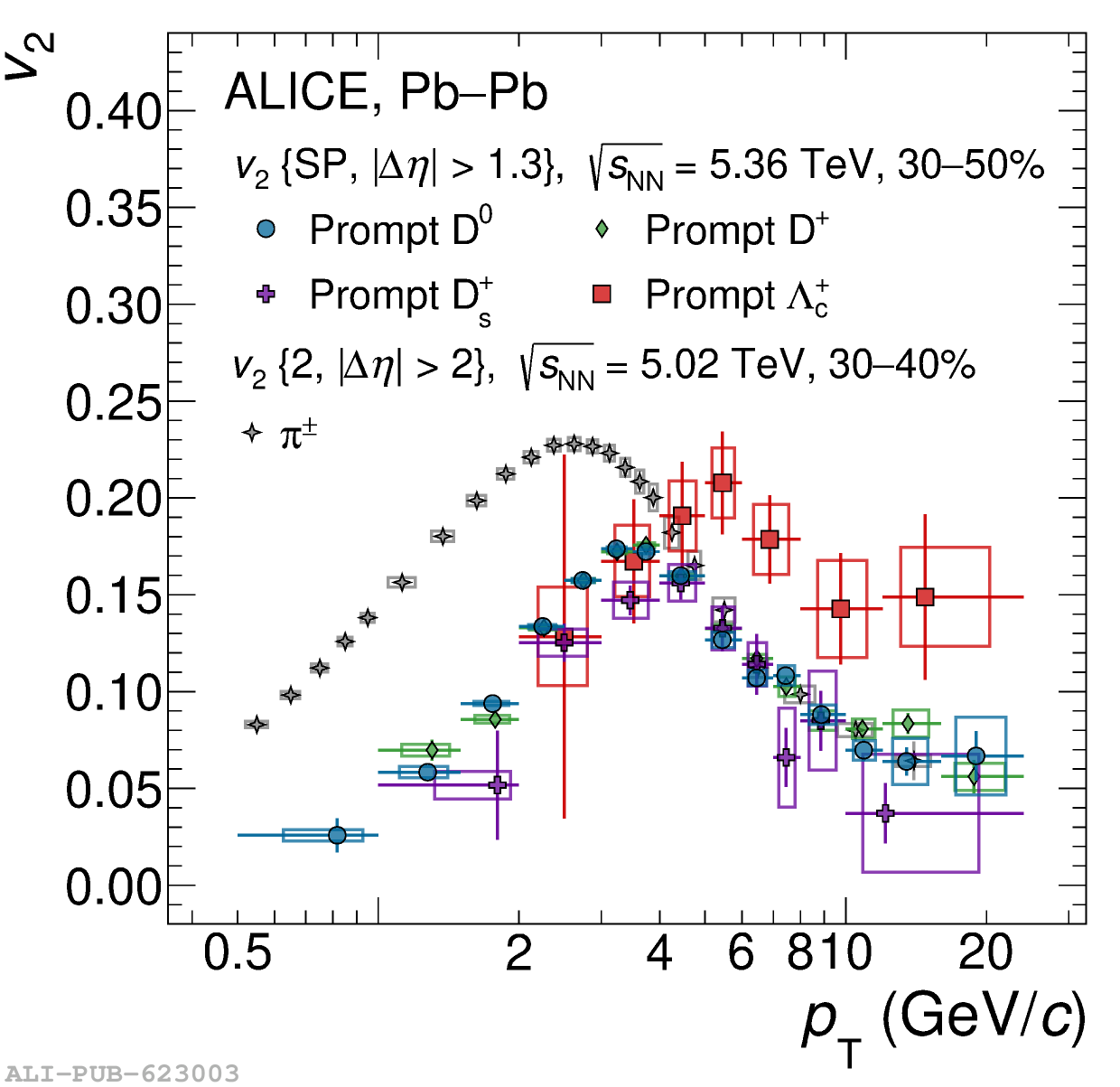 |
Figure 2
Elliptic flow of prompt \Dzero (top), \Ds (middle), and \Lc (bottom) hadrons at midrapidity (\yrange 0.8) in \PbPb collisions at $\sNN = 5.36$ TeV in the 30–-50\% centrality class as a function of \pt. The data are compared with predictions from TAMU , Catania , POWLANG , LBT-PNP , EPOS4HQ , and Langevin transport models at $\sNN = 5.02$ TeV. | 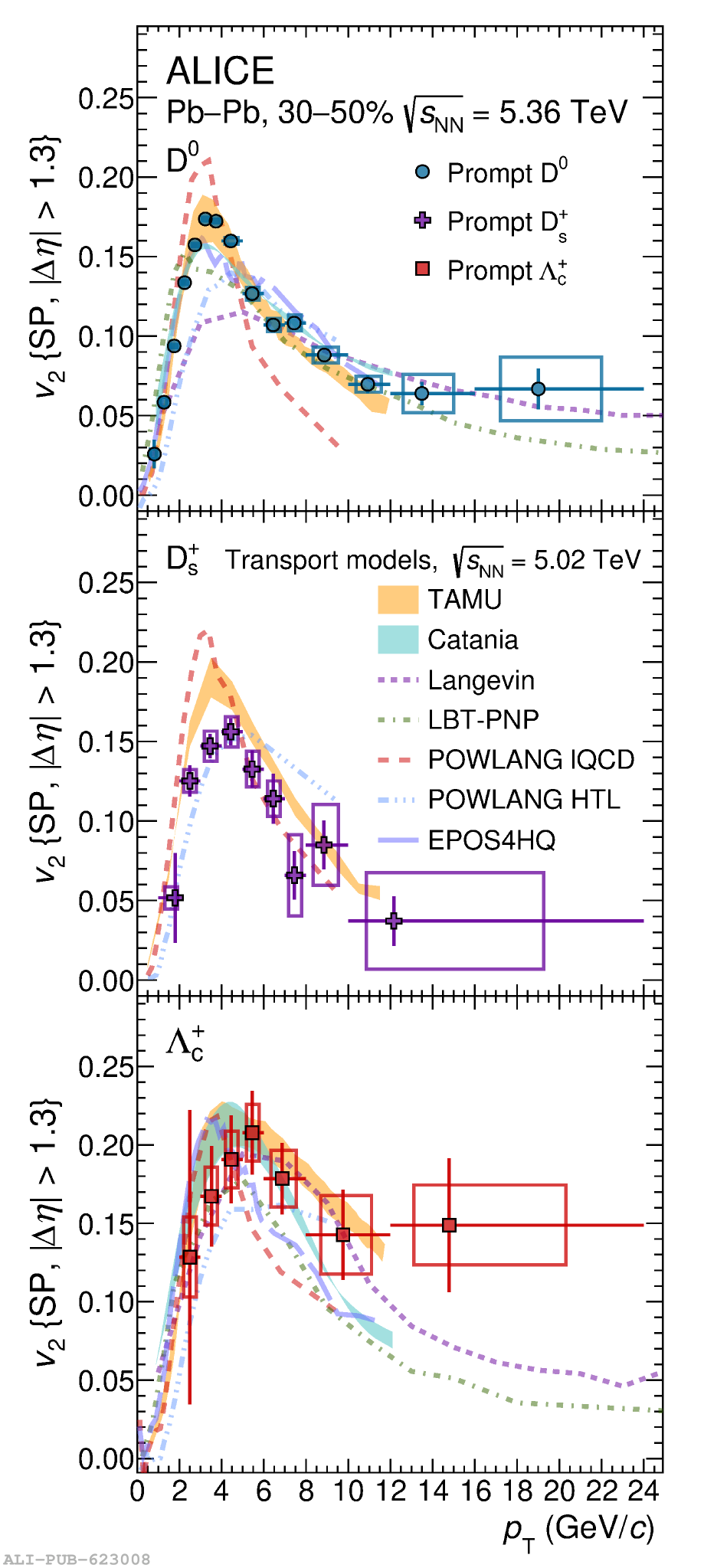 |
Figure A.1
Left: simultaneous fit of the candidate yield (top) and total $\vtwo$ as a function of the candidate invariant mass (bottom) of \Lc baryons in $6 \pt 8 \GeVc$ in \PbPb collisions for the 30--50\% centrality class. The combinatorial background and the total fit functions are depicted as dotted red curves and blue lines, respectively. The BDT-based selection and the corresponding signal \vtwo are reported in the bottom panel. Top right: raw-yield distribution as a function of the minimum threshold on the BDT prompt score of \Lc baryons in $6 \pt 8 \GeVc$ for the 30--50\% centrality class. The prompt and non-prompt populations, along with their sum, are reported in red, blue, and green, respectively. Bottom right: linear fit to the signal $\vtwo$ of \Lc baryons in $6 \pt 8 \GeVc$ for the 30--50\% centrality class as a function of the non-prompt fraction. The blue band represents the $1\sigma$ confidence interval obtained from the fit. | 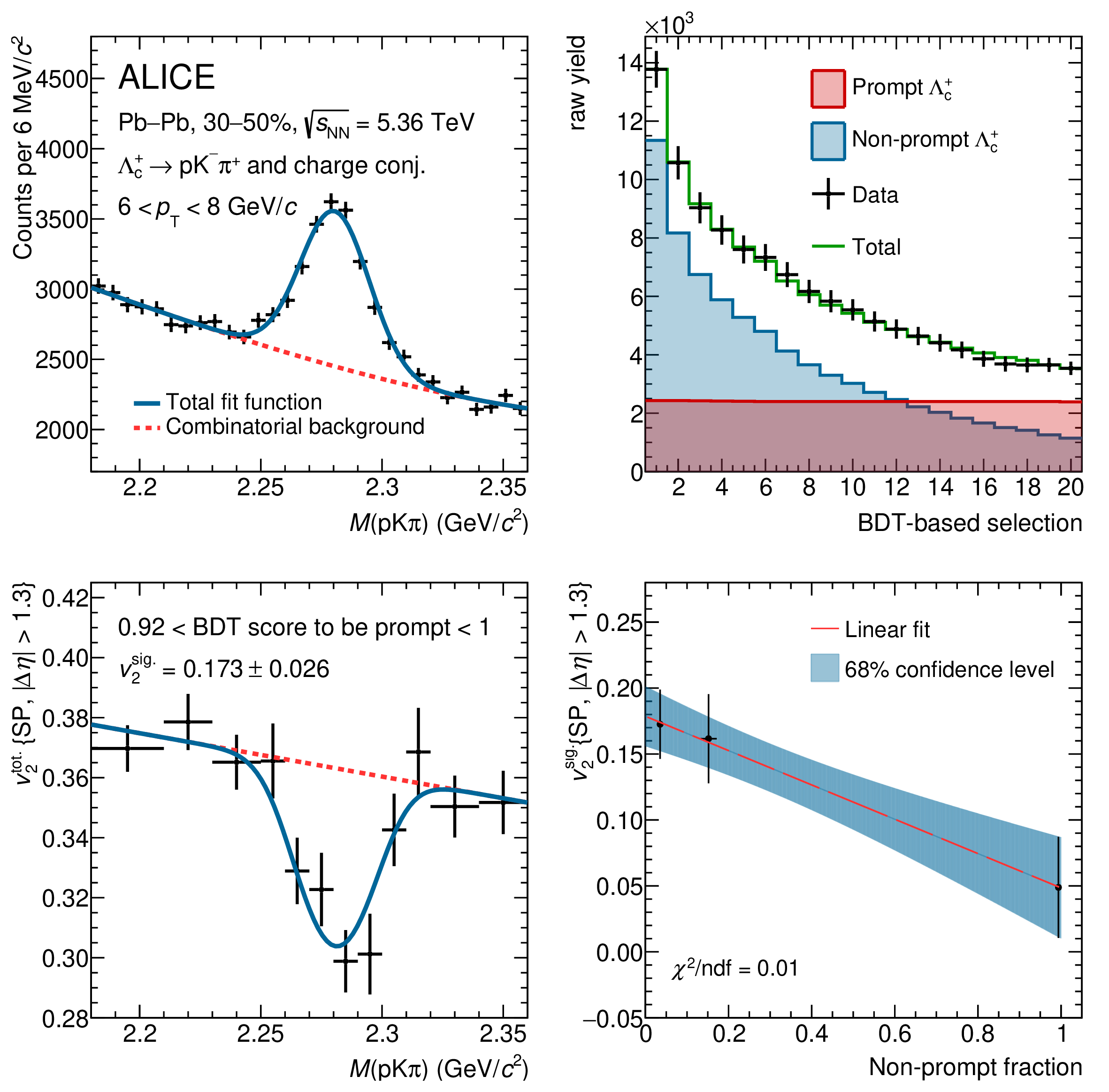 |