
The latest experimental studies related to the search for the Chiral Magnetic Effect (CME) in Pb-Pb collisions at $\sqrt{s_{\rm NN}} = 5.02$ TeV recorded with the ALICE detector at the Large Hadron Collider (LHC) are presented. Charge-dependent two-particle correlations relative to the reaction plane are measured for charged particles in the pseudorapidity range $|η| <~ 0.8$ and the transverse-momentum range $0.2 <~ p_{\rm T} <~ 5$ GeV/$c$. Two approaches have been employed: in the first method, the contribution of the background to the measurement is varied using the event shape engineering (ESE), while the second relies on changing the contribution of the potential CME signal by measuring azimuthal correlations relative to the participant plane, where the background contributions are maximized, and spectator plane, where the CME signal contribution is maximized. Both methods yield results consistent with the absence of a CME signal within the measurement uncertainties. The result obtained from correlations relative to different symmetry planes, a technique applied for the first time at LHC energies, gives the possibility to test independently and confirm the upper limits from previous measurements, while the new limit from the ESE analysis offers improved constraint relative to previous attempts.
Submitted to: PLB
e-Print: arXiv:2602.22900 | PDF | inSPIRE
CERN-EP-2026-035
Figure group
Figure 1
Centrality dependence of inclusive charged particle $v_2$ (top) and of $\gamma_{\alpha \beta}$ for pairs of particles with same and opposite sign (bottom) for shape-selected and unbiased events. The $q_2$ determined in the V0C is used for event selection. Statistical and systematic uncertainties are represented by vertical lines and shaded boxes, respectively. |  |
Figure 2
The dependence of $\Delta \gamma_{\alpha \beta}$ (top) and of the expected CME signal from a MC Glauber simulation (bottom) on $v_2$ together with linear fits (solid lines) for various centrality intervals. For the model, no event shape selection is performed and the range of the fit is based on the $v_2$ variation observed in data within each centrality class. Statistical and systematic uncertainties are represented by vertical lines and shaded boxes, respectively. | 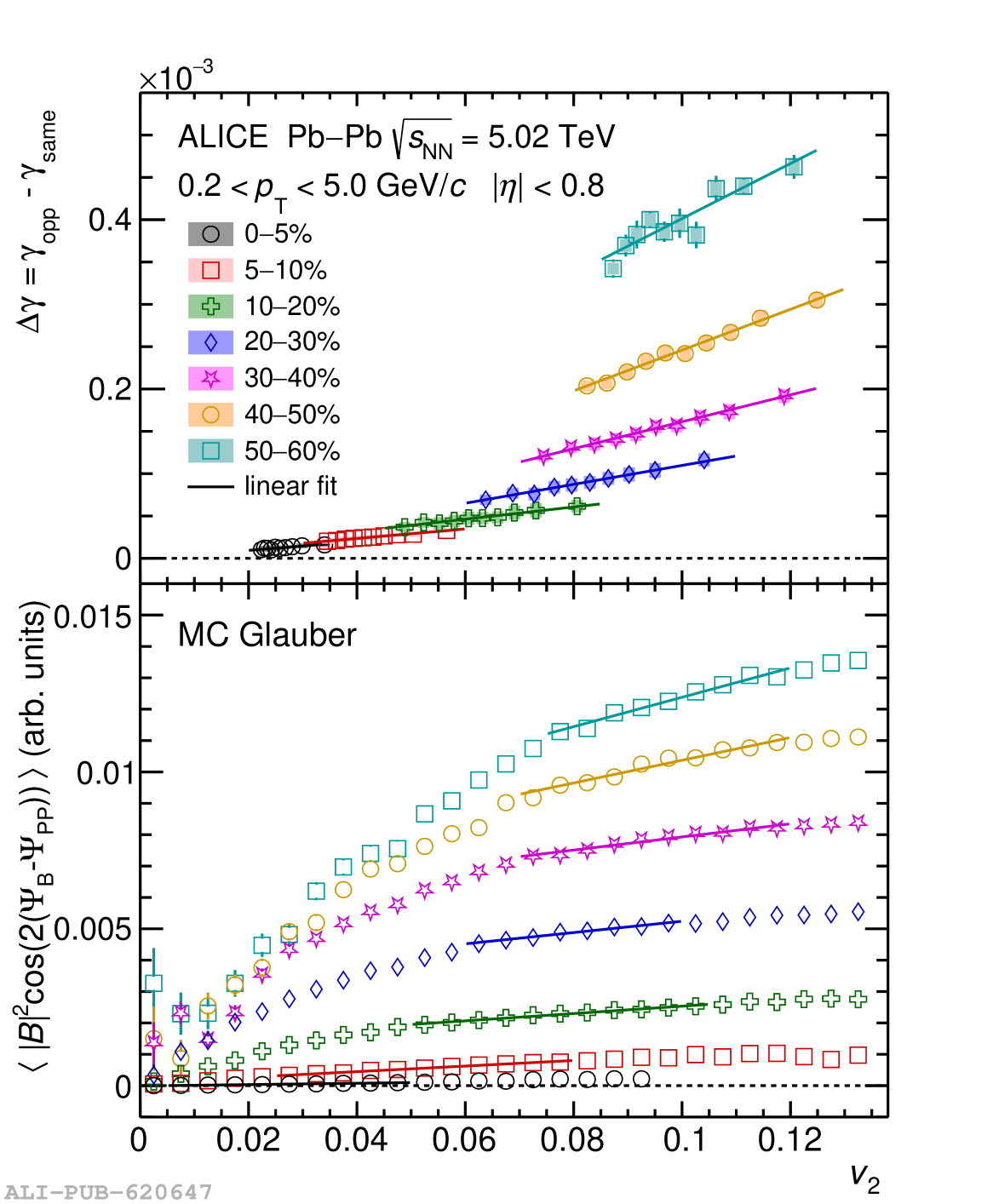 |
Figure 3
Centrality dependence of the CME fraction extracted from the slope parameter of fits to data and MC Glauber and T$_{\rm R}$ENTo models (see text for details). The T$_{\rm R}$ENTo points are slightly shifted along the horizontal axis for better visibility. Only statistical uncertainties are shown. | 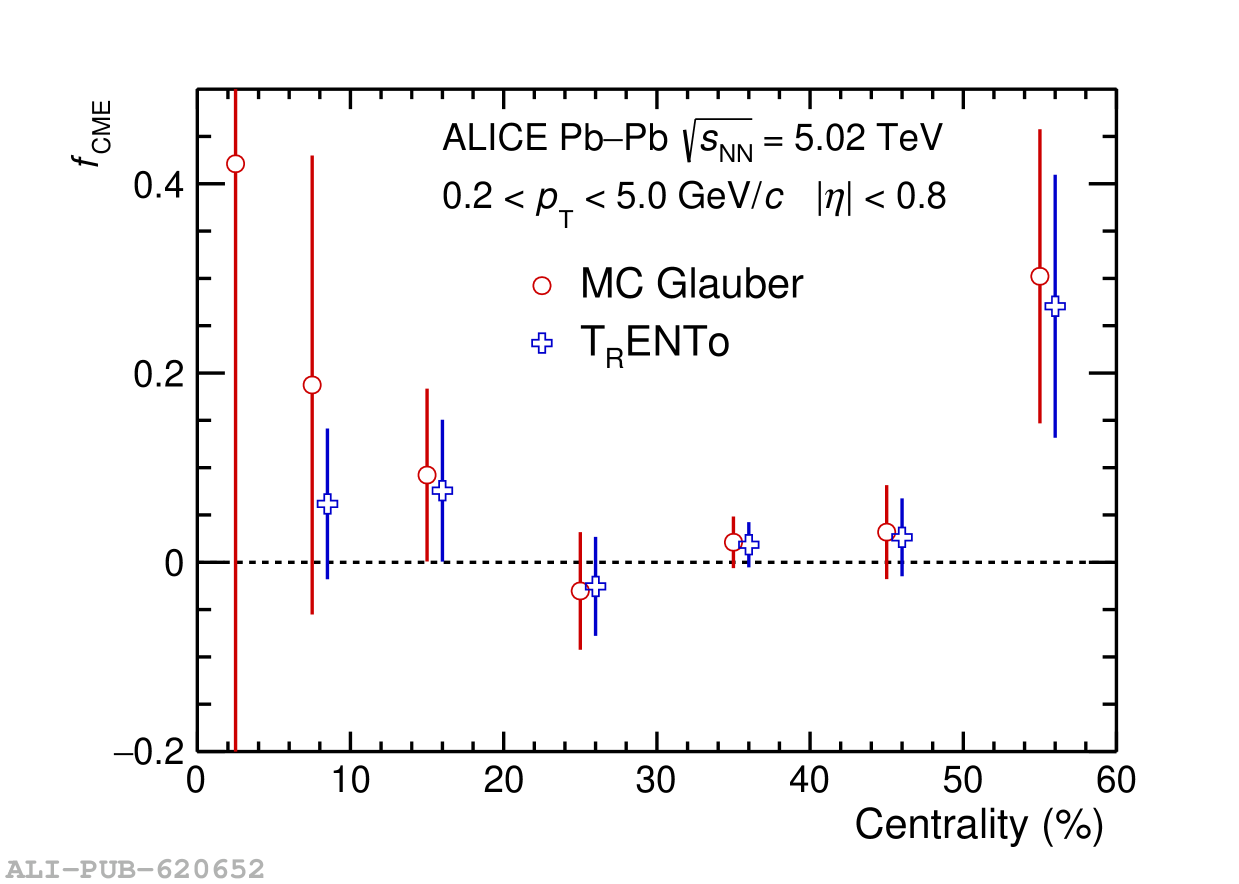 |
Figure 4
Centrality dependence of $\gamma_{\alpha\beta}(\Psi_{\text{PP}})/ v_2(\Psi_{\text{PP}})$ (black) and $\gamma_{\alpha\beta}(\Psi_{\text{SP}})/v_2(\Psi_{\text{SP}})$ (red), where pairs of particles in $\gamma_{\alpha\beta}$ are either of the same charge or the opposite charge in Pb--Pb collisions at $\snn = 5.02$ TeV. Filled markers correspond to OS correlations, open markers to SS correlations, with vertical bars representing statistical uncertainties and boxes representing systematic uncertainties. |  |
Figure 5
The double ratio of $\Delta \gamma/v_2$ in Eq. \ref{Eq:doubleRatio} calculated with the spectator and participant planes as a function of centrality in Pb--Pb collisions at $\snn = 5.02$ TeV. The vertical bars and boxes represent statistical and systematical uncertainties, respectively. | 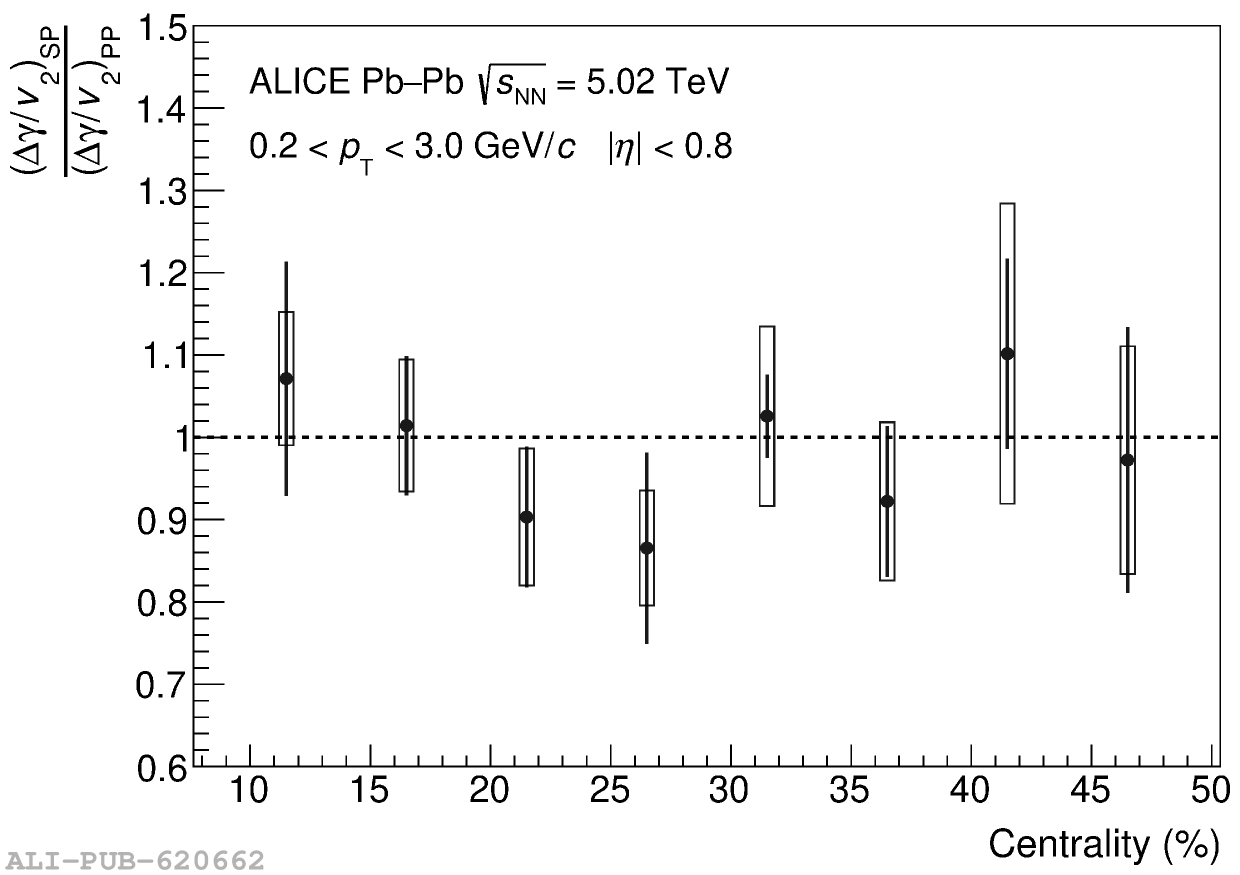 |
Figure 6
The centrality dependence of $f_{\text{CME}}$ extracted from correlations measured relative to the spectator and participants planes according to Eq.7 in Pb--Pb collisions at $\snn = 5.02$ TeV. Statistical uncertainties are shown as vertical bars, and systematic uncertainties are shown as boxes. A constant fit is shown along with a 95% confidence level band. |  |
Figure 7
Summary of the results for the CME limit at 95$\%$ confidence level (C.L.) obtained from different analyses for different colliding systems at various energies at the LHC integrated over centralities from ALICE. The previous measurements are taken from Refs. and are represented with the open markers. |  |